PCB HW Design Practice: Mixed-signal Board Design Project Using STM32

The competitiveness of circuit design ultimately lies in broad domain experience! Solve all your hardware knowledge and experience needs at once, including STM32 MCU, Ethernet PHY, Motor Driver, ADC/DAC, EMI, ESD, and more!

(5.0) 121 reviews

535 learners

Level Intermediate

Course period Unlimited

orcad
orcad
kicad
kicad
artwork
artwork
stm32
stm32
hardware
hardware
orcad
orcad
kicad
kicad
artwork
artwork
stm32
stm32
hardware
hardware

Reviews from Early Learners

Reviews from Early Learners

5.0

5.0

cow09260

54% enrolled

When I first encountered PCB design through self-study, I thought it was just a matter of connecting lines. However, through this lecture, I was able to perfectly establish the organic relationship between schematic design and artwork (layout). In particular, the biggest takeaway was learning how to perform "reasoned design"—such as analyzing the block diagrams and power systems in STM32 datasheets to understand why crystals and decoupling capacitors are essential, and why checking ESD tables is necessary. It was incredibly beneficial because it didn't just teach me how to use the tools; it allowed me to experience the actual professional workflow, from strategic pin mapping using CubeMX to setting up a JTAG debugging environment. Now, I have the confidence to design my own circuits without being intimidated by complex datasheets. Thank you for teaching me so thoroughly!

5.0

아에이오우12

58% enrolled

I took classes on circuits and PCBs in school, but after taking this course, I realized that what is learned in the field is definitely different. It was great for understanding the workflow because it followed the exact methods used in actual companies, from technical meetings and component selection to datasheet analysis. The explanations are easy to understand even for those who are new to HW design.

5.0

kyy77

100% enrolled

This course contains all the information related to STM32-based HW design. Since it was my first time designing hardware, I personally drafted a requirement sheet suited to my level and solidified the documentation through feedback from Coach Sam. Based on this, I was able to proceed with component selection, datasheet interpretation, schematic design, and even PCB artwork. I believe this is a course I will continue to refer back to even when working on more advanced designs in the future!
What you will gain after the course

  • How to prepare an HW Requirement Sheet through technical meetings with customers

  • How to create a System Level HW Block Diagram

  • Implementing high-speed communication by connecting an MCU and Ethernet PHY

  • Motor Control Circuit Design Using Motor Driver & MOSFET

  • How to apply Ferrite Beads, TVS, and ESD devices for EMI/ESD countermeasures

  • Implementing analog and digital signal processing circuits with ADC/DAC

  • Solid power supply configuration including LDO, Charge Pump, and Bulk Capacitor

  • Analysis of various IC datasheets and know-how in creating power budgets

  • 4-6 Layer PCB Stack-up Configuration and Mixed-Signal Area Isolation Layout

  • Hands-on practice of the entire process, up to extracting Gerber & BOM files for PCB manufacturing

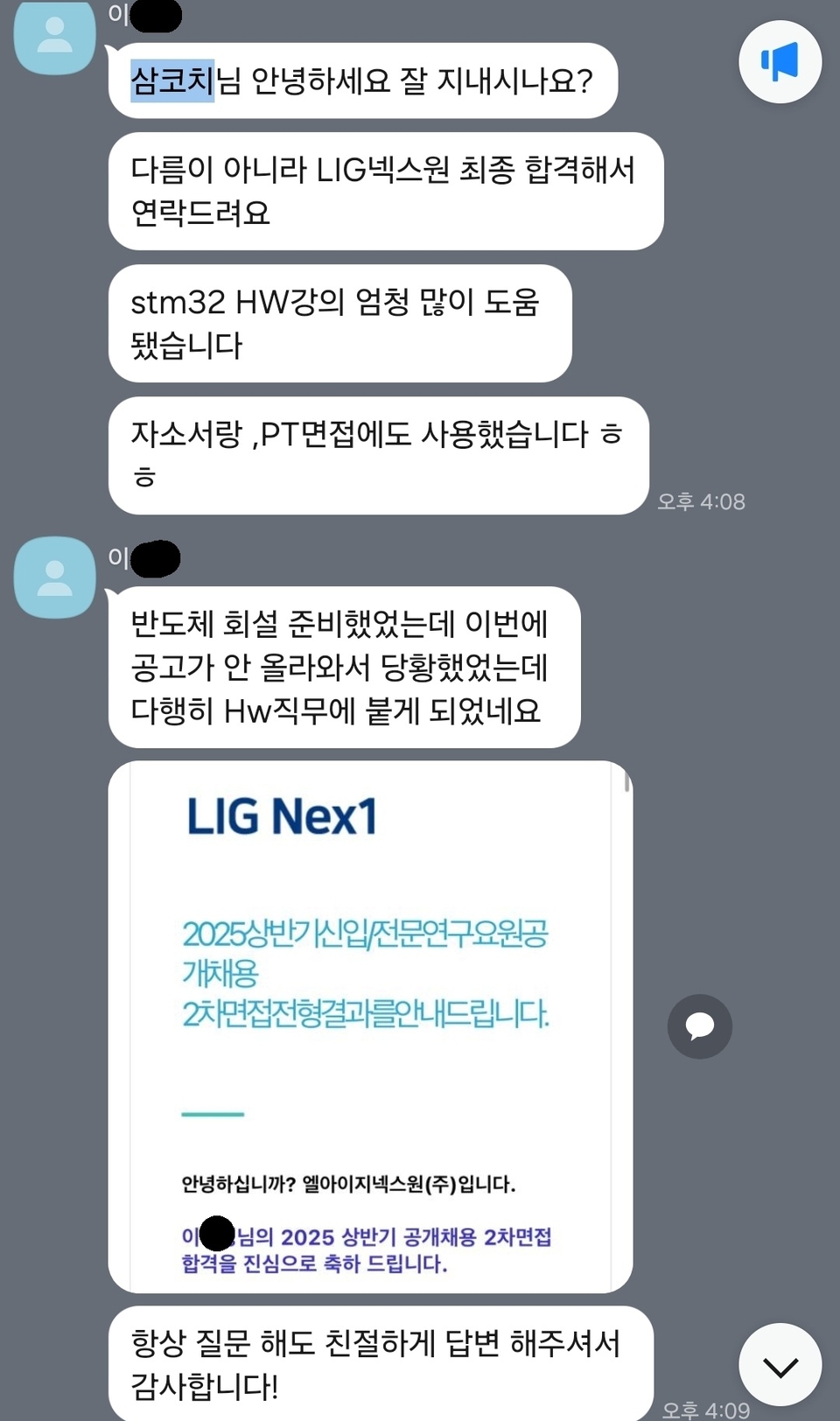
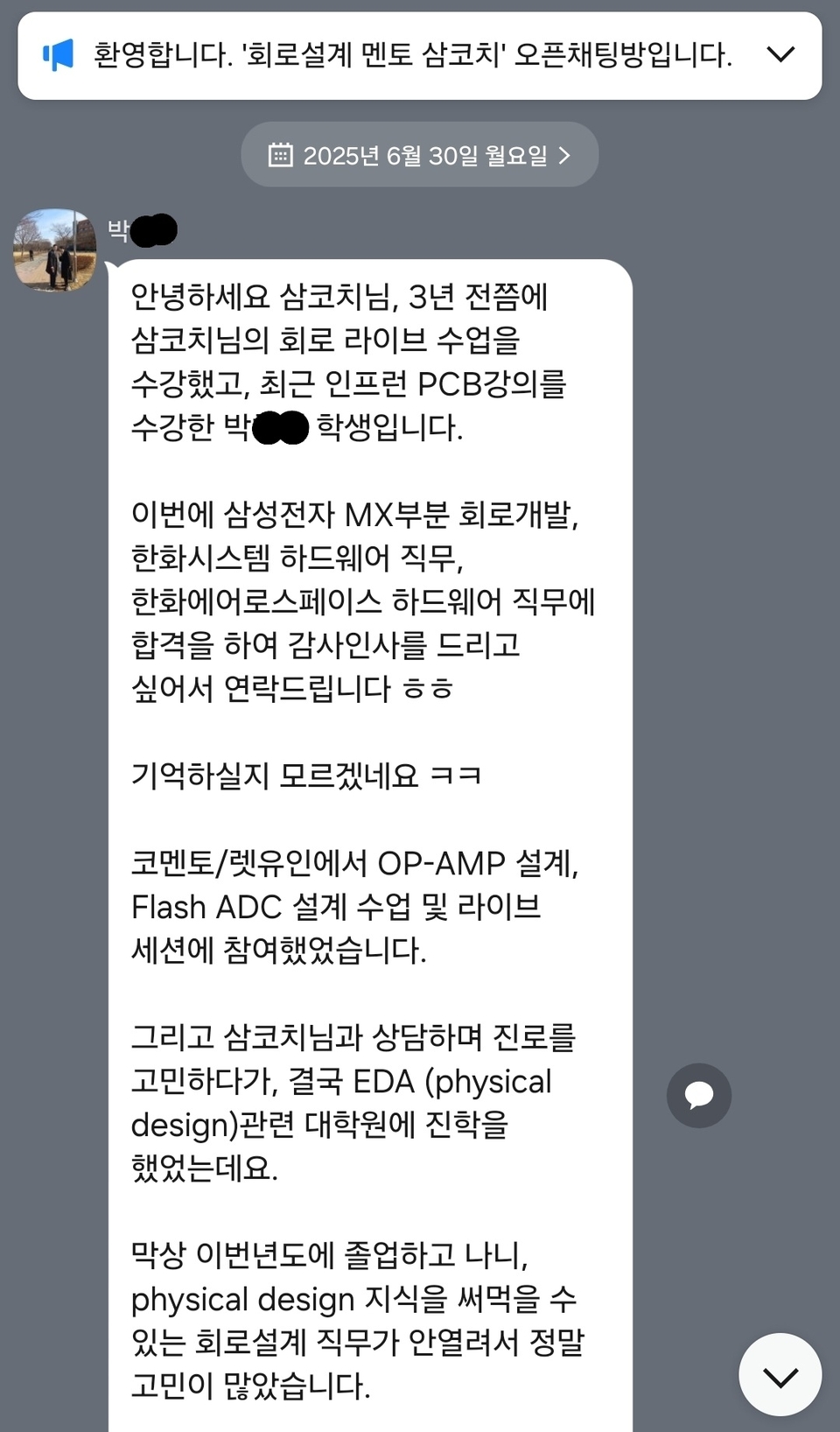
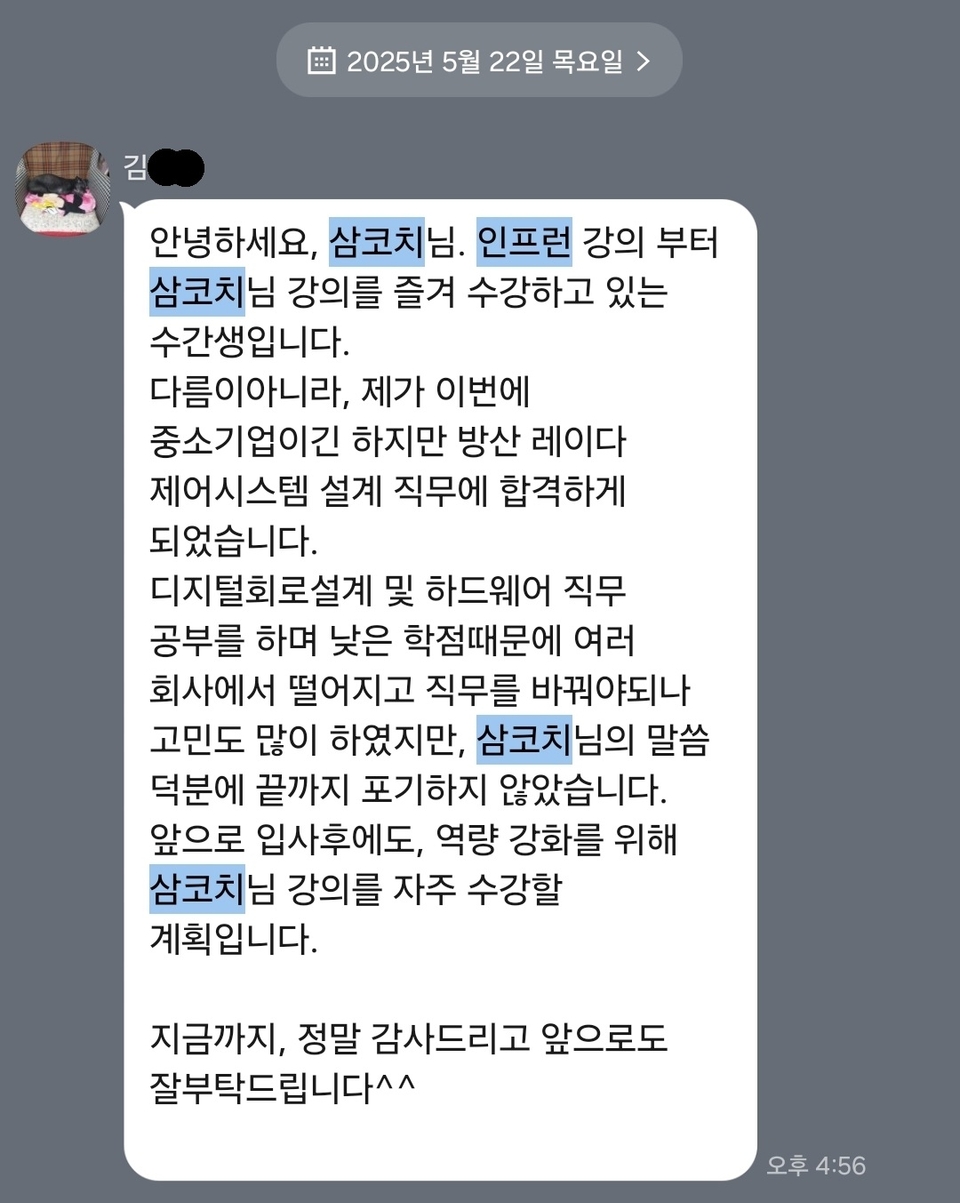
🔥From Samsung Electronics MX to Hanwha Systems... success stories are pouring in!
LIG Nex1

Samsung Electronics, Hanwha Systems, etc.

Anti-Collision Radar Control System

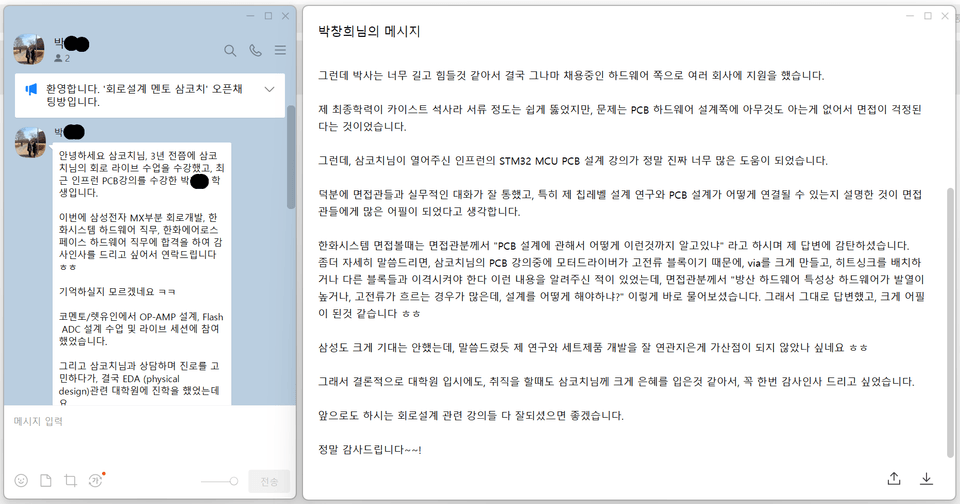
😮Lecture content that actually impressed the interviewers at Hanwha Systems!

Hanwha Systems Interview

EVENT 1. Take the Level Test

EVENT 2. 30% Discount for Existing Students

This is a lecture where I communicate with students through Naver Cafe!

  1. Please join the open KakaoTalk chat room for announcements! (Entry code: 0459)
    https://open.kakao.com/o/gm1KFaCg

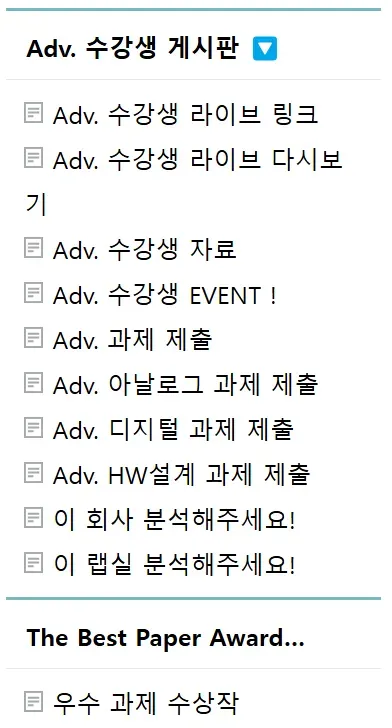
  2. Please join the Naver Cafe to receive the student materials!


    https://cafe.naver.com/samcoach

  3. Through live classes held every weekend, we provide assignment feedback and counseling for your concerns!


    ➡ Schedule and live class details are announced weekly via the Naver Cafe (Replays provided!)

  4. We provide various information and EVENTS for employment!
    ➡ Cafe level-up + continuous updates + accessible even after completion.

The competitiveness of the circuit design role,

Now, HW design capability has become a necessity. 😢


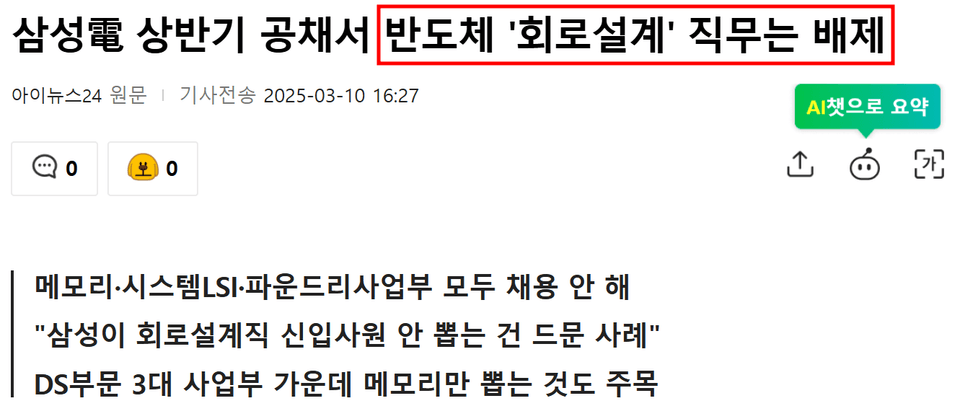
Red light for semiconductor circuit design recruitment... How should you prepare?

In the first half of 2025, both Samsung Electronics' DS division and SK Hynix did not recruit any semiconductor circuit design personnel.

As a result, I have realized that many Bachelor's and Master's students preparing for semiconductor circuit design are feeling anxious.

Semiconductor Circuit Design Concerns 1

Semiconductor Circuit Design Concerns 2

That is why I have previously...

The more you are a Bachelor's/Master's circuit design job seeker or junior engineer,

'Narrow and deep (X)' → 'Shallow and broad domain knowledge and experience (O)' is what I have been emphasizing you should pursue.

You need to get a job right away, but there might be no job openings in the narrow field you prepared for,

This is because even if you enter a circuit design role, it might be different from the field you were studying.


However, I felt there were limits to explaining this only in words.

That's why I created this lecture so that you can personally build broad domain knowledge and capabilities, and


Common competencies for all circuit design roles

I have prepared a HW Design Class!

Link with Semiconductor Circuits

HW Design Practical Tasks

Resume/Cover Letter/Interview

Lectures connected to semiconductor circuit design

  • Check the connection points between semiconductor Analog/Digital circuits and System-level circuits in a product.

  • Check the collaboration methods and key selling points between Semiconductor ↔ Board-level circuit design roles

  • Check what the job competencies are for Semiconductor / Board-level circuit design
    through experienced hire job descriptions

Lectures related to semiconductor circuit design

Practical tasks using HW design tools

Practical tasks using HW design tools

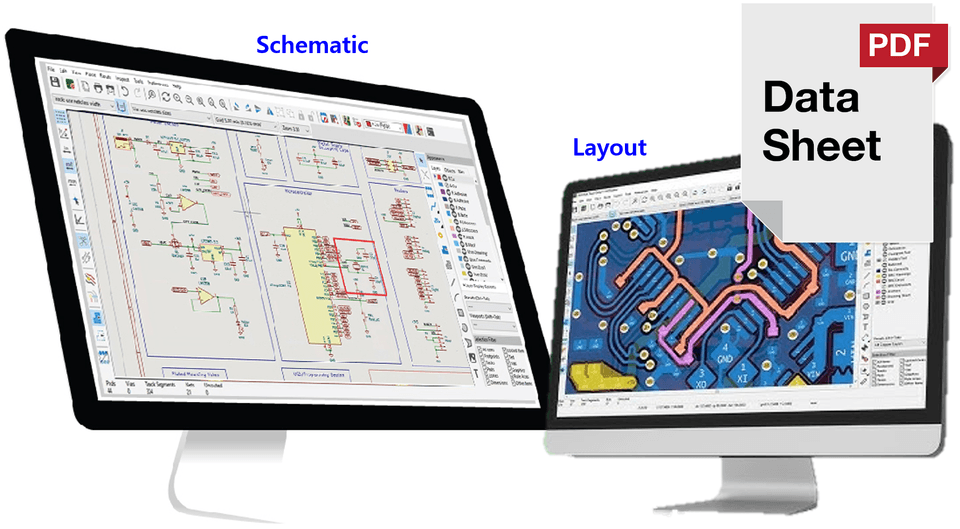
  • Schematic / Layout design using industry-standard tools

  • Practical practice by creating virtual scenarios by remaking actual client requests

  • System Block-Diagram and Power Budget Creation

  • Component selection methods and reasoning, and Datasheet Reading

Resume/Self-Introduction/Interview Past Questions

  • Provision of past and expected job interview questions and solutions by interviewers who are former hardware design engineers from Samsung Electronics, LG Electronics, Coway, and US-based companies.

  • Checking points for utilizing design experience
    in resumes, cover letters, and interviews

  • The Best Paper Award for students with excellent improvement results

  • How to utilize awards and certificates received

  • Access to job-related
    materials and event participation rights in the Sam-Coach community

Resume/Self-introduction/Interview Questions

Mixed-signal board design using STM32 MCU, frequently used in practice!

STM32 Series Selection and Design

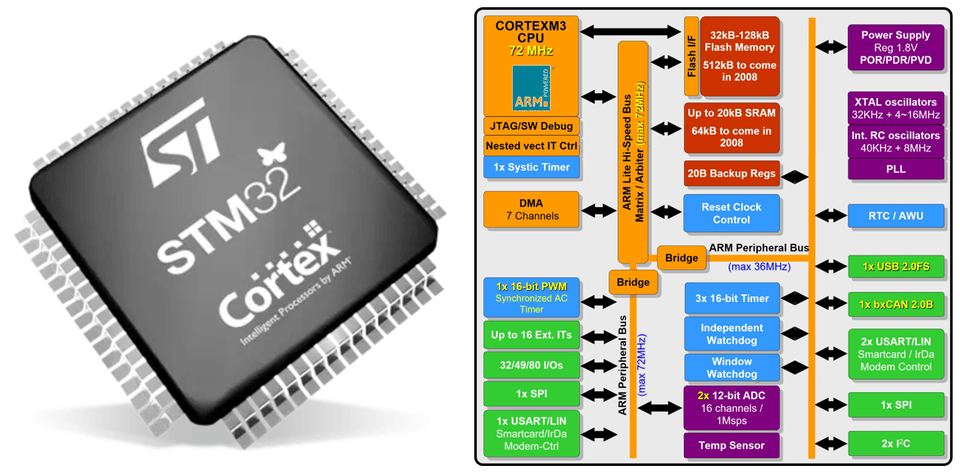
  • Analyze STM32 Core (Cortex-M0/M3/M4/M7) performance, Peripheral Interfaces (USART, I²C, SPI, etc.), and Clock Tree Architecture through Block Diagrams

  • Calculation of Power Budget considering Power Consumption and stable Power Distribution design through DC-DC and LDO

STM32 Series Selection and Design

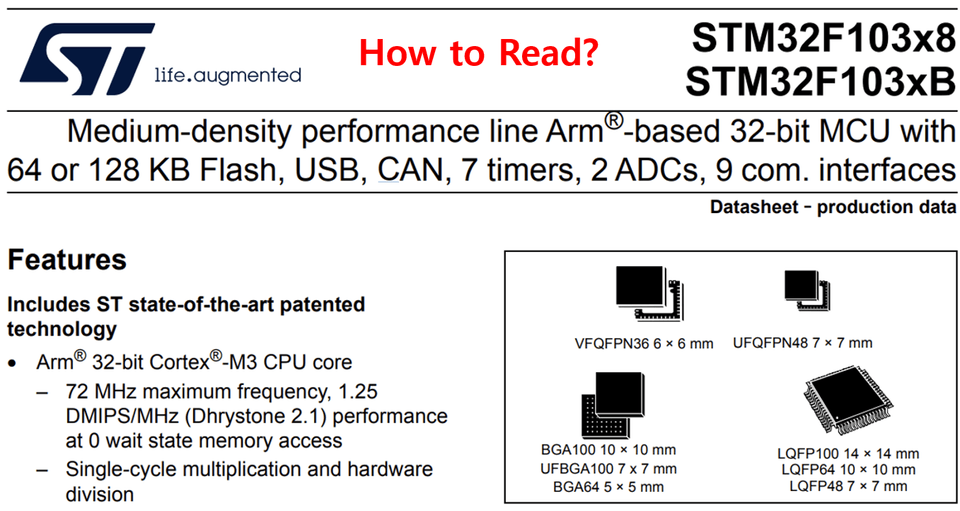
How to read data sheets

How to read data sheets

  • Focus on analyzing core engineering parts such as Functional Block Diagram, Electrical Characteristics, and Pinouts., Pinouts, v.v.

  • Identify component limit specifications and connectivity strategies through Absolute Max Ratings, Timing Diagrams, and Optional Features.

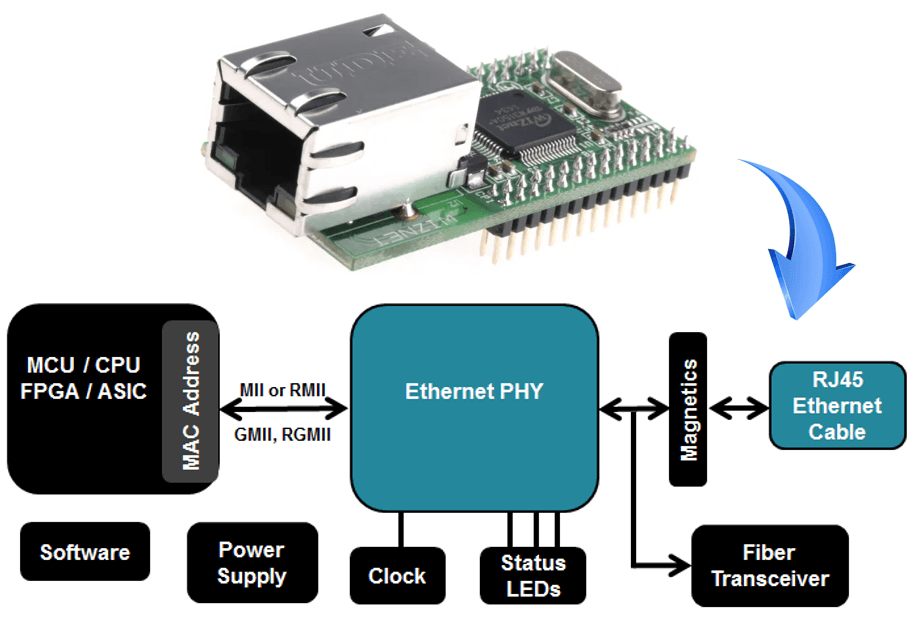
Ethernet PHY/ESD/Bead Selection and Design

  • When selecting the Ethernet PHY Chip, consider the Link Speed (10/100/1000Mbps), Interface (RMII, GMII), matching resistors, and routing conditions., cần xem xét các điều kiện về Tốc độ liên kết (10/100/1000Mbps), Giao diện (RMII, GMII), Điện trở khớp (Matching Resistor) và Định tuyến (Routing).

  • Integrated design of ESD/EMI protection and noise filtering using ESD Diodes, LAN Transformers, and EMI Beads

Ethernet PHY/ESD/Bead Selection and Design

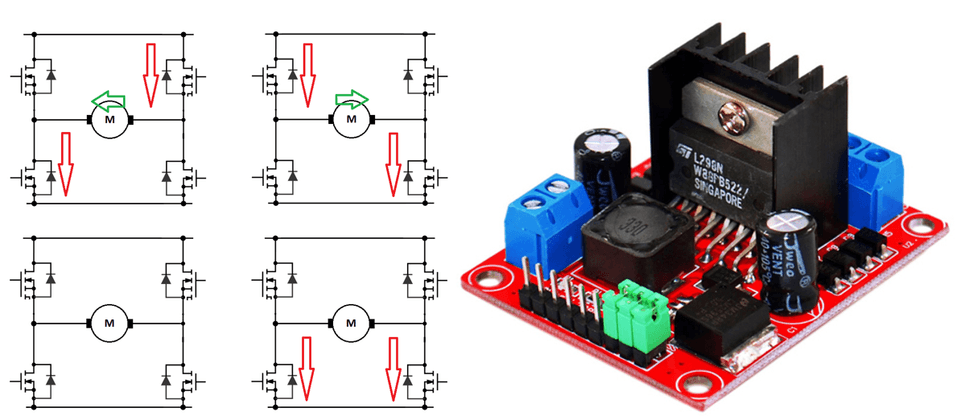
Motor-Driver/MOSFET Selection and Design

Motor-Driver/MOSFET selection and design

  • MOSFET/H-Bridge Driver specification selection based on parameters such as Load Current, Switching Characteristics, and Body Diode reverse current dựa trên các tham số như Dòng tải (Load Current), Đặc tính đóng cắt (Switching Characteristics), Dòng ngược của Body Diode, v.v.

  • Heat dissipation through Gate Drive Voltage, Heat Sinks, and Thermal Pads, and implementation of stable switching

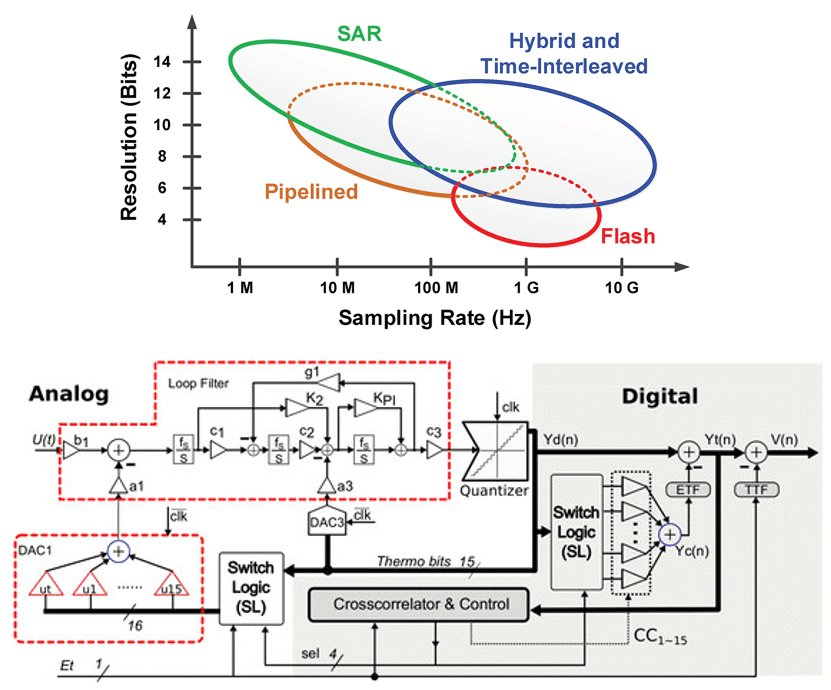
ADC/DAC/MIC/LDO Selection and Design

  • ADC component selection based on required specifications such as Resolution (12/16/18-bit), Sampling Rate, Microphone Sensitivity, and Frequency ResponseResolution (12/16/18-bit), Sampling Rate, Microphone Sensitivity, Frequency Response, v.v.

  • Maintain power quality for analog circuits through LDO noise specifications (PSRR, Output Ripple), Dropout Voltage, etc. Noise Spec (PSRR, Output Ripple), Dropout Voltage, v.v.

ADC/DAC/MIC/LDO Selection and Design

Designing Schematics

Designing Schematics

  • Create a schematic by distinguishing major blocks such as Power Tree, Clock Tree, and Communication Line and reflecting the placement of noise suppression and protection components. và phản ánh việc bố trí các linh kiện Noise Suppression, Protection Component.

  • Ensuring circuit stability through the interconnection between protection parts such as TVS Diode and Fuse and the power/signal routing layout. và bố cục Power/Signal Routing.

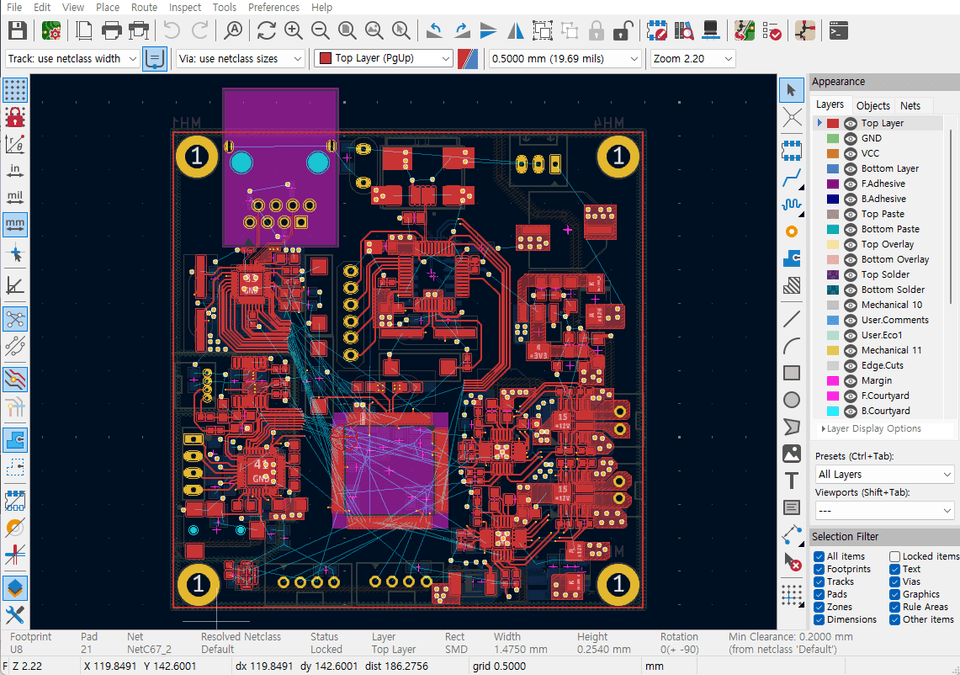
Designing PCB Layout

  • In multi-layer PCBs, adhere to guidelines for Power Plane and Ground Plane partitioning, and High-speed Signal (Differential Pair, Impedance Control) routing. (Differential Pair, Impedance Control)

  • EMI/EMC response (Ground Plane, Shielding) and Heat Dissipation (Thermal Via, Heat Sink) to ensure signal integrity and stability

Designing PCB Layout

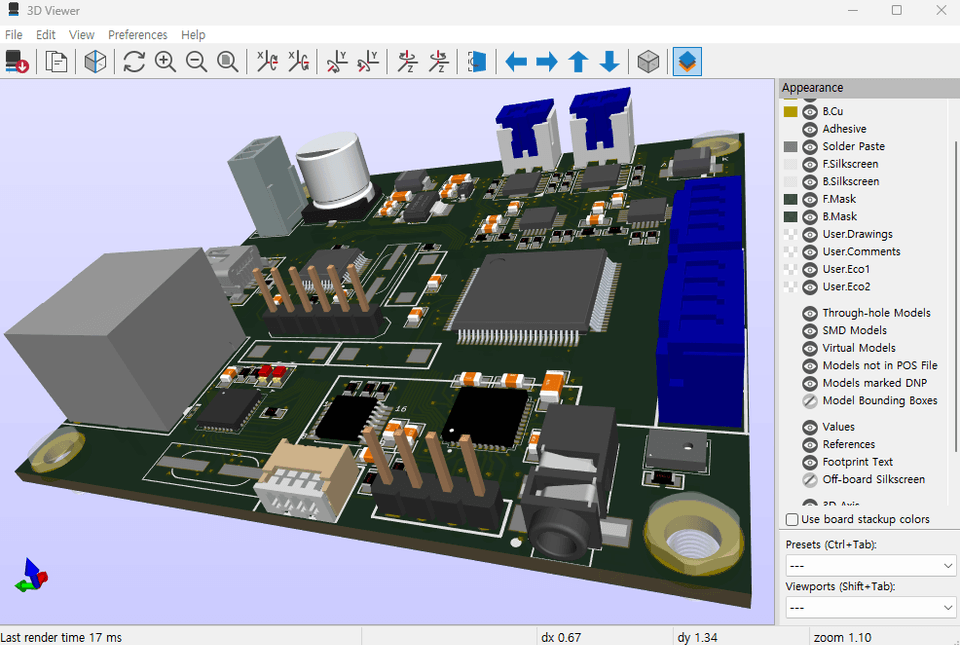
Check the physical board with 3D Board Viewer

Verify the physical board using a 3D Board Viewer

  • Visually review component clearance, thermal structure, and connector position in advance through PCB 3D Modeling.

  • Minimize rework risk and costs by verifying dimensions, assembly feasibility, and cooling solution placement during the pre-production stage.

💻 Practice Environment

  • PC: Windows 64-bit Operating System

  • Tool Used: KiCAD (Free Version)

  • Minimum required capacity: 10GB or more

(Covers orcad, kicad, artwork, stm32, hardware, etc.)

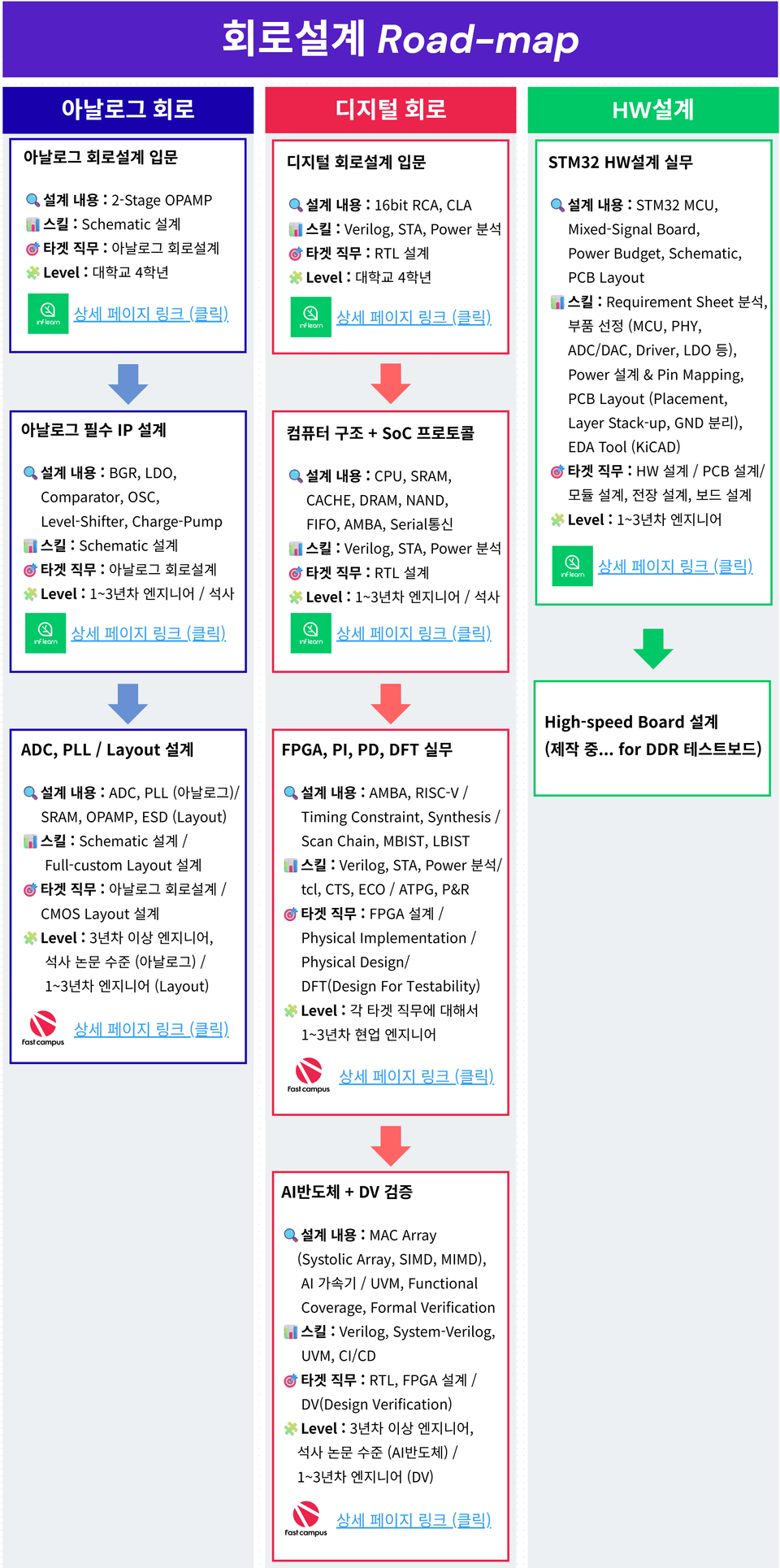
🪜 Sam Coach's Circuit Design Lecture Roadmap

(Click the image below)

커리큘럼

Coach Sam's Semiconductor Circuit Design Road-map

✨✨✨✨✨✨✨✨✨✨✨✨✨✨

2nd Early Bird Discount EVENT!

1st Early Bird EVENT: 500,000 KRW → 240,000 KRW

2nd Early Bird EVENT: 500,000 KRW → 270,000 KRW

3rd Early Bird EVENT: 500,000 KRW → 300,000 KRW

...
✨✨✨✨✨✨✨✨✨✨✨✨✨✨

Turn on access to Coach Sam's community and EVENT participation for circuit design job seekers!

We invite you to Samcoach's Naver Cafe for circuit design job seekers!

https://cafe.naver.com/samcoach
To upgrade your cafe membership level, please apply for the lecture, join the cafe, and then fill out the form below!
https://forms.gle/r76HSgCHNyf43qmV6

For students,

  • Coach Sam Group Consulting Voucher

  • Advanced Student Resource Access

  • Discounts on other content applied

We are preparing various benefits such as these.


Also

  • Review / Friend Referral EVENT

  • Live Broadcast Feedback EVENT

  • Guerrilla Consulting EVENT

Through various events like these, we will communicate with our students
and support you all the way until you get hired.


Coach Sam's Naver Cafe

Continuous updates planned!


We plan to provide updates by continuously communicating with students regarding content that needs supplementation.

(Updates are scheduled to be posted simultaneously on the Naver Cafe or Samcoach YouTube, so
you can still access the updated content even after your 12-month enrollment period has ended.)

Nice to meet you, I'm Sam Coach, your circuit design mentor! 🙌

  • Former Samsung Electronics DS Division / CHIP Circuit Design Engineer

    • Analog IP / Digital Scenario Design

    • Class A patent application filed

  • Technical support for global foreign companies as an engineer

  • Former) Startup Hardware Accelerator / MCU Firmware Design

  • Former) Major Home Appliance Company / All-in-one Water Purifier Production Technology

  • Former) Mid-sized medical device company / PCB HW, CIS, DDI ASIC design


🧭 Mentor Activities

  • Author of the Circuit Design part of 'The Semiconductor Job Bible: Insights from Current Professionals by Role'

  • 'Korea Semiconductor Industry Association SEMI-MOOC' Circuit Design Core Theory and Simulation Instructor

  • Circuit Design Job Mentor at 'LetUin (No. 1 in STEM Employment) & Career Community Comento'

  • Conducted circuit design job boot camps and special lectures at over 10 universities, including Yonsei University, Hanyang University, and Konkuk University.

  • Over 200 sessions of resume, cover letter, and interview consulting for circuit design roles

  • 'K-Digital Basic Competency Training' Instructor (Stop with difficult circuit formulas; Semiconductor circuit (chip) design done with your eyes)

  • Operating the YouTube channel 'Coach Sam, the Pathfinder for Circuit Design Careers'

See you in the lecture! 🖐🏻

The fact that you are reading this right now means you are more than qualified to challenge yourself in the field of circuit design. My role is to help passionate individuals like you ensure that your challenges lead all the way to a successful job offer.
This lecture will provide those of you pursuing circuit design with the gift of 'distinctive design experience.'

Of course, it would be great if we could work together on circuit design projects following the roadmap, but I recommend you first try what you can on your own through the free lecture (click). Then, if you feel the need, please sign up for the course.

I look forward to seeing you in the lecture. Thank you 😊

Recommended for
these people

Who is this course right for?

  • ▼ For those preparing for a career in circuit design

  • → University juniors and seniors aiming for circuit design positions across various industries such as semiconductors, IT, automotive, defense, medical, and display all at once.

  • → Job seekers who have no intention of pursuing a master's or doctoral degree and wish to find employment in circuit design with a bachelor's degree.

  • ▼ For those aiming for a semiconductor circuit design role or dreaming of applying as an experienced newcomer (junior with prior experience)

  • → Job seekers who want to challenge themselves in semiconductor circuit design but are considering a "junior-experienced" strategy in HW design/development due to the limited number of openings.

  • → Experienced newcomers who are currently working in HW design/development and want to create a strategy to transition into a semiconductor circuit design role.

  • ▼ For HW design/development engineers with less than 3 years of experience

  • → Junior engineers with less than 3 years of experience who joined for HW design/development roles but find themselves feeling disillusioned while doing nothing but soldering, BOM management, and verification.

  • → Junior engineers with less than 3 years of experience who want to practically develop the competencies required for hardware engineers with 5 to 10 years of experience.

Need to know before starting?

  • ※ Please make sure to take this course after completing a second-year university circuit-related major subject. If you take this lecture without having completed a major course on circuits, the content may be somewhat difficult to follow.

  • ※ If you have taken major courses related to circuits in your 3rd or 4th year of university, it will be relatively easier to understand the lecture content and find connections to employment.

  • (Required) Digital-related subjects among the core major courses for 2nd and 3rd-year circuit design — Circuit Theory, Digital Logic Circuits, etc.

  • (Optional) Junior/Senior level advanced circuit design courses - Electronic Circuits, RF Circuit Design, Microprocessors, DSP, Digital System Design, etc.

Hello
This is samcoach

4,941

Learners

476

Reviews

254

Answers

5.0

Rating

8

Courses

Experience & Background

Current) Major Semiconductor Company (Chip Circuit Design, 4th Year)

  • Analog IP / Digital Scenario Design

  • Class A Patent Application

  • Technical support for global foreign company engineers

Former) Startup Incubator (MCU Firmware Design)

Former) Major Corporation Home Appliance Company (All-in-one Water Purifier Production Technology)

Former) Mid-sized medical device company (CIS, DDI ASIC design)

Yes, Former) Startup Incubating Company (MCU Firmware Design) Former) Large Enterprise Home Appliance Company (All-in-one Water Purifier Production Technology) Former) Mid-sized Medical Device Company (CIS, DDI ASIC Design)

Yes, Former) Startup Incubating Company (MCU Firmware Design) Former) Large Enterprise Home Appliance Company (All-in-one Water Purifier Production Technology) Former) Mid-sized Medical Device Company (CIS, DDI ASIC Design)

You can definitely take on the challenge of getting a job or changing careers in CHIP design.

Get one step closer to landing a job or switching careers in CHIP design with me!

"Are you dreaming of a career in semiconductor analog/digital circuit design?

I will help you from the basics through the eyes of a current employee at S Electronics, a major corporation!

Get closer to landing a job or switching careers in CHIP design! "Are you dreaming of a career in semiconductor analog/digital circuit design? I will help you from the basics through the eyes of a current employee at S Electronics, a major corporation!"

Nice to meet you! I am Coach Sam, currently designing system semiconductors at S Electronics :)

"Do you dream of becoming a circuit designer? I will help you from the basics through the eyes of a current employee at S Electronics, a major corporation!" Nice to meet you! I am Sam-coach, currently designing system semiconductors at S Electronics. :)

I have gone through many trials and errors while taking on the challenge of circuit design, starting from a startup.

I gained experience in PCB design, F/W design, FPGA design, and CHIP design through trial and error.

However, there was one thing I found disappointing.

I've faced many trials and errors while taking on these challenges. I gained experience in PCB design, F/W design, FPGA design, and CHIP design in a somewhat haphazard way. However, I always felt that something was missing.

'Why are there so few opportunities for systematic hands-on practice and information about employment in the field of circuit design?'

I experienced chip design in a haphazard, trial-and-error way. However, I felt one lingering regret: "Why are there so few structured hands-on opportunities and job-related information in the field of circuit design?"

While there was plenty of content for fields like semiconductor processing and programming, circuit design felt like a "hidden world" because information was so scarce.

Those of you preparing for a career in circuit design who are reading this have likely felt the same frustration I did. That's why I interviewed professionals in the field, asked my professors, and took IDEC courses.

Those of you preparing for a career in circuit design who are reading this have likely felt the same sense of frustration that I did.

So, you might try interviewing current professionals in the field, asking your professors for advice, or taking IDEC courses.

However, in most cases, you still find yourself feeling like you almost get it, but not quite.

SO! I went ahead and created a structured course myself that leads directly to employment!

I have experienced everything from [Analog Circuits -> Digital Systems -> MCU Firmware -> Driver Design -> Software], and

Through 'Top-down / Bottom-up' skills, I have become able to perfectly explain products and circuits.

And through my practical circuit courses on Inflearn, I will share everything from my own intuitive methods for interpreting 'analog/digital circuits' to the ways I evaluate trade-offs.

And on Inflearn, as we work with practical circuits, I plan to share everything from my own intuitive methods for interpreting 'analog/digital circuits' to the ways of evaluating trade-offs.

Let's build a solid foundation together, develop practical skills, and create your very own chip design story!

Let's build a solid foundation together, develop practical skills, and create your own unique chip design story!

More

Curriculum

All

76 lectures ∙ (15hr 18min)

Course Materials:

Lecture resources
Published: 
Last updated: 

Reviews

All

121 reviews

5.0

121 reviews

  • thdbs52708137님의 프로필 이미지
    thdbs52708137

    Reviews 2

    Average Rating 5.0

    5

    100% enrolled

    • jjy9912313650님의 프로필 이미지
      jjy9912313650

      Reviews 2

      Average Rating 5.0

      5

      100% enrolled

      • dkhi209577님의 프로필 이미지
        dkhi209577

        Reviews 2

        Average Rating 5.0

        5

        100% enrolled

        • cow09260님의 프로필 이미지
          cow09260

          Reviews 1

          Average Rating 5.0

          Edited

          5

          54% enrolled

          When I first encountered PCB design through self-study, I thought it was just a matter of connecting lines. However, through this lecture, I was able to perfectly establish the organic relationship between schematic design and artwork (layout). In particular, the biggest takeaway was learning how to perform "reasoned design"—such as analyzing the block diagrams and power systems in STM32 datasheets to understand why crystals and decoupling capacitors are essential, and why checking ESD tables is necessary. It was incredibly beneficial because it didn't just teach me how to use the tools; it allowed me to experience the actual professional workflow, from strategic pin mapping using CubeMX to setting up a JTAG debugging environment. Now, I have the confidence to design my own circuits without being intimidated by complex datasheets. Thank you for teaching me so thoroughly!

          • dbwkdrb1236060님의 프로필 이미지
            dbwkdrb1236060

            Reviews 1

            Average Rating 5.0

            Edited

            5

            58% enrolled

            I took classes on circuits and PCBs in school, but after taking this course, I realized that what is learned in the field is definitely different. It was great for understanding the workflow because it followed the exact methods used in actual companies, from technical meetings and component selection to datasheet analysis. The explanations are easy to understand even for those who are new to HW design.

            samcoach's other courses

            Check out other courses by the instructor!

            $207.90