The course introduction page has been posted.
A Quick Look at C Programming
arigaram
$26.40
Beginner / C, Embedded
5.0
(1)
You can quickly understand the basic concepts and fundamental syntax of the C language.
Beginner
C, Embedded
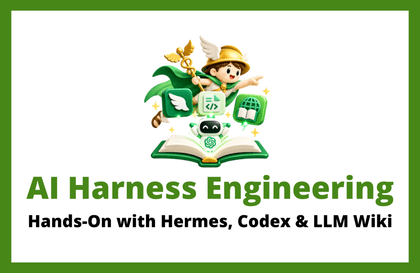
Moving beyond prompt engineering and context engineering, we are now entering the era of harness engineering. Harnesses can solve LLM-based challenges that are difficult to achieve with prompts and RAG alone.
You can gain a deep understanding of harness engineering.
Prompt engineering, context engineering, and harness engineering can be linked together.
Going beyond mastering a single LLM call, this course covers Harness Engineering—designing the entire execution structure outside the model. From the six core components—control flow, tools, state, validation, hooks, and permissions—to key patterns like chaining, routing, parallelization, evaluator-optimizer, orchestrator-worker, and ReAct, as well as multi-agents, cost, reliability, evaluation, and security. By implementing the principles directly in pure Python without being dependent on specific frameworks, you will build LLM system engineering capabilities that apply regardless of the tools you use.
Those who have created prompts or RAG but get stuck when moving on to repeated calls, tool use, verification, and multi-agents. Those who want to design a system that operates beyond a single call.
Those who need to elevate a working demo into an actual service equipped with cost efficiency, reliability, evaluation, and security. Those who want to address operational issues based on fundamental principles.
Those who want to use tools like LangGraph and Agent SDK, but also want to understand what is happening underneath by coding it directly in raw Python.
Those who want to complete the three concentric circles, from Prompt and Context to Harness. Those who want to master how to use the three techniques in combination.
It does not get stuck in a specific library. You will build loops, tools, states, and validation yourself using pure Python, and frameworks are only covered as references for "how these principles are abstracted."
First, we establish the components—control flow, tools, state, validation, hooks, and permissions—and then assemble patterns such as chaining, routing, parallelization, and ReAct by decomposing them into "which combination of components" they consist of.
It connects to the same coordinate system as prompts and contexts. It answers the final question of "how to execute" and binds the three pillars together.
The definition and three-layer structure of Harness Engineering, the ceiling of prompts and contexts (why a harness is necessary), the relationship between agents, workflows, and orchestration, as well as the practice environment and the minimal harness loop. This is the starting point for all subsequent sections.
Control flow, tools, state, validation, hooks & observability, and permissions & safety—these six components are paired into conceptual sections and code implementation practice sections, built directly with raw Python. From loops & termination conditions, function calling & tool routing, short-term & long-term memory, to guardrails & self-correction, tracing & metrics, and HITL & sandboxes.
Prompt Chaining, Routing, Parallelization (Sectioning/Voting), Evaluator-Optimizer, Orchestrator-Worker, and Autonomous Agents (ReAct). These are arranged in order of autonomy, breaking down each pattern into combinations of the six core components while covering practical code implementation exercises.
The essence of multi-agents (context separation rather than multiple personalities), collaboration patterns (manager-worker, handoff, discussion), and sub-agent implementation with context isolation. Also covers the "start from single" principle and pitfalls such as error propagation and cost.
Coding agents (write-run-fix loops), research agents (orchestrator + isolation), RAG harnesses (reinterpreting RAG as a harness), and customer support workflows (routing, handoff, HITL). Each case is broken down into "which component or pattern it belongs to."
Ensuring reliability through retries, caching, and cost optimization, as well as how to measure agents (evaluation harnesses), tracing and debugging, and even defending against prompt injection. This covers the dividing line between prototype and production.
Integrate prompt, context, and harness within a single codebase, master the entire process through a comprehensive project (Document QA RAG Capstone), and conclude by reviewing the course.
You can directly code the six major components—control flow, tools, state, validation, hooks, and permissions—using raw Python.
Select and assemble patterns such as chaining, routing, parallelization, and ReAct to fit the problem.
Orchestrate multiple agents using collaboration patterns and context isolation.
Operate the harness as an actual service with cost-efficiency, reliability, evaluation, and security.
Loop, Branching, Termination
Schema · Function Calling
Memory · Checkpoint
Guardrails · Retries
Logging·Tracing
HITL·Sandbox
The conceptual slides break down the components into cards like this, and the following slides dive deep into each part with SVG diagrams and code.
def run(task, max_retries=3): feedback = "" for attempt in range(max_retries): # ① Control Flow (Loop) out = llm(task + feedback) # Model Call ok, reason = verify(out) # ④ Verification if ok: return out # Pass → End feedback = f"[Previous Attempt Issue] {reason}" # Correction Signal Feedback raise RuntimeError("Max retries exceeded") # ⑥ Safe Failure
The code slides consist of a three-part structure: full code + line-by-line comments + intuitive explanations. We will directly connect the principles line by line without using a framework.
Intermediate Python (functions, classes, exception handling). Experience using LLM APIs (concepts of calls, tokens, and system prompts). Basic understanding of prompt engineering/RAG. Deep learning internal knowledge is not required.
The course introduction page has been posted.
Who is this course right for?
Those who want to create AI agents based on LLMs
Those who have hit the limits of prompt engineering or context engineering (such as RAG)
Need to know before starting?
Conceptual-level basic knowledge of LLMs
Conceptual-level basic knowledge of prompt engineering and context engineering

Career Verified
875
Learners
52
Reviews
8
Answers
4.6
Rating
19
Courses
I am someone for whom IT is both a hobby and a profession.
I have experience in various forms of writing, translation, consulting, development, and teaching.
All
248 lectures ∙ (7hr 21min)
Course Materials:
Check out other courses by the instructor!
Explore other courses in the same field!
25% off for new members
$194.10
25%
$254.10