

강의

멘토링

커뮤니티

Programming

/

Front-end

Implementing UART on FPGA

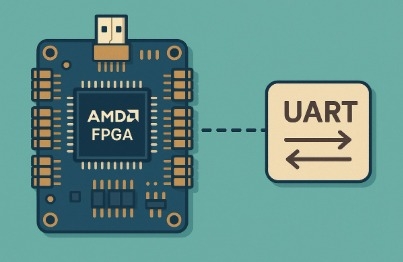
UART is the most basic and widely utilized serial communication method, making it a very suitable learning topic for beginners new to FPGA design. In this course, we will thoroughly understand the communication principles and frame structure of UART, and based on this, we will proceed with directly implementing transmit/receive logic through RTL (Register Transfer Level) design. By implementing UART on an FPGA, you can systematically develop your digital circuit design skills and gain experience verifying its operation at the actual hardware level through simulation and verification. Furthermore, by learning the method utilizing the MicroBlaze soft processor and Xilinx UART IP, you will gain a broad understanding of processor-based system design flow and interface configuration. This will enable you to acquire comprehensive development capabilities encompassing both logic design and processor design.

(5.0) 1 reviews

30 learners

Level Basic

Course period Unlimited

  • EasyFPGA
FPGA
FPGA
system-verilog
system-verilog
uart
uart
vivado
vivado
FPGA
FPGA
system-verilog
system-verilog
uart
uart
vivado
vivado

What you will gain after the course

  • Understanding UART communication

  • Designing UART TX/RX Modules with HDL

  • Implementation Method Using MicroBlaze Processor and UART IP

  • Simulation verification and Hardware verification

UART(Universal Asynchronous Receiver/Transmitter) is the most fundamental and widely used serial communication method in practical applications. Particularly for beginners learning FPGA-based digital design, UART serves as a very useful learning topic due to its simple structure and clear implementation.

In this course, we will theoretically learn about UART communication principles, data frame structure, and the role of parity bits, then based on this knowledge, directly implement transmitters and receivers through RTL (Register Transfer Level) design. We will systematically cover the process of analyzing UART frame components from Start Bit to Data Bit, Parity Bit, and Stop Bit through waveform simulation and connecting them to actual hardware operations.

Additionally, this course goes beyond basic UART design and extends to advanced implementation methods using MicroBlaze, Xilinx FPGA's Soft Processor, and UART IP. Through this, you can experience not only hardware-based logic design but also peripheral configuration and operating principles in processor-based systems, enabling you to develop practical embedded design skills.

Through hands-on practice of transmitting and receiving serial communication data, you will learn various digital design techniques including error detection (parity check), state transitions (FSM), and Baud Rate configuration. Additionally, the focus is on developing design intuition by following the entire FPGA development process, including writing RTL code based on Verilog/SystemVerilog, building testbenches, simulation verification, and hardware downloading.

This course is structured around hands-on practice so that even those without FPGA design experience can follow along, and by directly designing and visually confirming the transmission flow of UART frames, you can naturally acquire the core principles of digital communication structures. Upon completion of the course, students will not only be able to implement UART transmission and reception logic in RTL, but also gain an understanding of processor-centric system architecture through the MicroBlaze-based design flow.

Tools used in lectures

  • Development Tools: Vivado 2022.2, Vitis 2022.2

  • Development Language: system-verilog

  • Verifiable FPGA Board

  • PC Serial Communication Program

    • Tera Term, PuTTY, etc. (free to use)

Provided Materials

  • Development Code and Projects

  • PDF slide file

Recommended for
these people

Who is this course right for?

  • For those just starting FPGA design

  • Anyone needing to apply UART in practice

  • Those who want to learn FPGA design flow and methods

Need to know before starting?

  • FPGA Basics

  • Vivado, Vitis, etc. Development Tool Installation and Usage Methods

Hello
This is

514

Learners

30

Reviews

4

Answers

4.4

Rating

3

Courses

  • Unlike traditional semiconductor design processes, FPGA is a device with the advantage of being able to implement designs quickly and easily. As long as you have the design source, it can be immediately placed and routed using the FPGA's logic elements. Furthermore, due to its strong hardware nature, the code is not complex and can be written intuitively.

  • The important thing is to understand FPGA design concepts and flows, and furthermore, to understand the design objectives and targets. Based on this, the core is to optimize the structure of the design source and input appropriate constraints to design a stable FPGA.

  • The course focuses on FPGA design concepts, architecture, methodologies, and flows rather than just coding, featuring step-by-step, hands-on practice. Building know-how through direct implementation and practical experience is the core of being an FPGA engineer, and this will hold greater value than coding, which is increasingly being replaced by AI.

  • An FPGA and hardware design expert with 10+ years of experience, specializing in high-speed data processing, communication system design, and image processing, with extensive participation in various FPGA projects.

  • You can find additional information on the YouTube channel or blog below.

Specializing in areas such as [these], I have participated in various FPGA projects. You can find more information on the YouTube channel or blog below. https://www.youtube.com/@easy-fpga easyfpga.blog

Specializing in areas such as [this/these], I have participated in various FPGA projects. You can find additional information on the YouTube channel or blog below. https://www.youtube.com/@easy-fpga easyfpga.blog

Curriculum

All

19 lectures ∙ (1hr 6min)

Course Materials:

Lecture resources
Published: 
Last updated: 

Reviews

All

1 reviews

5.0

1 reviews

  • abcd123123님의 프로필 이미지
    abcd123123

    Reviews 327

    Average Rating 5.0

    5

    100% enrolled

    $22.00

    EasyFPGA's other courses

    Check out other courses by the instructor!

    Similar courses

    Explore other courses in the same field!