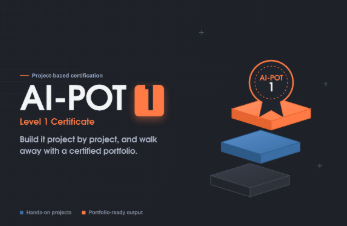

AI-POT (AI Prompt Proficiency) Level 1 Certification Course

AI prompt proficiency is the ability to write accurate and specific instructions so that artificial intelligence (AI) services can produce results that align with the user’s intent. Since AI services generate various types of content, including text, images, and music, based on the prompts they receive, well-written prompts have a significant impact on the quality of the results. This aims to assess the effective use of AI technology and problem-solving skills.

2 learners are taking this course

Level Basic

Course period Unlimited

Machine Learning(ML)
Deep Learning(DL)
Deep Learning(DL)
AI
AI
get a job
get a job
Machine Learning(ML)
Deep Learning(DL)
Deep Learning(DL)
AI
AI
get a job
get a job

What you will gain after the course

  • You can understand the basic concepts and principles of generative AI and develop the skills to use AI effectively in a variety of work environments.

  • You can master key concepts and practical problem-solving skills to prepare for the theory and practical assessments of the AI-POT Level 1 certification exam.


AI-POT (AI Prompt Application Skills) Level 1 Certification Course


AI-POT (AI Prompt Utilization Competency) is a hands-on certification that assesses prompt-writing skills for generative AI services.

AI prompt proficiency is the ability to write accurate and specific instructions so that artificial intelligence (AI) services produce results that match the user’s intent. Since AI services generate various types of content, including text, images, and music, based on the prompts they receive, well-written prompts have a significant impact on the quality of the results. This course is designed to help you pass the exam, which aims to assess effective AI technology use and problem-solving skills.

Here’s what you’ll learn

🔹 Part 1. AI, Machine Learning, and Generative AI Fundamentals

  • Concepts and evolution of artificial intelligence: Learn about the concepts and evolution of artificial intelligence.

  • Machine Learning Training Methods and Key Algorithms: Understand machine learning training methods.

  • Performance Evaluation and Validation Methods: Understand the concepts of accuracy, precision, recall, specificity, and F1 score.

  • Understanding and Comparing Generative AI: Identify the differences between analytical AI and generative AI

  • The Structure of Major Generative Models and Large Language Models (LLMs): Understand how GANs, VAEs, and diffusion models work and their underlying principles.


🔹Part 2. Prompt Design and Application Strategies

  • Learning and Optimization Techniques, and the Structure and Components of Prompts: Distinguishing and understanding pretraining, fine-tuning, and RLHF

  • Principles for writing effective prompts and basic prompting strategies: Understand the concepts of clarity, specificity, and output control, and how to apply them.

  • Advanced Prompting Strategies and Optimization : Understanding advanced prompting techniques such as Self-Refine, semantic filters, and feedback loops.


🔹Part 3. Practical Applications and Automation of Generative AI

  • Text Generation and Practical Applications: Understanding techniques for tasks such as document summarization, classification, and sentiment analysis.

  • Data, web, and video analysis: Learn how to clean and visualize data and write insight reports.

  • Image prompt design and weights/negative prompts/SEED : Distinguish and understand the key parameters of Midjourney and Stable Diffusion.

  • CFG/Steps/Option Control and ComfyUI Workflow: Understanding the differences between image generation options such as CFG, Steps, Sampler, and Scheduler.

  • Video generation, UI interpretation, and API request and response structure: understanding and distinguishing txt2vid, img2vid, and vid2vid

  • Code comprehension, error analysis, and Python-based automation, RAG pipeline: code comprehension, error reading, and analysis

  • Vector DB/embedding search and agent mode/deep research: understanding the internal structure of RAG search and the principles of embeddings


🔹Part 4. AI Ethics, Security, and Responsible Use

  • Applying generative AI at work and addressing hallucinations and bias: Understand hallucinations and bias and learn how to address them

  • Prompt Injection/Refinement and AI Ethical Principles: Understand the distinction between prompt injection and prompt jailbreaking.

  • Legal and Social Responsibility, Regulations, and Guidelines : Understand copyright and privacy infringement concerns and protection principles


🔹Part 5. AI-POT Practice Exam

  • Practice Exams, Lessons 1–3: Identifying key test topics and context

  • Improve time management and accuracy on the exam through repeated practice.


Frequently Asked Questions Q&A

Q. I’d like to know more about the AI-POT certification.

AI-POT (AI Prompt Utilization Skills) is a hands-on qualification that assesses the ability to write prompts for generative artificial intelligence (AI) services

qualification.

  • Registration Number: 2024-002196 AI-POT (AI Prompt Utilization Proficiency, Levels 1 and 2)

  • Qualification Type: Registered Private Qualification

  • For detailed information about the registration and accreditation system for private qualifications, please refer to the 'Introduction to Private Qualifications' section of the Private Qualification Information Service (www.pqi.or.kr).

    Please refer to it.

Q. What are the eligibility requirements?

Anyone who wishes to have their generative AI skills assessed (no eligibility restrictions)

Q. What is the format of the exam?

The AI-POT Level 1 exam consists of 40 questions in total and lasts 60 minutes.

  • Theory section (40 minutes): 35 multiple-choice and short-answer questions

  • Practical section (20 minutes): 5 prompt-writing questions

  • Those who score 70 or higher out of 100 points

The practical exam (20 minutes) will be held immediately after the theoretical exam (40 minutes).

Q. What is the 2027 exam schedule?

The 2027 AI-POT certification exam will be held six times throughout the year. The exam schedule is as follows.

Session Online Registration Exam Date Announcement of Successful Candidates

Session 1 26.12.3~12.9 1.9 1.28

Session 2 2.4~2.10 3.13 4.1

3rd session 4.1~4.7 5.8 5.27

4th Session 6.3~6.9 7.10 7.29

Round 5 7.29 ~ 8.4 9.4 9.23

6th session 10.7 ~ 10.13 11.13 12.2

Recommended for
these people

Who is this course right for?

  • Office workers who want to move beyond simply trying generative AI tools like ChatGPT and apply them consistently in their work.

  • Beginner and intermediate learners who have mastered the basics of prompting and want to expand their skills into automating document creation, analysis, and content production.

  • Learners who want to develop their ability to choose tools and evaluate results by understanding how AI tools work and learning the fundamentals of machine learning and deep learning.

  • Professionals such as planners, marketers, and training staff who want to streamline repetitive tasks and create tangible project deliverables

  • Learners looking to prepare for both the AI-POT Level 1 certification and a practical portfolio

Hello
This is greenonlinecamp

Green Online Camp is an online education platform that plans and operates practical digital training content in the fields of IT, AI, and design. In response to the rapidly changing technological landscape, it provides hands-on, application-focused education that anyone can easily learn and apply to their work, while continuously expanding its content across core digital job areas such as development, data, AI, and design.
Published: 
Last updated: 

Reviews

Not enough reviews.
Please write a valuable review that helps everyone!

greenonlinecamp's other courses

Check out other courses by the instructor!

Similar courses

Explore other courses in the same field!

Limited time deal

$26.40

68%

$84.70