▶ Would you like to try a hacking competition by following a guide?
▶ Do you want to get used to the consistent patterns of hacking competition problems?
▶ Have you felt uncomfortable and frustrated by poorly made internet materials?
If so, this course will be helpful.
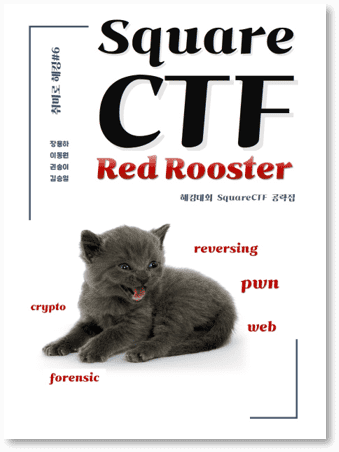
We will complete all online challenges of SquareCTF (2017) here. We will go through and practice every challenge from start to finish.
SquareCTF is an international hacking competition hosted and organized by SQUARE. * SQUARE: A competitor to PayPal. A company managed by Twitter CEO Jack Dorsey.
If you complete all the contents of the course, you will be able to solve challenges that 98% of participants could not clear, and as your skills improve, you will be able to challenge even more high-difficulty hacking competitions in the future.
The challenge types in hacking competitions cover five categories. They are divided into the Pwnable area, where the goal is to penetrate and seize system privileges; the Reversing area, where you disassemble and modify software at will; the Web area, where you bypass weak security procedures on websites to steal key information; the Crypto area, where you decrypt given ciphertexts to find secrets; and the Forensic area, where you investigate unauthorized activities based on acquired information.
You will get to see things like partially modifying (patching) a program to check for special features planted by developers, causing malfunctions by entering unexpected strings, understanding cryptographic systems to write programs that decrypt them, obtaining hidden data by finding patterns within massive piles of data, crafting exploit code stitch by stitch in machine language, and restoring hidden files by reconstructing intentionally corrupted archive files.
By working through these various challenge exercises, you will learn how to discover and respond to vulnerabilities. Specifically, it includes theory and practice regarding bugs and vulnerabilities related to IDOR, SQLI, shellcode, steganography, decryption, Git, and more.
For effective learning, we provide a virtual image that recreates the actual competition environment. This allows you to practice as if you were participating in the competition. Additionally, we cover tool installation and usage. The tools used include Ghidra, Pwntools, QEMU, FTK Imager, Checksec, 010 Editor, Wireshark, Scapy, Zsteg, PIL, BGB, and more.
The lectures focus on explaining both phenomena and principles to minimize the need for individual study, but if you have any questions, please feel free to use the Q&A board on the Naver Cafe "Hacking as a Hobby(Link)".
Please refer to the prologue video for other details. The video includes additional questions and their respective answers.