You can understand Spring naturally while creating examples.
You can learn naturally by creating examples of how to study Spring.
You can learn how to build web applications with Spring.
Your first guide to learning Spring! We'll help you stay on track with your development studies.
📣 Please check! This lecture is the first in the "Complete Java Spring Mastery" series . Please check out the Spring Mastery Roadmap from Younghan Kim, the youngest technical director at Woowa Brothers. • Roadmap link: https://www.inflearn.com/roadmaps/373 (click to go directly)
Kim Young-han's Spring Introduction Learning Spring Boot, Web MVC, and DB Access Technologies with Code
Reasons to give up learning Spring
Many developers begin studying Spring because they need it for employment or practical work. However, once they actually begin, Spring is so vast that it's overwhelming, making it difficult to know where to begin or how to learn. It feels like a sailboat lost in the middle of a vast ocean, stranded alone.
I've seen many developers who have lost their way and given up on learning Spring. This is because they start off with overly theoretical concepts like IoC (Inversion of Control), DI (Dependency Injection), and AOP.
Why should we study Spring? This fundamental question comes first. We need to learn Spring to develop web applications that function properly in practice .
This is how to study Spring
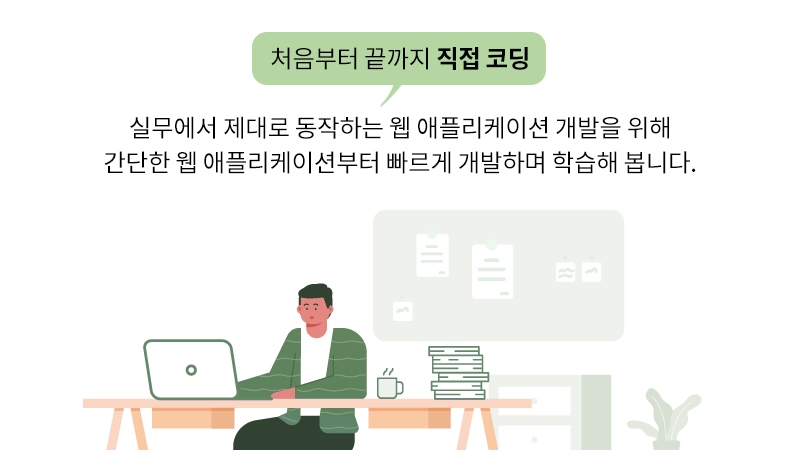
Developers learn most quickly when they actually code and create working applications. While you may have fallen asleep while reading a book or listening to a lecture, you've rarely fallen asleep while coding.
This course will quickly walk you through creating a simple, working web application, following these steps:
Create a Spring project
Running a web server with Spring Boot
Member domain development
Web MVC Development
DB Integration - JDBC, JPA, Spring Data JPA
Writing test cases
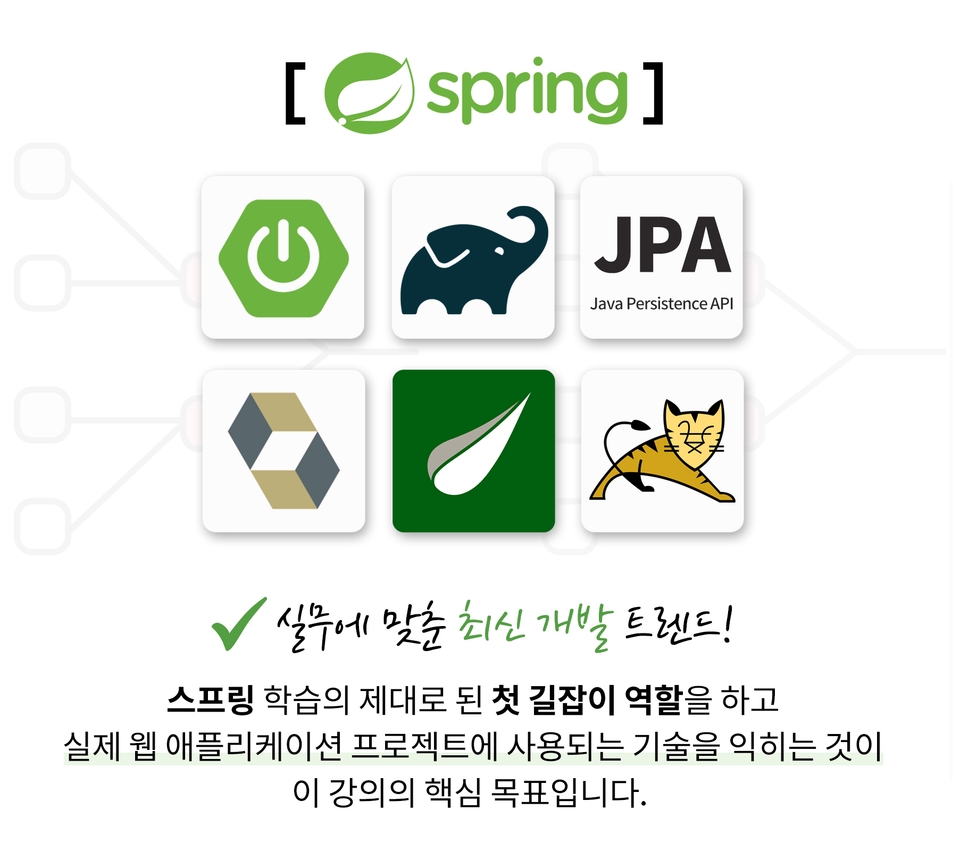
The main goal of this lecture is to help you understand the overall Spring development process and draw the big picture in your head by writing and running code yourself and understanding what technologies are used when developing web applications.
Let's start with the simplest example and go through the core cycle of building a Spring web application. This will naturally give you a bigger picture and show you which areas you need to delve deeper into. Later, by studying Spring's core theories, you'll gain a clearer understanding of how and where these technologies are used in the broader context.
Course Objectives
Rather than getting bogged down in Spring technology itself, we focus on how to use Spring in practice.
Old or minor Spring technologies that are rarely used in practice are boldly removed from the lecture content.
The youngest technical director of Elegant Brothers will reflect the latest development trends, boldly eliminate any content not used in practice, and teach you Spring, which is essential for practical development.
To be continued in the future Spring Complete Conquest Series
We're preparing a series designed to help you master Spring completely. We'll focus on core Spring features used in real-world applications, boldly omitting obsolete or outdated features, and provide practical know-how.
I tried studying Spring several times, such as taking a lecture by a famous instructor in the Spring field, but gave up. In particular, in that lecture, he emphasized that rather than understanding, you should just accept that Spring is originally used this way, so I thought that Spring was originally difficult and that you should just focus on getting used to it in the introductory stage. After taking this class, my thoughts changed. Spring is something that even beginners can fully understand and start with. I took this lecture on the recommendation of a coworker. To summarize... It is a very welcome and grateful lecture because the explanation is easy and friendly! The instructor is like Baek Jong-won in the cooking field. ㅎㅎ
1. When taking Inflearn lectures, there are many cases where free introductory lectures are distorted for the purpose of promoting paid lectures(?) ("~~If you want an explanation of this, please take the ~~~ lecture that I recorded. I will skip the detailed explanation due to time constraints.") but this lecture is free, but it is faithful to the introductory lecture itself, so I was impressed. It was really good that you went over it briefly, showed the big picture from the perspective of a beginner, and used diagrammatic materials. Even though you didn't promote paid lectures, I felt like I should pay more for these high-quality lectures.
2. In fact, many beginners have a hard time setting up the environment and give up before learning the core content. (Even if they don't give up, they are already overwhelmed here and start with the prejudice that the real core content is already 'difficult'.) You showed me how to follow along step by step for the process of starting Spring, such as installing Java, IntelliJ, and Gradle, so I was able to start Spring without being too scared. You might think, 'Isn't this a boring lecture for people who already know how to set up the environment?', but since this is an online lecture, students can skip it as they see fit. Therefore, a friendly lecture like Younghan's lecture has no disadvantages and is very helpful for beginners.
3. Rather than going into detail about the concept or cloning a completed project and looking at it, I first wrote a small amount of code myself and experienced the practice, and then listened to the explanation of the concept, so it was definitely easier to understand. In addition, it was not just explained in a curriculum-like manner, but rather, "Oh~~ If you do this, this is inconvenient. So, ~~ This is what you use. Now, I will explain how to solve this." In this way, it was easy to understand because it explained why the function was necessary in the actual problem-solving process in a way that conveyed experience.
4. Another reason why it was easy to understand was that it was provided with practice in connection with the test.
I could write more, but I can't express it well because it was such a good lecture^^; In short, you can believe that it is the best lecture related to Spring introduction in Korea. As of now, all 64 reviews are 5.0 points, and there seems to be a reason why there is no conflict of opinion.
Thank you so much for the great lecture!
Thank you. Hyunsang Han, it is not easy to write such a long review, but thank you for leaving detailed feedback. I spent a lot of time in my life refining and refining this lecture, especially for those who are taking it for the first time, and thanks to Hyunsang, I feel like all that time has been rewarded^^ I will prepare the next lecture even harder. Thank you again^^!
I feel this way in JPA lectures and other lectures, but I really like how the lecture introduction always starts with a bright and energetic [Hello] and explains the direction of the lecture. I don't know why, but whenever I watch the lecture introduction, I feel excited and nervous like when I first learned programming in college. I think it's because the lectures are so good that I unconsciously feel excited and anticipate what new content I will learn today. That's how great the lectures are. I look forward to future lectures. Thank you for the great lectures.
Ah~ Juhyuk Lee, you are so touching ㅠㅠ I can't believe that my lecture can give someone excitement when they first learn programming... In fact, I really like that feeling. After learning a new technology, I think, "Wow~ I can make something like this. How did I think of this?" So many curiosities and exciting thoughts about applying new technologies to practice. I wanted to convey that excitement when I first learned Spring and JPA, so thank you so much for giving me feedback in the form of a course review. ㅠㅠ I will surprise you with the next lectures too. ㅋㅋㅋ
I will write an honest review hoping that it will be helpful to others.
Before I say anything, I am a college student who has studied two introductory Java books and knows SQL.
In fact, I don't know much about this course to the point where I wonder if it is a course that I should take.
It is easy to follow from MVC to DB settings, but I don't know why it is done that way.
It feels like I am learning technology without any knowledge? Yes.
Of course, it seems that the instructor provides sufficient explanations of what is being done,
but even in those explanations, basic knowledge is omitted.
For example, if you say, 'This code is a container Spring bean~~ ...',
I feel that this code does that,
but I still don't know what a container is and what a Spring bean is.
It feels like I am just adding a spoon to a side dish that someone else has already prepared. It is a good lecture to experience Spring firsthand, but it is not enough to explain each lecture to others or to do a project with Spring.
Of course, this lecture is free, the lecture time is very short, and it is not a lecture that goes into Spring in depth,
but I feel a sense of self-loathing because I just follow the code without knowing anything.
I have a strong feeling that I should have studied JSP, servlets, etc. much more deeply?
' ' ' Do I have to listen to a 15-minute lecture for 5 hours by googling every time I come across something I don't know?
'
Thank you for your honest review, Lee Ki-jeong^^
You can think of this lecture as a lecture that roughly outlines what Spring is. So rather than learning too deeply, the goal is to get a general feel for it by following the code. Many people don't know the whole picture of Spring, and I've seen many people give up after digging deep from the beginning, so this lecture was created. Spring is so huge that if you don't know the whole picture and dig into it one by one, you can dig endlessly. Through this lecture, you will draw a rough blueprint, and through the following lectures, you will delve deeply into the content you are curious about one by one. You will be able to achieve your desired goal through the following lectures^^ I'm rooting for you.
I've done a simple Kahoot-like API project with node.js and got good grades in Java as a CS major, but I definitely wouldn't have understood this without GPT - the explanations are too vague and ambiguous.. The diagrams actually make it more confusing. It would have been better if you had first briefly explained what RESTful API is and then said it's applied simply like this~ That approach would have been much better.
I spent a month trying to understand Spring by reading Spring books, even though I didn't understand them. However, not all of the books were for beginners, so I ended up not understanding them. But I think I started to understand Spring with just this one lecture. I will follow the curriculum. Thank you for the lecture!





![How to use Redis effectively, based on my experience working at a large company [Practice]강의 썸네일](https://cdn.inflearn.com/public/courses/335185/cover/c3a4bec6-a4b9-44c9-ab81-f3418d8d6042/335185.jpg?f=avif&w=420)
![[From JSP to Spring Boot] The Unwavering Path to SpringBoot강의 썸네일](https://cdn.inflearn.com/public/files/courses/334897/cover/01k2j21p3rz09cqh5s0frefaa5?f=avif&w=420)


![[Season 2] Spring AI in Practice: Developing Multi-AI Agent Systems강의 썸네일](https://cdn.inflearn.com/public/files/courses/339915/cover/01kbqgcec3hb576vxxdf9ch76y?f=avif&w=420)

