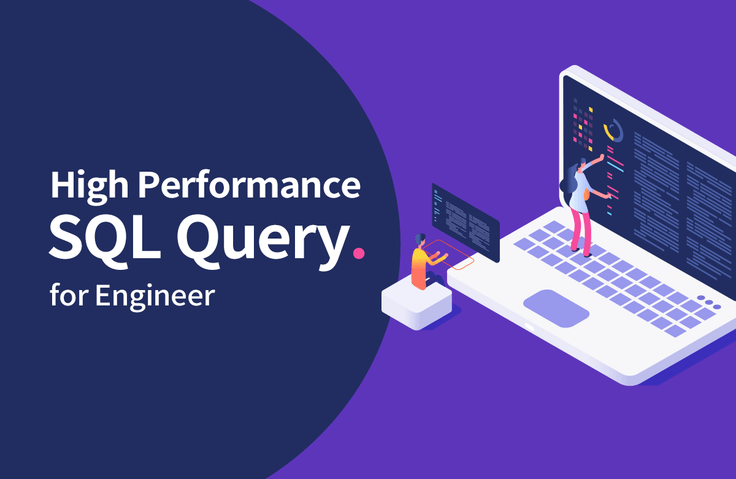
High-Performance SQL Query Writing Tips for Software Developers
This course teaches you how to write performance-conscious queries during the SQL development phase, guided by a SQL Server expert. You can learn the basics for meeting query performance requirements along with practical case studies.
Thank you so much for the great lecture^^ If I just understand this lecture well, I think more than 80% of performance issue queries will disappear!!!
5.0
mhryu
100% enrolled
I enjoyed it.
5.0
noh.chungho
100% enrolled
It was great educational content. I think it will be a big help in practice.
What you will gain after the course
Learn the basic rules and prohibitions for writing high-performance queries.
Basic knowledge for writing good quality queries
Indirect experience of common practical cases
Query writing determines performance and quality! Learn solidly with a focus on practical skills. 👨💻
A few lines of incorrectly written queries Are you experiencing performance issues ?
In terms of performance, poorly written queries are a major cause of DB performance and service performance degradation. It is common for queries written early in development to be result-oriented or implementations that are not suitable for SQL Serverto cause performance problems later as data increases .
So, writing quality queries is important!
Basic rules and taboos for writing performant queries
Basic knowledge for writing quality queries
Indirect experience of common practice cases
As a SW developer, I would like to share my knowledge and experience so that I can understand and immediately apply to my work which types of queries or implementations may cause performance issues in the future when developing projects or solutions.
To these people I recommend it.
SQL Server Beginner/Intermediate Developer
SQL Query User
For IT projects Mainly involved developers
On query performance Interested in~ Intermediate user
Query optimization Worried about Solution Developer
Writing a query Need a standard manager
Query Writing: Three Reasons Why You Must Know It!
1️⃣ In practice, when implementing and writing queries, you can use better queries by considering performance.
2️⃣ You can discuss with DB managers or field staff about queries that are expected to have performance issues.
3️⃣ It helps you learn query tuning.
better quality , For better maintenance .
There are basic rules, taboos, and writing methods that must be followed from the development and implementation stages for index and query tuning.
In this training, developers can learn various rules and recommendations that should be considered in the query implementation phase, which will help them implement better quality and easier to maintain queries . In particular, knowledge sharing experts with long-term consulting and teaching experience in SQL Server use examples that commonly appear in practice as samples for each topic, so it will be directly helpful for practical use after training.
SQL Server I'm a beginner Can I take the class?
If you know the basics of SQL, it will be easier to understand and follow the content. If there is something you don't know in the middle, it will be helpful to learn the relevant sentence/command/grammar and listen to it again. Or you can use Q/A. 😊
MySQL, PostgreSQL, etc. With other DBMS Even when developing Could this apply?
There are subtle differences in architecture for each DBMS, such as indexes, statistics, locks, and query optimization, so the content of this lecture based on SQL Server may not be 100% applicable. However, I can tell you that a lot of the content is applicable to other DBMS as well.
SQL Server Depending on the version Is there a difference?
Most of the content is almost the same as the versions currently in use. Any differences will be explained in the lecture.
The following content I am learning.
1. Query writing basics
Be careful when using SSMS or development tools on the operational DB~
Does the order in which WHERE and JOIN clauses are written affect performance?
What is the best way to do datetime literals or string literals and searches?
How do I differentiate between join conditions and search conditions?
Could the queries I've used so far be "semantic"?
2. Query Contraindications
What format should I write a conditional expression that is good for performance?
Are there any query taboos? Maybe I do them habitually?
Is it dangerous to use local variables and user-defined functions in the WHERE clause?
3. Write better queries
IN and BETWEEN, which one comes first? When is it better to use whom?
The main character of the aggregate function is NULL
Should I use UNION, ALL? Should I subtract them?
UPDATE and SELECT again? Just in one go
I really like the new functions and syntax in SQL Server^^
How to write a join statement? Unnecessary OUTER JOIN causing performance problems?
Subqueries are always slow? If used well, they are a cure.
A taste of the core features of query tuning, derived tables/CTE/APPLY
SELECT statement inside CASE? No, write it backwards.
Need a set difference query? Be especially careful with NOT IN
Make good use of recursive query and CTE
You're using query hints? Be careful~
In SQL Server, make sure to take care of locking issues when making queries~
4. Considerations when implementing cursors, views, and user-defined functions
Cursor? Implement in SQL if possible, but if necessary…
You didn't know about the STRING_AGG() function? You'll be surprised.
Gadget All-Purpose Arm! No, All-Purpose View? Be careful~
When custom functions and bulk searches meet, things get a lot heavier.
FORMAT() function? Be careful with bulk searches
(Appendix) Are you using an ORM like .NET EF, EF Core? Here is some advice
hello! This is knowledge sharer Kim Jeong-seon .
History
CEO/Director of Sequlo Co., Ltd. (www.sqlroad.com) (since 2005)
SQL Server consulting, technical support, lectures, solution development
Development of SQLBigEyes (SQL Server performance monitoring solution, www.sqlbigeyes.com)
Development of SQLBigEyes (SQL Server performance monitoring solution, www.sqlbigeyes.com)
Microsoft Data Platform MVP
Awarded for 24 years since 2002 (currently until 2025), MVP Achievement Award in 2008
Progressing through SQL Server's own development process (query tuning, DB tuning, understanding of core technologies for large-scale data, etc.)
Outside activities
Co-author of SQL Server MVP Deep Dives Vol 2 (Manning Pubs)
Kim Jeong-seon's SQL Server Consulting Story Season 13 in progress
SQL Unplugged Seminars for 5 years
SQL PASS Korea Chapter Leader
Speaker participation in Microsoft Ignite, BITEC, Tech Camp, MVP Camp, TechEd, MSDN, etc.
Frequently Asked Questions Check it out.
Q. Is this a lecture that non-majors can also take?
If you have basic or experience using SQL, you can take this course. Even if you are a little lacking, you can learn the basics you need while taking the course.
Q. Is there anything I need to prepare before attending the lecture?
You can install the SSMS program provided by SQL Server or a similar program that can use queries, and download the demo DB and SQL script provided in advance. The demo DB configuration will be explained in the training.
Q. Are there any notes regarding taking the course (environment required, other things to keep in mind, etc.)?
I need SQL Server for demos and assignments. If possible, the latest version (2019 as of 2021) is good, but an older version is also fine.
Q. How is it different from the training content on the topic of "Query Tuning"?
Query tuning covers the overall process, methods, and cases of diagnosing and analyzing query performance and improving performance through cause tracking and resolution. Since this is not covered in this course , please refer to it, and this part will be explained again in the first half of the training video.
Recommended for these people
Who is this course right for?
SQL Server junior to mid-level developer
Solution Developer
A developer who mainly participates in IT projects
Mid-to-entry level developers interested in query performance
Hello, Junhyun Park. Thank you for the good evaluation and review!
I hope you'll be able to attend my query tuning training when you get the chance.
Also, I'm planning to upload a course on "Understanding Core Technologies for Large-Scale Data Analysis" on Inflearn early this year.
Have a great day~
Best regards,
Jungsun Kim
Hello noh.chungho,
I am simply grateful that this can be of great help in your practical work :D
Wishing you happy days ahead~
Best regards, Jung-sun Kim
I took the course to write good queries in MySQL, but since the video lectures were made based on SQL Server, some of the video lectures were not very helpful, and some important contents were replaced with query tuning lectures, which was disappointing. However, it was good to learn things I didn't know.
I wouldn't recommend it to people who deal with MySQL,
but it seems to be a good lecture for people who deal with SQL Server.
Hello, result
Thank you for sharing your real-life experience that is better than my explanation! It will help those with similar conditions to decide on the course. I am glad that it was of some help. Thank you~
Kim Jeong-seon Dream







![[MMORPG Game Development Series with C# and Unity] Part 5: DatabaseCourse Thumbnail](https://cdn.inflearn.com/public/courses/325283/course_cover/afb413e6-681e-47cd-808a-099c79fed112/rookiss-rpg-5.jpg?w=420)


![Oracle PL/SQL Just This Much.. [Concept + Practice]Course Thumbnail](https://cdn.inflearn.com/public/courses/331731/cover/be361762-0351-44d0-afdb-5230f5a83052/331731-eng.png?w=420)



![[Web Development Full Stack Course] Learn Database Basics through Netflix and Carrot Market AnalysisCourse Thumbnail](https://cdn.inflearn.com/public/courses/330079/cover/c142fdb2-b4fa-4b6a-9e8f-7bd48aed7635/fullstack-db-1.jpg?w=420)
![The Easiest and Most In-Depth MongoDB Complete Guide [ By. Non-CS Major & Kakao Developer ]Course Thumbnail](https://cdn.inflearn.com/public/files/courses/337578/cover/01jwt82r7jn3c9mzybfn00mdnh?w=420)


.png?w=420)