Redis from a Kakao Interviewer Who Handles 500,000+ Traffic per Second
This is a Redis course created with a current Kakao interviewer. It covers everything from data structure practice (String to Sorted Set) to Sentinel and Cluster configurations, helping you build design rationales that work in both interviews and real-world practice.
Beyond simply entering commands, this course covers practical precautions based on real infrastructure environments and even the perspective of hash slots... I believe this is a lecture that shows what it means to be a real developer rather than just a simple coder, and what specific aspects a real developer needs to know about Redis.
Personally, I don't think it's right for anyone to say there's nothing to learn from this course. I feel there was a lot to learn (from a realistic perspective rather than just a simple command-based one).
I've come to understand what a developer, not just a coder, contemplates. Thank you.
5.0
02년생 개발자
86% enrolled
I paid to watch this for the Lunar New Year, and I learned much more than I expected. This is what a truly skilled developer looks like.... I feel quite ashamed of myself ㅠㅠ Thank you!!
5.0
warna
86% enrolled
I saw that you created a lecture as a Lunar New Year special, so I purchased and watched it right away!! I watch your lectures often, and every time I do, I feel like you cover only the core essentials with really great content!!
I believe this lecture is also one where I could learn a lot of practical information and build a solid foundation.
1. Most of the lecture consists of hands-on practice.
- You explain all the theories, but the practice sessions are not lacking at all; in fact, I felt there was even more practice than theory.
2. The content is taught concisely and realistically.
- There was no unnecessary fluff, and I was able to learn practical usage methods and patterns.
3. It focuses strictly on Redis.
- This could be both a pro and a con, but if you simply want to learn the Redis service, I don't think there is any lecture better than this one.
I'll be looking forward to your next lecture. Thank you for making such a great course!!
What you will gain after the course
The perspective to explain not just "using" Redis, but why it must be used that way.
Practical answering skills for responding to interviewer questions using structure and trade-offs rather than memorization
Criteria for selecting Single, Replica, Sentinel, or Cluster based on the situation
A mindset to avoid the misuse of Redis in practice beforehand
A perspective of viewing Redis as a core service component beyond just a cache
Development · Programming · Backend
A Redis lecture by a Kakao interviewer who handles 500,000+ transactions per second
You might be using Redis, but it's often difficult to explain why it should be designed that way. This course is not about memorizing commands; it covers how to choose a structure in a real traffic environment and how to interpret the trade-offs. We will help you establish the criteria to explain your decisions yourself, both in interviews and in practice.
Difficulty: Beginner
Practice-oriented
Course materials provided
Unlimited access period
500,000+The scale of per-second traffic handled by interviewers
Alternating between concepts and practiceLearn a data structure and try it out immediately with hands-on practice
5 Data StructuresString · List · Set · Hash · Sorted Set
This course is an introductory Redis lecture where you will learn the five basic Redis data structures and environment configurations from single to cluster through hands-on practice. A curriculum organized by a current Kakao interviewer · macOS · Docker · Node.js practice
Redis · In-memory Data StoreSET /
GET · 80% of usage patterns are StringBLPOP · Blocking Priority QueueSADD · Set that does not allow duplicatesHSET · Hash that can be more memory-efficient than
StringZADD / ZRANGE · Game Rankings · LeaderboardsPersistence ·
RDB / AOFSingle → Replica → Sentinel → ClusterHash Slot · Sharding PerspectiveDocker 28.0.0 · Node.js v23.11.0 ·
macOS (M3)Practice-oriented“I never hire people who don't know Redis in interviews” — Current Kakao InterviewerRedis · In-memory Data StoreSET /
GET · 80% of usage patterns are StringBLPOP · Blocking Priority QueueSADD · Set that does not allow duplicatesHSET · Hash that can be more memory-efficient than
StringZADD / ZRANGE · Game Rankings · LeaderboardsPersistence ·
RDB / AOFSingle → Replica → Sentinel → ClusterHash Slot · Sharding PerspectiveDocker 28.0.0 · Node.js v23.11.0 ·
macOS (M3)Practice-oriented“I never hire people who don't know Redis in interviews” — Current Kakao Interviewer
Why this course was started
A current Kakao interviewer made the proposal first.
Below is the actual conversation. Saying that "the Redis course you made alone isn't enough," the interviewer stepped forward, offering to organize and deliver the material personally.
Kakao InterviewerHong, there's something I want to do.
What is it... I already used up my annual leave to film all the topics I wanted to cover ㅠㅠ
Kakao InterviewerDidn't you work with Redis on your own before? And you split it into two parts. I'm not satisfied with that. Why did you only cover it to that extent? lol I want to teach you about it in much more depth.
Honestly, I think Redis is just as important as a database. I would never hire someone in an interview who doesn't know this. In fact, there's no one who doesn't know it anyway.
Fine… I guess I have to do what I'm told. Instead, give me all the practice files and theoretical content organized yourself. I really don't have much time these days.
Kakao InterviewerHaha, okay. I'll organize it myself and send it over. Just wait a bit.
That is how this course was created. It contains the very content that the interviewer said they "wanted to organize and share personally."
“
If someone doesn't know Redis, I never hire them in an interview. trong buổi phỏng vấn.
Current Kakao Server Developer · Interviewer12 years of experience · 500,000+ transactions per second traffic environment
Have you ever had a moment like this?
I know how to use Redis, but I struggle to explain it.
Redis is an in-memory data store that keeps data in memory, used in roles that determine the speed and stability of the backend, such as caches, sessions, queues, and leaderboards. You might be familiar with the commands, but you find yourself speechless when asked "why this structure." The problem isn't the commands, but the judgment behind them.
I use Redis, but it's difficult to explain why it was designed that way.
Whenever Redis questions come up in interviews, my answers always remain shallow.
I use cache only as a simple function and have never considered its structure or trade-offs.
There are no clear criteria for when to choose between Single, Replica, Sentinel, or Cluster.
You have experienced Redis failures or performance issues in practice, or you are always anxious that you might experience them.
Same question, different answers
"Please explain the Redis environment configuration patterns"
This single question, frequently asked by interviewers, separates the depth of the candidates.
BEFORE
Interviewer: Please explain the Redis environment configuration patterns.
"Ah… yes, just a moment. As far as I know, it consists of four configurations: Single, Replica, Sentinel, and Sharding Cluster."
Listing the memorized items and that's it. There is no follow-up on why those structures were created or what specific problems each one solves.
AFTER · 이 강의를 듣고 나면
Interviewer: Please explain the Redis environment configuration patterns.
"A single instance has memory limits and makes it difficult to guarantee high availability. That's why the replica structure was introduced, but the issue of manual master reelection remained. Sentinel emerged to automate this, and as the scale grows further, we move toward a sharding cluster to distribute the data..."
It explains in a single flow why the structure emerged, what it solves, and what trade-offs remain. It is about understanding, not memorization.
You can give that AFTER answer too.
If you start by pinpointing why a structure was introduced, you will be able to answer with a logical flow rather than just a memorized list.
What are the differences between Single, Replica, Sentinel, and Cluster?
There are four main ways to configure a Redis environment. As you progress through them, each one solves a specific problem left by the previous structure. If you understand this sequence, you will be able to answer in a logical flow rather than just listing them during an interview.
Single
인스턴스 하나로 운영합니다. 구성이 단순한 대신 메모리 한계가 있고, 장애가 나면 고가용성을 보장하기 어렵습니다.
Replica
마스터를 복제해 읽기를 나눕니다. 다만 마스터가 죽었을 때 재선정이 수동이라는 문제가 남습니다.
Sentinel
그 수동 재선정을 자동화합니다. 마스터 장애를 감지해 레플리카를 새 마스터로 승격합니다.
Cluster
데이터를 해시 슬롯 단위로 여러 노드에 나눠 담는 샤딩 구조입니다. 단일 노드의 메모리 한계를 넘어야 할 때
갑니다.
What you will gain after taking this course
Five things this lecture leaves you with
A perspective that allows you to explain not just that you "use" Redis, but "why it must be used that way"
Practical answering skills for interview questions based on structure and trade-offs rather than memorization
Criteria for selecting Single, Replica, Sentinel, or Cluster based on the situation
A mindset for avoiding the misuse of Redis in advance in practical applications
The decision to design Redis, which was only used as a cache, as a core service component spanning sessions, queues, and rankings.
Data Structure Map
When should you use which Redis data structure?
Redis has five basic data structures: String, List, Set, Hash, and Sorted Set. What you can do varies depending on the data type of the value. In this course, we will cover the concepts of each data structure and immediately follow up with hands-on practice.
String
가장 기본이 되는 타입. 실제 Redis 사용 패턴의 80%가 여기에 해당합니다.
List
순서가 있는 값의 나열. BLPOP으로 대기하는 Blocking 방식의 우선순위 큐를 만듭니다.
Set
중복을 허용하지 않는 집합. 중복 제거와 포함 여부 판정에 씁니다.
Hash
필드-값 묶음. 상황에 따라 String보다 메모리를 효율적으로 쓸 수 있습니다.
Sorted Set
점수로 정렬되는 집합. 게임 랭킹과 리더보드가 대표 사례입니다.
Curriculum
Redis Course Curriculum
Theory and practice are paired together. We cover the concepts for each data structure and immediately follow up with hands-on practice to get familiar with them.
Section 1. Course Introduction
Course Introduction · Preview
Source Code
Useful Pages Related to Redis · Preview
Section 2. Introduction to Redis
Every company seems to use Redis, but what exactly are you?
Design techniques for various Redis Cluster environments
Section 3. Basic Data Structures · Commands · Practice
80% of Redis usage patterns involve the String type
[Practice] Setting up the test environment and String
Priority Queue using Blocking, Redis List
[Hands-on] Redis List Practice and BLPOP Debugging
Redis Set that does not allow duplicates
[Hands-on] Redis Set that does not allow duplicates
Redis Hash, which can be more memory-efficient than String
[Practice] Redis Hash
Redis Sorted Set for Game Rankings and Leaderboards
[Hands-on] Sorted Set
Section 4. Redis Precautions from a Practical Perspective & Memory Persistence
Covers Redis usage precautions and persistence strategies that are easy to miss in practice.
Section 5. Concepts and Practice for Using Redis Like a Pro
Go beyond simple usage and master professional usage patterns and concepts through hands-on practice.
Section 6. Redis Configuration Master Section
Master the configuration perspective by directly handling the environment setup.
Technologies Covered · Practice Environment
What will be used for the practice sessions?
Redis
String
List
Set
Hash
Sorted Set
JavaScript
Node.js v23.11.0
Docker 28.0.0
backend
macOS (M3)
All practices are conducted by setting up a Redis environment using Docker. Examples are written in JavaScript (Node.js) and covered from a backend perspective, organized based on macOS, and each data structure is followed immediately by a practical session after the conceptual lecture.
If you have finished looking through the curriculum
The enrollment period is unlimited, so you can come back and watch it whenever you need.
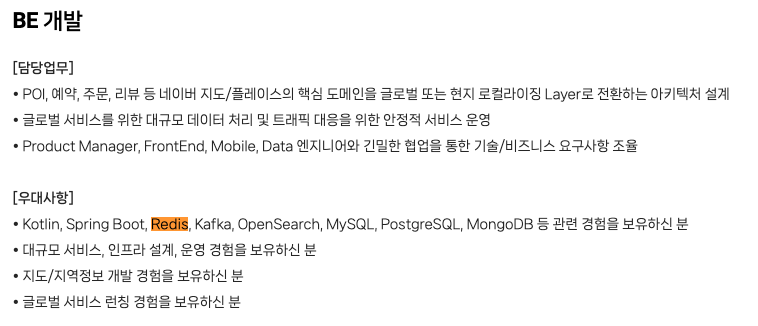
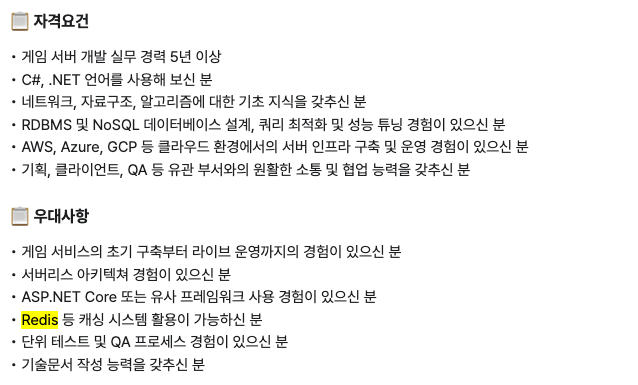
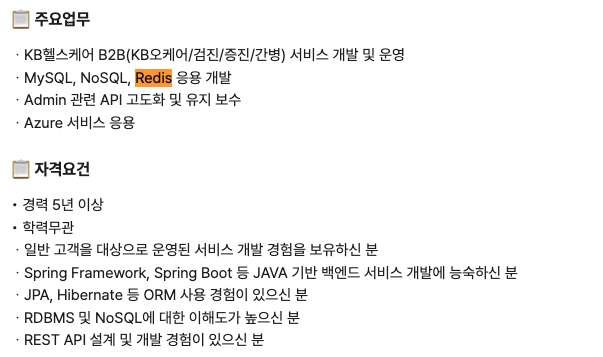
I have brought three actual backend recruitment notices. Redis is included in the list of required skills.
NAVER CloudService BE DevelopmentRedis
Required
NEXONServer ProgrammerRedis Required
KB Group Backend Developer Redis Required
It is not difficult to memorize the names of data structures listed in job postings. The hard part comes after that. What sets people apart is whether they can answer when asked why they chose that specific structure and what trade-offs they made.
Who is teaching?
Created together by active server developers and interviewers.
This course was co-created by Hong, a platform server developer in Pangyo, and Choi, a server developer and interviewer with 12 years of experience at Kakao headquarters.
Knowledge Sharer · Pangyo Platform Server Development
Hong
I am in charge of platform server development in Pangyo. I continue my activities as a knowledge sharer to share the methods I used to study and the problems and solutions I encounter in practice. I don't create these lectures alone; I develop them together with several developers currently working in the field.
I am a 12-year veteran developer currently serving as both a server developer and an interviewer at Kakao HQ. I have infused this course with experiences and traffic scales far beyond typical platforms, helping you prepare based on questions that actually appear frequently in real interviews.
[Current] Kakao HQ Server Developer · Interviewer
Experience in traffic environments handling 500,000+ requests per second
Summary of perspectives and concepts based on real-world interview questions
Reviews from those who took the course first
"Not just a coder, but a real developer"
★★★★★
"I believe this lecture shows what a real developer is, rather than just a coder, by going beyond simply entering commands to covering aspects that require caution in infrastructure environments and even the perspective of hash slots. It teaches what a true developer needs to know when it comes to Redis."
— Amy
★★★★★
"I bought and watched this for the Lunar New Year, and I learned much more than I expected. So this is what a truly skilled developer looks like... I feel quite humbled ㅠㅠ Thank you!"
— Developer, born in '02
★★★★★
"The course is almost entirely hands-on, and the content is delivered concisely and realistically. It's a course where you can build a solid foundation by focusing strictly on Redis."
— warna
Recommended for these people
Who is this Redis course for?
Developers preparing for job changes or resumes and getting ready for Redis questions in backend interviews
Developers who have only used Redis for caching and want to expand its use to sessions, queues, and rankings
Developers who have inherited a Redis configuration for a service currently in operation without even knowing who originally decided on it.
Developers who need to reach a level where they can explain these concepts because they have to review juniors or conduct technical interviews.
Conversely, if you can immediately explain the differences between Single, Replica, Sentinel, and Cluster, as well as their respective trade-offs, you do not need this course.
Frequently Asked Questions
Redis Course Frequently Asked Questions
What kind of database is Redis?
Redis is an open-source in-memory data store that keeps data in memory rather than on disk. As a result, its read and write speeds are extremely fast, and it is widely used in areas that determine the speed and stability of the backend, such as caches, sessions, leaderboards, and queues. The perspective of this lecture is to treat it as a core component of a service, going beyond a simple cache.
Why is Redis fast?
It is because data is stored in memory rather than on disk. However, since memory is finite and data disappears if the process goes down, you must understand persistence strategies like RDB and AOF along with memory usage patterns. Section 4 covers these trade-offs along with practical precautions.
How is the practice environment configured?
We will proceed by setting up the Redis environment directly using Docker 28.0.0. The example code is written in JavaScript (Node.js v23.11.0) and organized based on macOS (M3). You can complete all the hands-on exercises locally without any separate paid cloud subscriptions.
Can beginners to Redis follow along with this course?
Yes. As an introductory-level course, we cover basic data structures such as String, List, Set, Hash, and Sorted Set, along with their concepts and hands-on practice. Basic programming experience is all you need. We explain the basic data structures so that even those seeing them for the first time can follow along, while the environment configuration and expert usage patterns in the latter half offer new insights even for experienced professionals.
Single, Replica, Sentinel, Cluster: when should you use which?
We cover the selection criteria for each structure based on specific situations, explaining why they emerged and what trade-offs they involve. The goal is not to memorize commands, but to enable you to explain for yourself which configuration to choose in a real-world traffic environment.
What is the difference between Redis Sentinel and Cluster?
The purposes are different. Sentinel is a structure for high availability, automatically promoting a replica to a new master by detecting master failures. The data still exists as a single set. Cluster is a structure for scaling, distributing data across multiple nodes in hash slot units. If fault tolerance is the issue, choose Sentinel; if the memory limit of a single node is the issue, choose Cluster.
Is there a reason to take this course even if I'm already using Redis in practice?
Using commands and explaining why you chose a particular architecture are two different things. If you can answer the questions in the BEFORE/AFTER section right now, you don't need this course. However, if you find yourself stuck, this course is designed to fill those gaps.
Can I prepare for Redis interview questions with this lecture?
Yes. We cover actual interview questions like "Please explain the Redis environment configuration patterns" mentioned in the BEFORE/AFTER sections, using a flow that explains why the structure emerged and what trade-offs were made. The goal is to create answers based on reasoning rather than just a memorized list.
What is the sequence of the Redis lecture curriculum?
It starts with an introduction to Redis and an overview of cluster environment design, followed by alternating conceptual lectures and hands-on practice for basic data structures. It then continues with practical precautions, persistence, expert usage patterns, and configuration. The access period is unlimited.
You learn judgment, not just commands.
As a developer who interprets and explains the same question from different perspectives. Try handling Redis as a core part of your service.
I am running a developer open chat room where we share career advice, real-world scenarios, and technology. Feel free to share any questions you have while taking the course or any concerns you face in your actual work.
I started studying development after becoming interested in it while idling at home, and I am currently responsible for platform server development in Pangyo. I am continuing my activities as a knowledge sharer because I want to provide you with the methods I used to study, as well as the various problems and solutions you may encounter in practice.
These lectures are not created solely through my own knowledge. There are others who collaborate on every lecture.
Even though I've only watched about half of it, it's already very helpful.
I'm really enjoying it because you seem to clearly address the things I've been pondering while using Redis lately. Thank you.
Hello, Dolphin Festival!! Thank you for leaving such a great review!! I'll continue to provide even more helpful content in the future!! Have a wonderful day haha
I saw that you created a lecture as a Lunar New Year special, so I purchased and watched it right away!! I watch your lectures often, and every time I do, I feel like you cover only the core essentials with really great content!!
I believe this lecture is also one where I could learn a lot of practical information and build a solid foundation.
1. Most of the lecture consists of hands-on practice.
- You explain all the theories, but the practice sessions are not lacking at all; in fact, I felt there was even more practice than theory.
2. The content is taught concisely and realistically.
- There was no unnecessary fluff, and I was able to learn practical usage methods and patterns.
3. It focuses strictly on Redis.
- This could be both a pro and a con, but if you simply want to learn the Redis service, I don't think there is any lecture better than this one.
I'll be looking forward to your next lecture. Thank you for making such a great course!!
Hello wrana, thank you for leaving such a thoughtful review!! As you mentioned, I tried to approach things from a realistic and practical perspective as much as possible, so I look forward to your continued interest.
It's a bit late, but Happy New Year and stay healthy!! Thank you!








![[Up to 1,500 USD Credit Provided] Core Principles and Scalable Development of Practical AI Agents with Silicon Valley DevelopersCourse Thumbnail](https://cdn.inflearn.com/public/files/courses/342699/cover/01kvz7cv0bmwfc30aee3aymrwp?w=420)