inflearn logo
inflearn logo

AI does not think.

This course is designed for those who use AI but are confused about how much they can trust it. It covers how to use AI in your work or creative process without overdoing it, ensuring it provides actual value. Rather than requiring professional development knowledge or complex tools, it focuses on how anyone can effectively integrate AI into their own workflow. Instead of teaching complex prompt engineering, the course focuses on the mindset of **knowing when to use AI and when it's better not to**, as well as **how to verify and refine AI outputs** rather than trusting them blindly. Through this course, you will establish criteria for using AI not as an automation tool that replaces everything, but as a **practical partner** that helps organize your thoughts and assists in your work.

19 learners are taking this course

Level Beginner

Course period Unlimited

AI
AI
AX(Agent Experience)
AI
AI
AX(Agent Experience)

What you will gain after the course

  • A development mindset of verifying and refining AI responses rather than using them as-is

  • Practical standards for naturally integrating AI into the development workflow

  • The ability to judge and fully utilize AI even without complex tools

AI Utilization (AX), AX (Agent Experience) Standard-Setting Lecture
Learn how to use AI not just as an automation tool,
but as a partner that assists your thinking.


AI, don't use it excessively

Don't just be someone who uses AI well;
become someone who can control AI.


If you have ever experienced using an AI's response as-is,
only to discover unexpected errors later and
ultimately having to take responsibility for the results,
you will immediately understand why the standards covered in this lecture are necessary.

If you have been letting time slip away
without distinguishing between tasks that can be entrusted to AI and moments that require human judgment,
leaving both decisions and responsibilities in an ambiguous state,
then the standards presented in this lecture
can serve as a clear turning point.

If you have been following complex tools and functions to learn how to use AI,
only to find that the criteria for when to use AI and when to stop
have become even more blurred,
this lecture can help clear up that burden.

Now, use AI not as
something that thinks for you, but as a
colleague that organizes your thoughts.
Your workflow will become simpler,
and your judgment can become even clearer.


Learn when and how to use AI
and the criteria for verifying results without blind trust
within your actual workflow.


Instead of letting AI think for you,
you will learn how to use it as a partner that organizes your thoughts and assists with your work.


By the end of this course, you will

Establish clear standards for using AI and utilize it without any anxiety

If you have ever wasted time worrying every time you use AI,
thinking, "Is this result correct?"
or "Is there a better prompt?"
then through this lecture,
you will gain clear criteria for judgment.

Instead of blindly trusting AI's answers,
you will learn how to judge for yourself what to reference and what to filter out.
As a result, you will develop the ability to selectively use only the necessary parts
without placing blind faith in AI.


Make AI a practical partner without complex tools

If you were exhausted by the countless AI tools and complex prompt engineering methods,
this lecture offers a different alternative.

Instead of adding more tools,
it covers how to create a structure where you receive assistance
without overworking the AI.
You will learn practical standards for using AI not as an "all-in-one fixer,"
but as a companion that organizes your thoughts and assists with your work.


Design your own optimal workflow in collaboration with AI

You will gain clear criteria for judging when to use AI
and when it is better
not to use it.

You can distinguish moments when receiving help from AI
actually creates inefficiency, and
instead of using AI's answers as they are,
you can consistently improve the quality of your work
through a minimal routine of reviewing and refining them.


Establish standards to trust and utilize AI outputs

Instead of blindly accepting information generated by AI,
you will learn from what perspective you should ask questions
and by what criteria you should verify the results.

Through this,
you will maximize the strengths of AI and control its weaknesses,
establishing a standard for using AI confidently and without anxiety in various fields such as work, learning, and content creation
.


✔️

Using AI: Learning how to judge, not how to trust.

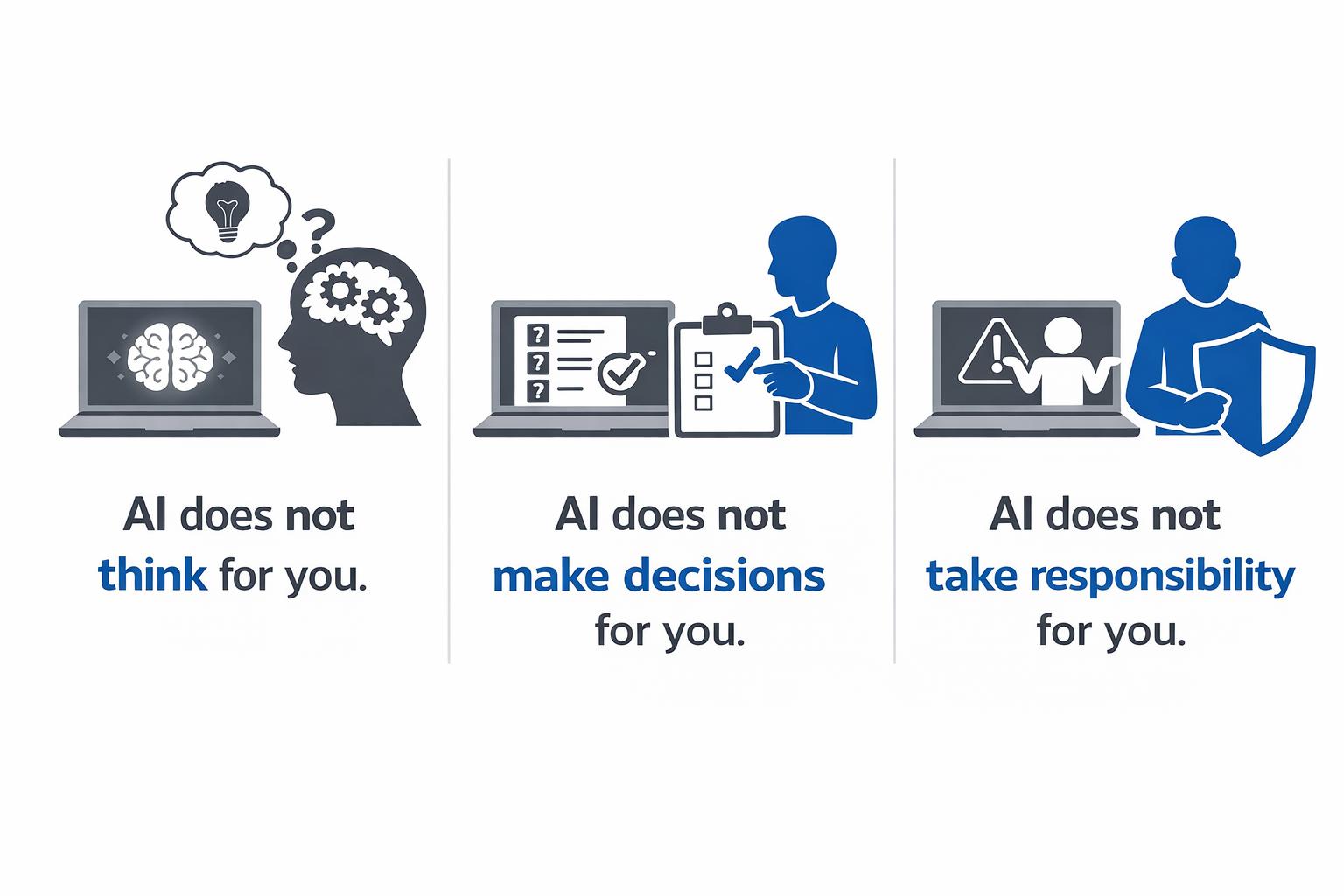
AI does not think.
It does not decide.
It does not take responsibility.
— That role still belongs to humans.

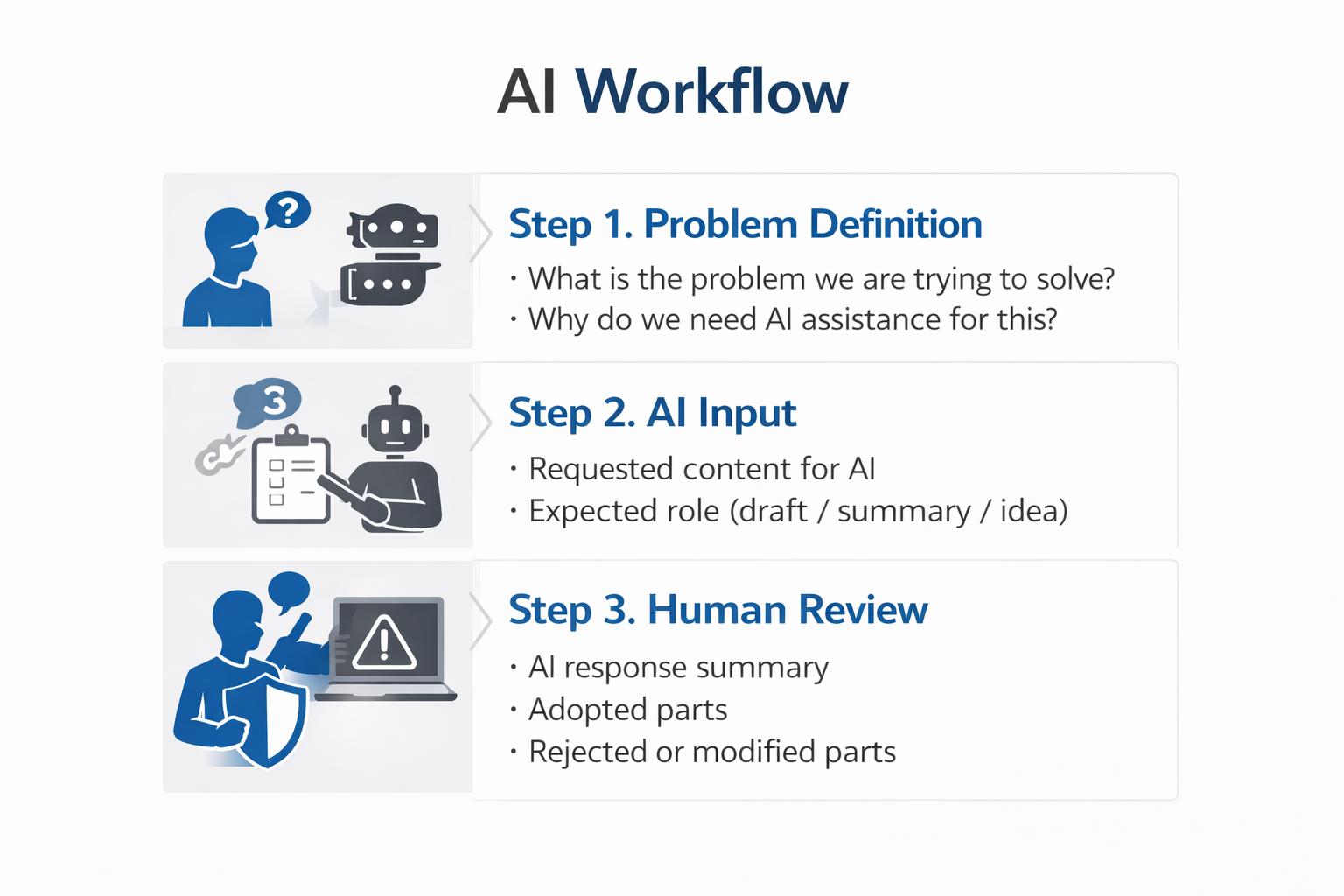
Step 1. Problem Definition (Human)

Defining what to solve is the role of a human.
Before using AI, clarify the problem first.

Step 2. AI Input (Tool)

AI suggests drafts and options.
Its role is not to 'decide instead' but to 'provide materials.'

Step 3. Human Review (Judgment)

Humans decide whether to adopt, modify, or discard.
Final judgment and responsibility are fixed here.

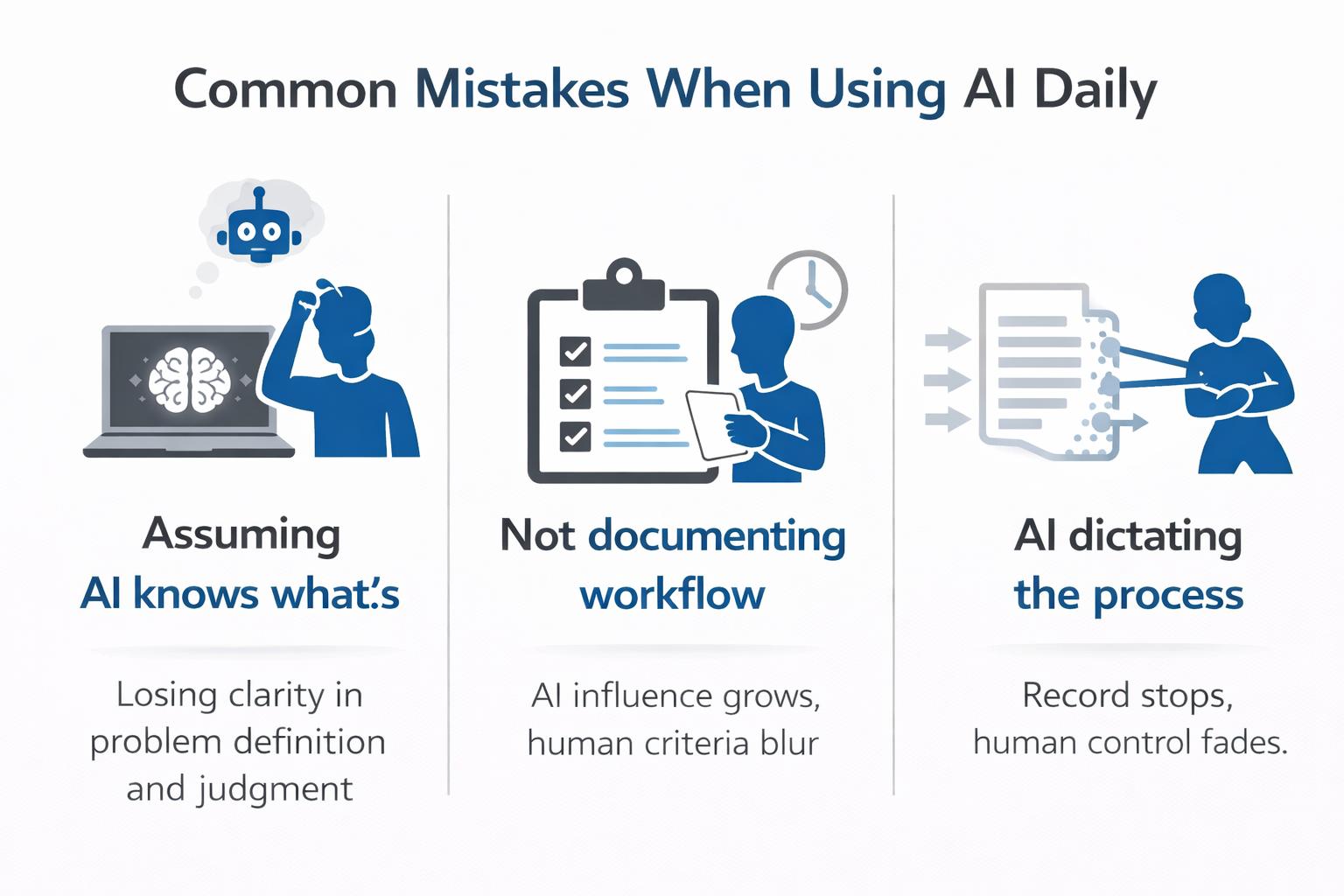
The most common mistakes made while using AI every day
Without standards, AI becomes a ruler rather than a tool


📚

The moment standards disappear,
AI becomes a ruler, not a tool.

Section 1

Introduction to Minimalist AI Architecture

Instead of complex tools and massive systems,
we propose a way to use AI that ensures human thought remains clear.

In this lecture,
focusing on the 'Constitution' that fixes the standards for AI use and
the 'Socratic Guide' that leads thinking through questions,
we explain the core concepts of Minimalist AI Architecture
that minimizes cognitive load.


Section 2

AI Utilization Perspective: The Philosophy of Simplicity

If you felt that using AI would make work easier,
but it has instead become more complex and exhausting,
this lecture offers a different perspective.

Instead of increasing the number of tools,
it covers how to make AI a practical partner
through a strategy of reducing unnecessary elements
so that human thought remains clear.


Section 3

Criteria for deciding when to use AI

It covers how to decide whether or not to use AI based on
clear judgment criteria,
rather than habit or atmosphere.

By distinguishing between moments when AI is helpful and
moments when it is better not to intervene,
it provides criteria for keeping AI as a controllable tool
rather than an element that hinders thinking.


Section 4

Complex prompts do not solve the problem

As AI responses become more unstable,
people often make their prompts even more complex.
However, most problems arise
not because the prompt is insufficient,
but because the question is not well-organized.

In this lecture,
we will explore why short and clear questions
produce more controllable results
than long and complex instructions.


Section 5

AI Answer Verification and Utilization Strategies

It covers how to ensure that human judgment remains at the center, rather than the AI's response.

Instead of using the results generated by AI
as they are,
you will learn a mindset of critically reviewing
and adjusting them to meet human standards.


Section 6

Designing Customized AI Workflows

This course covers a
workflow that positions AI not as the center of automation, but as a
tool to assist human thinking.

By clarifying through documentation and workflows exactly where AI should be involved
and where it must stop,
we design a structure that ensures you do not lose the initiative in judgment
even when using AI every day.


Section 7

The core of keeping AI as a tool

The conclusion of this lecture is simple.
AI does not think,
it does not decide,
and it does not take responsibility.

Therefore, what is more important than knowing how to use AI well is
clearly knowing the line that AI should not cross.
In this section,
we will outline the criteria for maintaining that line yourself.


If you have these concerns, this lecture will be helpful

📌

Office workers who feel overwhelmed by using AI

Those who have tried various AI tools but haven't grasped how to apply them to actual work,
and spend time editing every time because they feel uneasy about using the results as they are.

📌

If you are using AI but aren't sure if you're using it well

If you have tried various AI tools but
are not sure if you are using them properly for work,
and end up manually fixing the results
because you cannot trust the AI's output,
this lecture will provide you with clear standards.

📌

If AI seems promising but you're unsure how to use it

If you agree with the potential of AI
but are hesitating to adopt it because you lack a standard
for what structure to use and how far to utilize it,
this lecture provides a clear direction.


Notes before taking the course

Practice Environment

  • There are no tools that require special installation.

  • A PC with an internet connection is all you need.

  • Having a notebook to organize your thoughts and criteria will be helpful for learning.

Prerequisites and Notices

  • This is suitable for those who have experience using AI tools
    but are unsure of how much they can trust the results.

  • It will be helpful if you have been spending time on verification and editing every time
    because you felt uneasy about using AI outputs as they are.

  • Recommended for those who want to apply AI to their work or daily life
    but are hesitating because they lack clear standards.

Learning Materials

  • Materials related to the Minimalist AI Architecture explained in the lecture are provided.

  • We will also cover documents that help organize AI utilization standards and mindsets.

  • You can obtain practical guidelines for applying AI
    tailored to your personal workflow.


📍 Notice

This course is a text-based lecture. Please keep this in mind when purchasing and taking the course.

Recommended for
these people

Who is this course right for?

  • People who use AI but have no criteria for how much they can trust and utilize it.

  • People who spend time double-checking and fixing AI results every time because they feel uneasy about using them as-is.

  • People who want to use AI for work, study, or content creation but feel overwhelmed and don't know where to start.

26

Learners

3

Reviews

4.3

Rating

2

Courses

At the early-stage startup I was previously part of, I didn't just learn how to write code; I learned the structure of how technology functions as a complete service.

I was primarily responsible for front-end development, but I also handled back-end tasks when necessary to take charge of the core service flow.
In particular, I have experience building and operating pipelines that stably collect and manage over 1 million fashion product data points using FTP/SFTP and web-based architectures.

Through this experience, I have become convinced that the ability to understand and design the entire system is more important than any specific technology.
Currently, I am focusing on AI-based architecture design and structural development methods within the web environment.

Having started as a non-major and come this far through self-study, I understand well the points where people get stuck and the practical difficulties.
That's why in my lectures, I focus on "why we design this way" and "how to think" rather than showing off technical skills.

Simplifying the complex.
A structure that leaves only the essentials.
That is the development philosophy I strive for.

More

Curriculum

All

12 lectures ∙ (1min)

Course Materials:

Lecture resources
Published: 
Last updated: 

Reviews

Not enough reviews.
Please write a valuable review that helps everyone!

Similar courses

Explore other courses in the same field!

$7.70