inflearn logo

Practical Introduction to the OpenAI API: Finish in Just 30 Minutes with the Responses API

A 30-minute free introductory course that starts with just the OpenAI API. Quickly learn the essentials—from the Responses API and JSON response handling to validation, idempotency, and logs—and learn a practical backend workflow that you can test right away without external service keys.

(5.0) 2 reviews

116 learners

Level Basic

Course period Unlimited

Node.js
Node.js
TypeScript
TypeScript
Node.js
Node.js
TypeScript
TypeScript
Thumbnail

What you will gain after the course

  • How to Safely Implement a JSON-Based API Using the OpenAI Responses API

  • How to quickly understand the core structure of a practical AI backend and demonstrate it yourself in 30 minutes


A Practical Introduction to OpenAI API in Just 30 Minutes

This course goes beyond simply learning how to use an API and teaches you how to
quickly understand and directly design the core structure of an AI backend in just 30 minutes.


Would you like to experience a
hands-on backend workflow that you can test right away without an external service key?

Are you a beginner who wants to first learn the core structure of an AI backend
without complex external integrations?

Are you a developer who wants to quickly learn only the essentials, from the Responses API and JSON response handling to validation, idempotency, and logs?

Through this course, you will build a solid foundation in AI-powered backend development,
and develop the ability to implement practical APIs faster than anyone else.


With the OpenAI Responses API,
try a pattern for safely receiving
JSON responses
and integrating it directly into production code without complex external integrations.


Through this course, you will
become a developer who
implements the core structure of an AI backend
directly in just 30 minutes
.


By the end of this course, you will be able to


You will gain the ability to build safe and practical APIs using the OpenAI Responses API.

  • In just 30 minutes, you’ll learn how to reliably implement a JSON-based API using the Responses API, the core of the OpenAI API, without complex external service keys or a UI. Through hands-on demonstrations of practical examples such as summarization, email drafting, and schedule parsing, you’ll quickly grasp the core workflow of backend development.

You will gain a clear understanding of the core structure of AI-powered backend development.

  • Through the `demo.ts` file provided in the course, you can immediately see how the API works without an API key. This makes it easy for beginners to understand the basic structure and operating principles of an AI backend that receives natural language requests and returns responses in JSON format, while also improving its applicability in real-world development environments.

You can write practical code that can be tested immediately without integrating external services.

  • Students will experience a practical backend workflow that can be tested immediately, without complex configuration or integration with external services. This enables developers and beginners encountering AI APIs for the first time to confidently write production-oriented code and successfully take their first steps in AI backend development.

Learn the key points for improving the stability of API operations.

  • Beyond simply creating APIs, you will learn essential reliability techniques for real-world service operations, such as validation, idempotency, and logs. This will equip you with the ability to design and build more robust and reliable AI-powered backend applications.


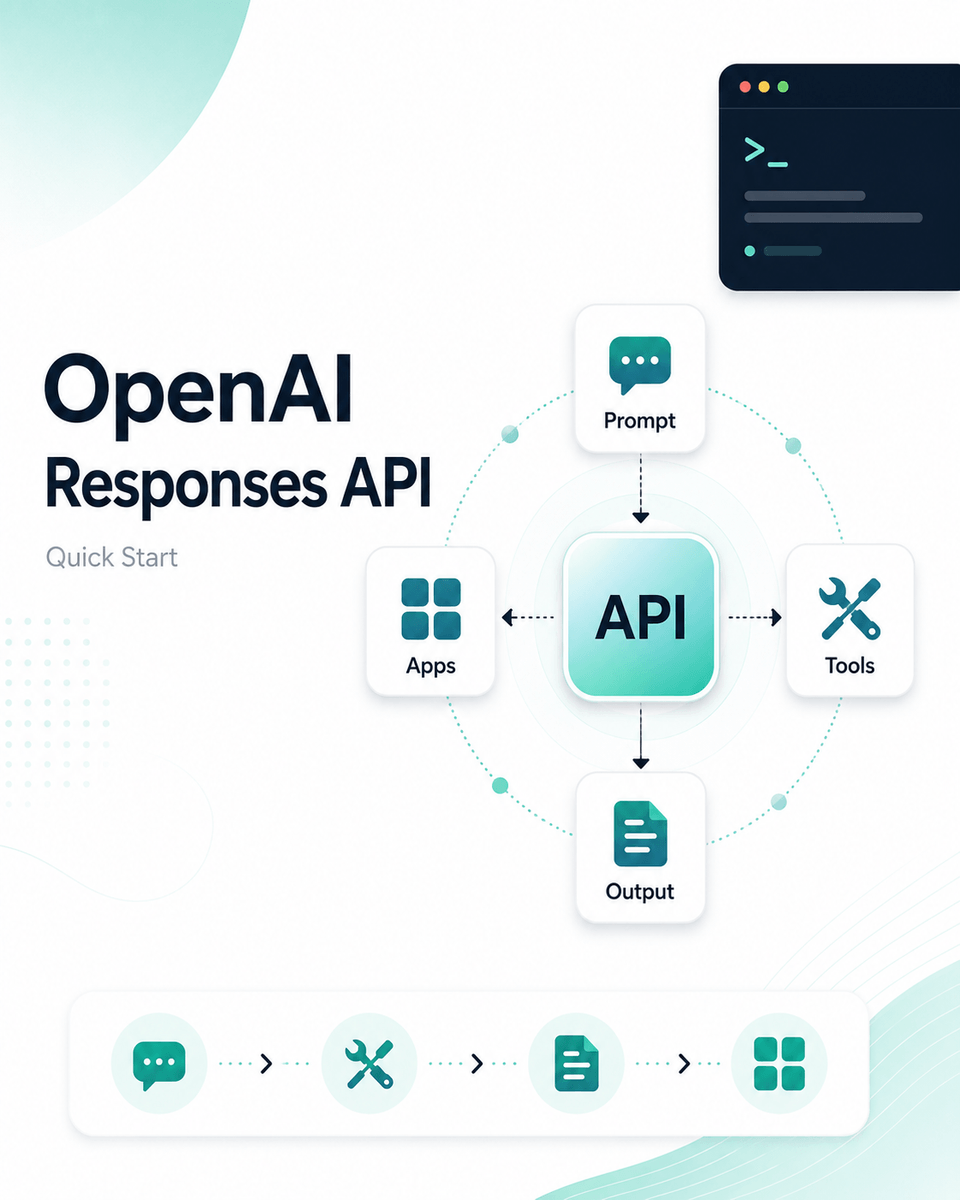
OpenAI API Flow

✔️

Master the OpenAI API: Build a Practical Backend in 30 Minutes

Getting Started with the OpenAI API
Finish in 30 Minutes

This course is designed to help you quickly learn, within one hour, a practical backend workflow using the OpenAI Responses API that can be tested immediately without external service keys. You’ll learn only the essentials—JSON response handling, validation, idempotency, logs, and more—in a condensed format, making it easy to apply in real-world projects.

Hands-on API implementation with Node.js and TypeScript

Learn how to securely integrate the OpenAI Responses API in Node.js and TypeScript environments. Using the `demo.ts` file provided in the course, you can directly demonstrate and test various features, such as summarization, email drafting, and schedule parsing, without an API key.

Code and materials provided for hands-on practice

All Node.js and TypeScript source code used in the course is provided, enabling you to apply what you learn in theory directly to hands-on practice. You can easily set up the development environment with the `npm run dev` and `npm run demo` commands, send actual API requests, and immediately check the results.


📚

Master the essentials of a practical AI backend
in just 30 minutes

You can solve the concerns of people like these!


📌

Beginners in AI backend development

Those who are new to the OpenAI API but want to apply it directly to real services without complicated setup
Learners who want to test immediately without external service keys and quickly grasp the core structure of AI backends

📌

Node.js/TypeScript backend developers

Developers who want to easily integrate the OpenAI API into existing backend projects
Those who want to learn how to reliably implement practical operational aspects such as JSON response handling, validation, and idempotency

📌

Developers who want to implement project-based AI features

Developers who want to incorporate AI into a new service or feature but have felt unsure where to start
Those who want to grasp the core concepts and build an AI backend workflow themselves within an hour


Notes Before Taking the Course


Practice environment

  • Node.js and TypeScript environments need to be set up.

  • A code editor such as VS Code is recommended.

  • The demo can be run without an OpenAI API key.

Prerequisites and Important Notes

  • An understanding of Node.js and TypeScript syntax is required.

  • It is helpful to have a basic understanding of APIs.

  • You can practice without external service keys.

Learning materials

  • TypeScript code examples to be used in the course will be provided.

  • A GitHub repository link needed for the hands-on exercises will be provided.

  • You can refer to materials summarizing the key content.


Recommended for
these people

Who is this course right for?

  • Developers who want to integrate the OpenAI API into production code in the lightest and fastest way possible

  • Beginners who want to first learn the core structure of an AI backend without complex external integrations

Need to know before starting?

  • It would be good to know the basic syntax of JavaScript or TypeScript.

  • If you understand the basic concepts of HTTP API requests and responses, it will be easier to follow along.

Career Verified

2,418

Learners

142

Reviews

4.3

Rating

6

Courses

At the early-stage startup I was previously part of, I learned more than just how to write code; I learned the structure of how technology functions as a service.

Although my primary focus was on web frontend development, I took responsibility for the core service paths by designing backends and data flows whenever necessary. In particular, I built and operated a pipeline to stably collect, refine, and manage over 1 million fashion product data points using FTP/SFTP and web-based architectures.

Through this experience, I have become convinced that what matters more than any specific language or framework is the ability to understand the overall system flow and responsibility structure.

Currently, I am designing AI-based systems in web environments, focusing on defining structures and control models before execution. Rather than simply adding features, my work is closer to designing state transitions and validation flows.

Starting as a non-major and getting to this point through self-study, I am well aware of the roadblocks and realistic constraints. That is why in my lectures, I focus on "why we design this way" and "how to make decisions" rather than showing off technical skills.

A structure that leaves only the essentials,
instead of increasing complexity.

That is the development philosophy I strive for.

More

Curriculum

All

8 lectures ∙ (27min)

Course Materials:

Lecture resources
Published: 
Last updated: 

Reviews

All

2 reviews

5.0

2 reviews

  • jjhgwx님의 프로필 이미지
    jjhgwx

    Reviews 1,199

    ∙

    Average Rating 4.9

    5

    63% enrolled

    Thank you for the great lecture!

    • smilegift6094님의 프로필 이미지
      smilegift6094

      Reviews 1

      ∙

      Average Rating 5.0

      5

      38% enrolled

      wonyoungchoiseou4177's other courses

      Check out other courses by the instructor!

      Similar courses

      Explore other courses in the same field!

      Free