
inflearn logo

(v501) The Heart of AI: AI Foundation Models and the Mechanics of Intelligence

[Understanding AI Foundation Models and Their Operating Principles: Engineering Control and System Architecture, Practical Methodologies for Resolving AI Uncertainty and Engineering Assetization] 1. Introduction: The Necessity of Engineering Control of Intelligence (Engineering Control vs. Systemic Chaos) A core conclusion derived from long-term practical insights in industrial fields is that power that is not properly controlled acts as a potential liability rather than an asset. Even a high-performance engine is nothing more than an unstable physical mass if it lacks sophisticated combustion logic and microsecond-level control systems. The organizational chaos currently appearing in the process of adopting Generative AI is judged to stem from a lack of understanding of these control principles and a blind faith in technical "black boxes." This masterclass redefines Artificial Intelligence not as a mysterious stochastic phenomenon, but from the perspective of Model-Based Engineering (MBE). By transforming the uncertain domain of intelligence into a predictable and reliable engineering framework, we aim to present a strategic methodology that allows organizations to secure strong leadership across the entire system without being dependent on technical trends. 2. The 4 Pillars for Solving Core Challenges ① Epistemological Paradigm Shift: Visualizing the Black Box and Assetizing Technical Debt Many companies are facing "technical debt"—characterized by exposure to security vulnerabilities and exponential increases in maintenance costs—by adopting AI models without a clear understanding of their internal structures. This course assetizes this through the following approaches: Deconstruction of Mechanisms: We engineeringly deconstruct the Self-Attention mechanism, the core of the Transformer architecture, from the perspective of numerical weight analysis. By understanding the numerical mechanisms that determine information priority, we visualize the basis for the model's judgment. Analysis of ID Formation: We transparently track the process by which a series of pipelines—leading from Pre-training to Supervised Fine-Tuning (SFT) and Reinforcement Learning from Human Feedback (RLHF)—forms the model's technical identity and ethical guidelines. This converts invisible threats into controllable system parameters. ② Securing Deterministic Reliability: Hallucination Control Strategies to Overcome Probabilistic Limits Large Language Models (LLMs) are not systems that reason for truth, but systems that generate the next most probable token. The "hallucination" phenomenon resulting from this inherent characteristic becomes a fatal flaw in engineering fields where reliability is vital. Constraints of Retrieval-Augmented Generation (RAG): We move away from closed structures that rely solely on the model's internal fixed memory (Internal Weights). We establish an "open-book strategy" that provides clear grounding for generated results by allowing real-time reference to trusted external knowledge bases. Hybrid Model Architecture: We design a redundancy strategy that achieves both accuracy and operational efficiency by deploying large models for areas requiring enterprise-wide knowledge and optimized Small Language Models (SLMs) for specific domains where security and real-time response are essential. ③ Computing Architecture Optimization: Overcoming Physical Bottlenecks (Memory Wall) While intelligence is implemented in software, its performance and economic sustainability are defined by the physical limits of hardware. Physical Constraint Analysis: We diagnose the "Memory Wall" problem, where data transfer speeds cannot keep up with the processing speeds of computing units, and heat generation issues resulting from high-density computation from an engineering perspective. Infrastructure Design Capability: We precisely analyze the physical impact of High Bandwidth Memory (HBM) stacking structures and 2.5D/3D advanced packaging technologies on inference efficiency. We cultivate design capabilities to optimize Total Cost of Ownership (TCO) through full-stack integrated insights that complement hardware limitations with software architecture. ④ Acceleration of Functional Expansion: Transitioning from Passive Tools to Autonomous Agent Systems Current AI remains at the level of simple Q&A, failing to create added value for practical business automation. This course evolves AI into an active subject that judges and executes on its own. Decomposition: We learn techniques for decomposing complex goals into achievable sub-tasks and logically organizing the execution sequence upon receiving them. Digital Workforce Deployment: We define the process of applying "Active Agent" systems to the field, which autonomously call internal ERPs, browsers, and external APIs to complete actual business logic and accept feedback on results. 3. Core Architecture: Closed-loop Control System The way an AI agent manifests intelligence and performs complex tasks is theoretically identical in logical structure to the closed-loop control system performed by an ECU (Electronic Control Unit), the core brain of a car. This course analyzes this in detail from the perspective of the ReAct (Reasoning and Acting) framework. First, the system begins at the Input stage, receiving ambiguous and complex requests from the user. This plays the same role as a sensor in control engineering collecting physical data from the external environment and delivering it to the system, serving as the standard for defining the initial state of the task at hand. Second, based on the received data, the Thought stage proceeds, where plans are established through logical reasoning within the LLM architecture. This is in line with the process where control algorithms in an ECU calculate optimal control values by processing input sensor data. At this stage, the agent sets the optimal path to achieve the goal and secures the logical rigor of the system. Third, the Action stage follows, where tasks are completed by calling external tools or APIs according to the established plan. This logically matches the mechanism where the calculation results of a control system are converted into physical power through an actuator to execute commands. Through this, intelligence exerts actual physical and digital influence beyond abstraction. Finally, the Observation stage is performed, analyzing the execution results and correcting errors relative to the initial goal. This is identical to the core principle of control engineering, which reduces system deviation through a feedback loop. The agent self-verifies whether the execution results meet the goal and continuously upgrades performance by reflecting occurred errors into the next action plan. AI equipped with such a closed-loop structure is no longer an incomplete system dependent on probability. By securing engineering rigor that self-verifies execution results and corrects errors, it functions as a trust-based partner capable of performing business-critical tasks. 4. Practical Application and Expansion: Software-Defined Vehicles (SDV) and Physical AI The final destination of AI architecture lies in the cross-industry proliferation of Software-Defined Vehicles (SDV) and Physical AI, which overcome and evolve physical constraints through software intelligence. This is the standard model for future System Integration (SI) across manufacturing and service industries. Securing Edge Intelligence and Data Sovereignty: Small models (SLMs) mounted on-device in vehicles or facilities learn real-time field data immediately. This minimizes cloud dependency, perfectly protecting data sovereignty—a core asset of the company—and enables precision services based on ultra-low latency. Hardware Optimization and Lightweight Engineering: To implement the best intelligence within limited power and computational resources, we actively introduce model compression technologies such as Quantization, Pruning, and Knowledge Distillation. Model deployment considering hardware bandwidth becomes a core competency that determines system response speed and user experience. Hybrid Orchestration: We design an integrated architecture that organically connects "Cloud LLMs" possessing broad general knowledge with "Edge SLMs" specialized for specific physical control and security. Integration from a full-stack perspective, penetrating from silicon chipsets to software stacks, provides a powerful competitive advantage that evolves the entire system through software updates alone. 5. Conclusion: The Role and Vision of the AI Architect The ultimate goal of this masterclass is to elevate students from the position of a "User" who passively relies on technology and hopes for luck, to a professional "AI Architect" who perfectly controls and tunes everything from the physical limits of the system to the depths of the software architecture. While the phenomenon of intelligence manifests from software logic, it is silicon (hardware) that defines the physical limits of that intelligence, and only sophisticated engineering can overcome those limits to complete actual business value. "Intelligence may reside in the realm of probability, but the vessel that contains that intelligence and makes it operate according to purpose must belong solely to the realm of rigorous and sophisticated engineering."

1 learners are taking this course

Level Intermediate

Course period Unlimited

Data Engineering
Data Engineering
AI
AI
Data literacy
Data literacy
product design
product design
RAG
RAG
Data Engineering
Data Engineering
AI
AI
Data literacy
Data literacy
product design
product design
RAG
RAG

What you will gain after the course

  • Complete the optimal AI technology selection matrix and the next-generation R&D system blueprint to secure a strategic technology roadmap aligned with business objectives.

  • We maximize system integration and orchestration capabilities through an MBE framework optimized for SW and HW convergence and an autonomous agent command system.

  • We break through model limitations by building an RAG-based reliability verification pipeline that elaborately controls AI learning mechanisms and references real-time knowledge.

  • Develop an eye for hardware optimization that combines the physical constraints of semiconductors with business ROI, and acquire engineering leadership for next-generation technology management.


📘Explains the heart of AI: foundation models and the mechanics of intelligence. It introduces the foundational and applied knowledge to dissect and control AI as a sophisticated engineering system, rather than just a black box or a tool.


📘 [Section 1] The Heart of AI: Foundation Models and the Mechanics of Intelligence

(The Heart of AI: Foundation Models and the Mechanics of Intelligence)

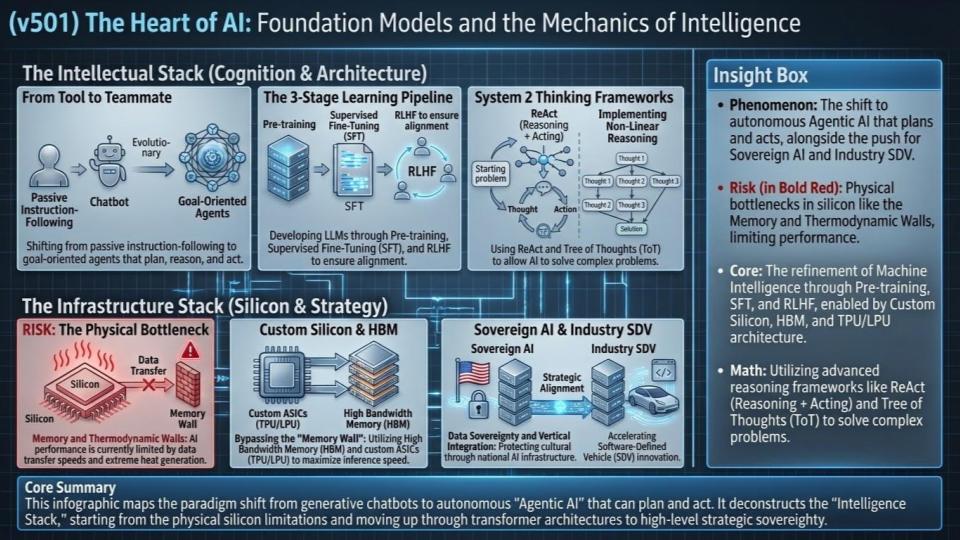
Section 1 covers the paradigm shift in which AI technology evolves beyond simple 'Generative' capabilities into 'Agentic AI' that plans and acts on its own.

  • Philosophical Disconnect (From Tool to Teammate): It analyzes the evolution process from a passive chatbot that only responds to specific user instructions to an 'active teammate' that plans its own methods and uses external tools when given only a goal.

  • Mechanisms of the Cognitive Engine: We will perform an engineering dissection of the "Transformer" and "Self-Attention" mechanisms—the core of modern AI—using a library search system analogy to explain how they deeply understand context through parallel processing.

  • The Birth of Mind and Thinking Structures: Learn the three-stage learning pipeline of LLMs, spanning from Pre-training to SFT and RLHF. Additionally, master the structures that implement 'System 2' thinking, such as the ReAct framework, where AI repeats reasoning and acting, and Tree of Thoughts (ToT), which explores complex problems non-linearly.


📘 [Section 2] AI System Literacy: Model Architecture and Operating Principles

(Foundation Models & Mechanics)

Section 2 covers the "internal anatomy" of large language models in depth, from the reinterpretation of the Transformer architecture to SLM efficiency technologies that overcome model limitations.

  • The Three Paradigms of LLM Architecture: Learn the differences and appropriate topologies between Encoders (e.g., BERT) that understand bidirectional context for business purposes, Decoders (e.g., GPT) that excel at text generation, and Encoder-Decoders (e.g., T5) specialized for translation and summarization.

  • The Limits of "Bigger is Better" and Model Collapse: We examine the scaling laws where performance improves as model size increases, alongside the risks of data exhaustion (Data Wall) and 'Model Collapse' caused by retraining on synthetic data.

  • Efficiency Revolution, Small Language Models (SLM): To address the high costs and latency issues of Large Language Models (LLM), we cover the rise of SLMs optimized for edge device operation and specific domains. Furthermore, you will learn how to maximize model practicality through Knowledge Distillation, which compresses the knowledge of giants, and Quantization/Pruning techniques.


📘 [Section 3] The Era of Generation and Expansion: The Essence of Generative AI and Multimodality

(Generative Systems Architecture)

Section 3 analyzes the revolution of probability distribution moving from Discriminative to Generative models, as well as the RAG architecture that controls hallucination risks.

  • Comparative Analysis of Generative Models (GAN, VAE, Diffusion): We provide an engineering selection guide tailored to industrial needs by understanding the trade-offs (speed vs. quality vs. diversity) of each model, such as GANs for generating rare data, VAEs for design exploration, and Diffusion for high-quality image restoration.

  • Multimodal and Zero-Shot Learning: Through the CLIP architecture, which maps text and images into a single mathematical space, we examine the zero-shot revolution that classifies manufacturing defects without additional training.

  • Hallucination Control and RAG (Retrieval-Augmented Generation): To control the structural risks of LLMs, such as the lack of up-to-date information and hallucinations (stochastic parrots), we build a RAG pipeline—an 'open-book exam' strategy using vector databases—and perform a comparative analysis with Fine-Tuning.


📘 [Section 4] The Technical Stack of Agentic AI: From Semiconductor Wars to Cloud Custom Silicon

(Agentic AI Silicon Stack)

Section 4 analyzes the hardware stack under the fundamental principle that "while AI intelligence manifests in software, its limits are determined by hardware (silicon)."

  • Understanding Physical Bottlenecks: Diagnoses the fundamental 'Memory Wall,' where data transfer speeds cannot keep up with AI computation speeds, and the 'Thermodynamic Wall' caused by extreme heat generation.

  • Semiconductor Technologies for Breaking Limits: To address this bottleneck, we provide an in-depth analysis of the principles of HBM (High Bandwidth Memory), which vertically stacks data highways, and Advanced Packaging and Chiplet technologies, which connect chips like Lego blocks to overcome the limits of Moore's Law.

  • AI Chip Wars and Custom Silicon: This section covers NVIDIA's overwhelming CUDA ecosystem (moat), the custom ASIC strategies of big tech companies like Google (TPU) and Amazon (Trainium) to overcome it, and the background behind the emergence of LPUs and wafer-scale engines that maximize inference speed.


📘 [Section 5] AI Technological Sovereignty and Future Industrial Innovation

(Sovereign AI Strategy and SDV Engineering Synthesis)

Section 5 covers convergence strategies ranging from macro AI geopolitics to micro chip-level engineering, as well as SDV (Software-Defined Vehicle) application cases.

  • Sovereign AI Strategy: Analyzes the importance of Sovereign AI, where nations build their own infrastructure and models to protect data privacy and cultural identity, and explores South Korea's strategic leverage with its competitiveness in memory and foundry.

  • SDV, the Melting Pot of Industrial Innovation: It demonstrates how the entire R&D pipeline of SDVs, often called data centers on wheels (VAE design, GAN simulation, RAG maintenance manuals), is accelerated using Generative AI.

  • Convergence of Safety and Intelligence (SLM & SLM): Learn about the synergy that completes functional safety by combining 'Small Language Models' for in-vehicle privacy and response speed with 'Silicon Lifecycle Management' for monitoring the health of semiconductors.


📘 [Section 6] Summary and Conclusion: The Heart of AI: Deconstructing Foundation Models and Agent Architectures

(Engineering Agentic AI: Deconstructing the Engine)

Section 6 synthesizes all the engineering principles and strategies from the previous Parts 1 to 5, presenting the definitive version of 'Model-Based Engineering' that leaders should adopt.

  • Anatomy of AI through Blueprints: We decompose the Transformer's attention mechanism from a tensor operation perspective and review the process of controlling raw intelligence—from pre-training to SFT and RLHF—by detailing it like an engineering blueprint.

  • Strategic Decision-Making Framework: Guarding against vague LLM universalism, you will internalize a decision-making matrix to accurately deploy RAG, Fine-Tuning, and SLM based on data types (dynamic facts vs. static styles) and resource constraints (cloud vs. edge).

  • From Prediction to Creation and Action: Move beyond the perspective of a mere 'User' who asks AI for answers, and complete your vision as an 'AI Architect' who integrates everything from the physical limits of silicon to agent workflows into business applications.

The following is a summary of this lecture in infographic format.
https://tinyurl.com/29y6ycmw

  1. My published book, which served as the foundation for this lecture, is attached at the very bottom of the curriculum. Please also refer to my introductory video.

  2. Audio files (URL) to help you understand this lecture are also attached.

Recommended for
these people

Who is this course right for?

  • Despite spending a massive budget, the project is on the verge of being halted because the causes of AI hallucinations and black-box errors cannot be identified.

  • I feel a deep sense of helplessness because of memory bottlenecks and performance limits that cannot be solved even by blindly adding more hardware like GPUs.

  • There are no engineering criteria to determine whether RAG or fine-tuning is optimal, so resources are being wasted like pouring water into a bottomless pit.

  • By using AI only as a simple summarization tool, we are being completely left behind in the massive paradigm shift toward autonomous agents.

  • By uncritically relying on Big Tech models, we are ultimately losing both data sovereignty and system control, being driven down the path of technological dependence.

Need to know before starting?

  • We must abandon the passive attitude of viewing AI as magic and instead adopt a model-based mindset that seeks to dissect internal training pipelines and transformer architectures.

  • Basic knowledge of the fundamental AI/ML paradigm and the cloud ecosystem serves as a solid foundation for understanding the complex structures of RAG and agent design.

  • We must face the 'Memory Wall,' a physical constraint that determines the limits of performance, and develop an architect's perspective that views hardware and software integrally.

  • We must be wary of the "silver bullet" mentality of trying to solve every problem with LLMs and be able to select the optimal technology (RAG vs. Fine-tuning) to maximize ROI according to domain characteristics.

Hello
This is khjyhy100

I am a retiree with over 40 years of experience (Jan 1984 – May 2024) working for major corporations and mid-sized enterprises in Korea.

I am a powertrain and propulsion systems engineer who served as an executive for 18 of my 40-year career, and held positions as Vice President and CEO at a mid-sized company during the final 5 years.

At Hyundai Motor Group, I achieved overseas technology transfer revenues (approximately 130 billion KRW, including mid-sized gasoline engines, turbochargers, AWD, etc.). I also have a history of conducting numerous government-funded R&D projects. Currently, I have begun writing with the aim of sharing the knowledge and experience gained throughout my career. I ask for the readers' great interest and encouragement.

  • Name: Hong-jip Kim

  • Publication Guide: https://khjyhy.upaper.kr/new

  • You can find more published books by searching for "Kim Hong-jip" in major domestic e-bookstores.

  • Education & Training: Completed KAIST AI Executive Program (Feb 2025 – Jun 2025)

  • Career 1: Hyundai Motor Group R&D (Hyundai Motor Company, Hyundai Wia Corp.: 1984~2018 

  • Career 2: INZI Controls Co., Ltd.: 2019–2024


  • Award 1: Korea's Top 100 Technologies and Leaders (Dec. 2010) (National Academy of Engineering of Korea, Ministry of Commerce, Industry and Energy)

  • Award 2: Presidential Award at the IR52 Jang Young-shil Awards (Development of medium-sized gasoline engines, Ministry of Commerce, Industry and Energy, 2005)


  • 13 papers published in domestic and international professional technical societies on powertrains and propulsion systems in the field of automotive engineering

  • Filed and disclosed numerous job-related invention patents

More

Curriculum

All

17 lectures ∙ (1hr 54min)

Course Materials:

Lecture resources
Published: 
Last updated: 

Reviews

Not enough reviews.
Please write a valuable review that helps everyone!

khjyhy100's other courses

Check out other courses by the instructor!

Similar courses

Explore other courses in the same field!

Limited time deal

$9,900.00

70%

$26.40