
inflearn logo

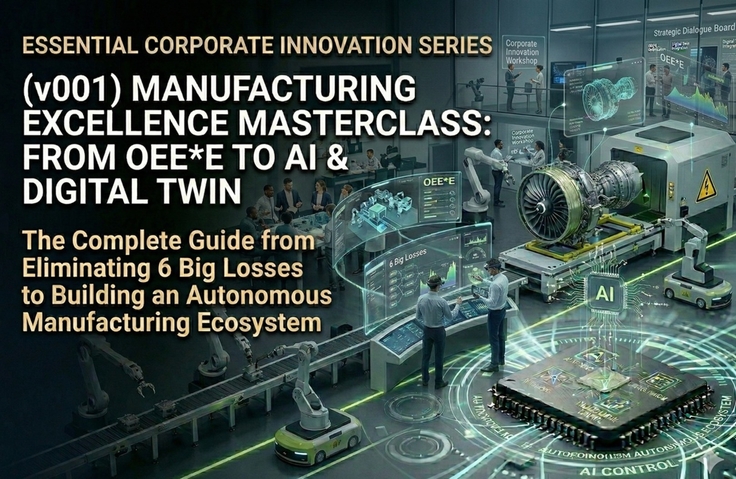
(v001) Manufacturing Excellence Masterclass: From OEE*E to AI & Digital Twin

[Process Optimization Roadmap: Eliminating Unnecessary Capital Investment and Converting 'Hidden Factory' Opportunity Costs into Tangible Profits] 1. Introduction: Transition to Intelligent Processes and the Prerequisite of Standard Operating Procedures For modern enterprises to maximize business value by adopting Artificial Intelligence (AI) technology, the rigorous standardization of physical processes and work procedures on the shop floor must come first. An intelligent system built upon an unstructured data environment lacking standardization will struggle to achieve optimal performance; instead, it is highly likely to amplify process uncertainty and act as a risk to the entire system. This training course aims to present a strategic methodology for discovering latent profit sources within the so-called 'Hidden Factory' and converting them into an engineering foundation that AI can autonomously control and optimize. 2. [Analysis] Quantitative Data-Based Field Diagnosis and Analysis of 'Baseline Losses in Critical Indicators' Many manufacturing sites tend to overlook potential operational losses by settling for superficial performance indicators. When Overall Equipment Effectiveness (OEE) is precisely analyzed through engineering decomposition techniques, the following structural losses are identified: Availability 90%: While external uptime is secured, power loss due to minor stoppages occurs continuously. Performance 90%: A slowdown in actual speed compared to theoretical cycle time has become chronic, yet there is no reference point to recognize and improve this. Quality 90%: A defect rate reaching 10% is evaluated as a critical figure that undermines the reliability of the entire process. The actual OEE, calculated by the multiplier effect of these three indicators, is only 72.9%, meaning the remaining 27.1% of opportunity cost is buried within the 'Hidden Factory'—unidentified by data. Therefore, the primary task of AI adoption is to quantify the source of this waste and ensure process transparency. 3. [Critique] Redefining Strategic Priorities: The Conflict Between Operational Excellence (OPEX) and Capital Expenditure (CAPEX) Prioritizing the expansion of new facilities (CAPEX) as a solution to declining productivity can be a strategically dangerous decision. Adding lines to a low-efficiency structure where OEE remains at the 60–70% level results in replicating fundamental inefficiencies, leading to an exponential increase in management costs. Before large-scale capital injection, maximizing Operational Excellence (OPEX) to break through the physical limits of existing assets must take precedence. Only when standard operating procedures capable of achieving the world-class standard of 85% OEE are established can a virtuous cycle be built—one that dramatically improves production capacity through integration with AI without additional investment. 4. [Evaluation] Integration of Data Architecture: Establishing an ISA-95 Based Decision-Making System The disconnection between the financial indicators of Enterprise Resource Planning (ERP) and the operational data of the Manufacturing Execution System (MES) is a core cause of information distortion and delayed decision-making. To resolve this, the international standard ISA-95 architecture is applied to organically integrate management strategy with the physical production site. Establishment of a Single Source of Truth: Complete a data pipeline where all dynamic field data is synchronized in real-time with the enterprise management system. Conversion of Indicators into Financial Value: By intuitively linking the impact of minor field stoppages to actual operating profit and cash flow on financial statements, an objective, data-driven performance evaluation and decision-making system is established. 5. [Execution] 4-Step Strategic Roadmap for Intelligent Process Management Implement an advanced strategy that fuses AI technology with human engineering insight based on strictly standardized procedures. Predictive Maintenance and Utilization of P-F Intervals: Build a predictive maintenance system by monitoring the P-F Interval—the period from a potential failure (a precursor to equipment breakdown) to a functional failure—in real-time. Digital Twin-Based Simulation and Minimization of Trial and Error: Practice a 'Zero-Trial' strategy that prevents physical losses by verifying various scenarios within a virtual environment before implementing process changes. Quantitative Control of the 6 Big Losses: Continuously track and manage the six core waste factors that hinder profitability—equipment failure, setup/adjustments, idling/minor stops, reduced speed, process defects, and reduced yield/rework—through AI. Digital Advancement of Total Productive Maintenance (TPM): Enhance the reliability of Human-in-the-Loop systems by establishing a proactive culture where field operators voluntarily detect and respond to signs of equipment abnormality. 6. Conclusion: Securing Technological Leadership Through Standardized System Architecture Technical knowledge can be transferred through education, but the insight to dominate process flow only manifests upon a sophisticatedly designed standard system. This masterclass aims to provide a precise engineering blueprint for transforming your production site into an intelligent asset. Establishing standardized work procedures and ensuring data integrity are essential prerequisites for the AI era. Only on a firm systemic foundation will AI function as a true intelligent production site that drives corporate growth.

1 learners are taking this course

Level Intermediate

Course period Unlimited

Statistics
Statistics
Team Collaboration Tool
Data literacy
Data literacy
product design
product design
Business Problem Solving
Statistics
Statistics
Team Collaboration Tool
Data literacy
Data literacy
product design
product design
Business Problem Solving

What you will gain after the course

  • We will secure OEE and 6 Big Loss analysis dashboard planning and automation capabilities to identify the root causes of production bottlenecks in real time.

  • Through AI predictive maintenance models and digital twin blueprints, we reduce downtime by 40% and realize optimal processes without trial and error in virtual space.

  • Establish an ISA-95-based enterprise integration roadmap to build a Single Source of Truth (SSOT) system where shop floor performance and management control are synchronized.

  • Complete next-generation leadership that leads the field with facts rather than intuition, equipped with data-driven ROI investment proposals and engineering command.

📘This course goes beyond simple on-site improvements to provide a 'Manufacturing Excellence Masterclass' that covers everything from OEE-based waste elimination to the establishment of an autonomous production ecosystem using AI agents and digital twins. The curriculum is designed to integrate data integrity, global standards (ISA-95), energy efficiency (OEEE), and AI governance (ISO 42001), presenting a strategic blueprint to fundamentally resolve the profitability and regulatory risks faced by companies.


📘[SECTION 01] Manufacturing Innovation Masterclass Overview: From OEE to AI and Digital Twin

  • We dynamically redefine OEE, which was once a simple lagging indicator, into a predictable leading indicator by combining it with the analysis of the 6 Big Losses.

  • We establish an automated data acquisition (DAQ) system that ensures data integrity and eliminates the limitations of manual entry, which is often subject to operator subjectivity.

  • By introducing Causal AI that goes beyond simple correlations, we diagnose the root causes of failures and prescribe the optimal timing for response.

  • By utilizing ISO 23247-based digital twins, we perform zero-cost simulations and control optimization in virtual space.

  • We design sustainable operations through OEEE, which combines productivity metrics with energy efficiency (EEM, EES), and global AI governance (ISO 42001).

📘[SECTION 02] Overall Equipment Effectiveness (OEE): The Foundation for Achieving World-Class Standards

  • OEE is a benchmarking tool that evaluates how close you are to 'perfect production,' which means operating at the highest possible speed without defects or downtime.

  • It is calculated as the product of three interdependent factors—availability, performance, and quality—and serves as a rigorous test where a drop in a single factor causes the overall efficiency to plummet.

  • To improve OEE, we eliminate the six major losses (equipment failure, setup, idling/minor stops, reduced speed, initial defects, and process defects) that hinder availability, performance, and quality.

  • We must evolve beyond manual measurement for post-analysis purposes into an automated system (Visual OEE) that enables real-time response and immediate action.

  • Achieving 85% OEE is the best investment for securing a factory's hidden production capacity without massive additional capital expenditure (CapEx).

📘[SECTION 03] In-depth Analysis and Execution Strategy for the Six Big Losses

  • Only the 'Fully Productive Time' remaining after sequentially subtracting the Six Big Losses from the total planned production time creates actual value-add.

  • Equipment failures and setup losses, which are critical to availability, minimize clear time-based downtime through preventive maintenance and SMED.

  • Momentary stops of less than 10 minutes and speed reductions, which are difficult to detect, are defined as 'Hidden Factory' losses and are tracked using digital sensors.

  • We do not stop at resolving surface-level symptoms, but must perform a Root Cause Analysis (RCA) from the 4M (Man, Machine, Material, Method) perspective.

  • The complete elimination of the six major losses goes beyond simply increasing efficiency; it directly contributes to the Return on Assets (ROA) by reducing defect rates and manufacturing costs.

📘[SECTION 04] Operational Excellence Toolbox

  • We avoid applying isolated methodologies and maximize improvement through the synchronized interaction of four core tools: TPM, SMED, Lean, and Gemba.

  • By operating Gemba Walks as a structured protocol, we visualize and verify the gap between management's KPIs and on-site data.

  • Through Total Productive Maintenance (TPM) and Autonomous Maintenance, we transform maintenance from a simple reactive cost into a predictable area of value creation.

  • By converting internal setup to external setup using SMED techniques, we reduce the economic batch size and improve the cash flow of tied-up working capital.

  • Upgrade traditional improvement tools to a higher dimension with smart capabilities (TPM 4.0, SMED v2) based on the Industrial Internet of Things (IIoT) and Digital Twins.

📘[SECTION 05] ISA-95 Manufacturing Standards Competitiveness and MES Advancement Strategy

  • We introduce the ISA-95 international standard architecture, which bridges data silos between enterprise business processes (ERP) and manufacturing execution systems (MES).

  • By resolving discrepancies between planning and execution data, we secure a 'Single Source of Truth' where performance and financial information are immediately synchronized in both directions.

  • By implementing a complete traceability lineage for 4M data, we decisively defend against large-scale quality risks and recall incidents.

  • Next-generation MES goes beyond passively reflecting the requirements of the field; it operates as a control hub that monitors and manages the site in real-time based on standardized KPIs.

  • Through a three-stage roadmap of Visualize, Analyze, and Predict, we will advance MES big data to the level of intelligent autonomous production.

📘[SECTION 06] AI and Digital Twin-Based Governance Integration Strategy

  • We maximize cost efficiency through four core pillars: AI predictive maintenance, the digital twin ecosystem, sustainability (OEEE), and trustworthy AI governance.

  • Through Causal AI, which goes beyond traditional forecasting, we explain the root causes of equipment failure and prescribe optimal intervention scenarios.

  • By combining the three major elements of OEE with energy efficiency in operating and standby states (EEM, EES), the next-generation metric OEEE simultaneously targets carbon neutrality and productivity improvement.

  • Based on the EU AI Act and ISO/IEC 42001 standards, we manage potential biases that may arise when introducing high-risk AI technologies and establish a risk control system.

  • To drive change in the field, we adhere to the 'Human-in-the-Loop' principle while simultaneously training the cultural maturity of organization members.

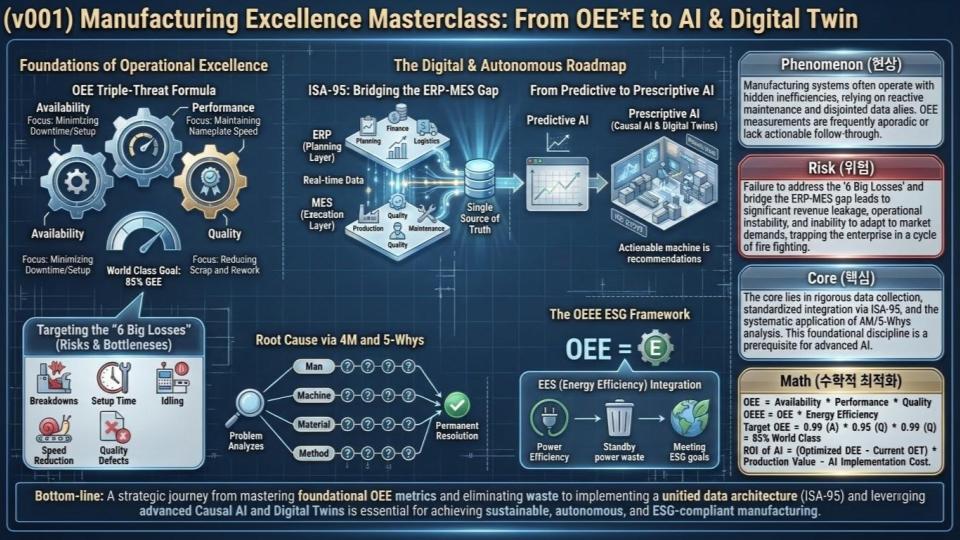
The following is a summary of this lecture in Infographic format.

https://tinyurl.com/2cpkjssf

  1. My published book, which served as the basis for this lecture, is attached at the very bottom of the curriculum. Please also refer to my introductory video.

  2. Audio files (URL) to help you understand this lecture are also attached.

Recommended for
these people

Who is this course right for?

  • They suffer from missing OEE improvement opportunities by failing to see the 'hidden factory' within current facilities, wasting tens of billions of won in massive capital on unnecessary new plant expansions (CAPEX).

  • Deceived by superficial utilization figures, we fail to see the reality of actual efficiency, and without precise data to address the six big losses and minor stoppages, we struggle in a never-ending cycle of daily overtime.

  • Communication between departments has been paralyzed due to the data disconnect between ERP and MES, leaving us trapped in a chaotic mess of conflict and inefficient decision-making caused by the absence of an ISA-95 standard architecture.

  • By sticking to methods that only repair equipment after it breaks down or replace perfectly functional parts prematurely, they are vainly missing out on the opportunity to reduce downtime by 40% through AI predictive maintenance (P-F interval).

Need to know before starting?

  • To identify the six major losses on-site and immediately apply SMED and TPM techniques to the process, a practical fundamental understanding of manufacturing processes and equipment operation is required.

  • For data-driven precision quality control, it is essential to possess basic statistical knowledge such as SPC and Process Capability Index (Cpk), along with a data analysis mindset rooted in quality engineering.

  • To resolve the data disconnection between management (ERP) and the shop floor (MES), it is necessary to clearly recognize the differences between the two systems and agree on the need to adopt the international standard ISA-95 architecture.

  • You must understand the latest DX technology trends, such as predictive maintenance and digital twins, to be able to digest a future roadmap for designing smart factory integrated management systems that go beyond simple site management.

Hello
This is khjyhy100

I am a retiree with over 40 years of experience (Jan 1984 – May 2024) working for major corporations and mid-sized enterprises in Korea.

I am a powertrain and propulsion systems engineer who served as an executive for 18 of my 40-year career, and held positions as Vice President and CEO at a mid-sized company during the final 5 years.

At Hyundai Motor Group, I achieved overseas technology transfer revenues (approximately 130 billion KRW, including mid-sized gasoline engines, turbochargers, AWD, etc.). I also have a history of conducting numerous government-funded R&D projects. Currently, I have begun writing with the aim of sharing the knowledge and experience gained throughout my career. I ask for the readers' great interest and encouragement.

  • Name: Hong-jip Kim

  • Publication Guide: https://khjyhy.upaper.kr/new

  • You can find more published books by searching for "Kim Hong-jip" in major domestic e-bookstores.

  • Education & Training: Completed KAIST AI Executive Program (Feb 2025 – Jun 2025)

  • Career 1: Hyundai Motor Group R&D (Hyundai Motor Company, Hyundai Wia Corp.: 1984~2018 

  • Career 2: INZI Controls Co., Ltd.: 2019–2024


  • Award 1: Korea's Top 100 Technologies and Leaders (Dec. 2010) (National Academy of Engineering of Korea, Ministry of Commerce, Industry and Energy)

  • Award 2: Presidential Award at the IR52 Jang Young-shil Awards (Development of medium-sized gasoline engines, Ministry of Commerce, Industry and Energy, 2005)


  • 13 papers published in domestic and international professional technical societies on powertrains and propulsion systems in the field of automotive engineering

  • Filed and disclosed numerous job-related invention patents

More

Curriculum

All

9 lectures ∙ (59min)

Course Materials:

Lecture resources
Published: 
Last updated: 

Reviews

Not enough reviews.
Please write a valuable review that helps everyone!

khjyhy100's other courses

Check out other courses by the instructor!

Similar courses

Explore other courses in the same field!

Limited time deal

$5.50

68%

$17.60