Hello, I am Jinman Lee.
Spring AI Multi-LLM Architecture and
Orchestration-centered Multi-Agent System
I am sharing news regarding an upgrade to the course.
Thank you for your interest.
We are pleased to introduce an advanced course on designing and implementing a Multi-LLM architecture that strategically combines GPT, Gemini, and LLaMA (local) based on Spring AI, along with an Orchestrated Multi-Agent system that connects Main/Sub, Tool, and Task.
The core topics covered in this course are as follows.
Expanding, stabilizing, and continuously improving quality through Agentic Workflows (Chain, Parallel, Routing, Orchestrator–Workers, Evaluator–Optimizer) rather than a single LLM call
Multi-LLM routing, fallback, and security branching for model selection and switching based on operations and regulations
Multi-Agent Orchestration — Weaving progress and state together using Agent Registry, Tool/RAG execution separation, Task Runtime, and HTTP·SSE·Redis
DAG workflow engine, YAML declarative DSL, and Validated DSL immediately after loading to integrate graph execution and reliability into a single flow
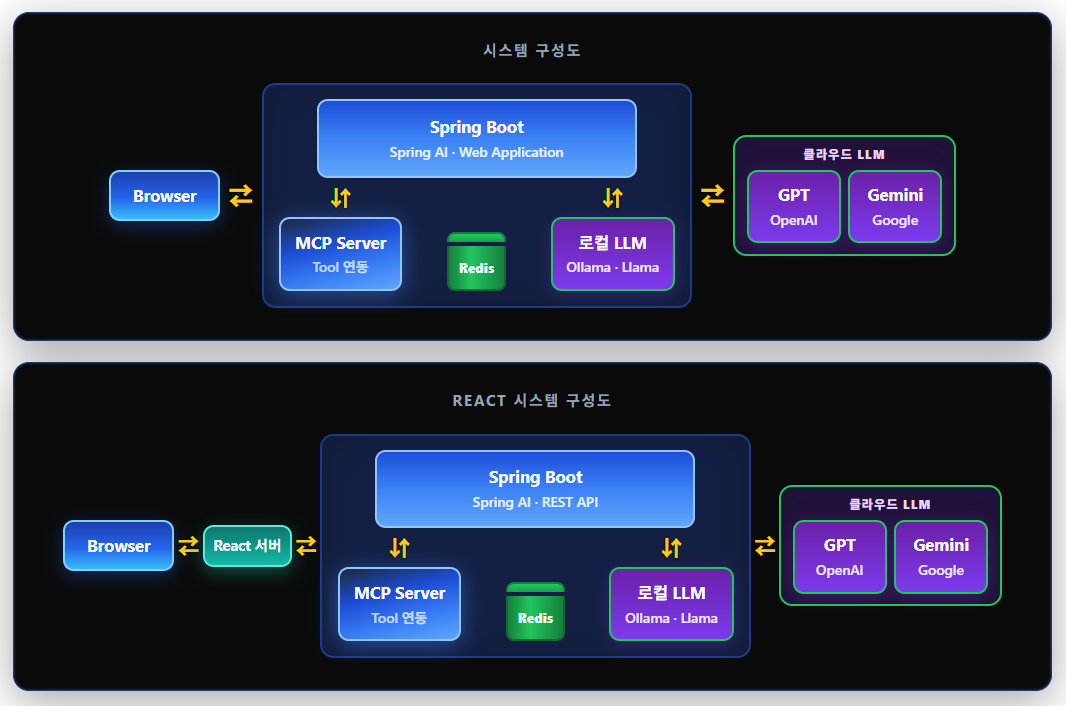
Optional Expansion: React·REST, MCP for UI/API Separation and Standard Tool Integration
Circuit Breaker, Reactive Stream, Redis monitoring, parallel, and iterative evaluation and other production-ready design perspectives
Recommended for the following people.
Backend and full-stack developers who want to go beyond just connecting APIs and design agents, workflows, and operations
Complex queries and automation pipelines to those preparing for architect or lead roles who need to structure and explain them to their teams.
After completing the course, we have structured it so that you can definitively gain an AI system design perspective, allowing you to discuss and document Multi-LLM, Orchestration, Tool, Task, DAG, Declaration, and Validation as a single execution architecture, rather than just a "single prompt."
Thank you.
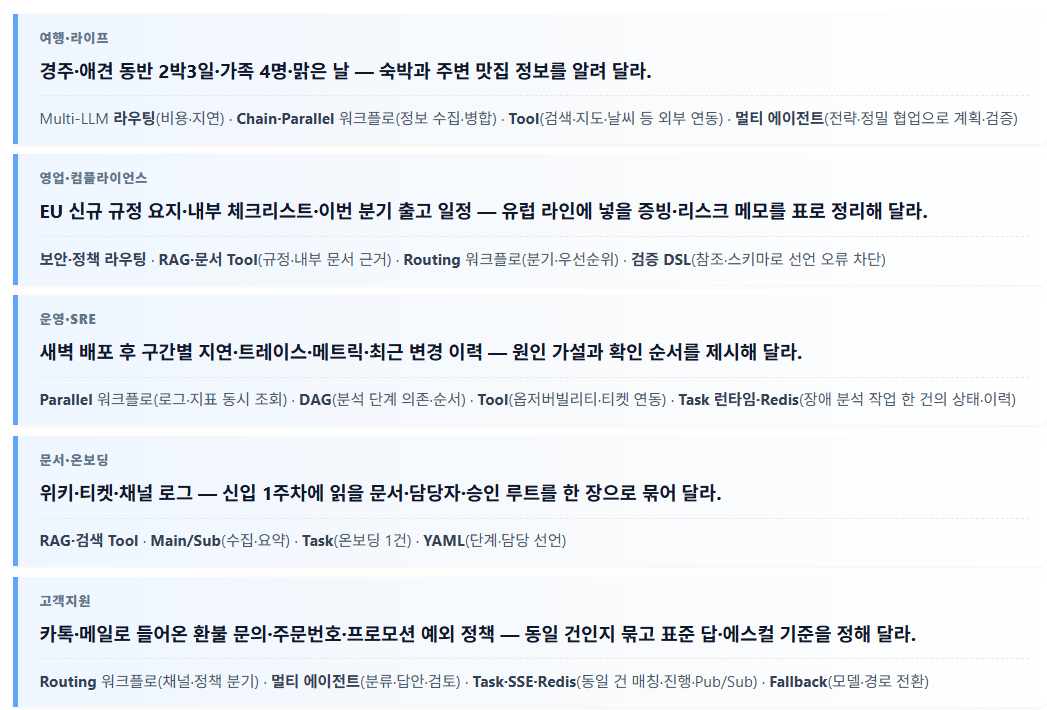
The system learned in this course allows you to build a system that handles complex tasks and decision-making like the following:
is the goal of this course.
The curriculum for this course is as follows.
1⃣ Building Spring AI Development Environment and Multi-LLM Environment in SpringBoot
2⃣Chapter 1. Multi-LLM Architecture (Multi-model and AI Architecture Design)
3⃣Chapter 2. Agentic Workflow Patterns (5 Agent Workflow Patterns)
4⃣Chapter 3. Orchestrated Multi-Agent Patterns (Implementation via Pipelines)
5⃣Chapter 4. Multi-Agent Architecture (Main Agent & SubAgent Separation Strategy)
6⃣Chapter 5. Tool-Orchestrated Multi-Agent (Separating Tool-based Execution Layers)
7⃣Chapter 6. Task-Orchestrated Multi-Agent(TaskTool Agent Runtime)
8⃣Chapter 7. DAG-Orchestrated Multi-Agent (DAG-based AI Workflow Design)
9⃣Chapter 8. Declarative Agent Workflow with YAML (YAML-based DAG)
🔟Chapter 9. Validated Agent Workflow DSL (DAG based on DSL Validation)
🅰Appendix A. React Front-End & REST API Server Integration
🅱 Appendix B. MCP Integration (Integrating Tool and Agent Runtime with MCP)
The system configuration for this course is as follows.