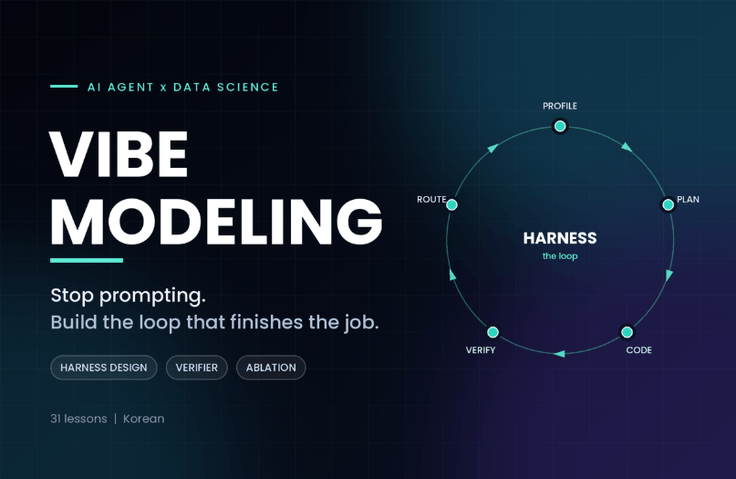
Vibe Modeling - How to make AI agents perform data analysis and modeling
If you ask an AI to "build a model with this data," the first few lines might look plausible, but as soon as things get slightly complex, it starts using the wrong columns, introduces data leakage, and results in a model that performs worse despite a higher score. This course does not teach you better prompts. Instead, it covers how to directly design a loop (harness) where an agent understands data, plans, writes code, validates its own results, and backtracks when wrong. After manually walking through the five-piece loop of DS-STAR, you will assemble components one by one, from data profile cards, hooks, and skill hierarchies to independent validators and ablation.
How to design a loop (harness) that ensures AI agents complete data analysis to the end
How to write data profile cards that prevent agents from misunderstanding data
How to turn rules into enforcement mechanisms rather than just documents using hooks and skill layers
You cannot verify your own code - Designing independent verifiers and judges
An iterative routine that actually boosts performance through ablation, ensemble, and leakage testing.
"Make a model with this data" — The reason why it doesn't end with just that one line
If you've ever tasked an AI with analysis, you'll know. The first few lines are surprisingly plausible. But as soon as things get a little complex —
· It sneakily uses columns that shouldn't be used
· Future information gets mixed into the training data (leakage)
· The metrics went up, but the actual model got worse
· They confidently present a wrong answer, saying, "It's all done."
This is not because the model is stupid. It's because you asked it to do everything at once.
■ This is not a course on prompting
I won't be giving you better prompts. Instead, we will design a loop that allows the agent to run on its own—a "harness." A five-piece loop that understands data first → makes a plan → writes code → verifies its own results → and goes back if it's wrong. After manually going through the very structure used by DS-STAR once, you will assemble it to fit your own work.
■ You will build things like this yourself
· Data Profile Card — The first step to ensuring agents do not misunderstand data
· Hook — A mechanism that enforces rules rather than just documenting them.
· Skill Hierarchy — Including everything is the same as including nothing. Ensure only what is necessary is activated.
· Experiment Ledger — A recording structure to avoid making the same mistake twice
· Independent Verifier and Judge — You cannot verify your own code
· Routers and failure exits — How to stop without falling into an infinite loop
· Ablation · Ensemble · Leakage Checker — The final stretch to actually boost performance
■ Why now
Models are already smart enough. These days, models even ask follow-up questions. The problem is that there is no one to answer them. A gap is widening between those who know what to ask the agent and what to verify, and those who do not.
Upon completing 31 lessons, you will walk away not with a slide deck, but with a single loop in your hands.
■ This course is not recommended for the following people
· If you have not yet experienced handling dataframes with pandas, it is better to take a basic course first
· This course is not suitable if you wish to learn the mathematical derivation of specific algorithms. It focuses on workflow structure rather than modeling theory.
· If you only need techniques for squeezing out Kaggle scores, I recommend other lectures.
■ Frequently Asked Questions
Q. Is Claude Code absolutely necessary?
A. No. The harness created in this lecture is a structure that is not dependent on specific tools. If you have used any other AI coding tools, including Cursor, you will be able to follow along without any issues.
Q. Is this a course aimed at reaching the top ranks of Kaggle?
A. No. This course is not about techniques for squeezing out every last point, but about building a structure that allows you to catch errors on your own when incorrect results occur. While it ultimately helps improve performance, the objective is different.
Q. Can this be applied to deep learning models as well?
A. The harness and validation loop operate independently of the model type. However, the hands-on exercises in this course are based on tabular data.
Q. Can this be used immediately with company data?
A. You can reuse it as is simply by changing the data profile cards and validator definitions to fit your company's data. It is designed with a structure that is independent of the dataset.
Q. Are class materials provided?
A. Yes, class materials are provided.
Recommended for these people
Who is this course right for?
A data analyst who asked AI for analysis but only received plausible-sounding wrong answers
A junior ML engineer whose performance no longer improves after the baseline.
Developers who are familiar with "vibe coding" but couldn't apply it to data and modeling tasks
MLOps and platform managers who need to design agent pipelines themselves
Need to know before starting?
Experience in handling data using Python syntax and pandas
Experience using AI coding tools like Claude Code or Cursor at least once

![[Soft Data] Learning Basic SQL with ExamplesCourse Thumbnail](https://cdn.inflearn.com/public/course-325916-cover/232a79c6-fc4a-4491-80c1-ffd0b33f0e87?w=420)





![[Suminjeongeum] Basic Mathematics for AI - An Introduction to Mathematics Starting from ConceptsCourse Thumbnail](https://cdn.inflearn.com/public/files/courses/342179/cover/01krw77g9yv13wy852v9na3fq1?w=420)


![[Side Project After Work] Big Data Analysis Certification Practical Exam (Type 1, 2, 3)Course Thumbnail](https://cdn.inflearn.com/public/courses/329972/cover/dcfb28fd-48c1-4bb1-ab31-d59eac874194/329972-original.png?w=420)