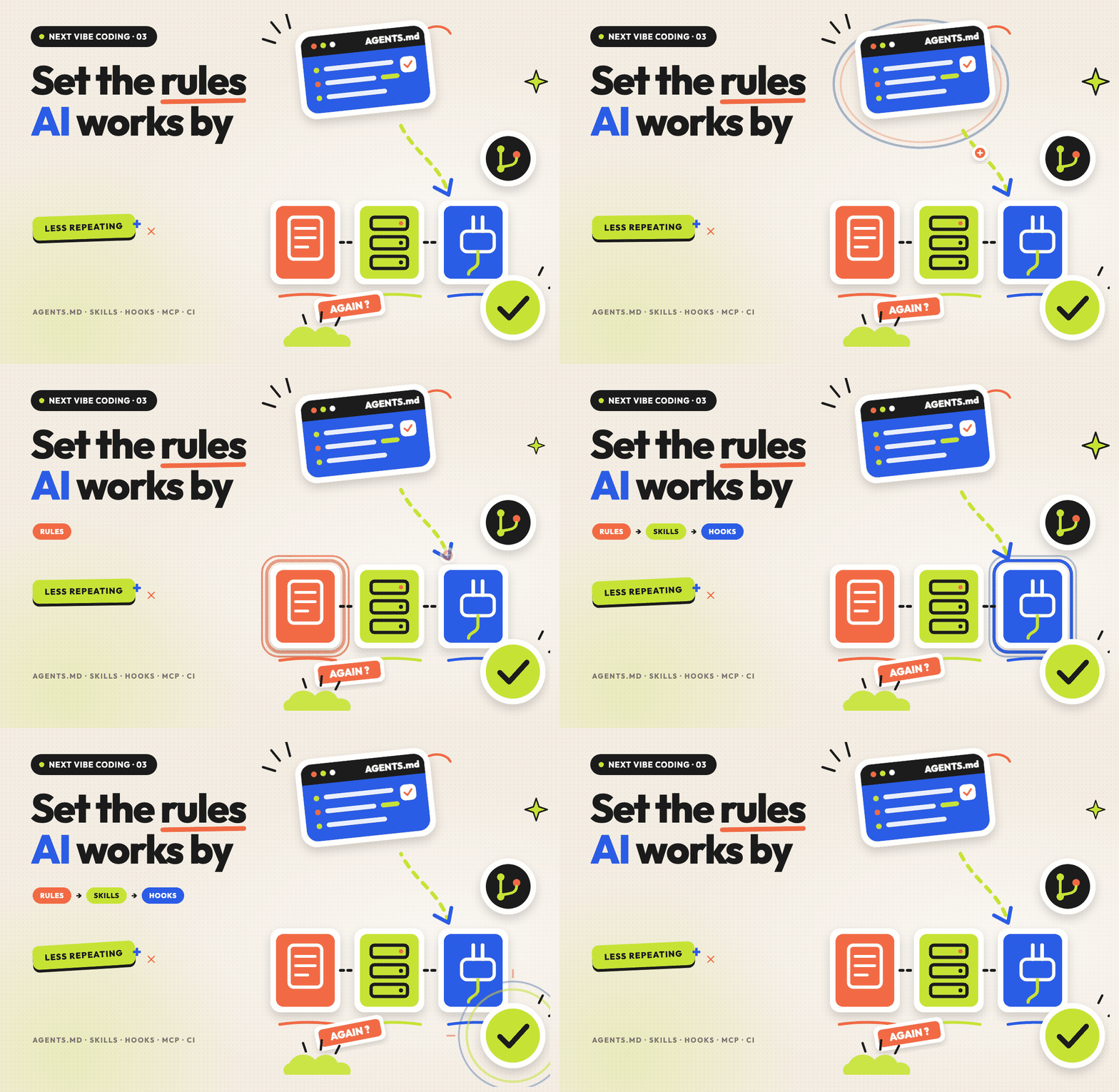
[Next Vibe Coding] Step 3: Build a Development System That Enables AI to Work Effectively with Instructions, Skills, Hooks, and MCP
“Please read the spec first and note anything that hasn’t been checked.” If you find yourself repeating the same explanation every time, it’s time to leave it in the project. This is a three-step course on connecting instructions, Skills, Hooks, and MCP to Claude Code and Codex, comfortably delegating repetitive tasks while ensuring people handle the important decisions.
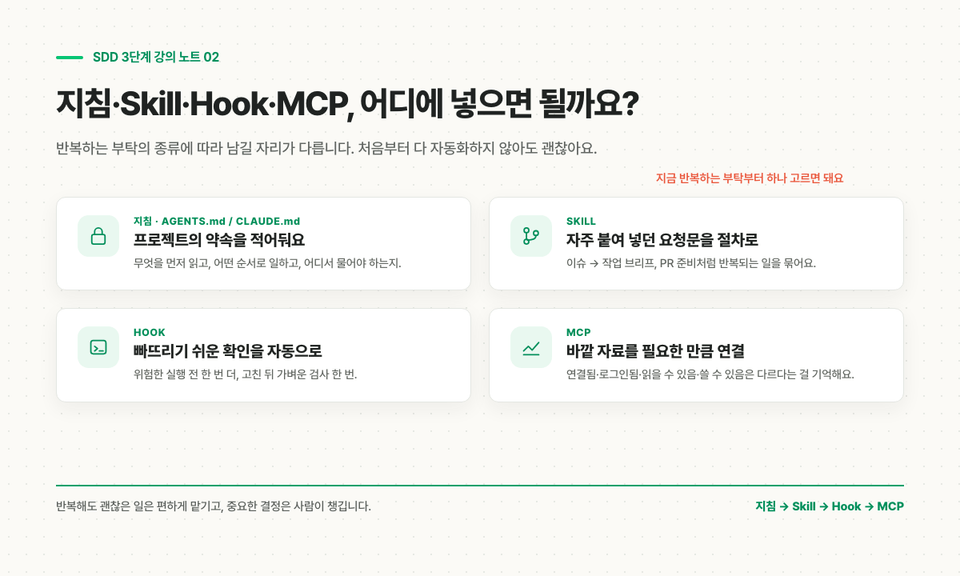
You can choose whether to leave the explanations you kept repeating in the instructions, Skill, Hook, or MCP.
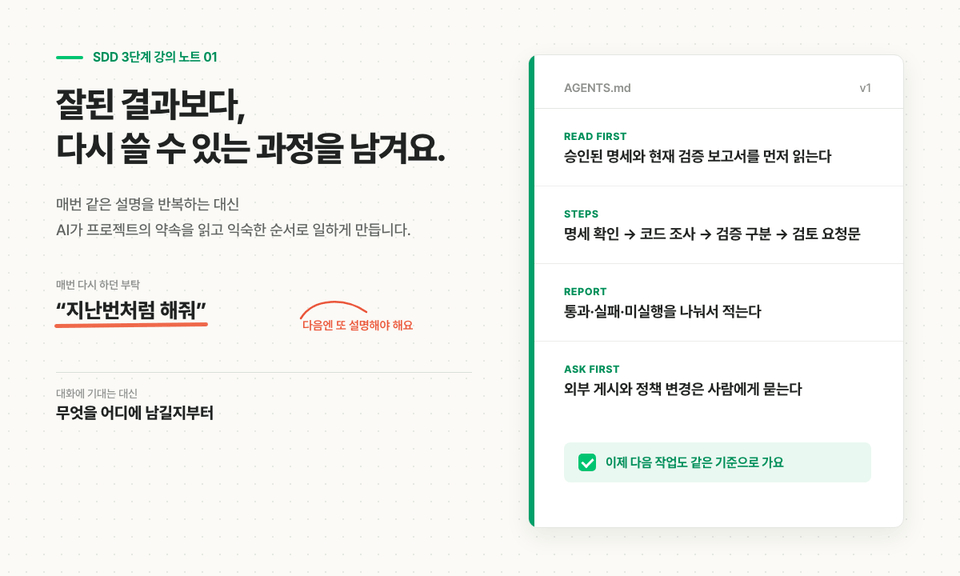
You can document the project's conventions, workflow, and points to ask about in AGENTS.md and CLAUDE.md.
You can bundle frequently performed tasks into Skills and set up Hooks for checks that are easy to overlook.
The Next Stage of Vibe Coding · Stage 3
[Next Vibe Coding] Step 3: A Development System That Helps AI Work Well
“Please read the specifications first. Write down anything you haven’t checked.” Aren’t you repeating this every time?
In Step 1, you decided what to build, and in Step 2, you checked whether it was built properly. But if you have to repeat the same requests from scratch every time the task changes, successfully completing something once and working by the same standards next time are two different matters.
This course isn’t about piling on a bunch of automation tools. It’s a three-step course on connecting instructions, Skills, Hooks, and MCP to Claude Code and Codex so you can comfortably delegate work that’s fine to repeat while keeping people in charge of important decisions.
Instead of copying successful results, leave behind a reusable process.
01 · Reframing the Problem
Passing along the entire previous conversation isn’t the answer.
Conversations contain not only the plans that were adopted, but also rejected suggestions, discussions that were temporarily put on hold due to the lack of a testing environment, and improvements that were deferred for later. Readers have to determine each time what is still valid. The same goes for AI.
It’s not because artificial intelligence (AI) has a poor memory. It’s because the agreements established by the team and what the AI did last time aren’t distinguished. Step 3 is a way to decide where and in what form to record those agreements.
Guidelines
What should you read first, what order should you work in, and where should you ask?
Skill
Which parts of the requests you paste every time can be grouped into procedures?
Hook
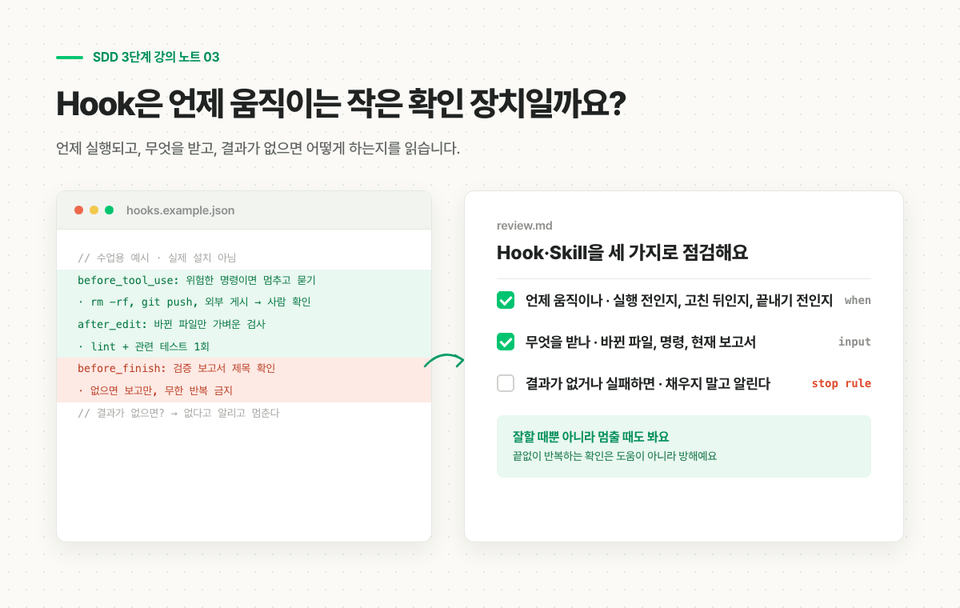
When do you perform the easy-to-miss checks, what do you receive, and how do you stop?
MCP
How much of the external material should we have it read, and what should we tell it not to follow?
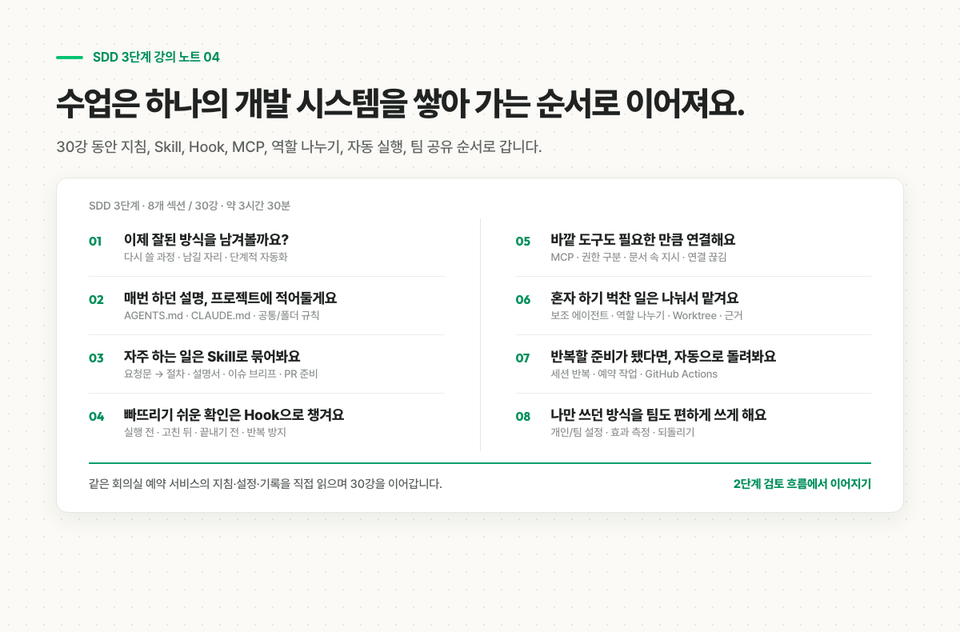
Once you can answer these four questions, the explanations you used to repeat become part of the project. The course works through these questions one by one in the following order: instructions, Skill, Hook, MCP, dividing roles, automation, and team sharing.
02 · From Instructions to Automated Execution
Add things one at a time, starting with what you need.
First, write down the project’s conventions.
Use AGENTS.md and CLAUDE.md so both tools read the same agreements, keeping shared rules at the top and folder-specific rules nearby. Leave product rules in the specifications and have the guide point only to their location. We also look at how to distinguish what the AI remembers from what the team has decided.
Then, turn frequently performed tasks into Skills and easy-to-miss checks into Hooks.
Try creating a Skill that turns issues into work briefs and a Skill for preparing PRs, and check not only when things are going well but also when to stop. Have the Hook take an extra look before risky execution, then add a lightweight check after making fixes, with conditions to prevent endless repetition.
Finally, connect, divide, and automate.
Have it directly read the necessary materials through MCP while distinguishing between being connected, logged in, able to read, and able to write, and divide the work among auxiliary agents and Worktrees. Compare session repetition, scheduled tasks, and GitHub Actions, separate personal settings from team conventions, and continue through how to measure the impact and roll back changes.
03 · One Continuous Example
Read the documentation and configuration of the same meeting room reservation service directly.
We continue with the meeting room reservation service from Steps 1 and 2 exactly as it is. Over 30 lessons, we use one continuous example to see how the request repeated while reviewing the booking cancellation task is translated into instructions, Skill, Hook settings, and execution logs.
There are no coding exercises or setup tasks to follow. We read the instruction files, work procedures, settings, commands, and execution results prepared by the instructor together. Even when scripts appear in the settings, we do not explain every bit of syntax; instead, we read when they are executed, what they check, and how much authority they are granted.
It continues directly from the review flow in Step 2.
The login check failures and unverified items carried over from Step 2 are brought forward as they are, without being marked as successful. The process of passing them on without hiding the unfinished parts is itself a reusable approach. Even if you haven’t taken Steps 1 and 2, you can follow along as long as the terms “specification” and “review report” aren’t unfamiliar.
Over the course of 30 lessons, we’ll proceed in this order.
We start with how to choose what to leave behind. After organizing the project guidelines, we group frequently performed tasks into Skills and use Hooks to handle checks at the necessary points. We connect external tools, divide up the work, and, once we're ready to repeat the process, run it automatically. Then, we wrap up the 30 lessons with methods for the team to use together and roll back changes.
04 · Check Before Enrolling
This is a good fit for people like these.
Those who repeat the same explanation every time they assign a task to AI
For those who want to understand what Claude Code and Codex instruction files, Skills, Hooks, and MCP each are.
Team leads and planners who want their team to use agents according to the same standards
For those who want to add automation while drawing the line at where human approval is needed
This isn’t a hands-on course where you simply follow along.
About 7 minutes per lesson, over 30 lessons in total, you’ll read through prepared instructions, settings, and execution logs to understand the role each plays. The course reflects information verified against official documentation as of September 2026 and focuses on decision-making criteria you can apply even when the tool’s interface changes.
I’ll answer only the questions you’re likely to have first.
Is it okay if I haven’t taken Steps 1 and 2?
That’s fine. If you’ve had experience defining specifications and reviewing results, you can start right away. When you encounter a situation where you need a case from an earlier step, we’ll briefly revisit it then and move on.
Do I need to write configuration files or scripts myself?
No. We’ll read through the prepared examples together. The focus is on understanding when they run, what they check, and how much access they’re granted. Knowing where to request the necessary technical review is also one of the goals.
Is it okay to listen at double speed?
I enhanced the instructor’s audio with AI to reduce noise and refine the pronunciation. I improved the sound quality and pronunciation so that the explanations remain clear even when listened to at 2x speed.
Recommended for these people
Who is this course right for?
Those who repeat the same explanation every time they assign a task to AI
For those who want to understand what Claude Code and Codex instruction files, Skills, Hooks, and MCP each are.
Team leads and planners who want their team to use agents according to the same standards
Need to know before starting?
It would be good if you have taken Steps 1 and 2, or have experience defining specifications and reviewing the results.
There are no coding exercises or installation assignments. We’ll read through the configuration files and execution logs together using the prepared examples.
I am Haeyeo, someone who explores the infinite possibilities of AI and computer science and wishes to share that journey with all of you.
During my undergraduate years, my passion for my major was so intense that I was nicknamed a 'Computer Science Addict.' I graduated at the top of my class with a major GPA of over 4.4. I then earned my Master's degree in AI from Seoul National University and further deepened my expertise through a doctoral program.
However, as I felt as much of a fascination for solving real-world problems with AI as I did for theoretical exploration, I took a break from my doctoral studies to gain valuable hands-on experience by working on AI-based LLM and video analysis projects at a startup.
Currently, I am working as an LLM project developer and PM at one of the top three conglomerates in Korea, contributing to creating positive changes that AI technology will bring to our lives. I will generously share with you the challenges I faced, the problem-solving processes I went through, and the vivid know-how I gained in the field. I will be your reliable guide on this journey into the exciting world of AI.










![[Practical AIoT] Perfect Preparation for Smart Mirror Makerthon: LLM, CV, and Hardware DesignCourse Thumbnail](https://cdn.inflearn.com/public/files/courses/340196/cover/01kexgfr26whtfsmsqd2dj1x7x?w=420)
![[4-Week Completion] Clean Architecture with AI for Senior Developer AdvancementCourse Thumbnail](https://cdn.inflearn.com/public/files/courses/339355/cover/01k8ags08xj5tpgyrpv77hkj21?w=420)

![[Done in a single word!] How to create your own monetized website with AICourse Thumbnail](https://cdn.inflearn.com/public/files/courses/336091/cover/01jxykkyatyya1dnv22ctkvtwe?w=420)
![[CLI, MCP] An Idle Unity Game Made with AICourse Thumbnail](https://cdn.inflearn.com/public/files/courses/343716/cover/01kzre6epavjnb1gk13svtewvq?w=420)
![[Inflearn Award Bestseller] How to Become an AI Automation Expert Without Coding, The Complete n8n GuideCourse Thumbnail](https://cdn.inflearn.com/public/files/courses/337053/cover/01jrkjt8emye2z7j7846br3vkk?w=420)