





Learn Blender 3D by Following Along
codemod
Follow along and create things to get familiar with Blender and enjoy it. Upgrade your Blender skills step by step through short examples.
Basic
Blender, 3d-modelling
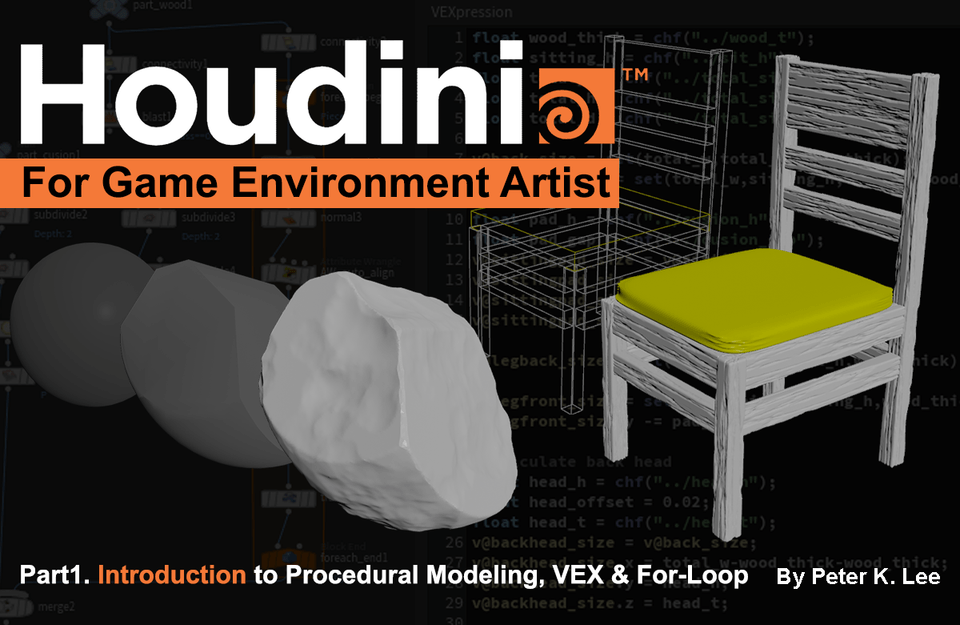
For background modelers who found Houdini daunting, this is a structure-focused introductory lecture created directly by a practitioner.
42 learners
Level Basic
Course period 3 months
Reviews from Early Learners
5.0
Eunpyoung Kim
It's a simple object, so it's great to follow along. I hope a more detailed part 2 comes out soon.
5.0
박예정
This is a really good course, I recommend it!
5.0
ice
What impressed me was how you explained difficult Houdini concepts in an easy-to-understand way. I think this is a great lecture for beginners!!
How to procedurally design and create background modeling using Houdini
Practice creating practical objects (stones, chairs, etc.) often used.
Learn all processes from structural design to Houdini implementation
Beyond Node Combination, Procedural Thinking and Practical Process
Practical application of mathematical concepts dealing with form (Vector, Random, Repetition)
We will teach you step-by-step through practical exercises using frequently used background objects in games, such as stones and chairs, as examples.
I'll make it slowly so that you can follow along, and we'll figure out together "why it's made this way" and "what nodes are used to solve problems."
Before starting modeling, we will conceptualize the structure and cover procedural 3d-modeling using VEX and loops.
It's structured around short, concise, hands-on examples.
Not just using simple tools,
First, think about “what to make” and “how to make it.”
Based on the concept,
In background modeling, only essential nodes are selected and explained, and only the basic parts are structured in a simple manner.
Based on a simple structure, we add details and convert it into a reusable form, a Houdini Digital Asset (HDA for short).
Now that you've finished modeling, it's time to put it into the game engine! We'll talk about things to watch out for when exporting from Houdini.
Learn Houdini's dotted lines and surfaces in a few easy steps, and use various nodes to trim edges and add details.
Learn how to use the basic For Loop.
By using random seeds, you can create HDAs and create variations.
Using simple math, we create blockouts and then create chairs based on those blockouts. Using VEX, we do the calculations so that when you change the values, the shape of the chair changes.
Create an automatic UV tool that automatically flattens UVs using a few nodes.
✅ Practical structure that learns through practice
→ Learn concepts while creating finished products and apply them directly to practice.
✅ Explained in the language of modelers
→ It is structured around problem solving that modelers actually experience, not TAs or effects artists.
✅ A structured approach based on practice
→ Learn practical, application-oriented processes such as iterative structural design and reuse of small elements.
✅ Complex concepts explained step by step
→ Without omission, we explain VEX and mathematical concepts intuitively and specifically so that even beginners can understand .
Why should we learn Houdini?
Section 0: Why? Houdini?
Section 1: Why is it so hard for us to learn Houdini?
Section 2: Labeling, Material Graph Basics
Section 3: Laying the foundations - 3D isn't just points, lines, and planes?
Section 4: Designing a Pebble
Section 5: Pebbles 1 - Shaping the Basics
Section 6: Pebbles 2 - Detailing, HDA fabrication.
Section 7: Pebble 3 - Using For Loop to carve pebbles.
Section 8: Pebble 4 - UV layout, collider settings.
Section 9: Finishing the Pebbles
Stone making process shots
Here are some shots of the chair-making process.
Section 10: Designing a Chair
Section 11: Chair 1 - Shaping the Basics
Section 12: Chair 2 - Basic Shapes 2 and VEX Utilization
Section 13: Chair 3 - Basic Shapes 3 and HDA
Section 14: Chair 4 - Inserting the Bevel,
Section 15: Chair 5 - Adding UV to Bevel
Section 16: Chair 6 - Adding Details, and For Each
It makes you think structurally.
Rather than blindly following it, you will actually understand 'why it is made this way' .
You will develop the ability to think , “I can make this with Houdini.”
Operating System and Version (OS): WINDOW,
Software version: Minimum Houdini 19.0 / Recommended Houdini 20.5
PC specifications: Intel or AMD x64 CPU with SSE 4.2 or higher, 16GB+ RAM, 5.0GB hard drive, GL 4.0 or higher graphics card with 12GB or more VRAM, latest graphics driver must be installed.
6 hours of footage
Presentation file
Final Houdini working files (hiplc, hdalc)
Basic workflow for background modeling
Basic 3D concepts of points, lines, and planes
Who is this course right for?
Background modeler: Knows nodes, practical use unclear.
Repeatedly creating similar assets, a practitioner who desperately needs an efficient method
A modeler who wanted to learn Houdini but felt VEX or loops were a barrier
Background modeler who needs to quickly create a large quantity of background objects in a small team
Practitioner seeking next-level modeling thinking
Need to know before starting?
Knowing just the basic concepts of 3D modeling like points, lines, and faces is enough.
You can follow along much more easily if you have experience with background modeling.
Don't fear math. I intuitively explain only the necessary parts.
42
Learners
7
Reviews
3
Answers
5.0
Rating
1
Course
I'm Peter Gyuyoung, a background artist with 12 years of experience.
I participated in the production of Diablo 4, WoW, and Warcraft Rumble while working at Blizzard,
and also experienced a new project at Riot Games.
In 2023, I released the indie game
In 2013, I won the Grand Prize in the 3D Environment category at the Unearthly Challenge,
and have speaking experience at NDC in 2018 and Unreal Summit in 2022.
I'm currently serving as the Environment Team Lead at StudioSai, a Seattle-based startup.
All
22 lectures ∙ (6hr 44min)
Course Materials:
All
7 reviews
5.0
7 reviews
Reviews 3
∙
Average Rating 4.0
5
It's a simple object, so it's great to follow along. I hope a more detailed part 2 comes out soon.
Wow, you're the first person to complete 100% of the course. Thank you!
Reviews 1
∙
Average Rating 5.0
5
What impressed me was how you explained difficult Houdini concepts in an easy-to-understand way. I think this is a great lecture for beginners!!
Thank you, ice!
Reviews 1
∙
Average Rating 5.0
Reviews 2
∙
Average Rating 5.0
5
The explanation of what nodes you place and with what intention was good. Although there are other lectures to some extent, from a background artist's perspective, it seems like this is something you can only hear/learn here.
Thank you, Seungwon!
Reviews 5
∙
Average Rating 5.0
Explore other courses in the same field!