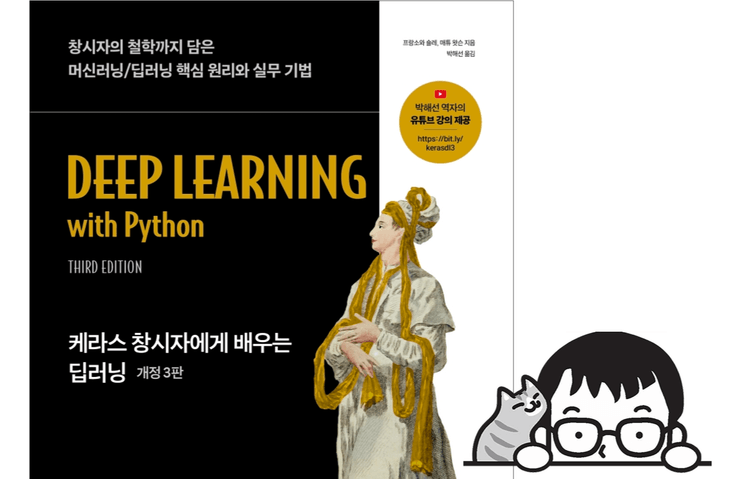
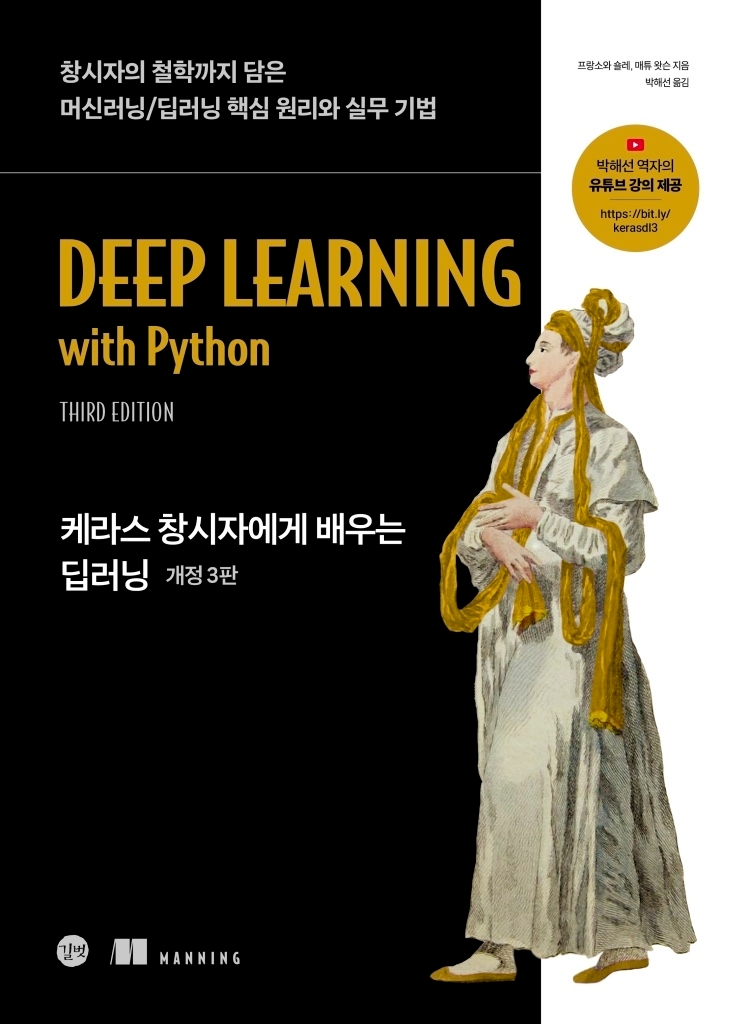
Explanation of the Example Code in <Deep Learning with Python, 3rd Edition, by the Creator of Keras>
This is a hands-on deep learning course where you learn by directly practicing the GitHub example code from *Deep Learning with Python, Third Edition* by François Chollet, the creator of Keras. You will implement everything step by step, from basic artificial neural networks to the latest LLMs and diffusion models, while learning machine learning pipelines and best practices that can be applied directly in real-world projects.
Implement everything from basic neural networks to LLMs and diffusion models directly in Keras
Practical Machine Learning Pipeline Design and Best Practices Application
Master the principles and practical application techniques of the latest deep learning architectures
This course explains the GitHub examples from <Deep Learning with Python, Third Edition> by the creator of Keras.
You can take this course for free if you join the <Deep Learning with Python, Third Edition> Complete Reading Challenge (https://inf.run/DPba3)!
Book Introduction
This book was written for anyone who wants to learn deep learning from the ground up or broaden their understanding. Whether you are a machine learning practitioner, software engineer, or college student, you will find something to learn in this book. We will explore deep learning by starting simply and gradually moving on to the latest techniques. This book strikes a balance between intuition, theory, and practice. Rather than using mathematical notation, it explains the core ideas of deep learning through discussions of fundamental principles and practical code. You will train machine learning models from scratch for problems in various domains and learn practical recommendations for building and deploying deep learning models in production. After reading this book, you will have a solid understanding of what deep learning is, when to apply it, and what its limitations are. You will become familiar with the standard workflow for framing and solving machine learning problems and learn how to address issues you are likely to encounter frequently.
Target Audience
This book is for Python programmers who want to get started with machine learning and deep learning. It will also be quite useful to other readers. ∙ If you are a data scientist familiar with machine learning, you will be able to grow the fastest and gain a solid, practical introduction to deep learning, the most exciting subfield of machine learning. ∙ If you are a deep learning researcher or engineer looking to start learning the Keras framework, this book will be an ideal intensive Keras course. ∙ If you are a graduate student studying deep learning with a theoretical background, you will learn its practical aspects, develop an intuition for deep neural networks, and become familiar with key best practices. Even if you do not code, if you have an understanding of technology, this book will help you learn the basic and advanced concepts of deep learning. You should be familiar with Python to understand the code examples. It is fine if you have no prior experience with machine learning or deep learning. This book covers all the fundamentals you need. You do not need any knowledge of mathematics either. High school-level math is sufficient to read this book.
Recommendations
Anthony Goldbloom (Founder of Kaggle)
“A perfect book for anyone who wants to learn directly from a master of the industry.”
“An insightful and practical guide that starts with the basic principles and teaches you how to think about building models that actually work.”
Aran Komatsuzaki (EleutherAI researcher)
“It is the most up-to-date and comprehensive guide among the deep learning books available today!”
Salvatore Sanfilippo (creator of Redis)
“It conveys the true essence of neural networks exceptionally well. It is an outstanding technical book, rare to see in recent years.”
Martin Görner (Google)
“Chollet is an excellent educator. He explains complex concepts clearly and uses practical code instead of mathematics. He is also an accomplished machine learning researcher. It is a pleasure to read his insights into various model architectures and training tips.”
Sayak Paul (Carted)
“Dive into this engaging introduction, which includes many practical examples in the field of deep learning. It is a must-read for every deep learning practitioner.”
Edmon Begoli (Oak Ridge National Laboratory)
“A modern classic has gotten even better.”
Yiannis Paraskevopoulos (University of West Attica)
“It’s the true bible of deep learning.”
Raushan Jha (Microsoft)
“It is the best book on deep learning with Python.”
Viton Vitanis (Viseca Payment Services)
“A book full of insights. It is useful for both beginners and experienced machine learning professionals.”
Todd Cook (Appen)
“It perfectly explains deep learning from A to Z.” Purchase the book
Although I majored in mechanical engineering, I have worked continuously reading and writing code since graduating. I am a Google AI/Cloud GDE. I run the TensorFlow blog (tensorflow.blog) and explore the fascinating boundary between software and science by writing and translating books about machine learning and deep learning.
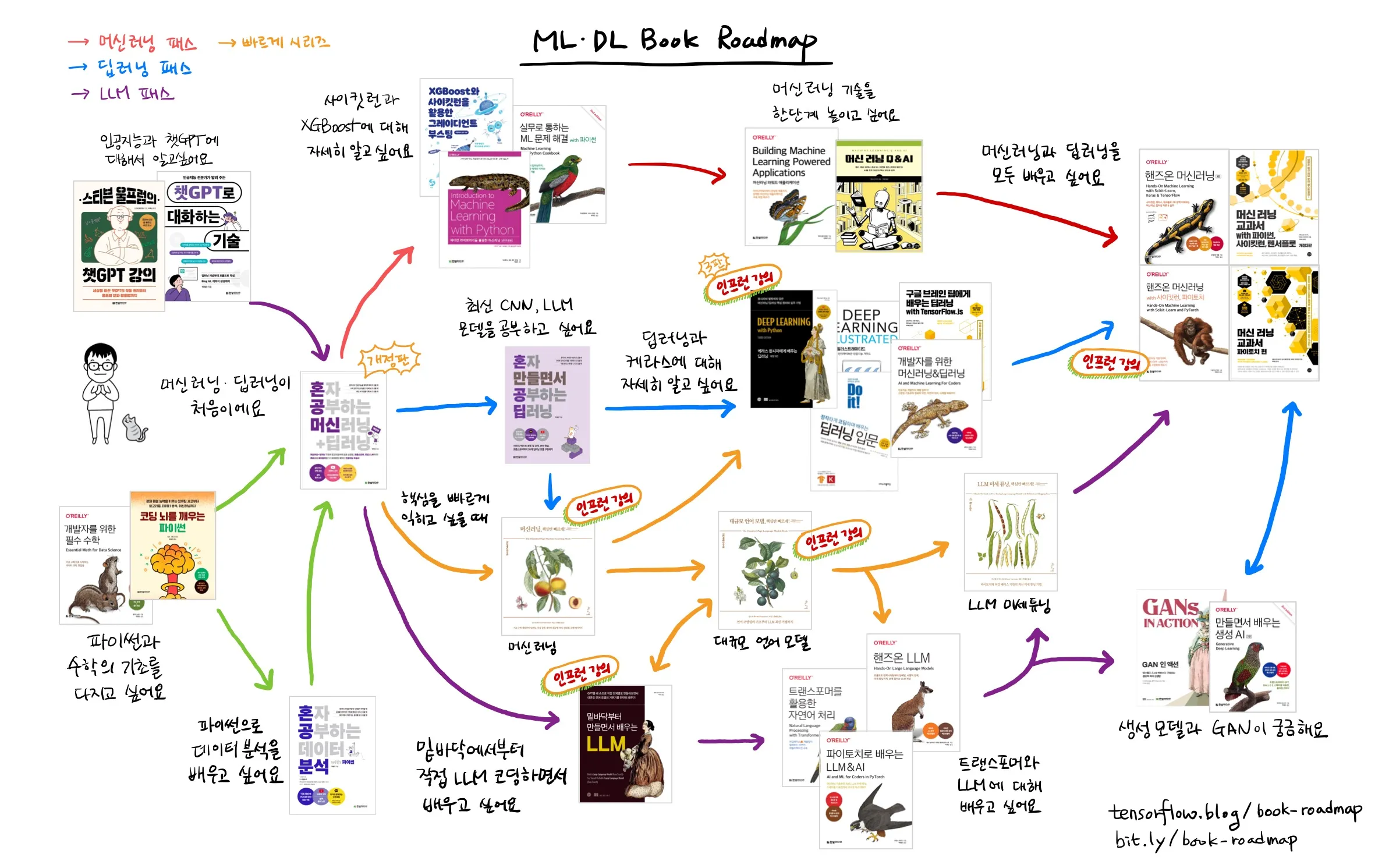
I have written 『Deep Learning You Study by Building It Yourself』 (Hanbit Media, 2025), 『Self-Study Machine Learning + Deep Learning (Revised Edition)』 (Hanbit Media, 2025), 『Self-Study Data Analysis with Python』 (Hanbit Media, 2023), 『The Art of Conversing with ChatGPT』 (Hanbit Media, 2023), and 『Do it! Introduction to Deep Learning』 (Aegis Publishing, 2019).
『Hands-On Machine Learning with Scikit-Learn and PyTorch』(Hanbit Media, 2026), 『Deep Learning from the Keras Creator (3rd Edition)』(Gilbut, 2026),『LLM Fine-Tuning, Fast and Focused!』(Insight, 2026), 『LLM & AI with PyTorch』(Hanbit Media, 2026), 『Large Language Models, Fast and Focused!』(Insight, 2025), 『Machine Learning, Fast and Focused!』(Insight, 2025), 『Learn LLMs by Building from Scratch』(Gilbut, 2025), 『Hands-On LLM』(Hanbit Media, 2025), 『Machine Learning Q & AI』(Gilbut, 2025), 『Mathematics for Developers』(Hanbit Media, 2024), 『Practical ML Problem Solving with Python』(Hanbit Media, 2024), 『Machine Learning Textbook: PyTorch Edition』(Gilbut, 2023), 『Stephen Wolfram's ChatGPT Course』(Hanbit Media, 2023), 『Hands-On Machine Learning, 3rd Edition』(Hanbit Media, 2023), 『Generative Deep Learning by Building, 2nd Edition』(Hanbit Media, 2023), 『Python That Awakens Your Coding Brain』(Hanbit Media, 2023), 『Natural Language Processing with Transformers』(Hanbit Media, 2022), 『Deep Learning from the Keras Creator, 2nd Edition』(Gilbut, 2022), 『Machine Learning&Deep Learning for Developers』(Hanbit Media, 2022), 『Gradient Boosting with XGBoost and Scikit-Learn』(Hanbit Media, 2022), 『Learn Deep Learning with the Google Brain Team with TensorFlow.js』(Gilbut, 2022), and 『Machine Learning with Python Machine Learning Libraries (2nd Revised Edition)』(Hanbit Media, 2022), among several dozen books translated into Korean.










![[Mobile] Deep Learning Computer Vision Practical ProjectCourse Thumbnail](https://cdn.inflearn.com/public/courses/324985/course_cover/6bedded2-1f32-4d11-be03-6e5bf5a3b488/sjh-mobile-cv.png?w=420)
![[PyTorch] Learn NLP easily and quicklyCourse Thumbnail](https://cdn.inflearn.com/public/courses/325056/course_cover/b66025dd-43f5-4a96-8627-202b9ba9e038/pytorch-nlp-eng.png?w=420)
![[Practical AIoT] Perfect Preparation for Smart Mirror Makerthon: LLM, CV, and Hardware DesignCourse Thumbnail](https://cdn.inflearn.com/public/files/courses/340196/cover/01kexgfr26whtfsmsqd2dj1x7x?w=420)
![[OpenCV] Python Deep Learning Image Processing Project - Find Son Heung-min!Course Thumbnail](https://cdn.inflearn.com/public/courses/324508/course_cover/067408c8-819a-4a84-bd51-0ffb20a4ec3d/sjh_opencv.png?w=420)
![[7-Day Complete] Pass MS AI-900 Certification in One GoCourse Thumbnail](https://cdn.inflearn.com/public/files/courses/338854/cover/01k4caartf5v7x2e574pq0wnp8?w=420)
![Experience the AI Singularity Right Now [Text To Image]Course Thumbnail](https://cdn.inflearn.com/public/courses/329683/cover/610fa6ca-6210-4561-99dd-94dc09dac0af/329683-eng.png?w=420)
![[Tensorflow2] Complete conquest of Python machine learning - Marathon record prediction projectCourse Thumbnail](https://cdn.inflearn.com/public/courses/324207/course_cover/1a79c7dc-1624-4d3a-95ff-79ba1e9c4025/python_machine_learning.png?w=420)