




inflearn logo

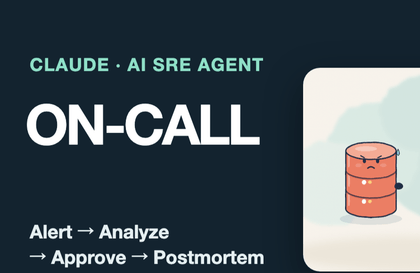
Detecting and Fixing Backend Failures and Signs of Hacking with AI Agents

A hands-on exercise in responding to backend outages and hacks, carried out end to end on my PC—from alerts and AI root-cause analysis to Claude’s fix PR, human review, deployment, and monitoring.

1 learners are taking this course

Level Basic

Course period Unlimited

claude
claude
Spring Boot
Spring Boot
AI Agent
AI Agent
secure-coding
secure-coding
Docker
Docker
claude
claude
Spring Boot
Spring Boot
AI Agent
AI Agent
secure-coding
secure-coding
Docker
Docker

What you will gain after the course

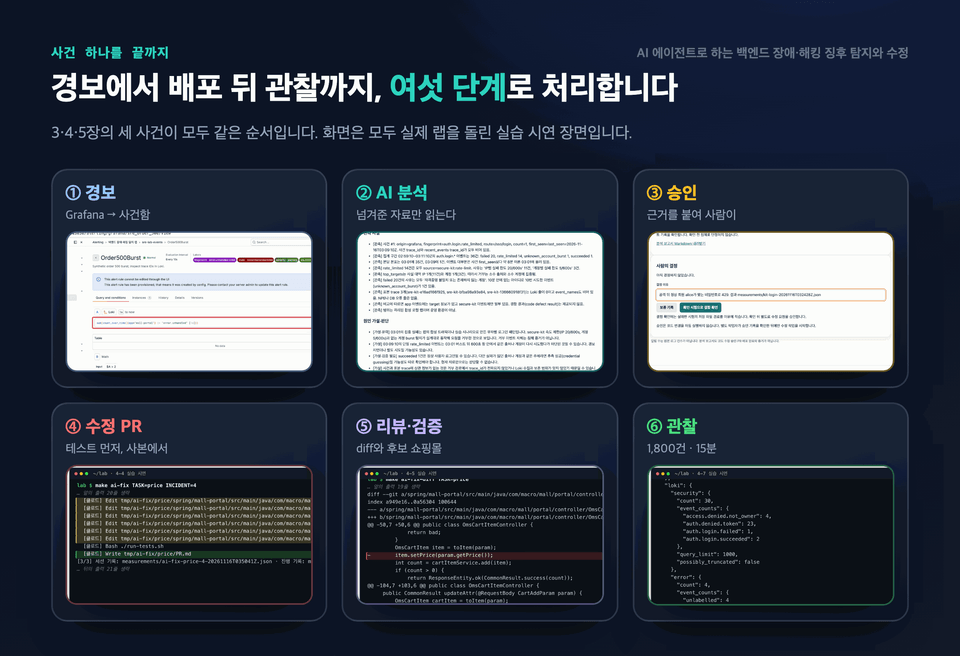
  • The sequence for handling an incident from alerting through post-deployment monitoring

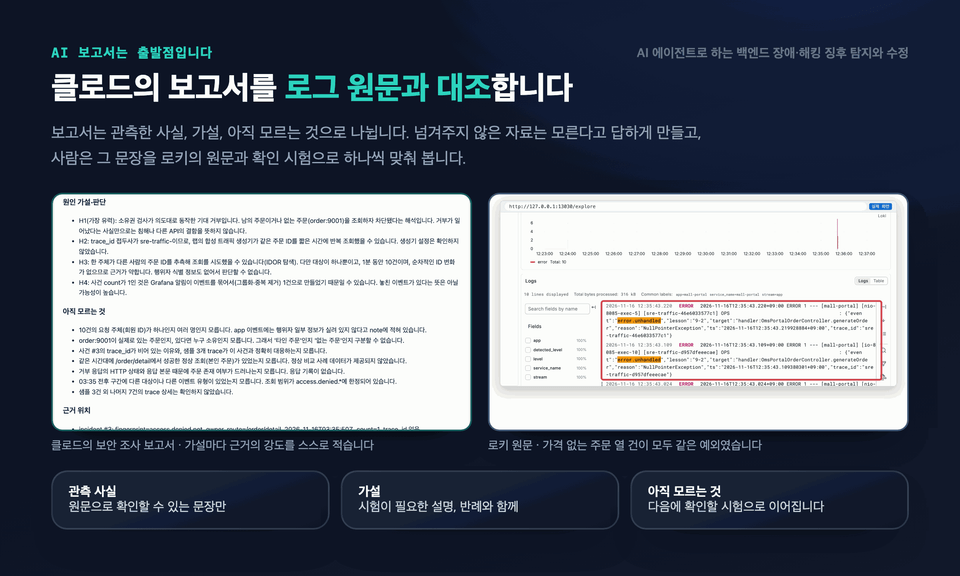
  • How to Verify an AI-Written Root Cause Analysis Report Against Original Logs and Test Results

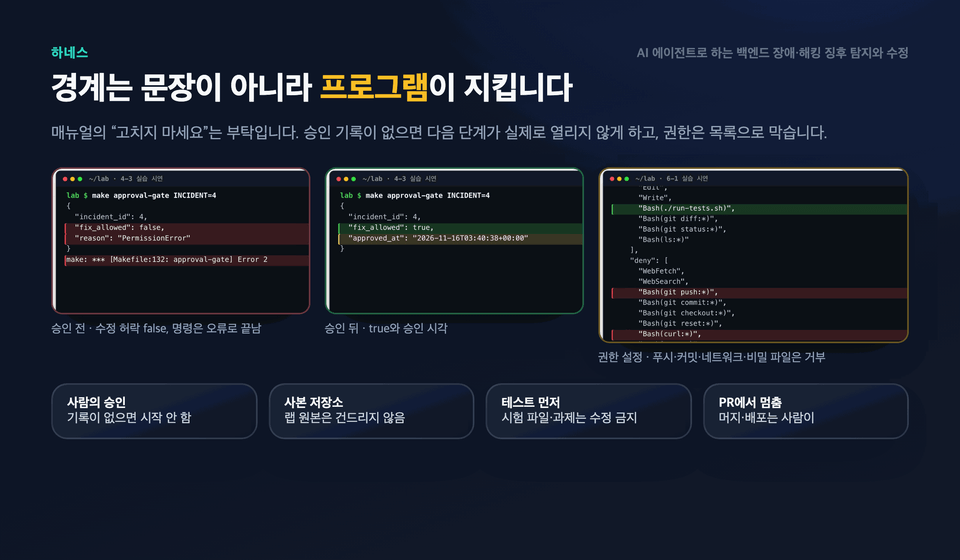
  • A harness for delegating code changes to Claude Code: approval checks, a copy of the repository, permission allow/deny lists, tests first, stop at the PR stage

  • A checklist for reviewing AI-generated PRs, validating candidates, and deployment, monitoring, and rollback procedures

  • The ability to read logs using trace IDs and security events and create Grafana alert rules

  • Experience validating the impact on legitimate users after adding security components through hypotheses, testing, and statistical analysis, then adjusting the settings.

  • How to evaluate rules using the number of unique targets and shadow mode without assuming rejection logs are attacks

  • How to design the system so that falling for instructions in logs (prompt injection) doesn’t cause harm

  • Draft Permission Settings and Rollout Stages for Introducing AI Agents to Our Team

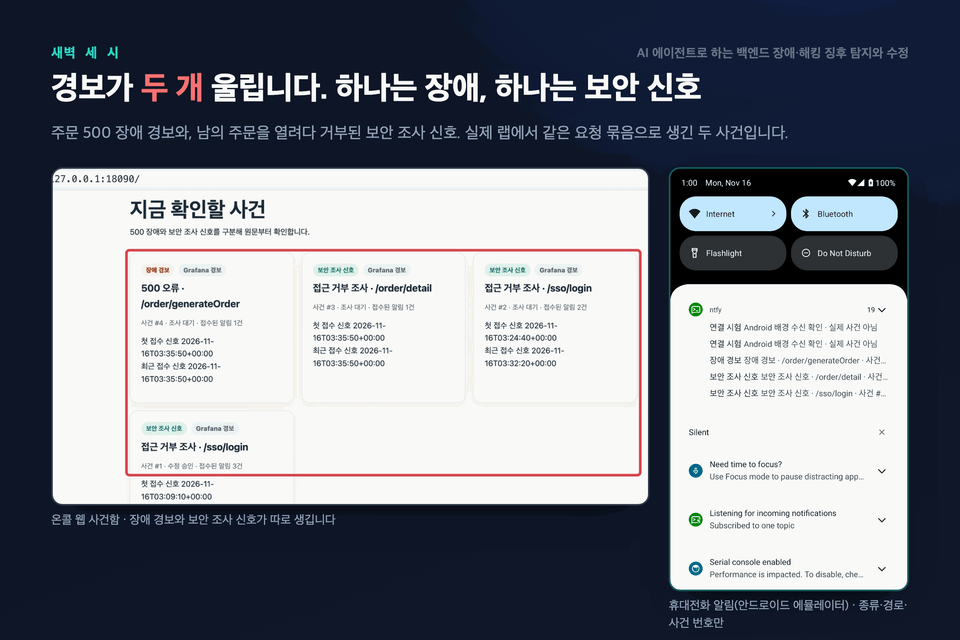
At three in the morning, two alarms go off.


One is a 500 error on the order service, and the other is a security alert triggered when someone tried to access another person’s order and was denied.

These days, you can hand logs to AI and quickly get a root cause analysis report. It may even fix the code and submit a PR. But questions remain.

  • Is that report accurate?

  • Can you merge that PR as is?

  • Did fixing it really stop it?

This course answers these three questions through hands-on labs.


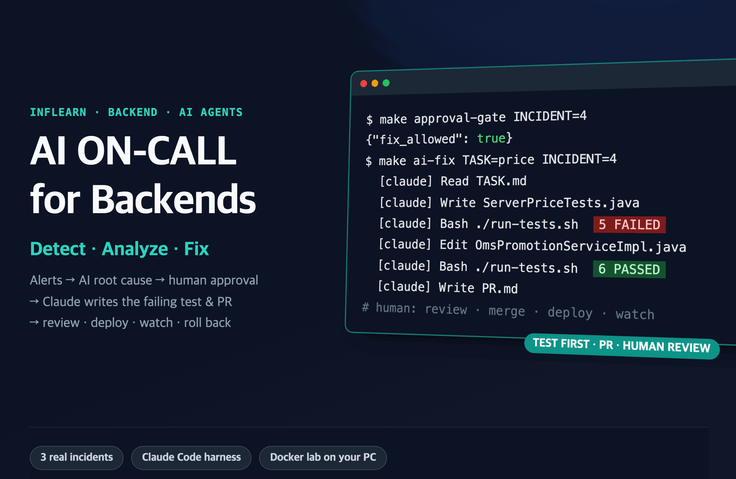
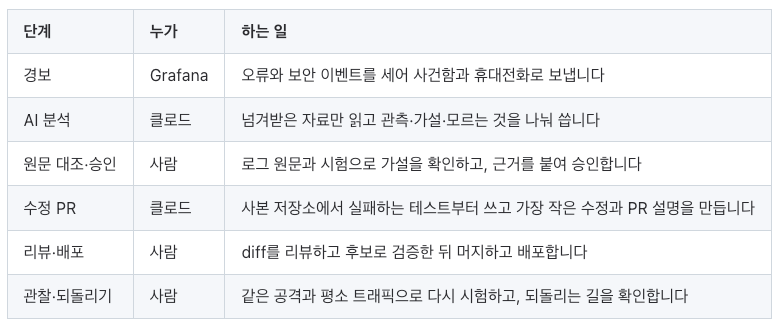
We handle three incidents in a demo shopping mall from alert to post-deployment monitoring. Grafana alerts arrive in the on-call web incident inbox and on a mobile phone. Claude reads only the materials handed over to it and writes a report. Once a person verifies it against the original sources and tests and approves it, Claude starts by writing a failing test in an isolated copy and creates a fix PR. People handle review, merging, deployment, monitoring, and rollback.

Three incidents in this course

  1. Login abuse · Blocking it with the security component secure-kit also blocked legitimate members behind the same IP. → A rate-limit adjustment PR and an alert for attempts across multiple accounts

  2. Order 500 · An order with no price returns a 500, while a tampered price of 1 won is charged as-is. → PR to fix server-side pricing, 6 tests, 15-minute monitoring

  3. Returning someone else’s order · Order lookups are blocked, but returns can still be submitted for someone else’s order. → Ownership fix PR

Compare the AI report with the original text.

Only approved cases proceed to the modification stage. Claude reads the assignment files and writes tests first to confirm they fail, then makes the smallest change, confirms they pass again, writes a PR description, and stops. A good PR doesn’t just say what was changed; it also explains the risks created by the change.

The program—not the prompt—enforces the boundary.

  • The editing stage won’t open without a record of human approval.

  • Claude makes changes only in a copied repository, not the original lab repository.

  • The tools that can be used are controlled by an allowlist, while push, commit, network access, Docker, and reading secret files are blocked by a denylist.

  • Test scripts, assignment descriptions, and permission settings cannot be changed. This prevents people from cheating by modifying the tests to make them pass.

  • Commit, merge, and deployment are done by people.

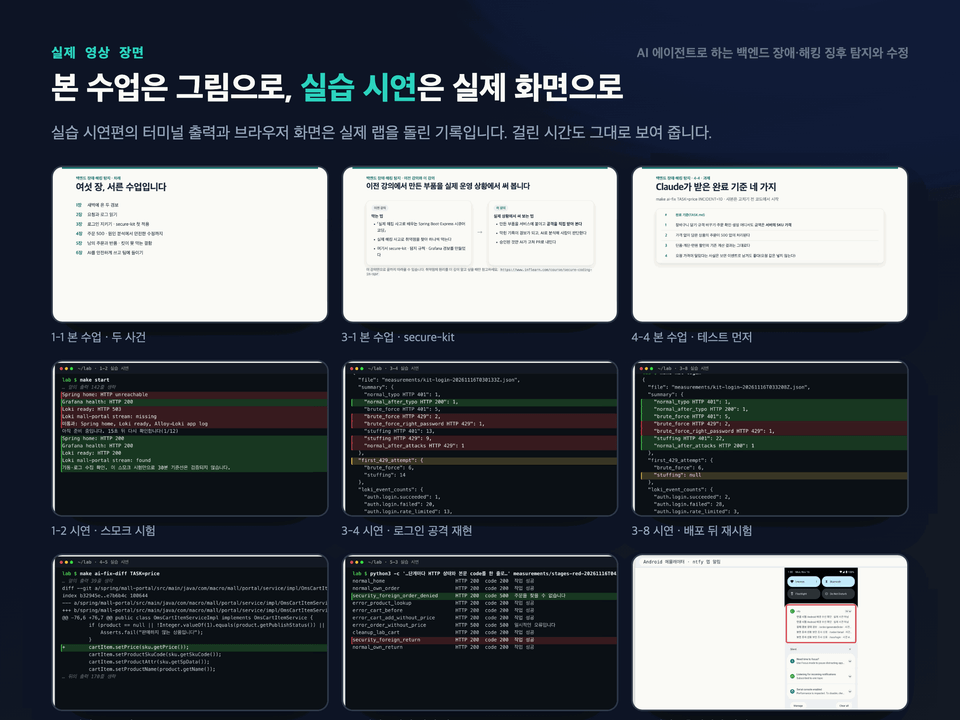
All the fixes shown in the video were actually run.

The three Claude repair sessions I actually ran while creating the course cost less than $2 in total. After deployment, I sent 1,800 ordinary requests over 15 minutes and monitored whether any new error fingerprints appeared. I also didn’t hide the failures that came up while preparing the course. I show them just as they happened: the app wouldn’t start after I added the kit, Claude stopped when a command was rejected, and the verification tool couldn’t find the logs.


Do you have concerns like these?

This lesson + hands-on demonstration

Course materials for participants

Recommended for
these people

Who is this course right for?

  • Backend developers and on-call staff who receive incident and security alerts directly

  • A development lead who wants to bring AI coding agents like Claude Code onto the team but is unsure how much to delegate to them.

  • For those who learned secure-kit in the previous lesson and want to integrate it into a real-world operational workflow.

Need to know before starting?

  • You just need to be able to read Spring Boot (Java) code. Claude will make the changes, and we’ll review them together.

  • You should be able to run commands in a terminal. It’s fine if you’ve never used Docker before (you can start the lab with a single command).

  • The AI analysis and editing exercise requires a paid Claude subscription that you can use to log in to Claude Code (or an Anthropic API key). Even without one, you can follow along using the actual results shown in the video.

Hello
This is brunoleebi8302

Career Verified

I took my first steps as a server developer during the Y2K era, a time of upheaval in the IT industry. Since then, I have moved between developer and infrastructure engineer roles across a wide range of industries, gaining hands-on experience with everything from the fundamentals of technology to complex infrastructure ecosystems. Building on my experience constructing and refining countless systems, I have recently been creating new value in the fields of IT security and convergent technologies.
More

Curriculum

All

58 lectures ∙ (1hr 44min)

Course Materials:

Lecture resources
Published: 
Last updated: 

Reviews

Not enough reviews.
Please write a valuable review that helps everyone!

brunoleebi8302's other courses

Check out other courses by the instructor!

Similar courses

Explore other courses in the same field!

Limited time deal

$8,487.00

22%

$67.10