Basic Design Synthesis Training (Digital Circuit Design Implementation)

Through what stages are semiconductor chips designed and manufactured? We will examine the basic concepts of logic circuits and the Chip Design Flow required for PI (Physical Implementation) / PD (Physical Design) roles step-by-step, and explore the key concepts of the synthesis process based on the tools used for digital chip circuit design in the industry.

(5.0) 6 reviews

33 learners

Level Beginner

Course period Unlimited

EDA
EDA
digital-logic
digital-logic
vlsi
vlsi
soc
soc
asic
asic
EDA
EDA
digital-logic
digital-logic
vlsi
vlsi
soc
soc
asic
asic

Reviews from Early Learners

Reviews from Early Learners

5.0

5.0

오병철

32% enrolled

I am a SoC Physical Design Engineer. I work in the ASIC industry, and I took this course to understand the work of Front End during collaboration with Front End Engineers for Tapeout. Furthermore, it seems good that I was able to acquire knowledge about RTL Design as well. Since I listened to it during my free time, it felt healing. You explained things calmly and well, and I was able to refresh points that I had been missing in my mind. There were things I was curious about regarding the Tape-Out Flow, and there were new things I learned, which was great. I think this will be a good reference for my future work performance. Thank you.

5.0

강동우

100% enrolled

I wonder if there has ever been such a detailed and clean explanation in semiconductor design field lectures.. Thank you so much for such a great video. The flow that actually takes place in design houses.. Above all, a video that explains so kindly in Korean.. It was so precious and welcome. You explain calmly and it goes right into my ears, so I think I'll recommend it to others as well. I think this would be a perfect lecture for those who are just starting out in semiconductor design. Thank you once again for the high-quality lecture! I think I'll be waiting to see if another lecture gets uploaded~

5.0

이규호

100% enrolled

Semiconductor design always felt difficult and distant to me, but this lecture completely changed my perspective. At first, the terminology was unfamiliar and I couldn't grasp the flow well, but as the instructor explained everything step by step in an easy way, I naturally began to understand.. Thanks to this, I became interested in this field and felt like I wanted to study it more. I'm really grateful that you made content I thought was just difficult so interesting!!

What you will gain after the course

  • Understanding Digital Logic Circuits from the Perspective of PI (Physical Implementation) and PD (Physical Design)

  • Understanding the Digital Chip Circuit Design Process

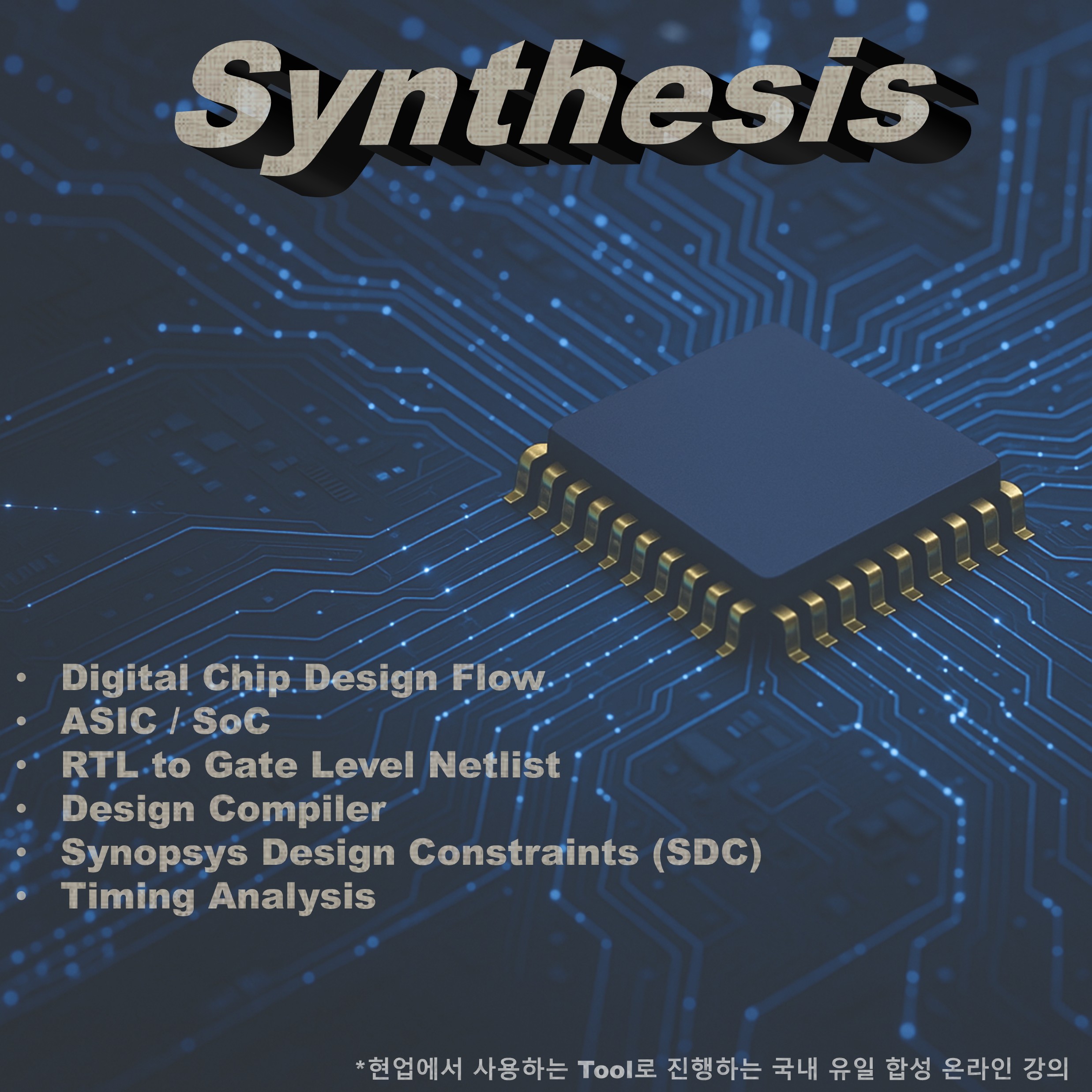
  • Key concepts of Synthesis using Synopsys Design Compiler, which is primarily used in the industry.

Synthesis

What is synthesis?

  • Converting a Register Transfer Level design written in an HDL such as Verilog into a Gate Level design.

  • During the conversion process, the design is optimized according to constraints known as Synopsys Design Constraints.

  • Finally mapping to standard cells provided by the foundry.


The beginning of digital circuit design implementation: learning synthesis.

The beginning of the digital circuit design implementation stage; the chip is only complete when you understand it properly.

Synthesis is the first gateway connecting the abstract and physical stages.
Ultimately, understanding synthesis means understanding the overall circuit design process.
In the industry, companies prefer new employees with experience in synthesis and timing verification.
However, because the related tools are expensive and inaccessible, it is a difficult field to study in school or through self-teaching.
In this course, you can experience the Design Compiler-based synthesis process used in the industry step-by-step,
and it explains many concepts used in circuit implementation roles beyond just synthesis.

What is covered in the synthesis lecture

  • Section 1. Basic Digital Logic Circuit concepts required for synthesis

    • Digital System

    • Timing concepts

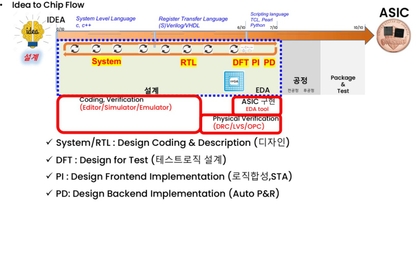
  • Section 2. Detailed understanding of the Digital Chip Design Flow

    • SoC / ASIC

    • Physical Implementation (Front-End) / Physical Design (Back-End) Flow

  • Section 3. Understanding synthesis using Synopsys Design Compiler, the most widely used synthesis tool in the industry

    • Design Setup

    • Synopsys Design Constraints (SDC)

    • Synthesis Techniques

    • Timing Analysis


What you will gain from the synthesis lecture

  • Preparation process required for synthesis

  • Understanding SDC commands for design optimization

  • Timing Concepts and Analysis

  • Various techniques in the compile process

  • Understanding of terms used in practice

Requirements

  • Since this is the process of mapping Digital Design into "physical" gates, the following prerequisite knowledge is required:

    • Digital Logic Circuits

    • CMOS operating principles

    • Basic knowledge of the Verilog language

  • Linux environment

    • While it is not a requirement for the course content, the Linux environment is used across all practical work in the industry.

  • TCL for communicating with EDA tools

    • Similarly, it is not mandatory, but it is recommended to study it in your spare time.


Reference sites for study materials related to the lecture

Hands-on challenge course in progress

  • What if you want to try hands-on practice after taking the lecture?

    • Inflearn Challenge Course [2-Week Synthesis Practice Challenge] is currently running (First 5 people per batch)

    • This is a great opportunity to try out Synopsys' Design Compiler.


Recommended for
these people

Who is this course right for?

  • Job seeker in the field of ASIC and SoC design

  • Student preparing for job-linked training programs at Semiconductor Academy / ETRI / IDEC

  • New Employee for PI (Physical Implementation) / PD (Physical Design) Position

Need to know before starting?

  • Logic Circuit

  • Semiconductor device

  • Digital Integrated Circuit

Hello
This is MetaEncore

138

Learners

18

Reviews

15

Answers

5.0

Rating

6

Courses

Market demand for application-specific integrated circuits (ASICs) such as AI (Artificial Intelligence) and IoT (Internet of Things) is increasing, and many chips are actually being designed, but it is rare for them to lead to substantial changes in our lives.

This is because many ASIC designs are either functionally flawed or fail to meet the planned performance requirements. To enrich our lives by creating high-quality semiconductors, services that provide advanced functional and performance verification capable of handling increasingly large and complex designs are essential. MetaEncore is a company that aims to increase the number of semiconductors that benefit humanity by providing such services.

More

Reviews

All

6 reviews

5.0

6 reviews

  • pa0202711님의 프로필 이미지
    pa0202711

    Reviews 1

    Average Rating 5.0

    5

    100% enrolled

    Semiconductor design always felt difficult and distant to me, but this lecture completely changed my perspective. At first, the terminology was unfamiliar and I couldn't grasp the flow well, but as the instructor explained everything step by step in an easy way, I naturally began to understand.. Thanks to this, I became interested in this field and felt like I wanted to study it more. I'm really grateful that you made content I thought was just difficult so interesting!!

    • metaencorehr
      Instructor

      Lee Kyuho, Although there is a lot of unfamiliar content, I tried my best to explain it as simply as possible. Meta Encore is working hard to open more lectures in the future. Please continue to show your interest. Thank you for your valuable course review.

  • obc8646521889님의 프로필 이미지
    obc8646521889

    Reviews 1

    Average Rating 5.0

    5

    32% enrolled

    I am a SoC Physical Design Engineer. I work in the ASIC industry, and I took this course to understand the work of Front End during collaboration with Front End Engineers for Tapeout. Furthermore, it seems good that I was able to acquire knowledge about RTL Design as well. Since I listened to it during my free time, it felt healing. You explained things calmly and well, and I was able to refresh points that I had been missing in my mind. There were things I was curious about regarding the Tape-Out Flow, and there were new things I learned, which was great. I think this will be a good reference for my future work performance. Thank you.

    • metaencorehr
      Instructor

      Thank you for your course review, Mr. Oh Byeong-cheol. I'm glad to hear that it seems like it will be helpful for practical work performance.

  • mn1231479237님의 프로필 이미지
    mn1231479237

    Reviews 1

    Average Rating 5.0

    5

    32% enrolled

    • dwoo09109047님의 프로필 이미지
      dwoo09109047

      Reviews 1

      Average Rating 5.0

      Edited

      5

      100% enrolled

      I wonder if there has ever been such a detailed and clean explanation in semiconductor design field lectures.. Thank you so much for such a great video. The flow that actually takes place in design houses.. Above all, a video that explains so kindly in Korean.. It was so precious and welcome. You explain calmly and it goes right into my ears, so I think I'll recommend it to others as well. I think this would be a perfect lecture for those who are just starting out in semiconductor design. Thank you once again for the high-quality lecture! I think I'll be waiting to see if another lecture gets uploaded~

      • metaencorehr
        Instructor

        Dear Dongwoo Kang, Meta Encore is preparing various content in the field of digital design and verification. We're glad it was helpful to you. Thank you for your valuable course review.

    • somisomisomsomi님의 프로필 이미지
      somisomisomsomi

      Reviews 3

      Average Rating 5.0

      5

      100% enrolled

      $254.10