Let's learn the core theories of AWS services that are often used in companies and various projects these days, and make AWS completely our own through hands-on practice!
I think it will be very helpful for those who are using AWS for the first time by going through various AWS services in theory + simple practice.
5.0
ericserra
100% enrolled
It was very good that the concept was explained first and then practiced. However, the only regret is that Auto Scaling was missing. I would appreciate it if you could continue to make intermediate and advanced lectures next time.
What you will gain after the course
AWS - IAM
AWS - EC2
AWS - RDS
AWS - S3
AWS - CloudWatch
AWS - Lambda
AWS - CloudFront
AWS - DynamoDB
AWS - API Gateway
AWS - CodeBase, CodeCommit, CodeDeploy
Learn AWS core technologies from the basics!
Lecture Introduction 📝
First, why should you learn about cloud computing? Let's assume you're working or aspiring to work as a data engineer or cloud engineer at a company. Using cloud computing eliminates the need for physical servers, dramatically reducing the costs associated with server maintenance and management. Furthermore, because servers can be automatically scaled up and down, you can enjoy cost savings here as well. AWS services offer numerous resources, and by combining them, you can build massive infrastructure. The analogy is like piecing together pieces of a puzzle.
Before you can master the numerous, yet essential, services offered by AWS, this course will provide you with a comprehensive understanding of the essential fundamentals, from the essential theory to hands-on practice exercises with the instructor from start to finish . By completing this course, you'll be confident you've mastered the fundamentals of AWS .
Lecture Content 📚
In this course for beginners to AWS (Amazon Web Service), you will learn about the following services:
1. IAM : You can learn how to create users/groups and manage various management methods required for using AWS.
2. EC2 : You can create a simple website using nginx by creating an instance remotely, and learn about the various types of instances and how to create them .
3. RDS : AWS offers a variety of database services, including MySQL and PostgresDB. Learn how to use databases on AWS and explore key concepts for database operation (backup, security, etc.).
4. S3 : One of AWS's oldest services, S3 is primarily used for uploading and downloading files (objects). However, S3 offers many storage types, and understanding their differences allows you to use the right service when needed. This allows for cost and performance benefits. You'll learn how to use S3 and various approaches.
5. CloudWatch : Provides basic, yet powerful, features that are essential for any cloud service user. It provides developers with essential information through real-time system logging and alarm settings, facilitating easy debugging. It also enables more efficient AWS management through various metrics.
6. Lambda : When numerous events within AWS are triggered, Lambda functions are executed, enabling preprocessing and also enabling the calling of other AWS resources. Lambda, in particular, plays a pivotal role in designing serverless architectures.
7. CloudFront : Based on a Content Delivery Network (CDN), CloudFront is a resource essential for providing the best possible service to users around the world . While the initial setup requirements are somewhat complex, it offers a wealth of convenient features once you get the hang of it. A basic understanding of networking will make understanding CloudFront much easier.
8. DynamoDB : This is a NoSQL database provided by AWS. It's ideal for loading batch and stream data, and it combines the powerful advantages of NoSQL, making it a highly valuable database . In this lecture, we'll learn about how DynamoDB differs from traditional relational databases and the unique advantages it offers.
9. API Gateway : Using API Gateway, you can create your own API, call and test various methods provided by RestAPI, and integrate them with various resources provided by AWS (e.g., Lambda functions) to create and maintain more sophisticated pipelines. APIs used on the web can also be implemented through API Gateway.
10. CI/CD : Software and application deployment isn't a one-time process. It requires ongoing maintenance and management. By learning about AWS resources like Code Commit, Code Deploy, and Code Pipeline, which greatly facilitate this process, you'll gain a comprehensive understanding of the overall software development and deployment process and gain hands-on experience building a CI/CD pipeline using AWS. You can upload your own code to a repository and easily maintain it through branches. You'll learn about the various deployment methods offered by AWS, including rolling deployment and blue/green deployment.
Books recommended by instructors
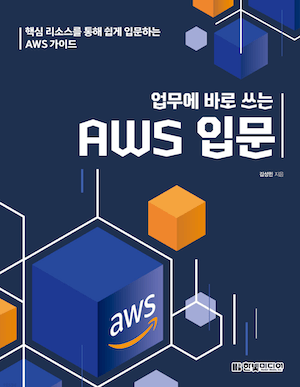
AWS for Business - Introduction by Seongmin Kim ( link )
Hello. I am Simon Kim, currently working as a data engineer in the healthcare domain after completing my Bachelor's in Computer Science and Master's in Data Science in the United States.
In my current role, I design and operate ETL pipelines that collect large volumes of data daily based on AWS and Airflow. I also manage monitoring systems using CloudWatch and Splunk to ensure data stability and quality. My responsibilities include analyzing the root causes of issues, improving pipelines as needed, and directly implementing new features.
My primary technology stack includes Python, SQL, and AWS. Recently, through a large-scale migration project to GCP, I have been gaining in-depth experience in BigQuery, GCS, and GKE environments. Additionally, I continuously work in IaC environments, managing infrastructure as code using Docker and Terraform.
Furthermore, I have recently developed an interest in AI Agent systems and Harness Engineering, and I am designing and experimenting with agent-based automation systems in both my professional work and personal projects. Beyond simply using models, I am continuously contemplating how to connect multiple agents and ensure their stable execution and management—specifically focusing on "AI Agent Orchestration" and "Execution Harness" architectures.
What I have felt most strongly while working as a data engineer is that while technology is constantly changing, its essence does not differ as much as one might think. Once you deeply understand one technology, the process of expanding to others becomes much easier. Focusing on this "commonality of core principles," I want to deliver a learning experience that goes beyond a simple list of technologies to help you understand the fundamental essence.
Through this lecture, I want to generously share the practical experience and insights I have gained in the field, and serve as a guide so that you can develop the strength to solve problems on your own.
I, Simon Kim, aim to create fun and easy-to-understand lectures by breaking down difficult and complex technologies. I want to grow together with my students through constant communication.
It is my greatest reward to witness the process of your skills growing noticeably. Thank you.
It was very good that the concept was explained first and then practiced. However, the only regret is that Auto Scaling was missing. I would appreciate it if you could continue to make intermediate and advanced lectures next time.
The lecture for AWS beginners is so good!!!
I recommend it to those who are new to AWS!!
I had a hard time at first because I didn't know much, but as I continued to listen to the lectures, I became familiar with AWS services.
I'm leaving this review because I want to share three reasons why I liked it!!
1. It was easy to follow the exercises.
2. The instructor updates frequently.
3. Explains the concepts easily!
Thank you to the instructor for uploading such a great lecture!














![[3-Week Completion] Cloud CS (AWS) for Senior-Level AdvancementCourse Thumbnail](https://cdn.inflearn.com/public/files/courses/339607/cover/ai/0/04a386cd-9003-440b-a9a3-1a25ddfd63df.png?w=420)