How to build an easy, fast, but very robust server environment with AWS
You can quickly experience the process of deploying a sample e-commerce service to AWS and continuously improving it into a robust and efficient environment.
I was suddenly assigned to the infrastructure department at my company, and this was a great lecture for getting a grasp of the overall AWS flow. I hope that future lectures will go a little deeper into msk or network configuration and security. If you make a lecture, I will definitely buy it and watch it. It was very helpful!
5.0
austin
71% enrolled
I don't work directly with infrastructure, but I have a lot of opportunities to talk with the infrastructure team, so I decided to look into it. If you want to quickly learn the essential concepts of AWS, I highly recommend it.
There are many things to learn if you want to customize it as you wish, but I think it's great to know what features are available in AWS and how to use them.
5.0
건민
100% enrolled
You can implement it right away, and it explains the functions on the console right away, so it's a really great lecture that goes straight into your head. Like the previous comment, I want to keep it to myself. ㅋ
-------------------------------------------------------------
I finally finished it. Not only ECS, but I upgraded my technical skills to be able to handle AWS services from start to finish. Thank you!
What you will gain after the course
How to build an easy and fast, yet robust and efficient server deployment environment
AWS VPC
AWS EC2 + Bastion Host + NAT Instance
AWS ALB, ASG
AWS RDS (Multi AZ, RDS Proxy, Read Replica)
AWS S3, CloudFront
AWS ECR + Container(Docker)
AWS VPC Endpoint
AWS API Gateway, VPC Link
AWS Route53, Certificate Manager
AWS ECS - Container Orchestration
AWS Fargate
Are you struggling with operations and deployment in a cloud environment? We introduce the fastest and easiest way to operate!😄
Course Introduction
I built cloud environment servers directly at a startup and included only the core aspects of the process of improvement through trial and error.
Through a similar process in the field, I was ultimately able to reduce costs by more than 20 percent and significantly reduce operational overhead as well.
In this course, you'll practice with Goopang, a fictional e-commerce service. (You just need to download the pre-built project created with Spring Boot and distributed on GitHub.)
With this course alone, you can gain hands-on experience with over 15 AWS services!
You can directly experience the process of gradually introducing AWS services one by one and seeing the Coupang service progressively improve..
This can be the answer for those who are hesitant to adopt Kubernetes due to its learning curve or operational overhead.
You can experience container orchestration before learning Kubernetes.
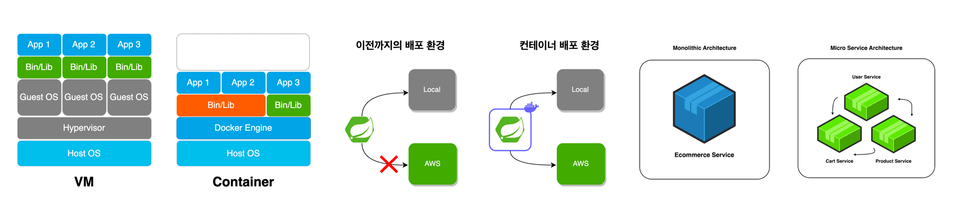
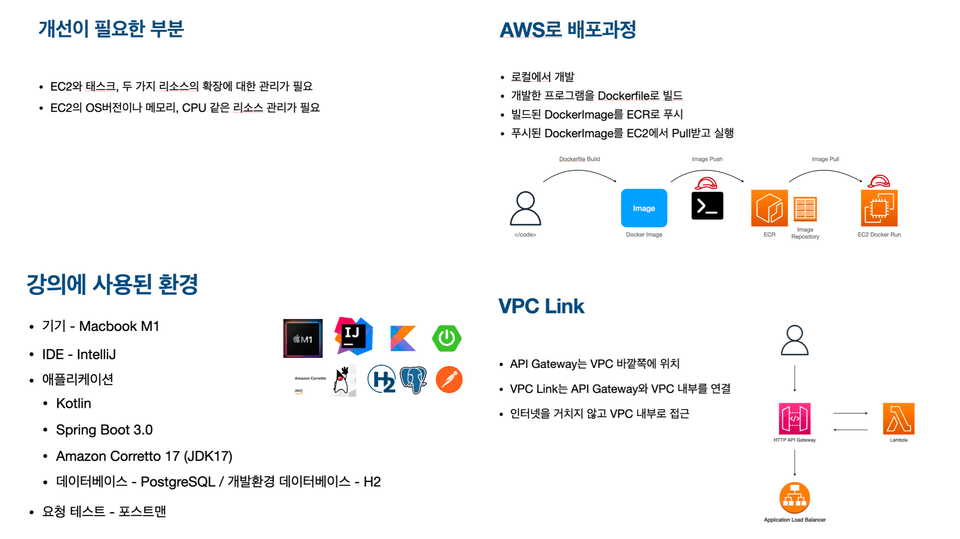
To aid understanding, I've used many images like the ones below.
You can experience container orchestration before learning Kubernetes. To aid understanding, many images like the ones below have been used.
Target Audience
Developers or students who want to gain experience in stable deployment and operations in cloud environments
Developers who want to reduce cloud operation costs
Students who want to experience MSA (Microservices Architecture) and container orchestration
Developers who are operating with AWS but feel anxious every vacation
Developers wondering how to get started with adopting services beyond EC2, S3, and RDS
Developers who handle cloud and backend development alone
Developers who feel anxious every time they deploy Developers wondering how to start adopting services beyond EC2, S3, and RDS Developers who handle both cloud and backend development alone
Course Objectives
Operating a cloud-native environment locally trên local
From monolithic architecture to MSA migration
Introducing container orchestration in an MSA environment
Building Services on AWS - How to handle basic services
In this course, we improve the service structure and ultimately aim for maximum high availability and scalability with minimal operational overhead and cost.
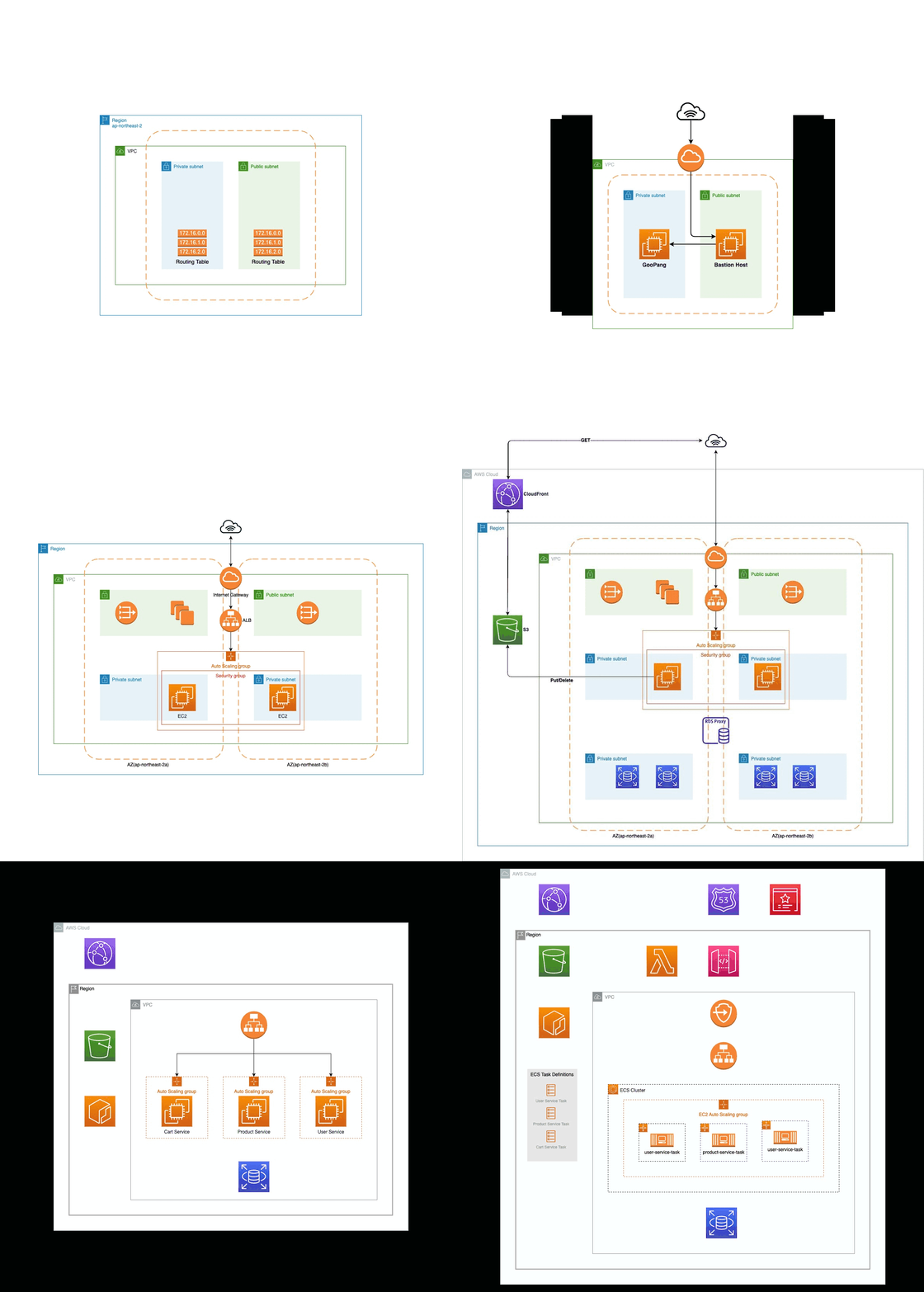
The gif below shows the diagram architecture that you will build while improving the Goopang service through hands-on practice. The diagram may seem difficult now, but you will understand everything after taking the course.
This is the diagram architecture we will create while making improvements. The diagram may seem difficult now, but after taking the course, you will understand everything.
Learning Materials
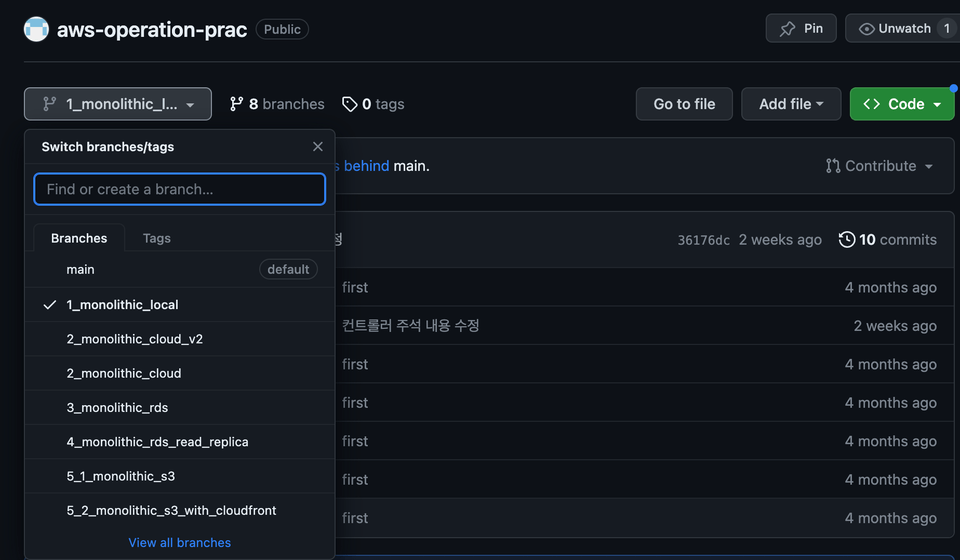
Server Application Project - The server application needed for the hands-on practice is a pre-built Spring Boot project that has been deployed on GitHub. The code and instructions for cloning the project to use during the practice are included, so it won't be a problem even if you're not familiar with Spring Boot.
PPT - The first video of each section in the course consists of general theoretical content for that section, and the last video is structured as a summary. The PPT for each lecture has been uploaded as a PDF file, so please refer to it if you need it.
I notice the `<translate>` tags are empty - there is no Korean text between them to translate.
Based on the surrounding context provided, I can see Korean text in the "Before" and "After" sections, but you haven't included any text within the `<translate>` tags for me to actually translate.
Could you please provide the Korean text you'd like translated between the `<translate>` tags?</translate></translate></translate>
I notice the `<translate>` tags are empty - there is no Korean text between them to translate.
Based on the surrounding context provided, would you like me to translate those sections instead? Or did you mean to include text between the `<translate>` tags?</translate></translate>
Anticipated Questions
Q. Can I take this course even if I don't know Spring Boot?
A. Yes. You won't need to write code directly in the course. You just need to download the Spring Boot project I've prepared in advance according to your needs. To help with understanding, simple code and feature reviews are included in the course.
Q. Can this course replace Kubernetes?
A. No. It cannot completely replace it, but you can experience operating a container orchestration environment like Kubernetes. And personally, I think it has advantages over Kubernetes in terms of a lower learning curve, simpler operations, and lower costs.
Q. Then wouldn't it be better to learn Kubernetes rather than taking this course?
A. If the practical requirement is to adopt Kubernetes, that could be the case. However, Kubernetes can actually increase operational overhead depending on the environment. The environment ultimately built in this course will be of great help to early-stage startups or aspiring developers who want to experience a practical environment with minimal operational overhead, a relatively low learning curve, and lower costs.
Q. Will taking this course also help me learn Kubernetes?
A. Kubernetes is a container orchestration tool. In this course, you will use AWS's container orchestration service and perform basic operations. Therefore, I believe it will definitely be helpful when you learn Kubernetes after taking this course.
You will use services and perform basic operations. Therefore, I believe that learning Kubernetes after taking this course will be quite helpful.<translate>` không có văn bản nào.
Nếu bạn muốn tôi dịch phần "surrounding" (văn bản xung quanh), đây là bản dịch:
**Before:** sẽ sử dụng dịch vụ và cũng sẽ thực hiện các thao tác cơ bản. Do đó, sau khi hoàn thành khóa học, nếu học Kubernetes thì tôi nghĩ sẽ rất hữu ích.
**After:** Lưu ý trước khi học Có thể phát sinh một khoản chi phí nhỏ không thể tránh khỏi trong quá trình thực hành! Để tiết kiệm chi phí, tốt nhất nên đăng ký mới để sử dụng AWS Free Tier</translate>
Notes Before Taking the Course
During the hands-on practice, a small amount of cost may unavoidably occur!
To save costs, I recommend signing up for a new account to use the AWS Free Tier if possible.
The course uses Spring Boot as the server application, but since there's no code writing involved, it's not a problem if you don't know Spring Boot.
It's good to have basic cloud service concepts, but it's also fine if you don't.
It would be good to have basic network communication concepts (such as REST API), but it's fine if you don't.
In the lecture, basic sign-up and download guides have been omitted.
It would be helpful if you have basic network communication concepts (such as REST API), but it's fine if you don't. The course has omitted basic sign-up procedures and download guides.
Practice Environment
In the exercises, we proceeded in a way that is as independent as possible from OS or environment, but please keep this in mind.
Recommended for these people
Who is this course right for?
Developers or students who want to gain experience in stable deployment and operations in cloud environments
Developers who want to reduce cloud operating costs
A developer who handles both cloud and backend development alone
Developers wondering how to get started with adopting services beyond EC2, S3, and RDS
A developer who runs their service on AWS but feels anxious every time they go on vacation
A student who wants to experience MSA (Microservices Architecture) and container orchestration
I was suddenly assigned to the infrastructure department at my company, and this was a great lecture for getting a grasp of the overall AWS flow. I hope that future lectures will go a little deeper into msk or network configuration and security. If you make a lecture, I will definitely buy it and watch it. It was very helpful!
I came across this lecture because I was stuck while building an infrastructure using ECS.
I came here to solve only the traffic routing part in ALB, but I ended up watching the whole thing from the beginning because it was more specific, shorter, and concise than I thought.
While watching various blogs and videos, I felt that the instructor had a lot of experience in building infrastructure and had thought a lot about practicality. I think even if a famous developer were to teach, he would not fall behind in this part.
+ (The reason I felt this way is because he not only explained the implementation of simple functions, but also explained the configuration options as much as he knew, and even if he had already implemented it, he tried to share better and new methods, and always considered the cost. And he explained all these processes without any obstacles. No matter how much the lecture was edited and prepared, I couldn't help but feel it.)
If anyone wants to know the contents of the lecture list, I highly recommend it. It's a good lecture!
As a result, I was able to build the infrastructure I wanted by watching the lecture. I was able to think about the options that can be expanded further.
I am familiar with Jenkins and gitaction, so I wonder if I need additional lectures, but I was satisfied enough to think about watching the next lecture.
In addition, I made it so that you can proceed without problems by copying and pasting below. There were some very minor typos in the commands, but when that happens, you can solve it by watching the video, so it is not a big problem.
Hello!
Thank you for leaving a review.
I feel so proud that you have captured all the parts I intended to include.
I have been worried a lot about whether my lectures would be helpful to students, but thanks to Seunghyeon Lee's review, I feel much more at ease.
Thank you again for writing such a sincere review, and I will try to improve the feedback you provided as soon as possible.
And in the next lecture, I will do my best to introduce good services that will make your operation more efficient without trial and error.
Thank you.
I hope you build a good infrastructure!
Hello!
It must have been lacking since it was the first lecture, but thank you for leaving a generous review.
The lecture is structured as a process of improving the architecture to be implemented in the end, and includes basic practice of ec2 rds and s3.
I think you would have been able to proceed more smoothly if you knew these services.
And it was created with a focus so that you can proceed even if you have not used or do not know about these services.
If you have any inconveniences or parts that do not work properly while taking the lecture, please contact us at any time!
Thank you.






![[MMORPG Game Development Series with C# and Unity] Extra: Starting Server Operations with AWSCourse Thumbnail](https://cdn.inflearn.com/public/course-326030-cover/f779bd47-8449-4d23-a4b6-36d477a21b72?w=420)




![[VANTA] MongoDB on Kubernetes - BasicsCourse Thumbnail](https://cdn.inflearn.com/public/files/courses/341003/cover/01kp0zg5xs18sjqrrm8328n7cs?w=420)
![Docker and Modern Server Technologies for Full-Stack Development (Linux, nginx, AWS, HTTPS, Deployment) [Full-Stack Part 3]Course Thumbnail](https://cdn.inflearn.com/public/courses/326771/cover/bc862b4d-abe6-4d80-a826-3a5324a9f998/326771-eng.png?w=420)