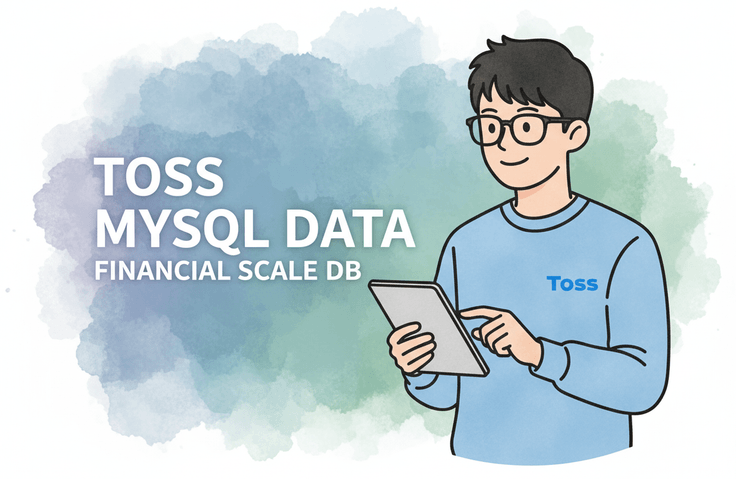






MySQL learned from a Toss developer who processes over 500 billion pieces of financial data

Learn how to design and handle large-scale data architectures that process hundreds of billions of records using only pure SQL and core MySQL features, alongside a Toss developer who handles hundreds of billions of financial traffic transactions and a developer who started as a non-major and is now developing platforms in Pangyo.

(4.7) 44 reviews

745 learners

Level Beginner

Course period Unlimited

MySQL
MySQL
Jetbrains
Jetbrains
mysql-query
mysql-query
MySQL
MySQL
Jetbrains
Jetbrains
mysql-query
mysql-query

Reviews from Early Learners

Reviews from Early Learners

4.7

5.0

에이미

88% enrolled

I really enjoyed the lecture. While listening to it, I thought about parts that other people might find helpful as reference, so let me organize the areas where I found it beneficial. Advantages: 1. It's really realistic. When covering topics, the instructor directly mentions if certain forms aren't commonly used in practice, often saying "I'm covering this because it's good to know, even though it's not frequently used." I think this shows that a truly skilled developer is making an effort to share both realistic and less practical aspects. 2. The content itself is really valuable. From general and simple CRUD operations to explanations of various architectural perspectives possible with MySQL - it's not just content limited to databases, but contains rich material about development itself. 3. These seem like topics you can't hear anywhere else. Most MySQL or database lectures are limited to how to write queries and what functions are available, but this lecture uses procedures and explains well the essential topics of how databases should be used. However, honestly, I think this lecture has some disadvantages as much as it has advantages. 1. The difficulty level doesn't seem easy. Beginners in development might find it difficult to follow due to lack of basic knowledge. 2. The explanations aren't that rich and Kind. While covering really diverse topics, the explanations aren't proportionally detailed. To put it simply, it feels somewhat like having a mentor who's really good at development, but from the mentor's perspective, some things are so obvious that they just skip over them. Conclusion: But even excluding all these points, I think it's a really good lecture. If you actually have the will to study and want to learn many aspects, this lecture would be suitable. Conversely, if you're fine with learning just the basics and want to be spoon-fed, this lecture probably won't be of much help. From my perspective, it was a really satisfying lecture because I could learn not only about MySQL but also think about its applications and study from an architectural perspective. I was so impressed that I'm leaving a comment like this for the first time.

5.0

미래 1인 개발자

79% enrolled

I'm a server developer working at Toss who participated most deeply in this MySQL course. Hong previously prepared and created a Kafka-related course together with Choi, and since that topic was really good and I also wanted to share my knowledge in a deeper way, I decided to participate like this. - Of course, I had participated indirectly or directly before, but I was more immersed and engaged in this course. Actually, I don't think simply covering MySQL content alone would have that great of a learning effect for you all. Currently, with AI advancement, AI actually writes queries better than we do. What you need to know here is "what aspects you can consider" and "what methods are available." I think the ability lies in knowing these aspects and knowing how to instruct AI accordingly. I hope this course will be very helpful to you all from that perspective. Please show lots of interest. Thank you!!


5.0

lsls ks

83% enrolled

I think this is a great topic for gaining truly deep knowledge about MySQL. It covers some basic CRUD operations and focuses only on queries that are realistically used, which makes it even more helpful. However, the more important part seems to be the design patterns at the end. It was a great help in gaining the perspective to see the forest. Thank you.

What you will gain after the course

  • MySQL Horizontal Scaling Techniques Using Sharding and Partitioning

  • Is sharding always the right approach? Knowledge regarding that fundamental question.

  • Traffic distribution strategies and load balancing using replication, and the resulting methods for ensuring HA.

  • Concurrency control using Transaction & Lock and MVCC for ensuring performance

  • MySQL API for mastering only the CRUD operations actually used in real-world practice.

  • Advanced optimization techniques for SELECT queries, which account for 90% of traffic.

  • Index analysis and query analysis through query pre-planning

  • Database structure design principles for scalable system design

How do Toss developers, who handle over 500 billion financial data records, utilize MySQL?? 🤔

❗This is an actual conversation.❗

😄 Hong : But hyung, I've been curious lately—when Toss uses MySQL, there must be hundreds of billions or even trillions of rows of data. How do you handle all of that??

😁 Toss : Who are you?

😄 Hong : No, seriously, I've been worried about that lately. Simple SELECT optimization must have its limits, and there must be physical storage limits as well... I'm just wondering how to solve these issues as the service grows;;

😁 Toss : Instead of trying to solve it simply through query statements like SELECT, if you know how to utilize the database, you can solve it in other ways. Since physical limits are clear, you know.

😁 Toss : But who are you??

😄 Hong: -- Stop joking around... Tell me about this this time. Let's combine what I know and build it together.

Don't just try to solve it through simple query statements like SELECT; if you know how to utilize the database, you should solve it in a different way, because the physical limitations are clear.

What does this mean?? 🤷 And how should we solve it?? The answer lies in going beyond the SELECT and JOIN we already know, understanding and appropriately utilizing mysql-query, and designing architectures that handle MySQL in extreme situations. Furthermore, this course goes beyond simple tuning to reveal the core principles of replication, partitioning, and sharding for handling high-volume traffic, along with all the know-how from Toss developers and myself.


Rather than a boring lecture that just lists theories, I have prepared this as a practical guide to completely mastering the core features of MySQL by writing actual queries and observing how they operate together. 🚀

Key Features of This Course

📌 A course implemented purely in SQL

* No additional languages are used. It covers MySQL using purely SQL syntax.

📌 Practical SQL queries and content consisting of over 1,500 lines of syntax

* This lecture consists of approximately 1,624 lines, including various queries, SQL queries for generating mock data, and theoretical aspects related to the lecture content!

📌 Various MySQL techniques that are not easily encountered in practical work environments

* Are procedure-style queries bad?? It would be incorrect to say they are just bad. This covers procedures that can be utilized based on actual table structures.

📌 Providing SQL query syntax for mock data generation

* Simply sending queries using small amounts of data is not effective. To enable you to continue learning more on your own in the future, I am providing some queries for generating various types of mock data.

📌 The shortcut from junior to senior..! System Design

* There are clear limits to simply tuning poorly written queries. You can learn how to design systems based on the specific objectives of the traffic.

* By mastering the various architectures that can be built using databases, you can develop your skills as a system architect.

Recommended for these people

Backend Developer

I want to handle large-scale data.

Job seekers

It's so hard to find a job.

Junior DB Engineer

To be honest, I only know CRUD...

The lecture covers the following topics.

* Various configuration variables of MySQL

* MySQL access management techniques for practical security

* DB Design Patterns for Server Developers

* Processing techniques for data distribution [ Partitioning & Index Optimization ]

* Data Modeling Techniques

* Optimization patterns for CRUD

* MySQL Internal Architecture and Storage

* Memory Management, Transactions, and Locking Mechanisms

* MySQL Scaling Systems [ Replication and Distribution, Partitioning and Sharding ]

* Data Compression and Archiving

* Practical! Data Modeling for Service Building

Why should I learn MySQL?? 🤔

Our goal for most of us is getting a job or changing careers. Under these conditions, it is actually very simple. This is because MySQL is the representative database used by companies.

The person who created this course 🤭

  • A developer who started as a non-major and is currently working as a platform backend developer in Pangyo.

  • My goal is to teach realistic development methods and theories, and I am a knowledge sharer who creates courses not alone, but together with talented colleagues around me.

  • A knowledge sharer who had the opportunity to do an interview with Inflearn thanks to active contributions.

People who participated in this lecture 🤭

  • A server developer who majored in computer science in a provincial area, worked as a developer at Naver, and is currently working as a backend developer at Toss

  • A developer who is always short on time and gets scolded a lot by Hong...

  • A developer who wants to achieve financial freedom and dreams of becoming a solo developer

Lectures that are 10 times more effective when watched together

The Easiest and Deepest Guide to Kafka [ By. Non-major & Kakao Developer ]

  • I will show you everything about how to implement an architecture that enables loose coupling between services by utilizing the most representative MSQ (Message Queue) used alongside databases!

Notes before taking the course

  • IDE :

    Jetbrains intelliJ

  • MySQL :

    9.2.0 for macos15.2 on arm64 (Homebrew)

We are running an open chat room to help you prepare for your career. We look forward to your interest!

Recommended for
these people

Who is this course right for?

  • 1–3 year backend developers who feel limited by doing only CRUD.

  • A developer who has experienced service performance degradation due to slow queries

  • Those who want to take on the challenge of designing scalable systems that can handle high-volume traffic

  • Server developers who want in-depth communication with DBAs and data engineers

  • Those who want to develop real-world problem-solving skills rather than just learning theoretical SQL.

  • An engineer who wants to work on systems where stability and performance are critical, such as financial data.

Hello
This is Hong

7,492

Learners

461

Reviews

142

Answers

4.7

Rating

25

Courses

Introduction

I started studying development after finding an interest in it while idling at home, and I am currently in charge of platform server development in Pangyo. I am continuing my activities as a knowledge sharer because I want to provide you with the methods I used to study, as well as the various problems and solutions you may encounter in practice.


These lectures are not created solely through my own knowledge. Every lecture is made together with others.


Instructor Experience

[Former] Blockchain developer related to Sandbox IP

[Former] Metaverse Backend Developer

[Current] A veteran server developer in Pangyo


Interview History

Other Inquiries

  • unduck2022@gmail.com

More

Curriculum

All

24 lectures ∙ (4hr 41min)

Course Materials:

Lecture resources
Published: 
Last updated: 

Reviews

All

44 reviews

4.7

44 reviews

  • ghwlsrnt1230881님의 프로필 이미지
    ghwlsrnt1230881

    Reviews 1

    Average Rating 4.0

    4

    88% enrolled

    Hmm... I got excited on my own because of the title and thought there would be practical examples, and I wanted to see some real-world work on handling large volumes with MySQL. But there's no such content. In the latter part, it seemed like they were going to cover large-scale data handling, but it ended with explaining one syntax and saying things like "there's actually no need to introduce it to this extent" and "MySQL is sufficient in many cases," which was disappointing. I wanted to know what cases MySQL is sufficient for, when you feel MySQL's limitations in real work, etc. It's disappointing. Since there's a lot of content within the time limit, the depth is somewhat shallow, so it seems like content that beginners or those who want to study MySQL can listen to comfortably and without burden, rather than for working professionals.

    • mongi74213091님의 프로필 이미지
      mongi74213091

      Reviews 1

      Average Rating 4.0

      Edited

      4

      100% enrolled

      I enrolled in this course because the title "Processing Over 500 Billion Financial Data Records" made me think that it would propose methods for handling large-scale data and allow me to practice some of these methods. However, since the content was entirely theoretical, I honestly feel this aspect might remain as a disappointing part. Nevertheless, the course contains good content in terms of broadening the directional approaches for how to handle large-scale data well, and it seems to have provided an opportunity to think once more about whether we truly understand the MySQL we've been using. Thank you for the good lecture.

      • jhong
        Instructor

        Hello Cheon, thank you for your feedback!! Since diving deep into MySQL alone and practicing it doesn't have much significance these days, I mainly focused on how to handle large volumes of data and traffic. Next time, I'll provide even better lectures so I can receive a perfect star rating. Thank you :)

    • goryp017165님의 프로필 이미지
      goryp017165

      Reviews 13

      Average Rating 4.8

      5

      100% enrolled

      It's too abstract and broad. I'd appreciate it if you could focus specifically on databases, but you're discussing too many different things.

      • jhong
        Instructor

        Hello young pyo lee, thank you for your evaluation and feedback!! I think that in modern times, it's not just about simple database usage that's important. I believe what matters is whether you can do something derived through that database. From this perspective, I filmed the lecture and wanted to share a very broad range of perspectives with you all. As a result, it seems like there ended up being quite a lot of abstract concepts. Next time, I will work even harder to provide you with a more satisfying lecture. Thank you for taking the time to leave this review!!

    • lslsk08018196님의 프로필 이미지
      lslsk08018196

      Reviews 1

      Average Rating 5.0

      5

      83% enrolled

      I think this is a great topic for gaining truly deep knowledge about MySQL. It covers some basic CRUD operations and focuses only on queries that are realistically used, which makes it even more helpful. However, the more important part seems to be the design patterns at the end. It was a great help in gaining the perspective to see the forest. Thank you.

      • jhong
        Instructor

        Hello lsls ks, thank you for leaving such a positive review. As you mentioned, I wanted to focus mainly on the practical usage patterns for CRUD operations, and I concentrated more on design architecture. I will strive to provide even better lectures in the future. Thank you :)

    • tttos님의 프로필 이미지
      tttos

      Reviews 8

      Average Rating 5.0

      5

      79% enrolled

      I'm a server developer working at Toss who participated most deeply in this MySQL course. Hong previously prepared and created a Kafka-related course together with Choi, and since that topic was really good and I also wanted to share my knowledge in a deeper way, I decided to participate like this. - Of course, I had participated indirectly or directly before, but I was more immersed and engaged in this course. Actually, I don't think simply covering MySQL content alone would have that great of a learning effect for you all. Currently, with AI advancement, AI actually writes queries better than we do. What you need to know here is "what aspects you can consider" and "what methods are available." I think the ability lies in knowing these aspects and knowing how to instruct AI accordingly. I hope this course will be very helpful to you all from that perspective. Please show lots of interest. Thank you!!

      • jhong
        Instructor

        Thank you for creating another great course that can have a positive impact!! I hope the parts we worried about and thought through will reach the students. Please take good care of us next time too!!

    Hong's other courses

    Check out other courses by the instructor!

    Similar courses

    Explore other courses in the same field!

    $61.60