Beginning Kubernates-Based MSA (with Spring Boot) - Part 1
zk202308a5410
Covers the topics you need to know to work on projects using Kubernetes.
Basic
Spring Boot, Kubernetes, CI/CD
Completing an integration project between an API server built with Spring Boot (ver 3.4.x) and React 19 (with TypeScript)! Applying front-end to a back-end portfolio! A course written for working professionals (not a beginner-level course).
1,537 learners
Level Intermediate
Course period Unlimited


Reviews from Early Learners
5.0
minho.ha
It would be really helpful if you explained the actual project in order while coding it. My skills just can't keep up with it. Hahahahahaha
5.0
원데이
I think this kind of lecture is really helpful for practical work. The tips and information from the instructor's experience were also good. The depth of each technology in the lecture seems a bit shallow due to the nature of the lecture, but it is easy to understand if you search or refer to a book. However, I think it might be a bit difficult for developers in those years.
5.0
b0i4s
In these times when it's not enough to just do front and back, I've always wanted to vaguely create front and back separately and create a normal integrated project once. I think this is a really good lecture for those who are curious about the integration of both sides with one main, not those who only know one side. I didn't buy the book, but I think the lecture is sufficient. However, I think it would be possible to reduce the time spent looking it up again if you study it with the book. For your reference, both React and Spring require some prior knowledge, but since these are contents that can be learned in just a week, I think this will be a good lecture for those who are even a little interested in full stack. Thank you for the great lecture.
React Development Process
API Server Development
JWT Authentication Processing
Redux Toolkit
React Query
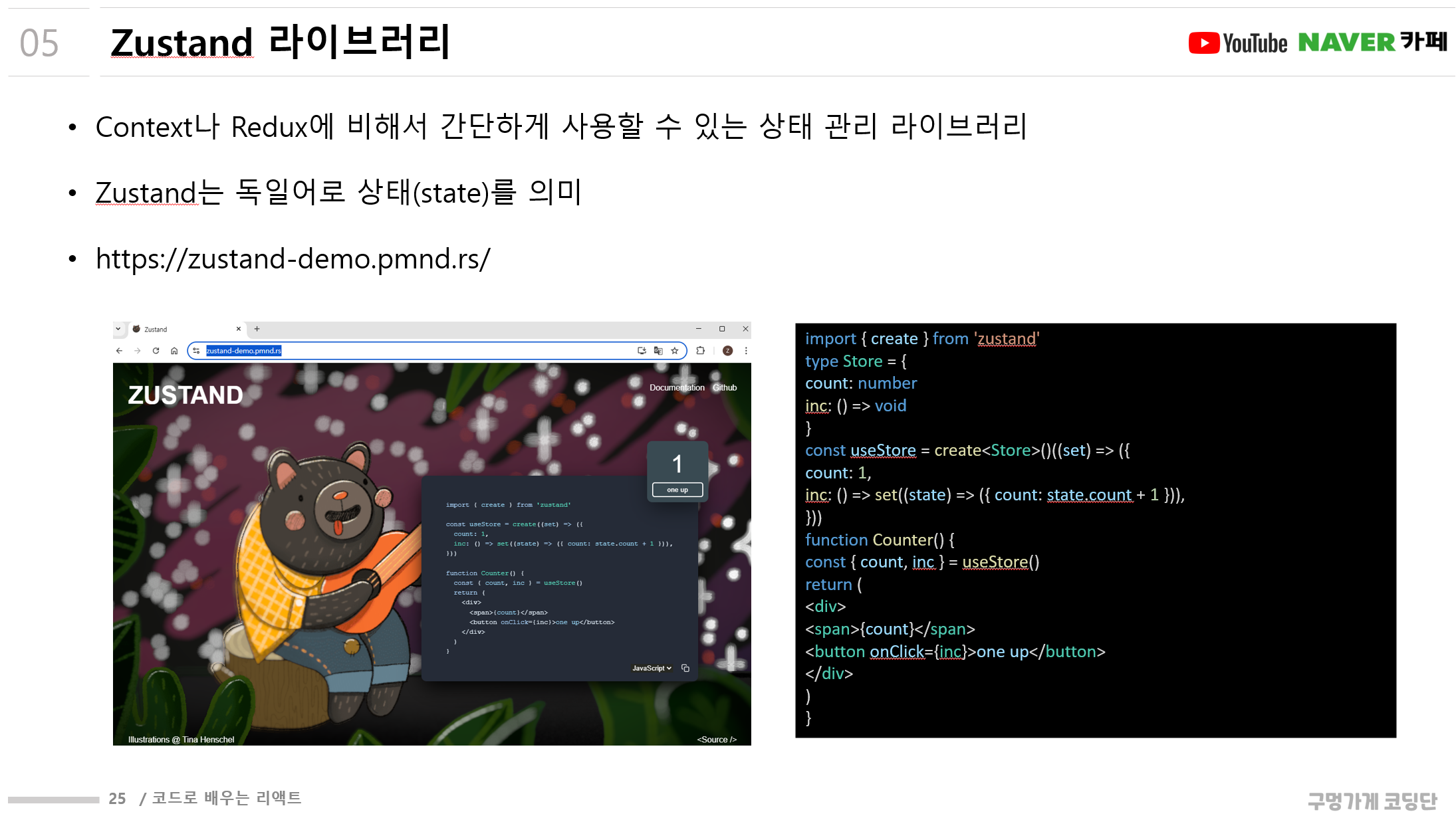
Zustand
I see many new employees who know React and Spring Boot, but when given actual tasks, they fail to produce results. The reason they can't apply what they've studied so hard is likely due to a lack of understanding of the process.
You can generate the detailed code you want using ChatGPT, but the problem is that you cannot explain exactly what kind of code it is that you want.
Project progression requires processes or procedures that many people can agree on. And a lot of practice is needed for this.
Precautions before taking the course
Since this course focuses on procedures and processes rather than simple grammar or concepts, basic React syntax is not covered. Additionally, you must have experience with JavaScript and TypeScript.
The Java portion is conducted using Spring Boot 3.4.x and does not cover basic knowledge.
Additional materials or questions needed during learning are being distributed through the 'Gugongage Coding Grouphttps://cafe.naver.com/gugucoding' cafe.
2026/01/02
There have been changes to the screen and other elements in the Kakao Login settings section.
https://docs.google.com/presentation/d/1ndFy0UfqcIHMbSF2Kyjtw3o8Gimx7I9GVeEaE-7lfs8/edit?usp=sharing
Please refer to the document.
2025/12/05
The most important section in Spring Boot, "Section 3 - Building a Todo API Server," has been updated with lectures using Spring Boot 4.0.0.
2025/11/26
When developing with Spring Boot 4.0.0 using VSCode, you may encounter an issue where JUnit 5 test codes do not function properly (this issue does not occur in IntelliJ).
If you encounter issues while using VSCode, please refer to https://blog.naver.com/cookie_00/224088514199.
2025/06/24
As the Vite version has been updated to 7.0.0, a situation has arisen where tailwindcss is not yet properly supported.
If you created your project using npm create vite@latest
Open the package.json file and change the vite version at the end to 6.
"devDependencies": {
...
"vite": "^6.0.0"
}After making the changes, run npm install and
npm install tailwindcss @tailwindcss/vite
If you run that, it should be added successfully.
2025/05/03
The video lectures will be updated with content produced using Vite and TypeScript.
Although it was produced to be as similar as possible to the structure of the existing lecture, there may be slight differences in progress.
The source code will also be fully updated and released to be compatible with React version 19.
Added on 2025/02/24
The complete code written in Vite and TypeScript has been added to the end of the course as part of the lesson materials.
Major Version Changes
React-Router version 7
React Query Version 5
Spring Boot version 3.4.2
These are the parts of the code that have been changed.
Things to watch out for when creating with Vite are
https://drive.google.com/drive/folders/1t0NdcBPCN57boutJcjdKODk5DccJUixV?usp=drive_link
has been added to.
Added on 2024/03/28
I have added materials for using AWS Elastic Beanstalk, RDS, and S3 as attachments to the final lecture.
We will build an API server using Spring Boot and utilize it within a React project.
In this process, we will cover the following examples.
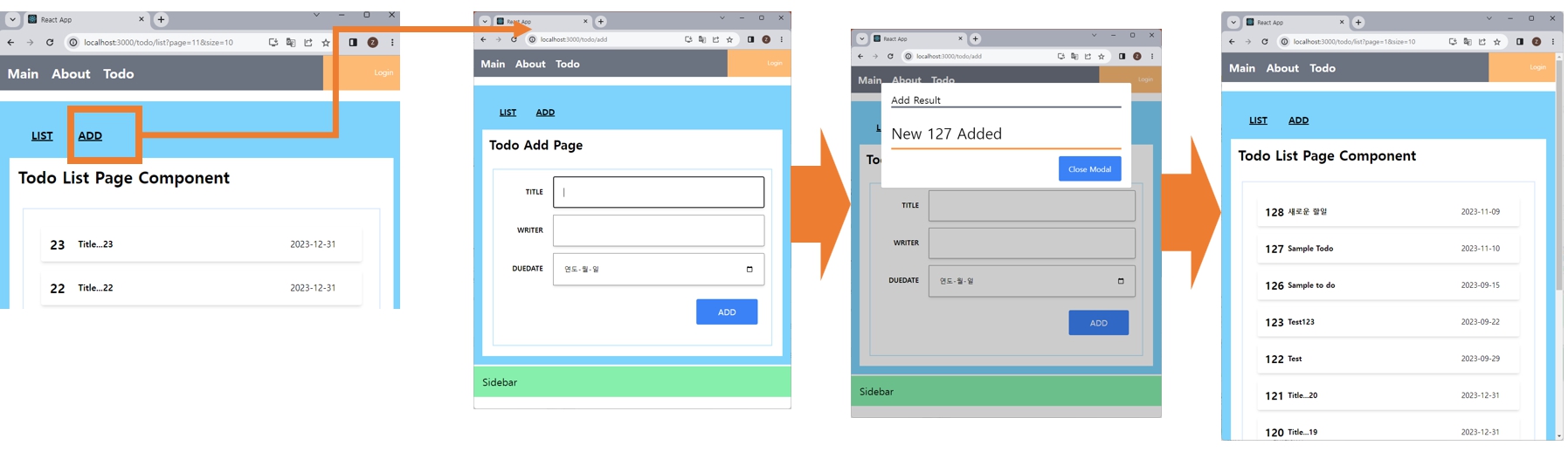
Todo Example - React-Router, Axios, Paging, Querydsl Configuration
Product Example - Axios
Login processing - Redux Toolkit, JWT
Social Login Processing
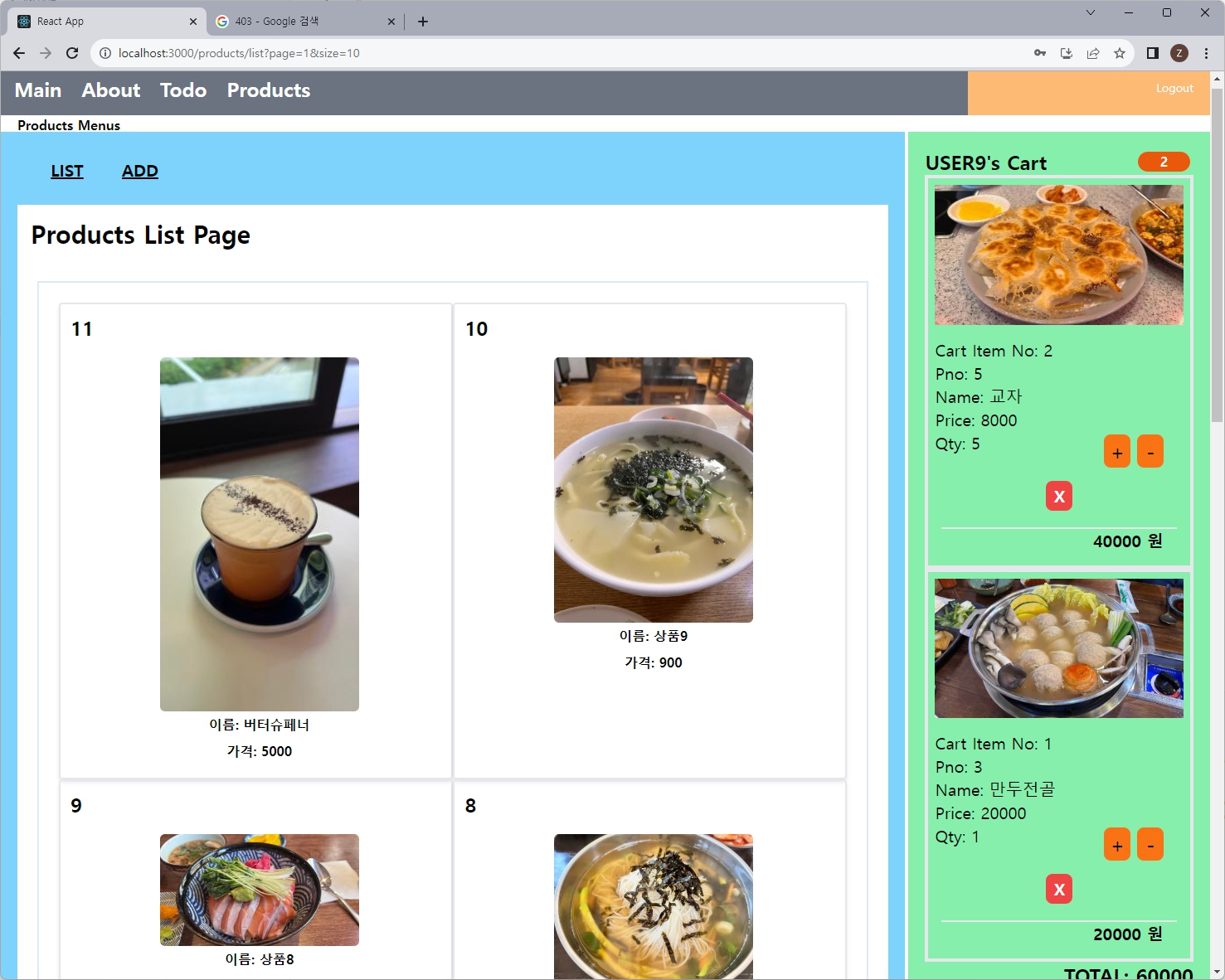
Shopping Cart Implementation
React Query, Recoil Practice


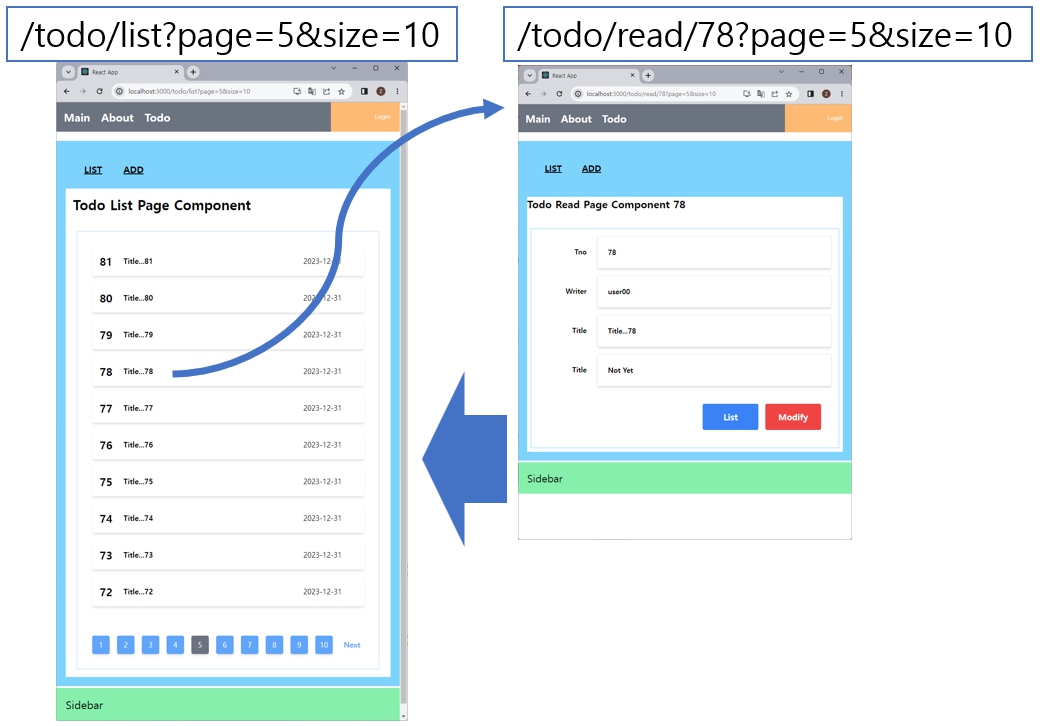
In the case of React projects, React-Router is used to handle navigation to different screens based on the address bar.
You can set up a common layout and use <Outlet> to configure screens appropriate for each module.
Routing settings can be configured in a separate file for easier maintenance.
You will learn how to design and use custom hooks to reduce redundant code.
/builder/270c9a0a-4465-40d4-ae8c-b666ff2df3f0/0067.jpg)
You can personally complete the file upload process and implement modal handling for the processing results.
/builder/0e558177-1e32-40ce-9ce8-86c82ac122af/0060.jpg)

We will implement authentication processing through login handling and social login.
Manage login status using RTK (Redux Toolkit) and ensure login information is remembered by utilizing cookies in the browser.
We will look into how to create Access Tokens and Refresh Tokens using JWT and apply them to the project.
In the final chapter, we will convert the example written using React Query and Zustand.
✅ The source code used in the lectures is attached to the last lecture of each section.
Who is this course right for?
Those who want to build an API server
Those who are concerned about how to apply React syntax
Need to know before starting?
JavaScript
Spring
Web Programming
2,392
Learners
185
Reviews
294
Answers
4.8
Rating
6
Courses
Gumonggage Coding Team is a community established in 2015 for people working in development-related fields to gather.
The lectures are currently being conducted by Manager Cookie, who is the operator of the Guman-gage Coding Group.
I began my career in development in 2000 and have experience working across venture companies, SMEs, large corporations, and as a freelancer.
Since the 2010s, I have been primarily focusing on corporate training and consulting.
I have development experience with corporations, large enterprises, and as a freelancer. Since the 2010s, my primary focus has been on corporate training and consulting. Naver Cafe
Major Publications
Spring Web Project Learned Through Code
Learning Spring Boot Through Code
Learning React through Code
Implementation of RESTful API Server
Spring 6 Legacy Project
Java Web Development Workbook
React Native in Action (Translation)
Development/Lecturing
Worked at Samsung SDS Development Team
Worked at SK Customer Happiness Co., Ltd.
Corporate lectures for companies including KT, SK, POSDATA, Kyobo Life, Shinsegae, Asiana, National Health Insurance Service, and more.

All
98 lectures ∙ (21hr 54min)
Course Materials:
4. React-Router 설정
18:56
5. 공통레이아웃설정
07:59
6. Todo 레이아웃
16:48
8. 동적처리
05:49
11. 부트 프로젝트 생성 및 확인
14:23
12. 엔티티 클래스 만들기
15:02
13. 엔티티의 테스트
15:28
14. 목록(페이징)처리 구현
12:50
15. Querydsl설정하기
11:56
17. 서비스계층 만들기
11:44
18. 페이지처리를 위한 DTO설계
25:37
19. Querydsl 검색처리
18:43
All
128 reviews
4.7
128 reviews
Reviews 2
∙
Average Rating 5.0
Reviews 1
∙
Average Rating 5.0
5
I think this kind of lecture is really helpful for practical work. The tips and information from the instructor's experience were also good. The depth of each technology in the lecture seems a bit shallow due to the nature of the lecture, but it is easy to understand if you search or refer to a book. However, I think it might be a bit difficult for developers in those years.
Thank you for understanding the intention of the production. As you said, there were some limitations in explaining the basic parts. However, I boldly reduced it to this extent, thinking of it as a project in practice.. If you post questions through Cafe or Infraon during the remaining period of study, I will help you as much as I know.
Reviews 11
∙
Average Rating 5.0
Reviews 4
∙
Average Rating 5.0
5
In these times when it's not enough to just do front and back, I've always wanted to vaguely create front and back separately and create a normal integrated project once. I think this is a really good lecture for those who are curious about the integration of both sides with one main, not those who only know one side. I didn't buy the book, but I think the lecture is sufficient. However, I think it would be possible to reduce the time spent looking it up again if you study it with the book. For your reference, both React and Spring require some prior knowledge, but since these are contents that can be learned in just a week, I think this will be a good lecture for those who are even a little interested in full stack. Thank you for the great lecture.
Thank you for fully understanding the intention of the production. I hope the remaining lectures will be helpful to you. Thank you.
Reviews 19
∙
Average Rating 4.9
4
If you have some knowledge, it's comfortable to listen to. However, there are many codes(?) that reflect personal styles, such as visually checking by printing logs in the unit test code, or calling repo.save in the modify method, so it seems difficult for beginners to properly integrate it to their own style. If you have enough knowledge to filter out and absorb things like "There are people who write this way, Oh, that looks good," it's a pretty good lecture for review.
If it is a normal creation situation, there is no need to save( ) when modifying (dirty checking) For dirty checking, the entity object must be guaranteed to be persistent. However, sometimes when working with other developers, I see code like the following. @Transactional // User entity unrelated to the persistence context connected to the transaction boundary public void saveRefreshToken(User user, String newRefreshToken) { ... user.setRefreshToken(newRefreshToken); ... } In this case, the User object is not subject to dirty checking. I thought that using save( ) to prepare for these situations is not an anti-pattern. -------------------------- ChatGPT Spring Data JPA provides two main approaches to changing the state of an entity: change detection (dirty checking) and using the save() method. Each method can be used appropriately depending on the specific situation. Below, I will explain the pros and cons of each method and their use cases. --------------------. Conclusion Which method to use depends on the situation. Change detection is suitable for simple and small transactions, and explicit save method (save()) is suitable for large transactions with clear and complex business logic. In practice, the two methods are usually used interchangeably. Change detection is used for simple CRUD operations, and when complex business logic is required, the save() method is used to explicitly manage it.
Oh, there are situations like that too. I'm learning again. Thank you.
Check out other courses by the instructor!
Explore other courses in the same field!