1. More than 500 people have already purchased the course materials.
2. More than 50 people have paid for the course.
3. The Inflearn manager said the course was great after watching it.
Please show lots of love!
5.0
집성재
75% enrolled
Although it wasn't mentioned in the orientation, I highly recommend that you purchase a multimeter.
In addition, you will need a tool to cut wires, electrical tape, a Daiso soldering iron, a flat-head screwdriver, a cutter knife, and a small box to complete the pepper dehydrator.
5.0
서시
42% enrolled
First of all, thank you so much for creating this lecture!
When I decided to go into embedded field and study, there weren't many places to teach and there wasn't much information, so I was at a loss.
I found OJ through YouTube, and when I heard that Inflearn had launched a lecture, I started taking it.
I haven't finished the course yet, but what I felt while taking the course was that it was like a mentor teaching me practical content.
For me, who only studied a little bit of C language and knew nothing about embedded, this lecture was like a shower. I was able to draw a picture in my head of what I would do in the field if I did embedded development. Through the lecture, I became clearer about what I wanted to do.
While studying on my own while listening to OJ's lecture, I happened to find out that there was an embedded course in the national education program, so I took the course.
I think I will not be able to finish OJ's lecture, but I will be taking the course, but I think what I have learned through the lectures will be very helpful. As with other development fields, I think there is a lot to learn in the embedded field in particular. Although you may not be able to gain broad and deep knowledge of embedded through this lecture, it was worth the tuition just to be able to draw a big picture of how to study and what to do in embedded in the future.
I think it would be good for those who want to do embedded like me but are at a loss due to lack of information, rather than majors!
As one of your YouTube subscribers, I would like to thank you for always uploading good content.
I hope that if I meet you by chance while working in the field someday, I can greet you warmly. :)
What you will gain after the course
You can learn how embedded development is actually carried out in the field.
You can learn the skills required for embedded development.
Learn core technologies by building products that have actually been commercialized together.
Learn tips on how to develop quickly.
I will show you how to research and grow on your own.
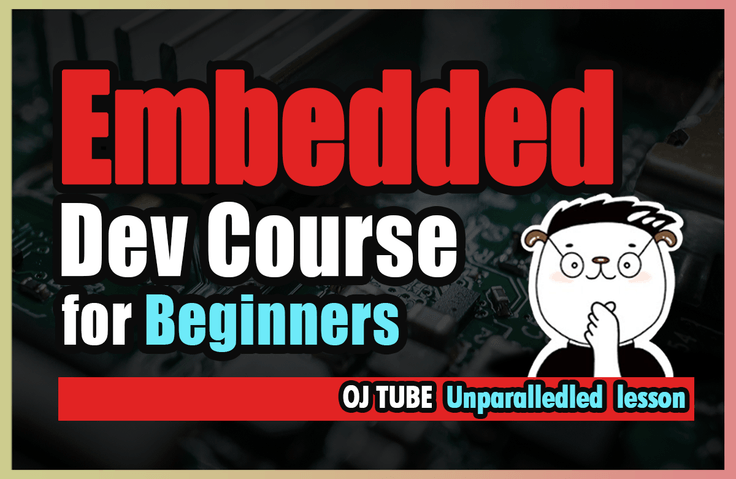
Are you looking for a basic embedded course? Start with the course that is closest to real-world practice! ⭐
Price adjusted for surpassing 300 students: 300,000 KRW -> 150,000 KRW 🎉 I have adjusted the price as I felt it was too burdensome. Since the editing costs were approximately 10 million KRW, I initially set a high price with the intention of selling to only a small number of people. However, more people than expected have taken the course, so I am now in a position where I can lower the price.
++ Additionally, I will be running a sale for the time being. 40,000 KRW additional discount coupon: https://inf.run/icvKy
Thank you!
From essential embedded knowledge to hands-on practice 🌶️
This course first began at the request of YouTube subscribers. When a YouTube survey was conducted, about 640 people voted, and approximately 45% requested an embedded course, so I proceeded with it. Unlike other development studies, embedded systems require various learning tools. This means it costs money. Nevertheless, I decided to start because so many people showed great enthusiasm.
Embedded System lectures are not common, and unlike other fields (Web Front-end, Back-end, Application development), the courses are very difficult and there are few lectures for beginners. Therefore, I planned an embedded lecture that even beginners can take. I commissioned an editor to refine the conducted lectures for better viewing and added learning materials to create the course.
In this course, you will learn the fundamental knowledge of embedded systems and then proceed with a hands-on project to build a chili pepper dryer. The chili pepper dryer incorporates embedded technologies currently used in commercial products. By working on the dryer yourself, you can fully apply the basics of embedded systems, such as 7-segment control, calculating temperature values via I2C analog temperature sensors, and GPIO control.
Recommended for these people 🙋
Those who want to become an embedded developer but don't know specifically how to start
Those who have experience with Arduino or Raspberry Pi but aren't exactly sure what "embedded" means.
Students who are curious about how embedded development actually works in practice
Embedded systems are difficult, but let's tackle them together with this lecture! ✍️
I explain difficult concepts in an easy-to-understand way.
Instead of just conveying information like reading from a book, I teach based on experience and understanding gained through practical field work.
I will teach you not only about software but also the minimum hardware knowledge you need to know.
I will show you how to grow as a developer.
What you will learn 📚
Learn the core knowledge that every embedded developer needs to know.
You can learn how embedded products are actually developed.
We will develop a product by following the process of one that was actually commercialized.
I will show you how to conduct research and grow as a developer on your own.
상세 커리큘럼이 궁금하다면?
0. Orientation
Course description, how to purchase learning tools, and lecture upload schedule
0-1. How to use the board correctly
Explanation of how to use the board, a learning tool, without damaging it
0-2. [Latest] Board Debugging Methods and Frequently Asked Questions
Detailed explanation on how to debug, and responses to frequently asked questions
1. What is embedded?
Exactly what embedded is
The process of how embedded products are created
How to grow as a developer
2. How do practitioners choose a chip?
Developer growth, the reason why you must see the big picture
Considerations for chip selection
Let's study chips.
3. Basic Knowledge of Electricity
Basic common sense about electricity
How to use a multimeter
3-1 Setting up the Development Environment
Setting up the development environment
4. Hello GPIO!!
What is setting up a development environment?
GPIO control!
5. How to become an embedded expert on your own
How to analyze drivers
6. Mastering GPIO Control
GPIO control code analysis
Analysis of GPIO control settings
7. Mastering GPIO Control
Manual GPIO Control
Why is the GPIO being controlled?
8. Saving everything learned so far into the big picture
GPIO control process
Check Startup code
main function code
Memory Control
Scanning the circuit diagram
9. Let's learn just as much of the schematics as we need
Schematic Concepts
Areas that an embedded software developer needs to know
10. Tricks for reading data sheets
A somewhat easier way to read data sheets
11. The Man Who Reads Datasheets
Data Sheet Interpretation
12. How to use a multimeter!
How to use a multimeter
13. How to use an oscilloscope!
Oscilloscope structure
Oscilloscope functions and principles
14. Red Pepper Dryer Set Unboxing
Looking at parts
15. Let's implement printf() using UART!
Implementing printf via UART
16. Create and control an LED circuit on my own
LED circuit configuration
Control software implementation
17. Creating a switch circuit on my own!
Switch circuit configuration
Control software implementation
18. FND Control + Practical Know-how!
Implementing FND circuits
How to use "shortcuts" or "hacks" during development in actual practice...
19. Let's learn SPI communication properly
Basic SPI Configuration
20. FND control source analysis!
Analyze the implemented FND control source code
21. Trying out the SPI functions provided by the STM32 chip
SPI features provided by the chip
22. Let's attach a temperature sensor!
Explanation of the temperature sensor
Course Review Preview 👀
* The reviews below are comments posted on a YouTube video uploaded by the instructor with a curriculum similar to this course.
Anticipated Q&A 💬
Q. Do I have to purchase the learning tools?
You must have the learning tools to take the course.
Q. Do I have to purchase the items from the market mentioned by the instructor?
No. It doesn't matter where you purchase them. The market is primarily for the convenience of the students. If you wish to purchase from the same place I mentioned, please refer to the link below.
Q. Do I have to purchase the exact board mentioned in the lecture?
No. It doesn't matter if you use a separate board that uses the same chip. However, you must have enough embedded-related knowledge to follow the lecture using a different board.
Q. Is there anything I need to prepare in advance?
Yes, you should be able to use the C language to some extent.
Q. What is the C language lecture conducted by the instructor that was mentioned in the lecture?
Q. Do I have to take the C language lecture mentioned above?
No, however, I recommend watching "[C Language Live Lecture 5] Bitwise Operations for Embedded Developers." This is because most other C language courses do not cover bitwise operations in depth.
Q. When and where does the instructor's consultation broadcast take place?
It is held every Saturday at 9 PM on the YouTube channel, OJ Tube.
Q. You said you provided embedded lectures for free, so why is it a paid service here?
Editing costs are the biggest reason. On YouTube, unedited videos are uploaded in real-time. This is because the editing costs alone amounted to 10 million won. T_T The edited content and learning materials are provided only to paid students. However, the learning materials can be viewed for free on a separate blog, not on YouTube.
Q. Aren't the learning tools being sold too expensive?
ㅠ_ㅠ It truly breaks my heart. Why does it cost so much for students learning embedded systems? Even so, these are the most affordable products I could find after doing my best to research. In the case of the pepper dryer set, if you were to purchase it separately, the shipping cost alone would be 50,000 KRW. Later, once you actually become an embedded developer and try researching and purchasing parts yourself... you will realize that these are by no means expensive prices. ㅠ_ㅠ
About the Instructor ✒️
Experience
I started my career as a developer through embedded systems. Since then, I have also developed web and app services, and have now become an 11th-year developer. Currently, I am the CEO of a small corporation called OJWare. I am also serving as a CTO at the request of another company.
I have been running a YouTube channel for three years and currently have 19,700 subscribers. Although it is growing very slowly, I have managed it consistently.
I hope the knowledge I have can be helpful to students who dream of becoming developers.
I started my career as a developer through embedded systems. Since then, I have also developed web and mobile apps, and have now become a developer in my 13th year. Currently, I am running a small company called 'OJ Co., Ltd.'
I have been running a YouTube channel for four years and currently have 24,000 subscribers. Growth has been very slow, but I have managed it consistently.
I hope the knowledge I have can be helpful to students dreaming of becoming developers.
First of all, thank you so much for creating this lecture!
When I decided to go into embedded field and study, there weren't many places to teach and there wasn't much information, so I was at a loss.
I found OJ through YouTube, and when I heard that Inflearn had launched a lecture, I started taking it.
I haven't finished the course yet, but what I felt while taking the course was that it was like a mentor teaching me practical content.
For me, who only studied a little bit of C language and knew nothing about embedded, this lecture was like a shower. I was able to draw a picture in my head of what I would do in the field if I did embedded development. Through the lecture, I became clearer about what I wanted to do.
While studying on my own while listening to OJ's lecture, I happened to find out that there was an embedded course in the national education program, so I took the course.
I think I will not be able to finish OJ's lecture, but I will be taking the course, but I think what I have learned through the lectures will be very helpful. As with other development fields, I think there is a lot to learn in the embedded field in particular. Although you may not be able to gain broad and deep knowledge of embedded through this lecture, it was worth the tuition just to be able to draw a big picture of how to study and what to do in embedded in the future.
I think it would be good for those who want to do embedded like me but are at a loss due to lack of information, rather than majors!
As one of your YouTube subscribers, I would like to thank you for always uploading good content.
I hope that if I meet you by chance while working in the field someday, I can greet you warmly. :)
1. More than 500 people have already purchased the course materials.
2. More than 50 people have paid for the course.
3. The Inflearn manager said the course was great after watching it.
Please show lots of love!
Although it wasn't mentioned in the orientation, I highly recommend that you purchase a multimeter.
In addition, you will need a tool to cut wires, electrical tape, a Daiso soldering iron, a flat-head screwdriver, a cutter knife, and a small box to complete the pepper dehydrator.