The Complete Guide to AB Testing
거친코딩
$38.50
Basic / AB test, Statistics
4.9
(22)
300+
As the popularity and interest in AB Testing explodes, we will introduce Korea's first AB Testing lecture right now!

Basic
AB test, Statistics

Implementing a Personalized Recommendation System ✅
Rough but informative with Rough Coding!

Netflix, Amazon, YouTube, Spotify, and other
world-renowned services, as well as
services utilizing recommendation algorithms,
are increasingly on the rise.
"Can I really grasp the concepts of recommendation algorithms correctly?"
"I understand the concept of recommendation algorithms, but... how do I actually implement them?"
👇👇
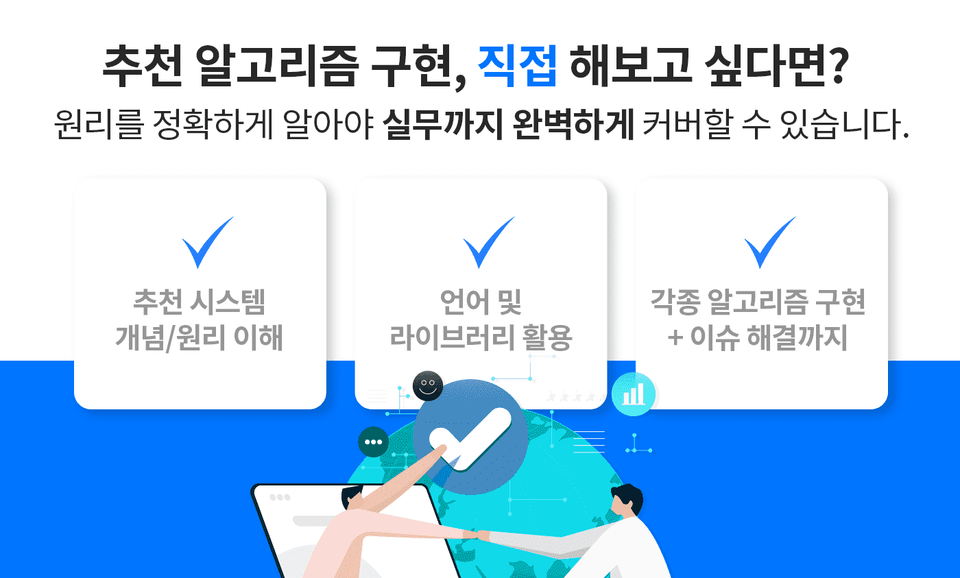
As services utilizing recommendation algorithms continue to grow, the number of people wanting to learn about them is also steadily increasing. In line with this trend, <Personalized Recommendation Systems Using Python> aims to explain the accurate concepts and principles of recommendation algorithms using Python, an easy-to-understand and intuitive programming language.
Recommendation algorithms, why Python?

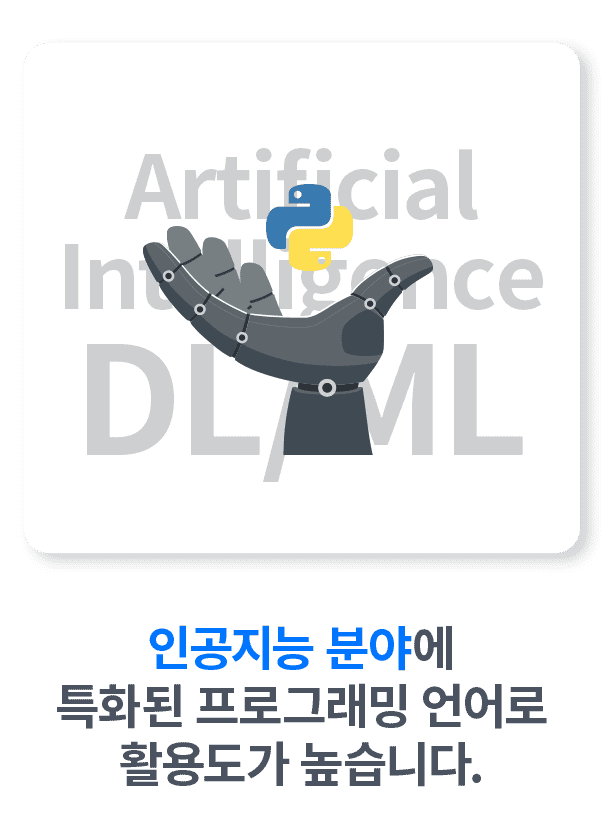
I hope this will be a meaningful time for those who want to learn about recommendation systems and those who wish to develop implementation skills suitable for practical work 😊
💻 Please check the prerequisite knowledge!

Hello! I am Geochin Coding, currently working as a Data Analyst at "one of the NAVER/Kakao/LINE companies".
Have you been wondering if you can truly grasp the concepts of recommendation algorithms? Do you feel like you understand it when reading a book, but feel completely lost when it comes to actually implementing the algorithm?
Through this course, I intend to solidly establish the foundation of recommendation algorithms by accurately explaining the concepts and operating principles. The course is structured not just to end with simple conceptual explanations, but to provide you with the confidence for actual implementation by coding the specific operating principles together.

Currently, I am performing data collection, processing, analysis, prediction, visualization, and task automation using Python and visualization tools (Tableau) at "one of the Naver, Kakao, or Line companies".
Key Experience
Mentoring in progress
The beginning is the most important part of everything. If you have any questions while learning, please inquire through [Q&A]. I am also conducting mentoring, so I hope to be of great help to those interested in data analysis. 😊

A vague lecture focused only on simple conceptual explanations?
• The lecture doesn't seem much different from the materials
scattered across the internet.
• The conceptual explanations are good, but
how exactly do I implement it in practice?
• The difficulty level of the language itself is too high.

Systematic curriculum, practice-oriented practical lectures!
• This is a practical lecture focused on
principles and hands-on practice, not just simple conceptual explanations.
• It's not just a collection of web materials, but a compilation of
authoritative reference books.
• It utilizes Python for quick and easy learning.
Simple conceptual explanations of recommendation algorithms are already scattered across many sites. However, no matter how good a conceptual explanation is, it is useless if it does not lead to an actual, accurate implementation.
In this course, we will not only provide a thorough explanation of recommendation algorithm concepts but also share solid know-how for implementing recommendation systems in real-world business environments.
The lectures are conducted using Python, a language that can be learned faster than other programming languages and is specialized for the field of artificial intelligence. The course is structured so that you can learn not only the understanding of recommendation algorithms but also the data engineering required for building AI models.
 Personalized Recommendation Systems using Python (Published by Chungram, written by Im Il)
This is not a lecture hastily put together by simply gathering random information scattered across various websites. The curriculum has been systematically structured based on organized content from authoritative reference materials.

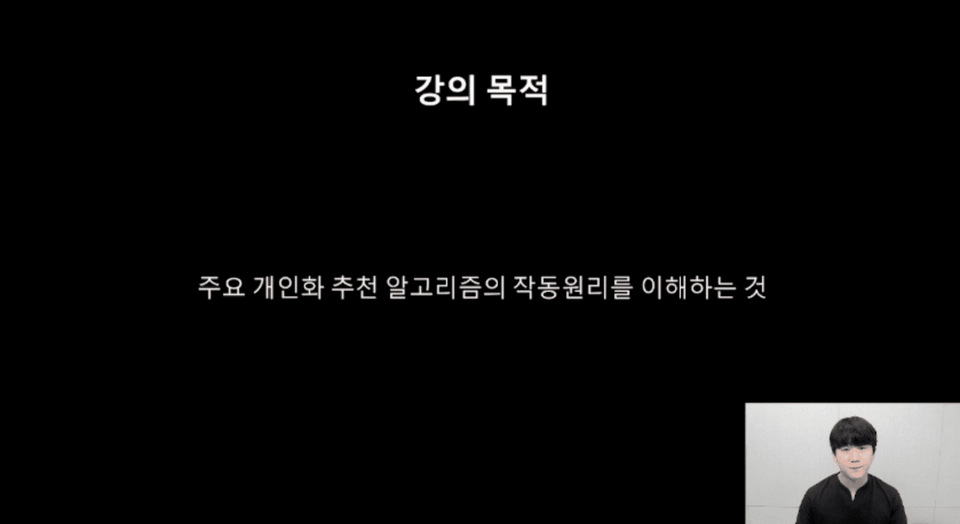
Orientation
The purpose of this lecture is to understand the working principles of major personalized recommendation algorithms. The objectives and introduction of the lecture are summarized in a 5-minute orientation video, so please check it out via [Course Preview]!
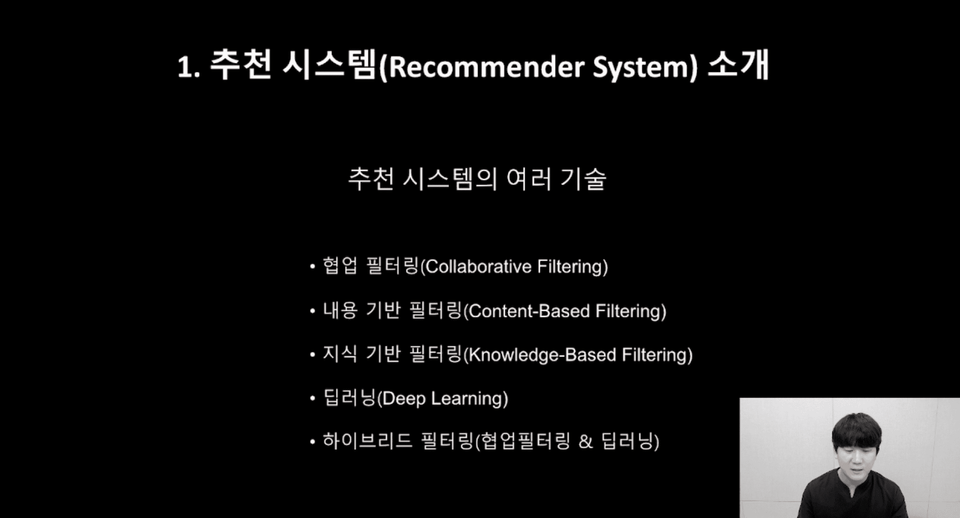
Introduction to Recommendation Systems
We introduce the concept of recommendation systems, which select and present necessary information or products to users based on their past behavioral data or other information, along with various technologies and their evolutionary processes.
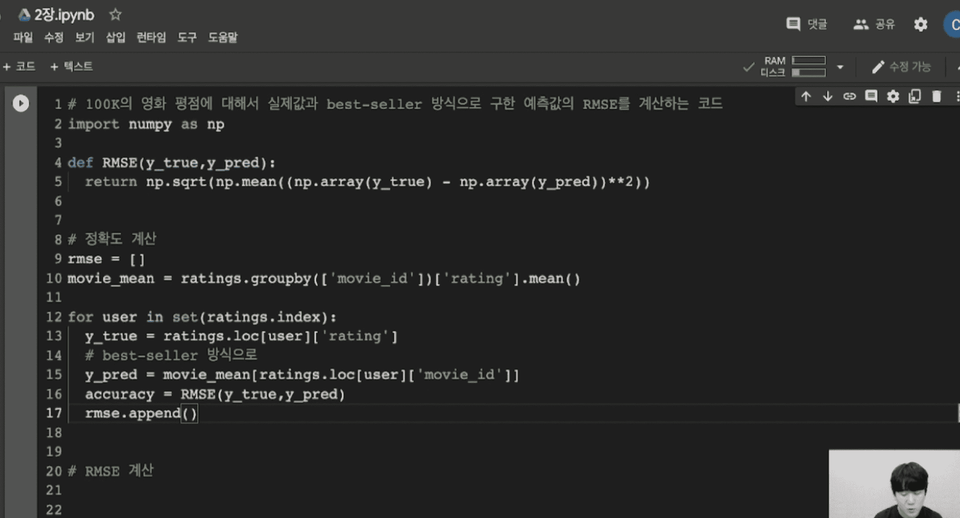
Basic Recommendation Systems
This is the process of preparing and understanding the basic data for future theory and practice. We will introduce the basic operating principles of recommendation systems.
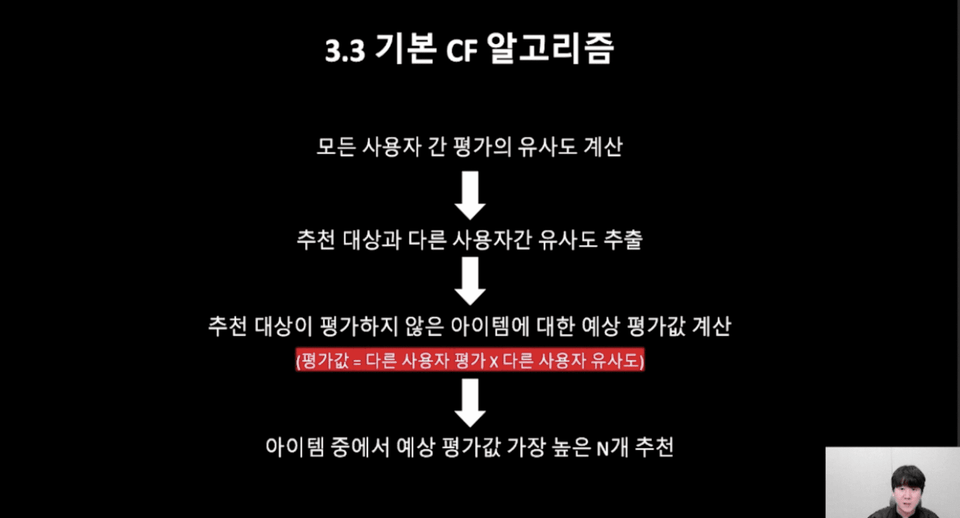
Collaborative Filtering Recommendation System
We will introduce the concepts and operating principles of similarity-based Collaborative Filtering (CF) and enhance your understanding of these concepts by implementing them together.
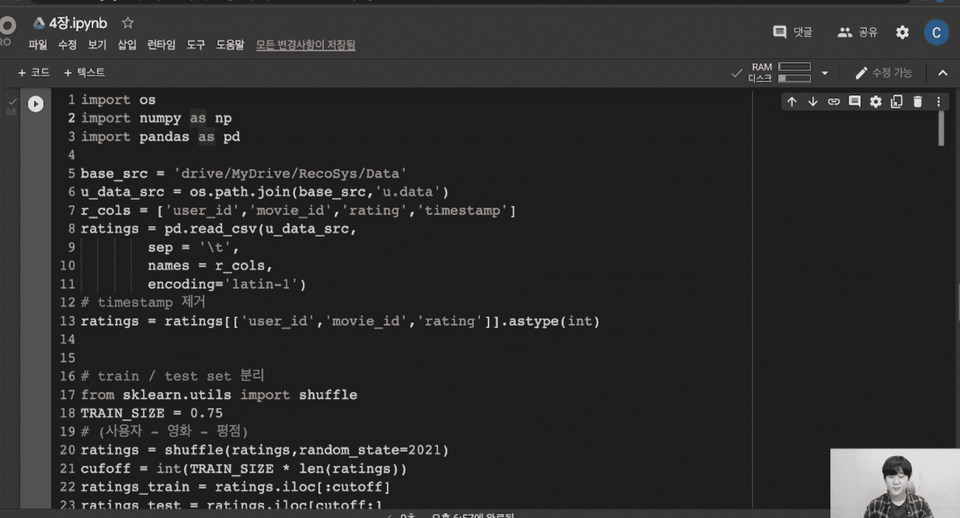
Matrix Factorization (MF) Based Recommendation
We introduce the concept and operating principles of Matrix Factorization (MF), which is based on matrix operations, and enhance your understanding of the concept by implementing it together.
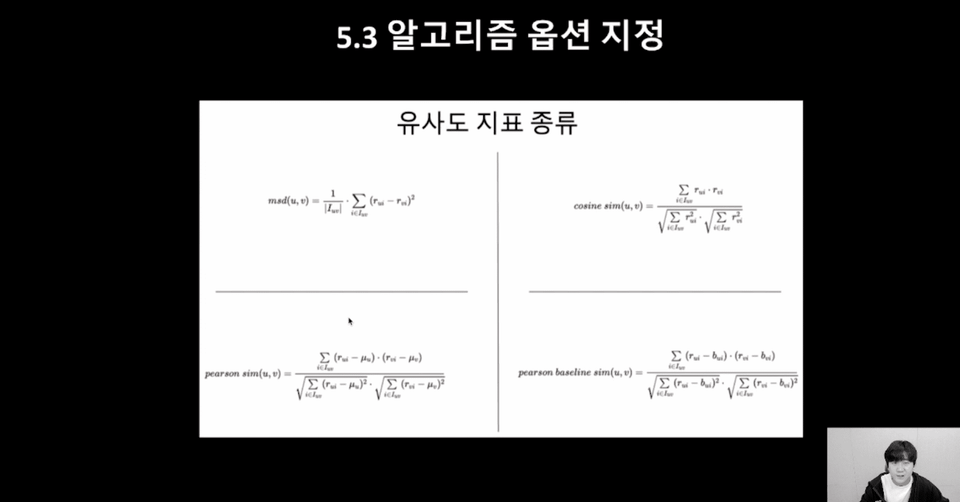
Using the Surprise Package
Learn the concepts and operating principles of a package that allows you to easily implement and test CF and MF-based recommendation systems.
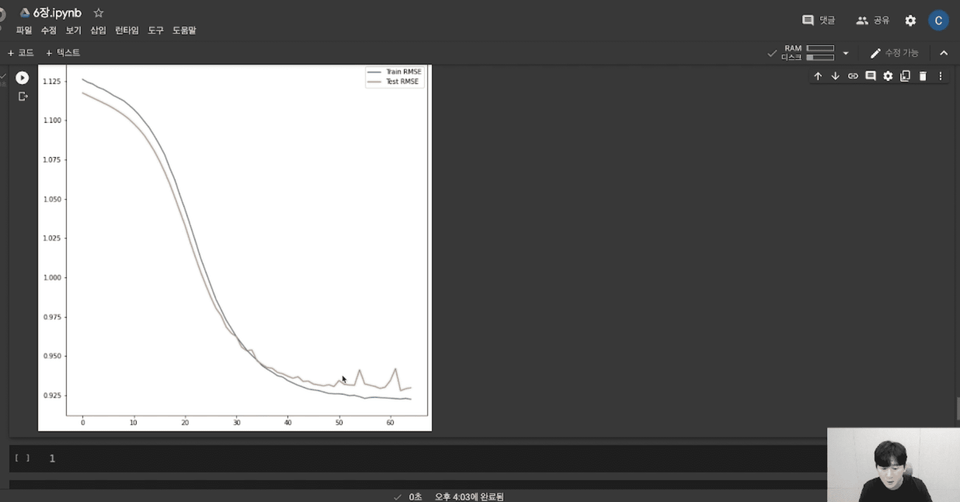
Recommendation Systems Using Deep Learning
We will enhance our understanding of the concept by exploring the principles and practical applications of operating a recommendation system using artificial neural networks with multiple hidden layers.
Hybrid Recommender Systems
We will enhance understanding through methodological content on complementing and improving mutual performance by combining multiple recommendation algorithms, as well as through practical hands-on exercises.
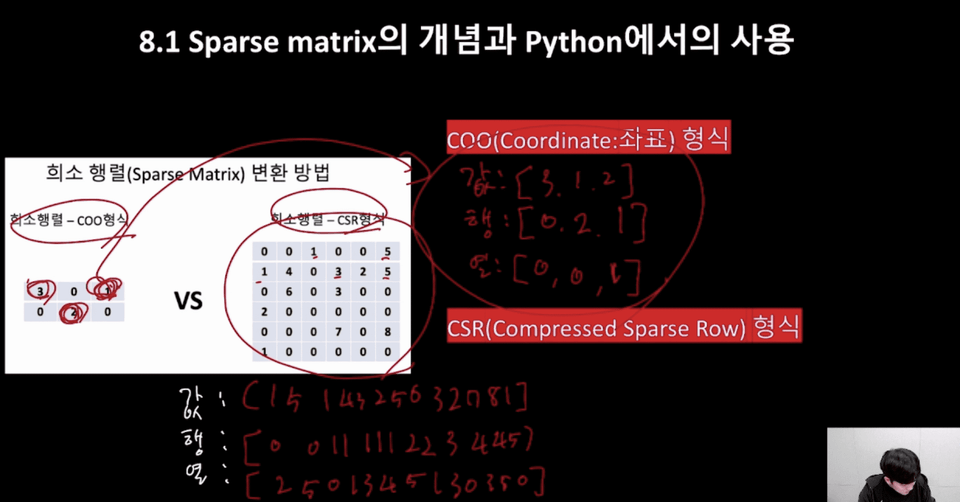
Using Sparse Matrix for processing large-scale data
By learning the methods for processing overwhelming amounts of data and the entire process of applying actual recommendation algorithms, you will gain a sense of practical, real-world skills.
Issues in building recommendation systems
Through a comprehensive summary of problems and issues that frequently occur when building an actual recommendation system, you will directly learn various know-hows that can help reduce trial and error during the actual production process.
Q. Is it mandatory to have prior knowledge of Python, Numpy, Pandas, and Keras?
You must know Python, but you don't need to study the other libraries too deeply in advance. I recommend looking up and studying only the parts you don't know as they come up while taking the course. The library functions used in the lectures are very useful and commonly used, so for those studying for the first time, they could serve as a guideline for what to study first. 😉
Q. Is the data provided in advance?
Of course. The data used in all lectures will be the MovieLens data, which was developed and verified by the GroupLens project at the University of Minnesota. You can download it via the data URL provided before the class begins.
Q. Can I develop an actual recommendation engine by taking this course?
In every lecture chapter, we cover not only the concepts of various recommendation algorithms but also practical hands-on exercises. Therefore, by making slight modifications to the code we practice together to fit your specific domain, you will be able to develop your own recommendation engine.
Q. Do I need to install Python separately or set up a development environment?
There is absolutely no need for that. To eliminate the hassle of installation and setting up a development environment, we will use Colab, a web-based editor provided by Google.
You can find detailed instructions on how to use Colab on my blog, or you can find more information by searching for "how to use Colab" on Google.
Machine Learning Built from Python Basic Libraries
The perfect guide for those starting machine learning for the first time!Free Lecture

Hello. I am "Rough Coding," a rough but truly informative data analyst.
Korea University, Department of Statistics (Graduated)
Korea University Graduate School, Department of Big Data Convergence (Enrolled)
QS World University Rankings Evaluation Committee Member
Completed the Advanced Artificial Intelligence course at Korea University, a SW-centered university
Session Leader of KUCC (Computer Club), Korea University
5-time Department Valedictorian and 1-time Overall Valedictorian at Korea University
Big Data Analysis Engineer Certification
Advanced Data Analytics Semi-Professional (ADsP) Certification
I am currently working at "one of the NAVER/Kakao companies" performing data collection, processing, analysis, prediction, visualization, and task automation using Python and visualization tools (Tableau).
Efficient study methods for students dreaming of a career in data analysis
Mentoring for junior analysts currently working in the field of data analysis
Those who are not in an IT role but wish to apply IT technology to their own work.
Conducted remotely via Zoom
Requirements: Computer, camera, earphones
Mentoring will proceed based on pre-prepared questions or your current situation.
The beginning is the most important part of everything. Let's make sure to achieve what you want with burning passion!
rough_coding@naver.com





![[ICT Archive] Big Data Core and Business ModelsCourse Thumbnail](https://cdn.inflearn.com/public/files/courses/338811/cover/01k44rs7zkwq0ehc8vqsy2mdtb?w=420)