This contains everything you need to truly get started with Kubernetes (☸). 🧭
Through this course, you can begin your journey with the easiest way to understand the structure of Kubernetes. 🥇
This lecture stands out for the instructor's kind efforts to hide the code. Thanks to this, even if you don't know the Kubernetes concept, you can easily approach it. Even after becoming a developer, Kubernetes felt difficult, but thanks to this lecture, I was able to grasp the concept of what Kubernetes is. I want to listen to the next lecture soon.
5.0
rainingdaewoo
59% enrolled
It seems like a good lecture, but it's still too early for me.
I use Docker a lot at work, so I tried to study it after Docker... but it's still difficult.
I'll try Kubernetes a little and come back to listen again.
5.0
김석영
17% enrolled
After updating to 1.25, various things that weren't working are now working properly, so I think I'll be able to watch all the lectures!
What you will gain after the course
You can understand why Kubernetes works that way.
You can understand the difference between control plane nodes and worker nodes.
I can understand the basic objects of Kubernetes.
You can gain a general understanding of microservices architecture.
You can have your own Kubernetes environment anytime, anywhere, without any time or cost constraints.
You can learn about the components that form the solid backbone of Kubernetes.
How to upgrade Kubernetes version
How to manage Kubernetes versions more effectively using Ansible
The first step of your Kubernetes journey! 🚢 Lay the foundation for your growth as a developer/engineer.
The Easiest Kubernetes Guide
📢 Practice updated to Kubernetes v1.35!
On February 19, 2026, the Kubernetes practice exercises were updated to version 1.35.
📢 Practice updated to Kubernetes v1.30!
On June 16, 2024, the Kubernetes practice labs were updated to align with v1.30.
Accordingly, each ch2 has been changed to a format commonly used throughout the entire course, and subsequent lectures have had their sequence numbers increased by one level. (e.g., ch3 changed to ch4, supplementary lessons changed to A)
Additionally, the default operating system has been changed from CentOS 7 to Ubuntu 22.04.
The additional videos filmed for the v1.30 update are 7.1 and 7.2.
Previous reinforcements have been saved in A, and from v1.30 onwards, they will proceed with B.
🎉 Mac Silicon (M Series, arm64) is now officially supported. 😄
📢 Practice updated to Kubernetes v1.25!
On September 18, 2022, the Kubernetes practice exercises were updated to align with v1.25.
Accordingly, the videos for 4.2, 4.3, and 6.2 have been updated.
Other than that, the parts where the practice exercises themselves did not change have been maintained!
This course was created with the goal of helping you start Kubernetes easily by organizing the areas where people typically struggle when beginning. Therefore, to ensure better learning outcomes, all content is explained through diagrams and hands-on practice whenever possible.
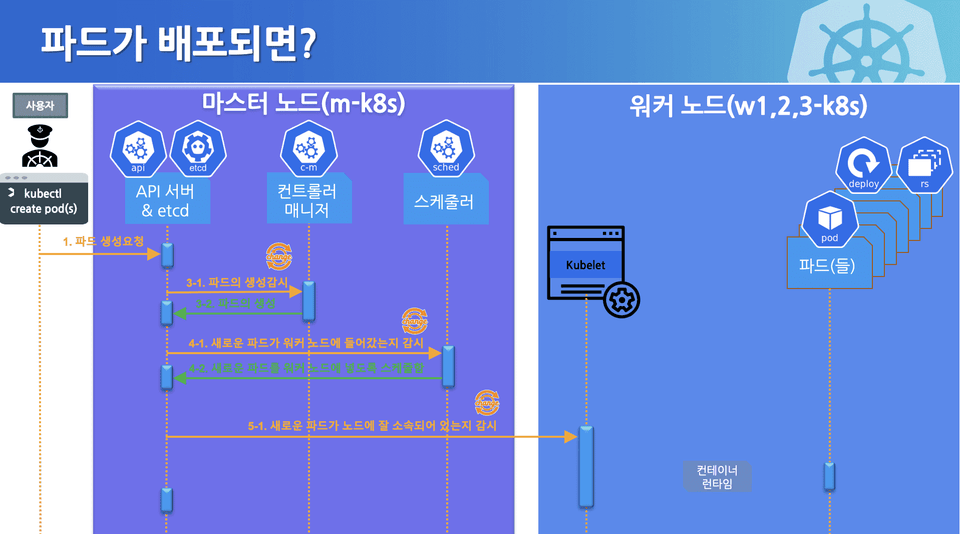
Pod Deployment Lifecycle
In other words, the goal is to understand Kubernetes itself without looking at code, thereby providing a proper foundation to start learning Kubernetes.
💡 Things to know before enrolling in the course
This course is designed to provide a big-picture understanding of the Kubernetes platform and does not involve coding, so it is difficult to learn the granular details of Kubernetes. Accordingly, the target audience for this course includes PMs, planners, some managers, and those who wish to approach Kubernetes after establishing a broad overview.
코드를 다루는 것을 포함하여 좀 더 깊이 있는 강의는 이후 강의인 그림으로 배우는 쿠버네티스에서 다루며, 현 강의 스타일을 사전에 확인하기 위해서는 미리보기로 무료 공개된
If you find the content above satisfactory and believe the current course list will be helpful, I recommend proceeding with the lecture.
Why Kubernetes?
Kubernetes is becoming an unavoidable trend in modern IT. Not only the major three providers (AWS, Azure, GCP), but almost all IT vendors are releasing Kubernetes-related solutions, making it emerge as a fundamental technology for all of IT. Therefore, I hope you encounter Kubernetes as soon as possible and use it as a foundation to grow as a developer or engineer.
Google Kubernetes Engine
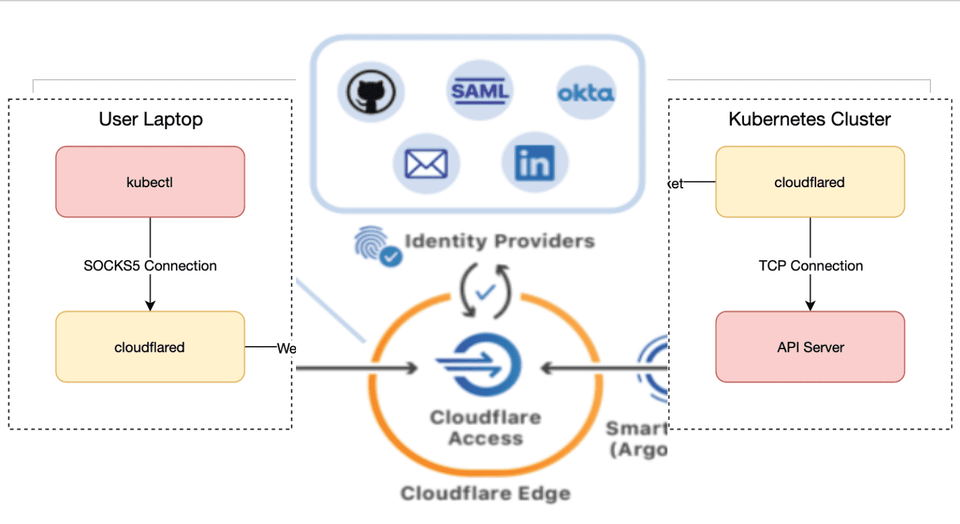
As an example, Cloudflare, famous for its CDN and the 1.1.1.1 address, uses Kubernetes internally in a way where engineers configure the environment and developers request and use it. The foundational architecture of famous portal IT companies in Korea is also built on Kubernetes.
Cloudflare's Kubectl
Furthermore, the market has already shifted to a Kubernetes environment, to the extent that VMware, a famous virtualization company, has released Tanzu based on Kubernetes.
Why not start learning Kubernetes right now?
Features of this course
Even if you don't know code, you can take this course.
You can understand the overall flow of Kubernetes.
You can have your own Kubernetes test environment.
It enables you to start handling Kubernetes.
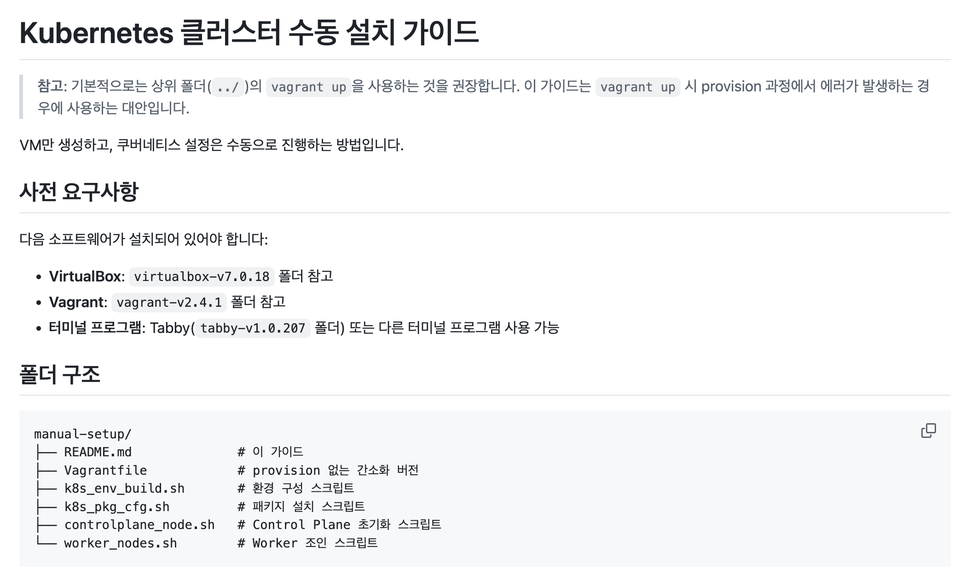
A Kubernetes cluster (1 control plane node, 3 worker nodes) will be automatically configured as we proceed, and scripts and manuals for manual installation are provided in case automatic configuration is difficult.
I have seen many people around me trying to start with Kubernetes but finding it very difficult to grasp the concepts. This is likely because it has many unique conceptual aspects and the foundational knowledge required is quite broad. Therefore, this lecture is a reflection of my concerns on "How can I explain this part easily?" and "How can I help resolve the fundamental challenges of studying Kubernetes?"
During that time, I have been conducting Kubernetes-related activities in various places.
Load balancers even on-premises? (w/ MetalLb) Kubernetes Korea User Group presentation video
Comparison between Porter and MetalLB (Open Infra Day Presentation)
Demonstration of automated Kubernetes deployment with a multi-control plane structure using kubespray
Q. I don't know what Kubernetes is; will I regret taking this course?
That is a very good question. I prepared this specifically for people like you. I have handled everything with scripts so that almost no prior knowledge is required. I worked hard to create this as a lecture for getting started.
Q. Do I really need to know Kubernetes?
What a great series of questions... Yes, if you are retiring in 3-5 years, or if you plan to start your own business by then, you might not need it. However, Kubernetes will become an essential element that almost everyone in IT (even in planning...) must know. It will reach a status similar to where Linux is today.
Q. Can I learn everything about Kubernetes just by taking this course?
I will be honest with you... it is impossible to teach everything about Kubernetes in a few dozen hours of online or offline lectures. Because Kubernetes is constantly integrating all elements of modern IT, it is not possible for an individual to learn and claim to know everything in a short period of time. Furthermore, it is a technology that evolves very rapidly and requires different directions depending on specific needs, so it requires a significant amount of individual study.
But the important thing is... there are certain things you must know when starting Kubernetes, and I believe this course will help you get started with Kubernetes the right way by covering those essential parts.
Programs and versions used in the course & course source address
We are doing our best to ensure a smooth practice experience for all students, but please understand that we may not be able to provide assistance for Vagrant-related errors that occur due to individual environments.
(x86-64) Vagrant related errors can make it difficult to proceed with the practice, so we are providing an OVA image for those experiencing issues. (The download link is provided at the bottom of lecture 2.3)
We provide answers to questions, but Q&A is not included in the course fee. However, if the practice exercises do not work or if there is incorrect content, please let us know and we will take action as quickly as possible.
Recommended for these people
Who is this course right for?
Those who are using Kubernetes in the cloud and are curious about its inner workings
Those who need an understanding of the architecture of on-premises Kubernetes (e.g., OpenShift)
Those who want to experience Kubernetes without knowing how to code
Those who really want to start with Kubernetes
Those who need their own Kubernetes test environment without any cost burden
Need to know before starting?
Basic Linux commands (e.g., cd, ls, cat, etc.)
Basics of networking (e.g., 192.168.1.10/24 and 192.168.1.101/24 can communicate with each other)
As an expert in Kubernetes and AI-native technologies, he is a CNCF and Agentic AI Foundation (AAIF) Global Ambassador and a Kubestronaut. He operates KubernetesLab (kuberneteslab.dev) where he researches and shares infrastructure automation technologies. He is active as an organizer for the 'IT Infrastructure Engineer Group' and an open-source contributor, conducting various practical PoCs such as customized infrastructure training, Kubernetes cost optimization, and comparative verification of multi-LLM and AI agents. He has authored a total of five IT books, including the recently published "Infrastructure Configuration and Deployment for Developers in the AI Era with Claude Code," and continues his knowledge-sharing activities through Inflearn lectures and contributions to YojeumIT.
This lecture stands out for the instructor's kind efforts to hide the code. Thanks to this, even if you don't know the Kubernetes concept, you can easily approach it. Even after becoming a developer, Kubernetes felt difficult, but thanks to this lecture, I was able to grasp the concept of what Kubernetes is. I want to listen to the next lecture soon.
It seems like a good lecture, but it's still too early for me.
I use Docker a lot at work, so I tried to study it after Docker... but it's still difficult.
I'll try Kubernetes a little and come back to listen again.
The lectures are currently being updated, but
you cannot proceed with the practice by just watching the lectures.
There are many parts that have changed and have been omitted from the book.
You can follow the omitted parts by reading the book.
You need to ask questions and find the changed parts to solve them.
I don't know what you mean by saying that you can't do the practical training just by watching the lecture.
And I think you have some expectations related to the book, but it is separated from the book and is not designed to be 100% related to the contents of the book. The book is fixed, and the lectures can be updated continuously. I think you are dissatisfied with the lectures being updated.
I think you are dissatisfied with something that I can't figure out exactly... I would like to suggest that you consider canceling the lecture.
+(Additional 1) The reason I recommended canceling the lecture is because it is difficult to fix that part. The lectures will continue to be updated and changed, and I think that will be helpful to the students. That's why it may be different from the book. Also, I think that delivering the same content as the book (3 years ago) is more considerate to the students.
+(Additional 2) If there is something that you can't do the practical training just by watching the lecture, please let me know so that I can take action. (As for the password part, I tested it on various platforms and dozens of times, and it doesn't appear as <if you copied config.yaml>, but if it does appear, it is written in the note below so that you can enter the password.)









![Docker and Modern Server Technologies for Full-Stack (Linux, nginx, AWS, HTTPS, to Deployment) [Full-Stack Part 3]Course Thumbnail](https://cdn.inflearn.com/public/courses/326771/cover/bc862b4d-abe6-4d80-a826-3a5324a9f998/326771-eng.png?w=420)



![[VANTA] MongoDB on Kubernetes - BasicsCourse Thumbnail](https://cdn.inflearn.com/public/files/courses/341003/cover/01kp0zg5xs18sjqrrm8328n7cs?w=420)