It was a really good lecture. I finished it once and will listen to it again and study. Please continue to give good lectures.
5.0
NC_Ryan
100% enrolled
It is incomparable to lectures that simply explain theories and codes.
The instructor's sincerity is in what he wants the students to learn, and the content and structure are also very good.
This is the kind of lecture I was looking for. Please make many good lectures on various topics.
5.0
양창민
100% enrolled
It's a good lecture. Especially, after explaining the theory, it's great for understanding the flow by implementing it from the bottom up with TensorFlow code and Python code. I hope the error backpropagation lecture comes up soon.
What you will gain after the course
Deep Learning Basics
Deep Learning Network Operations
Tensorflow
This lecture is the first lecture in the [L4DL Project] that deals with deep learning in earnest.
When studying deep learning, simply creating a model and training it doesn't have much long-term meaning.
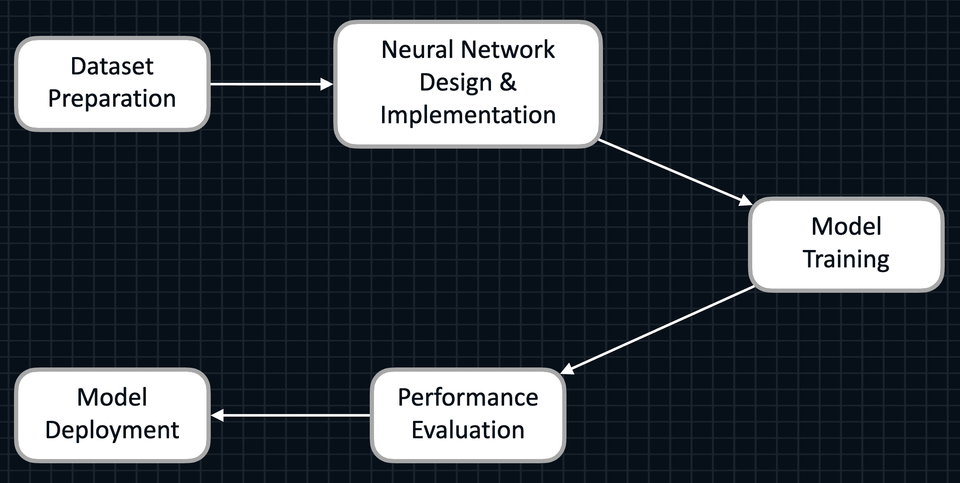
To truly understand deep learning, you need to understand what operations deep learning networks use to calculate output before covering backpropagation or parameter update algorithms. The actual deep learning model is created through the following process.
From the perspective of learning deep learning, the part that you need to focus on the most is the Model Training process. And this process is as follows:
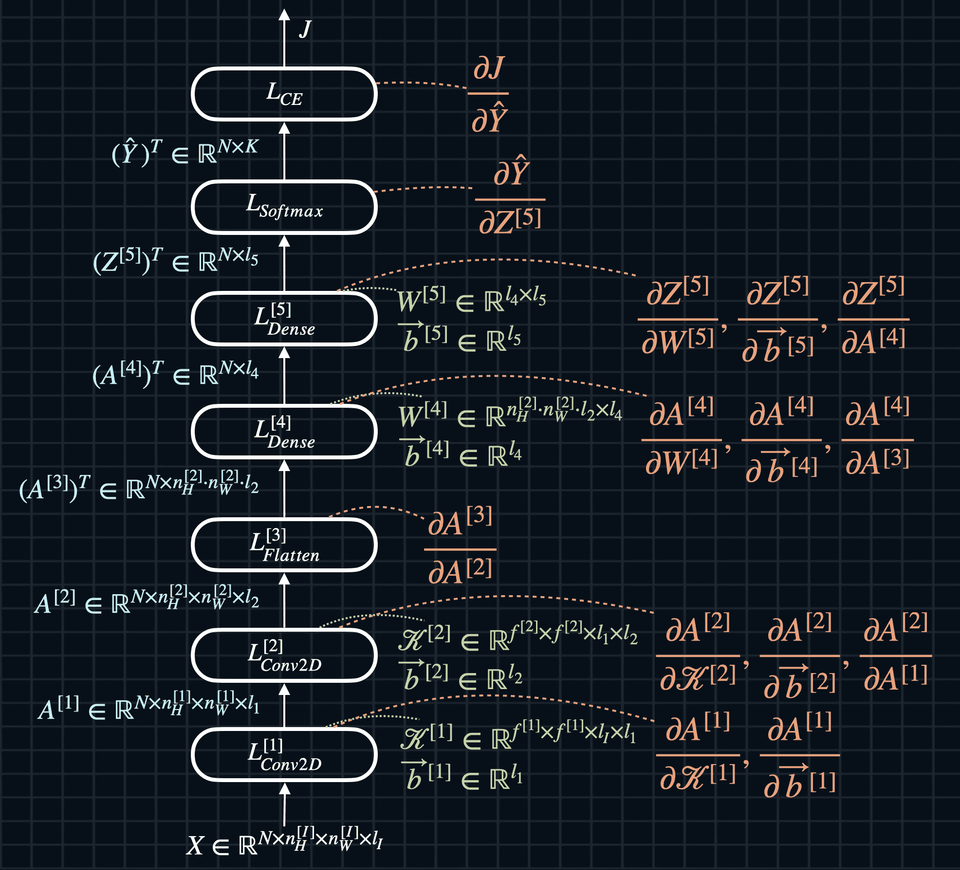
This lecture focuses on forward propagation , which corresponds to model prediction and loss calculation in this course. Through this, you will learn how a convolutional neural network generates its output . And based on this concept, a deeper understanding of deep learning will be achieved.
Convolutional Neural Networks
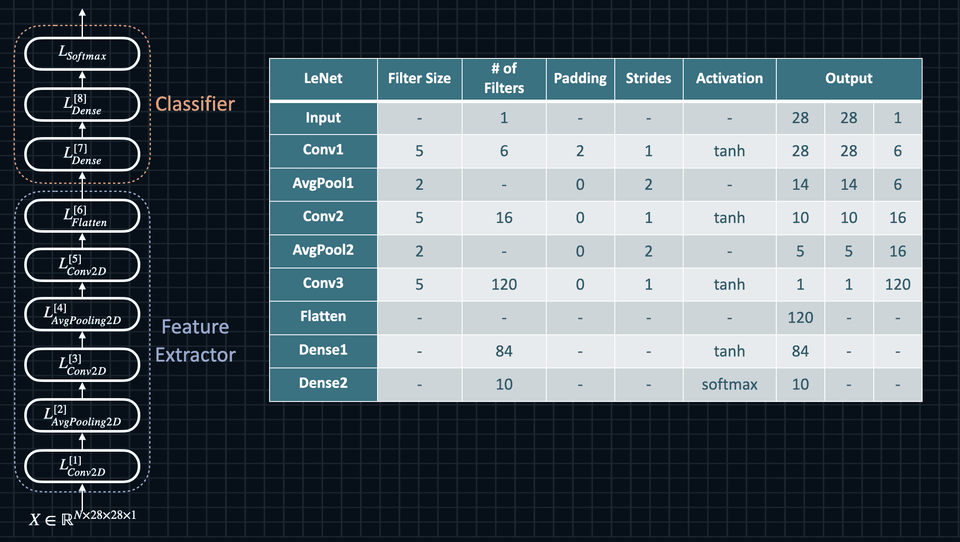
Deep learning was first introduced to image classification. Accordingly, the most fundamental models for understanding deep learning are image classifiers like LeNet, AlexNet, and VGGNet. Therefore, in this lecture, we will focus on the computation of the network related to Convolutional Neural Network, which we will be focusing on for a while in the future.
Implementation with Tensorflow
In this lecture, we will use TensorFlow to create the most basic layers used in deep learning, such as dense layers, convolutional layers, max/average pooling layers, and softmax layers. We will also create operations ourselves and see how what we learned theoretically is implemented in TensorFlow .
Parameters in Networks
After completing this course, you will understand the trainable parameters of the entire deep learning network andhow these variables are used in computation . Therefore, you will understand the characteristics of each layer, as follows: Later, this concept will be used to understand the vector chain rule that trains deep learning models.
Recommended for these people
Who is this course right for?
Deep Learning Beginner
[L4DL Project] Participants
Need to know before starting?
Python Basics
Hello This is
3,872
Learners
180
Reviews
85
Answers
4.9
Rating
21
Courses
Lecture History
[Like Lion] Intermediate/Advanced AI Course
[National Institute of Meteorological Sciences] 2022, 2023, 2025 Meteorological AI Boost Camp
[Samsung Electro-Mechanics] Advanced Software Course for New Employees
[Korea Institute of Human Resources Development in Science and Technology] Long-term Mentoring for Strengthening R&D Implementation Capabilities
[Korea Institute of Human Resources Development in Science and Technology] E-learning content production for R&D professional courses
[Korea Institute of Human Resources Development in Science and Technology] Research Data Visualization Course for Postdoctoral Researchers
[Wonkwang University] Wonkwang University AI Collective Training and AI Short/Long-term Courses
[National Information Society Agency] SW Education for Women Professionals
[SK m&service] Data-Driven Decision Making
[Korea IT Business Promotion Association] ICT COG Academy
[Seoul Metropolitan Office of Education] Training in New Technology Fields
[KT] KT AI Competency Enhancement Course
[K-ICT] Data Safe Zone Analysis Camp
[Gyeonggi-do Business & Science Accelerator] Vision AI for Beginners
[Gyeonggi Business & Science Accelerator] Introduction to Data Analysis with Python
[Seoul National University of Science and Technology] Advanced AI Utilization Training
[Seoul National University] AI Utilization Capacity Building Training
[HD Korea Shipbuilding & Offshore Engineering] AIC AI Research Position Competency Assessment Development
[Multicampus] Mastering Core Machine Learning Algorithms: From Principles to Implementation
[Fast Campus] A Mathematical Approach to Deep Learning
[패스트캠퍼스] Machine Learning and Data Analysis A-Z: All-in-One Master Class
[Fast Campus] Byte Degree Lv.2 Deep Learning Essentials
[Fast Campus] Deep Learning & AI Super Gap
[Fast Campus] Computer Science Super Gap VER.2
Analysis A-Z [Fast Campus] Byte Degree Lv.2 Deep Learning Essentials [Fast Campus] Deep Learning AI Super Gap [Fast Campus] Computer Science Super Gap VER.2
It's a good lecture. Especially, after explaining the theory, it's great for understanding the flow by implementing it from the bottom up with TensorFlow code and Python code. I hope the error backpropagation lecture comes up soon.
It is incomparable to lectures that simply explain theories and codes.
The instructor's sincerity is in what he wants the students to learn, and the content and structure are also very good.
This is the kind of lecture I was looking for. Please make many good lectures on various topics.







![[PY 0205] Python Level 4 for Artificial Intelligence - Objects and Classes강의 썸네일](https://cdn.inflearn.com/public/courses/334425/cover/d595b571-3e0c-4a63-9d5f-f2195736de2b/334425.png?f=avif&w=420)
![[PY 0204] Python Level 3 for Artificial Intelligence - Functions강의 썸네일](https://cdn.inflearn.com/public/courses/333279/cover/eb80d90b-0359-4c7d-b9ee-f4997c35171d/333279.png?f=avif&w=420)
![[PY 0203] Debugging Fundamentals강의 썸네일](https://cdn.inflearn.com/public/courses/333278/cover/1c14834a-9ab7-4973-b8f0-e8f6f24bffc8/333278.png?f=avif&w=420)
![[PY 0202] Python Level 2 for Artificial Intelligence강의 썸네일](https://cdn.inflearn.com/public/courses/332825/cover/af1a2083-d1ee-4b72-8ce9-55281cb89c9a/332825.png?f=avif&w=420)
![[PY 0201] Python Level 1 for Artificial Intelligence강의 썸네일](https://cdn.inflearn.com/public/courses/332643/cover/db98c954-be00-44ca-bd33-3cd69e290fff/Untitled.001.png?f=avif&w=420)


![[PL 0303] Python for Data Visualization - Matplotlib Master Class강의 썸네일](https://cdn.inflearn.com/public/courses/336172/cover/80fa86e7-dcb6-4b0f-b15b-323b6fa32809/336172.png?f=avif&w=420)
![[PL 0302] Python for Data Manipulation - NumPy Masterclass강의 썸네일](https://cdn.inflearn.com/public/courses/334756/cover/a4cbdc80-53da-4422-9b8d-67362b68a9fa/334756.png?f=avif&w=420)
![[PL 0301] Python Virtual Environment and Anaconda강의 썸네일](https://cdn.inflearn.com/public/courses/334755/cover/9d8ca8fb-2031-4dba-aa31-efb43963dba7/334755.png?f=avif&w=420)

