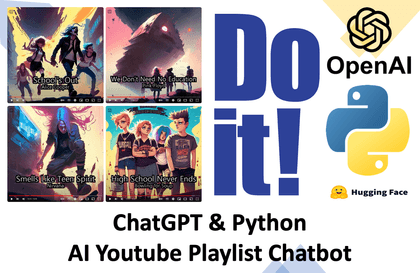
Creating a YouTube AI Employee with ChatGPT and Python
SungYong Lee
$68.20
Basic / ChatGPT, gpt, Python, openai
4.7
(18)
100+
Create a program using the GPT API, and even generate images and videos!

Basic
ChatGPT, gpt, Python

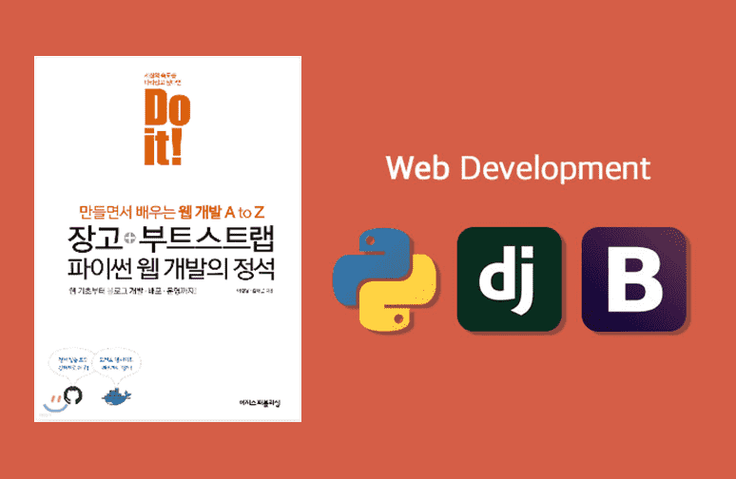
The 'Standard' of Python Web Development!
Learning Web Development from A to Z by Building 💬
In this course?

From HTML, CSS, and JavaScript
to Django, Docker, and Amazon Web Services (AWS)!
A course covering the overall content of web development through Python 😆
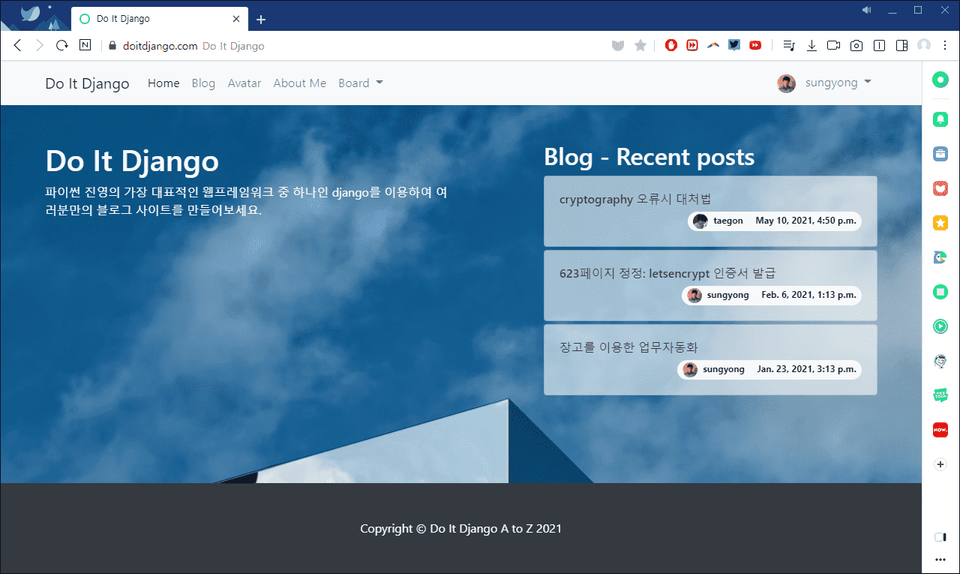
This course is for Python users who want to do web development. You can create your own blog site using Django, one of the most representative web frameworks in the Python ecosystem. After following this course to the end, everyone will be able to have a website like doitdjango.com .
In this course, you can learn everything from HTML, CSS, and JavaScript to Bootstrap, the Python web framework Django, Docker, and Amazon Web Services (AWS). Build a comprehensive understanding of web development and develop problem-solving skills by implementing necessary features one by one and overcoming the challenges you encounter. Let's get started right now!

Please check before taking the course!
This course is for those who want to learn through video the <Do it! Django+Bootstrap Python Web Development Guide> published by Easyspub. As of 2021, it includes additional commonly used technologies, and incorporates as much feedback as possible from students who took the course that opened in 2019.
Shall we properly dive into web development together? 👉

"I've learned the
basics of Python,
but now I'm worried
about what to do next."

"I want to make
something worth showing
based on the Python
I have learned so far."

"I came up with a great web service
idea, but
I feel lost on
where to start."
I have structured this course so that even those who have only taken a basic Python course and know nothing about the web can easily follow along. Go from the stage of installing Python and setting up your development environment to developing a Google login feature and finally hosting your service on an Amazon web server using Docker.
This course aims to develop and actually deploy a blog that you can use and operate yourself. Therefore, it includes the development of all necessary features for real-world web development, such as writing permission settings, social login, and security. By the time you finish this course, doitdjango.com you will have a fully functional website just like it.
HTML/CSS/JS
Bootstrap
Django/Docker
AWS
We will install the necessary programs for Python web development so that you can work in the same environment as the other students.
Most websites we see through web browsers on computers or smartphones are composed of HTML, CSS, and JavaScript. By creating your own self-introduction page, you will understand the roles of HTML, CSS, and JavaScript and learn how to use them.
Bootstrap is a toolkit that provides pre-designed components commonly needed for web development. By using Bootstrap, even developers with little web design experience can create professional-looking pages and build responsive websites that adapt to various screen sizes.
Now that you have learned how to create the interface, it is time to learn the structure of a website. You will grasp the concepts of general website architecture and learn how to implement them using the Python web framework, Django.
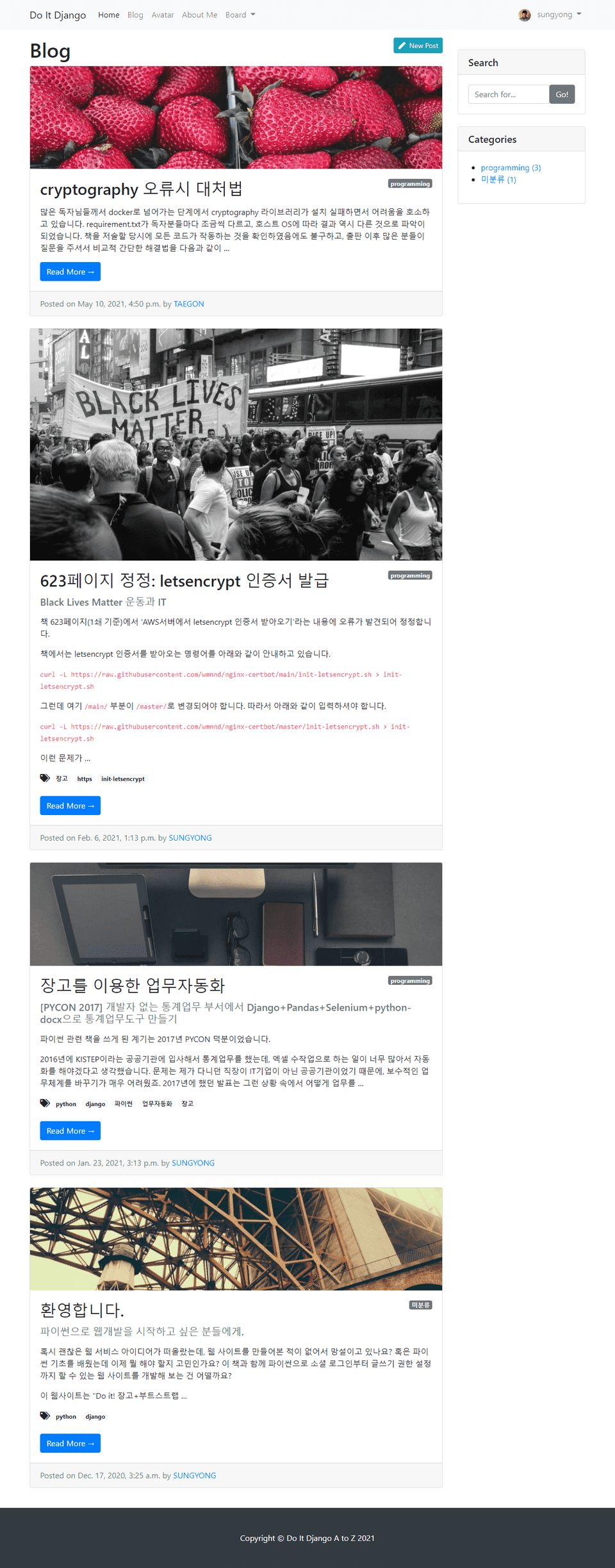
While implementing blog features, you will learn how to configure URLs for website pages and develop them to provide the necessary information.
You will learn how to use CSS or JavaScript files in a website created with Django, and also learn how to implement a feature for uploading files to the website.
You will learn how to use conditional statements within HTML files.
While programming, there are often cases where the program becomes so complex that it is difficult to find the cause when a problem occurs. Sometimes, even if you identify the cause, the source code is so intricately tangled that it is difficult to make changes hastily.
However, by using Test-Driven Development, you can reduce these frustrating situations. From Section 8 onwards, we will understand the concept of Test-Driven Development and apply it to our project.
It is easier to manage elements that are used repeatedly by modularizing the source code. You will learn how to modularize and manage elements that must be maintained throughout the website, such as navigation bars and footers.
When developing for the web, there are times when you need to connect different pieces of information. For example, the relationship between blog posts and authors is a many-to-one relationship, as a single member can write multiple blog posts. While learning about many-to-one relationships, I will show you how to implement an author feature for posts and a category feature for blog entries.
While the relationship between a post and its author is a many-to-one relationship, Instagram hashtags are a many-to-many relationship. By implementing the tag feature for a blog, you will naturally learn about many-to-many relationships.
Django provides a tool called 'form' to make it easy to develop features for creating new posts. In this lecture, we will study how Django's forms work. In the process, we will implement features for creating and editing blog posts.
When developing web applications using Python and Django, it is easy to import and use libraries developed by others in your project. We will use Django-crispy-forms to refine the appearance of the forms developed in Section 12, add Markdown functionality using Django-markdownx, and implement Google and email login features using Django-allauth.
A blog should naturally have a comment feature. While implementing the comment functionality, we will review the Django features we learned previously.
Through pagination, you will learn how to control the number of posts displayed on a single page to prevent too many from appearing at once. Additionally, you will practice JavaScript while implementing a search function and utilize Django's filtering features.
We will implement the important pages that have been put off, so that the website you created can serve as your portfolio and your public face.
Now is the time to prepare to move the results developed so far to an Amazon web server. We use Docker to provide the same environment without major issues even in different OS environments.
Along with using Docker, we will show you how to use a specialized DB program (PostgreSQL) and a web server program (Nginx) so that your project can become a real public web service rather than just a test web page.
To ensure our website runs 24 hours a day, we need to rent a server. Amazon Web Services offers an affordable server rental service called Lightsail. In this section, we will learn how to upload and serve the website we created on this server.
Now it is time to purchase a domain and connect it to our website. This process also covers the steps for obtaining HTTPS security certification.
PYCON Presentation : Django + Selenium
Creating Statistical Work Tools with Python

Seoul National University, Regional Systems Engineering
(Agricultural Eng.) Ph.D.
Q. How well do I need to know Python?
A. This course does not require a high level of Python proficiency. If you understand the concepts of variables, loops, functions, and classes, you will be able to follow along without any problems.
Q. I'm a complete beginner in web development; is it still possible for me?
A. Yes, it is possible. Of course, it would be easier if you have background knowledge of HTML, CSS, and JS. However, the course is structured so that even those who are completely new to web development and do not know HTML, CSS, or JS can follow along without any trouble.
Q. You mentioned using Amazon servers; will there be additional costs?
A. No costs are incurred up to Section 17. When you make your completed website public on the internet, costs will arise as you will be renting and using an Amazon server. Fortunately, AWS allows you to use it for free for the first month, and after that, you only need to pay $3.50 per month.
At the very end, there is a section on purchasing a domain, which also incurs a cost of about 12,000 KRW. If this is a burden, you can still master Django by listening only up to Chapter 17.
Q. Can I get the source code?
A. Yes. As you will see in the lecture videos, the written content is committed to GitHub every time. You can refer to the committed files at the GitHub link below. Please refer to the link at the bottom.
Introduction to Programming and Business Automation for Professionals
Programming basics and syntax that anyone can easily learn!





![Python Backend for Beginners: An Introduction to FastAPI (From FastAPI to Asynchronous SQLAlchemy) [Full-Stack Part 1-2]Course Thumbnail](https://cdn.inflearn.com/public/courses/333248/cover/7323d828-100e-4ac9-8e6e-0e51a17ac741/333248.png?w=420)
![[Electron #2] React + Electron Offline Face Recognition Access and Attendance Management System (With DeepFace)Course Thumbnail](https://cdn.inflearn.com/public/files/courses/339677/cover/ai/0/3f0aeb99-6e04-4d30-ba5b-841a2c0fea14.png?w=420)