Young-han Kim's Practical Database - Basic Course
yh
Learn the fundamentals of SQL and databases essential for practical work. Not only developers, but also planners and data analysts can learn SQL in depth.
Basic
SQL, MySQL, DBMS/RDBMS
Learn practical core Java object-oriented concepts easily via example code.


Reviews from Early Learners
5.0
suco
I took all the basic lectures after the introductory lecture. If I had to pick the best part of Younghan's lecture, it would be 'Why?'. [Reason to learn] The answers to 'Why should I study this?' and 'Why is this important?' are so clear. It was very helpful to understand the concepts because he explained with examples when these concepts are used and how they are used in the field. [Solid examples] I felt this way from the Spring lecture, but I felt it even more through the Java lecture. You really thought a lot about each example and made it. Through this part, I realized that this is inconvenient, and that there is something that solves this. This process flows very naturally. [Coding habits] This Java lecture consists of many examples in each section. As Younghan emphasized, you should always try it out yourself. I think I could really feel the meaning. It helped me develop the habit of simply coding and checking when I was curious. If I had to pick a big difference between a book and a lecture, I think it would be that it is better to listen while coding and following along. [Recommendation for those in the field] I work with Java in the field, and I have studied many Java books, but I don't think I have ever approached it this easily and explained the concepts so clearly. Personally, the part about object-oriented languages was always like that. It was too difficult to approach just by reading the book. After learning through the lecture, I have a lot of regrets about not taking this lecture in college. I recommend it to those who are just starting out with Java, but I think it will also be a great help to those in the field who are working with Java to organize object-oriented languages once again. [Regrettable points] This lecture had absolutely no regrets! One thing I'd like to say for a better lecture is, I think it would be better if you showed the problem part of 'Problem and Solution' on one screen first. I often skipped the lecture a little bit to check only the problem part or to check which package and what name to create and solve, but I think it was a bit disappointing when listening to the lecture as if it were an actual lecture! I thought it would be a little smoother if you showed this part (problem description, problem solution package/class/method name) on one screen first. Of course! It's a very minor part..I can proceed while looking at the lecture materials! [Other urging] I'm having a baby in May 24. There's not much time left. Intermediate, advanced...Please release it quickly.
5.0
벚꽃엔딩
Give up two chickens and take the class unconditionally The beginning of Java upward leveling Java is coming!!! Java is coming!!! Spring is coming!!!
5.0
Lazy Loading
I can't imagine how much thought went into preparing the PDF and each word of the lecture content yourself. 17 hours is not a short time, but it is a really compact lecture in itself. Regardless of your years of experience, if you lack basics or want to go back to the beginning and study Java properly once more, this is a lecture I highly recommend!
Java Object-Oriented Programming
Object, encapsulation, inheritance, polymorphism, abstraction
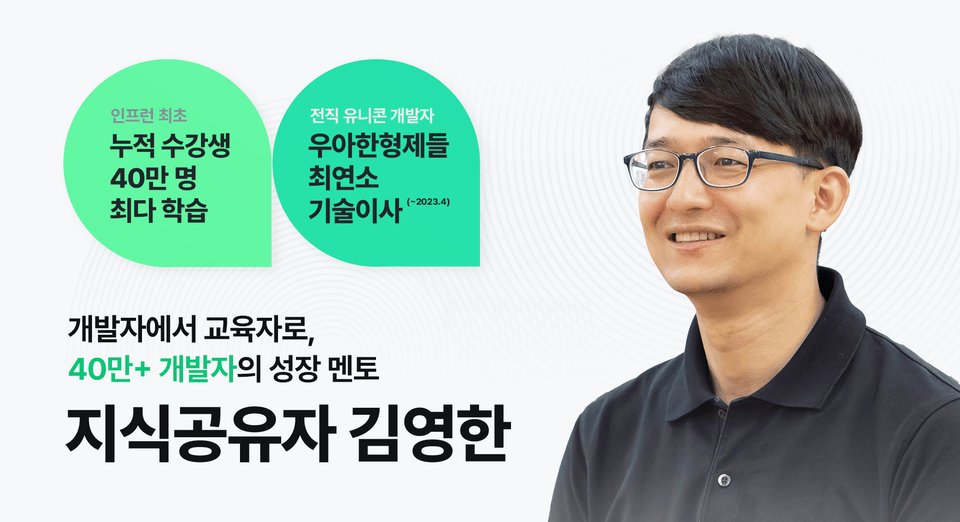
Former Woowa Brothers Technology Director, cumulative student enrollment surpasses 400,000
Why Kim Young-han Created Java Courses
•••
“I wanted to create a proper Java course that would produce real developers needed for real work.”
/builder/5bc79430-526f-4e16-816d-5361231f5c1f/332506-1.png?w=960)
Most modern software we develop in our practice is large-scale, requiring the collaboration of dozens to hundreds of people. When developing such large-scale software, the following aspects are crucial.
Code reusability
Modularization
Scalability and flexibility
Complexity Management for Abstraction
maintenance
Java is an object-oriented programming language. Object-oriented programming concepts like encapsulation, inheritance, polymorphism, and abstraction play a role in solving these problems , which is why Java is widely used in practice.
Therefore, object-oriented programming can be considered the most important core concept in Java.
Unfortunately, many beginners to Java often only learn simple Java grammar. However, in object-oriented programming, understanding why and when to use a language isn't the key .
The problem is that many Java developers only study the grammar without understanding the essence of object-oriented programming (OOP), and so they realize this too late. I don't believe the learners are at fault. Most existing books and lectures focus solely on grammar .
And in practice, when using Java, you'll inevitably use it alongside a technology called Spring. So, after learning Java, you'll learn Spring next.
However, most developers find Spring extremely difficult. This is because Spring is a tool that makes object-oriented concepts easier to use. Therefore, a solid foundation in object-oriented programming is essential for learning Spring.
/builder/1f5f946c-7b8c-4837-b549-53f6d1ebfa43/332506-2.png?w=960)
However, many developers simply learn Java syntax without understanding why object-oriented concepts are necessary. Naturally, Spring feels overwhelming, and countless developers give up halfway through.
Therefore, this lecture will look at the essence of object orientation,
By doing so, we aim to provide a solid understanding of the core Java concepts essential for practical use .
This lecture is the second lecture in Kim Young-han's Practical Java Roadmap , and is intended for those who have learned basic Java grammar.
Kim Young-han's Java Introduction - Java's First Steps Starting with Code
Kim Young-han's Practical Java - Basics
>> Introducing the Java Roadmap Guide to help you learn effectively and purposefully .
/builder/b99991a4-c97a-4dba-9441-e3f5981ef129/332505-3.png?w=960)
About Java OOP
Those who want to learn
/builder/bdcdedf7-42d8-45f9-997e-5e5a3c5a5dbd/332505-5.png?w=960)
I studied Java, but
Those who want to build a solid foundation
/builder/d9975a2a-5b67-4e3c-b48f-e71db7a0d3dc/332505-4.png?w=960)
Developer job seekers
In fact, object-oriented concepts like encapsulation, inheritance, and polymorphism are often difficult to understand even when explained in theory. This is because the concepts are often explained abstractly.
Therefore, this course explains all the core object-oriented code, step-by-step, using example code. The course begins with coding without object-oriented concepts, and then gradually introduces them, allowing you to experience the benefits firsthand through your code.
After learning, you'll naturally gain insight into object-oriented concepts as you work with me to transform existing code into better, object-oriented code. And along the way, you'll also learn the Java syntax needed to support object-oriented programming.
In this lecture, we will make it clear why object-oriented programming, which is the most important aspect of Java, is necessary.
We cover the fundamentals that are frequently used in practice in depth and with certainty.
We boldly exclude features that are not used in practice.
Even with the same investment of time, some people excel while others struggle. Where does this difference come from? Java is so broad and requires so many features to learn. This is why many beginners often feel lost and lost.
If there are 100 Java features, there's no need to learn them all. Learning unimportant features that aren't used in practice is a waste of time. You shouldn't spend a lot of time learning features you won't use.
/builder/b18fd0a9-24ab-4455-8e33-67aaf242759c/332506-3.png?w=960)
This course will save you time, so you can move on to the next step quickly.
We provide numerous examples to help you understand the concepts naturally through code.
Think back to when you learned to swim. Programming is actually more about learning by doing, by actually following the code, rather than just understanding it in your head.
Rather than studying theory separately, I've structured the course so you can learn Java alongside me, as if you were swimming in the water. Even when explaining the theory, example code is provided to help you fully understand it. You'll naturally grasp the fundamentals as you follow along with the code.
/builder/74397631-80cc-4c4d-adeb-9cafc30f729f/332506-4.png?w=960)
You can develop the ability to solve problems with code.
All programming is like solving a problem directly with code. If you've learned how to swim, you only truly master what you've learned by practicing it in the water.
This course emphasizes the process of learning through problem solving. To truly learn, you must be able to solve problems on your own, based on what you've studied. I also demonstrate the process of solving problems with you. You'll naturally learn from watching a developer with extensive practical experience like myself solve problems.
/builder/0c465d4a-a96d-4857-92ec-995eccfa506a/332506-5.png?w=960)
“Rather than thinking about what more I should teach, I thought more deeply about what absolutely must be known.”
My goal in this "Kim Young-han's Practical Java Roadmap" course is to cultivate capable developers with a solid foundation in the fundamentals necessary for practical work. I hope this course will help you gradually build a foundation in Java object-oriented programming, and I will help you become a successful developer.
Who is this course right for?
For those who want to easily learn Java Object-Oriented Programming with code
Learned Java, but want to solidify basics.
Aspiring developer
Need to know before starting?
Kim Younghan's Java Introduction - First Steps in Java, Starting with Code Course
Java Basic Syntax (Variables, Operators, Conditionals, Loops, Arrays)
Inflearn Verified
600,165
Learners
41,843
Reviews
9,106
Answers
5.0
Rating
26
Courses
Educator
Former: Technical Director at Woowa Bros, Kakao, SK Planet
Author: Java ORM Standard JPA Programming
My goal is to provide education so that you can become a truly practical and competent developer.
EO Interview Video
The Life of Young-han Kim, Korea's Top Developer Instructor [Part 1]
The Life of Younghan Kim, Korea's Top Developer Instructor [Part 2]
Gaebalbadak - A Country Youth Becomes the King of Development
All
98 lectures ∙ (16hr 51min)
Course Materials:
All
2,282 reviews
5.0
2,282 reviews
Reviews 9
∙
Average Rating 5.0
5
I took all the basic lectures after the introductory lecture. If I had to pick the best part of Younghan's lecture, it would be 'Why?'. [Reason to learn] The answers to 'Why should I study this?' and 'Why is this important?' are so clear. It was very helpful to understand the concepts because he explained with examples when these concepts are used and how they are used in the field. [Solid examples] I felt this way from the Spring lecture, but I felt it even more through the Java lecture. You really thought a lot about each example and made it. Through this part, I realized that this is inconvenient, and that there is something that solves this. This process flows very naturally. [Coding habits] This Java lecture consists of many examples in each section. As Younghan emphasized, you should always try it out yourself. I think I could really feel the meaning. It helped me develop the habit of simply coding and checking when I was curious. If I had to pick a big difference between a book and a lecture, I think it would be that it is better to listen while coding and following along. [Recommendation for those in the field] I work with Java in the field, and I have studied many Java books, but I don't think I have ever approached it this easily and explained the concepts so clearly. Personally, the part about object-oriented languages was always like that. It was too difficult to approach just by reading the book. After learning through the lecture, I have a lot of regrets about not taking this lecture in college. I recommend it to those who are just starting out with Java, but I think it will also be a great help to those in the field who are working with Java to organize object-oriented languages once again. [Regrettable points] This lecture had absolutely no regrets! One thing I'd like to say for a better lecture is, I think it would be better if you showed the problem part of 'Problem and Solution' on one screen first. I often skipped the lecture a little bit to check only the problem part or to check which package and what name to create and solve, but I think it was a bit disappointing when listening to the lecture as if it were an actual lecture! I thought it would be a little smoother if you showed this part (problem description, problem solution package/class/method name) on one screen first. Of course! It's a very minor part..I can proceed while looking at the lecture materials! [Other urging] I'm having a baby in May 24. There's not much time left. Intermediate, advanced...Please release it quickly.
ㅋㅋㅋㅋㅋㅋ suco-nim, I really burst out laughing at the other urging you wrote at the end. I also sincerely appreciate the feedback you gave me regarding the problems and solutions. I'm working hard to prepare the intermediate version with the goal of releasing it in February or March^^! I hope you have a happy 2024 with your new family that is new but feels like it's always been there :)
Reviews 4
∙
Average Rating 5.0
5
Give up two chickens and take the class unconditionally The beginning of Java upward leveling Java is coming!!! Java is coming!!! Spring is coming!!!
Cherry Blossom Ending, thank you so much for listening and cheering us on!
lol
😆😆😆 YangPang, get struck by lightning! Get struck by lightning!
Reviews 7
∙
Average Rating 5.0
5
It's really the best. While taking other lectures, I had questions like "Why is it used like this?" and "Why is this part like this?" while studying on my own. Everything is clearly explained. While studying on my own, I spent a lot of time trying to find answers to questions like "What is a class?" and "When do you use a constructor?"... I was able to get clear answers to those questions. I recommend you to go through the introduction and move on. If you have ever studied Java and object-oriented programming on your own and had questions that you couldn't clearly resolve, I highly recommend it. I'm really looking forward to the intermediate and advanced lectures. I hope I can take them soon.
Jung Cheol, I think a good developer is one who can always answer the fundamental question, "Why should I learn this technology?" :) I'm rooting for you!
Reviews 2
∙
Average Rating 5.0
5
I can't imagine how much thought went into preparing the PDF and each word of the lecture content yourself. 17 hours is not a short time, but it is a really compact lecture in itself. Regardless of your years of experience, if you lack basics or want to go back to the beginning and study Java properly once more, this is a lecture I highly recommend!
Lazy Loading, I am even more grateful that someone who always works hard has left a review like this :) I will always support you too!
Reviews 50
∙
Average Rating 5.0
5
Hello~ I took the Java course taught by the technical director of the elegant brothers For those who lack the basics It's great for re-learning the concepts If you have time, definitely listen to it!! Thanks to you, I gained confidence in Java Spring MVC JPA When handling data in the backend with Java I hope you will also produce in-depth intermediate and advanced courses that general developers may not know Thank you. Stay healthy and happy..
Mr. Kim Dong-hee, I heard that you studied hard and gained confidence, so it was worth preparing the lecture. I'm rooting for you!
Check out other courses by the instructor!
Explore other courses in the same field!