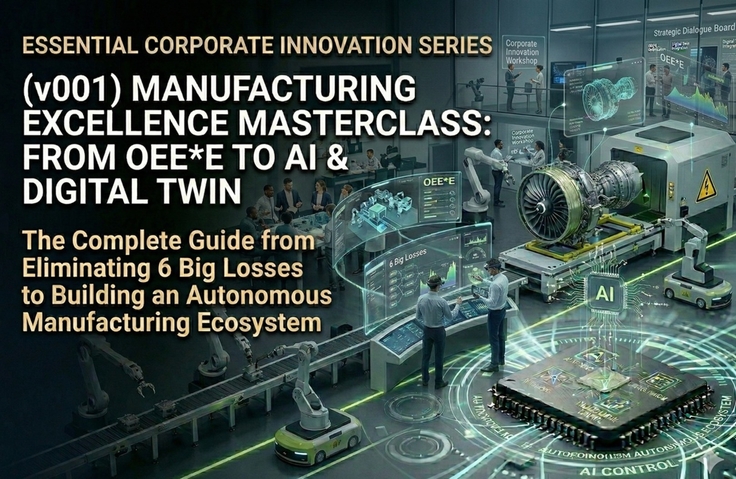
(v001) Manufacturing Excellence Masterclass: From OEE*E to AI & Digital Twin
[Process Optimization Roadmap: Eliminating Unnecessary Capital Investment and Converting 'Hidden Factory' Opportunity Costs into Tangible Profits] 1. Introduction: Transition to Intelligent Processes and the Prerequisite of Standard Operating Procedures For modern enterprises to maximize business value by adopting Artificial Intelligence (AI) technology, the rigorous standardization of physical processes and work procedures on the shop floor must come first. An intelligent system built upon an unstructured data environment lacking standardization will struggle to achieve optimal performance; instead, it is highly likely to amplify process uncertainty and act as a risk to the entire system. This training course aims to present a strategic methodology for discovering latent profit sources within the so-called 'Hidden Factory' and converting them into an engineering foundation that AI can autonomously control and optimize. 2. [Analysis] Quantitative Data-Based Field Diagnosis and Analysis of 'Baseline Losses in Critical Indicators' Many manufacturing sites tend to overlook potential operational losses by settling for superficial performance indicators. When Overall Equipment Effectiveness (OEE) is precisely analyzed through engineering decomposition techniques, the following structural losses are identified: Availability 90%: While external uptime is secured, power loss due to minor stoppages occurs continuously. Performance 90%: A slowdown in actual speed compared to theoretical cycle time has become chronic, yet there is no reference point to recognize and improve this. Quality 90%: A defect rate reaching 10% is evaluated as a critical figure that undermines the reliability of the entire process. The actual OEE, calculated by the multiplier effect of these three indicators, is only 72.9%, meaning the remaining 27.1% of opportunity cost is buried within the 'Hidden Factory'—unidentified by data. Therefore, the primary task of AI adoption is to quantify the source of this waste and ensure process transparency. 3. [Critique] Redefining Strategic Priorities: The Conflict Between Operational Excellence (OPEX) and Capital Expenditure (CAPEX) Prioritizing the expansion of new facilities (CAPEX) as a solution to declining productivity can be a strategically dangerous decision. Adding lines to a low-efficiency structure where OEE remains at the 60–70% level results in replicating fundamental inefficiencies, leading to an exponential increase in management costs. Before large-scale capital injection, maximizing Operational Excellence (OPEX) to break through the physical limits of existing assets must take precedence. Only when standard operating procedures capable of achieving the world-class standard of 85% OEE are established can a virtuous cycle be built—one that dramatically improves production capacity through integration with AI without additional investment. 4. [Evaluation] Integration of Data Architecture: Establishing an ISA-95 Based Decision-Making System The disconnection between the financial indicators of Enterprise Resource Planning (ERP) and the operational data of the Manufacturing Execution System (MES) is a core cause of information distortion and delayed decision-making. To resolve this, the international standard ISA-95 architecture is applied to organically integrate management strategy with the physical production site. Establishment of a Single Source of Truth: Complete a data pipeline where all dynamic field data is synchronized in real-time with the enterprise management system. Conversion of Indicators into Financial Value: By intuitively linking the impact of minor field stoppages to actual operating profit and cash flow on financial statements, an objective, data-driven performance evaluation and decision-making system is established. 5. [Execution] 4-Step Strategic Roadmap for Intelligent Process Management Implement an advanced strategy that fuses AI technology with human engineering insight based on strictly standardized procedures. Predictive Maintenance and Utilization of P-F Intervals: Build a predictive maintenance system by monitoring the P-F Interval—the period from a potential failure (a precursor to equipment breakdown) to a functional failure—in real-time. Digital Twin-Based Simulation and Minimization of Trial and Error: Practice a 'Zero-Trial' strategy that prevents physical losses by verifying various scenarios within a virtual environment before implementing process changes. Quantitative Control of the 6 Big Losses: Continuously track and manage the six core waste factors that hinder profitability—equipment failure, setup/adjustments, idling/minor stops, reduced speed, process defects, and reduced yield/rework—through AI. Digital Advancement of Total Productive Maintenance (TPM): Enhance the reliability of Human-in-the-Loop systems by establishing a proactive culture where field operators voluntarily detect and respond to signs of equipment abnormality. 6. Conclusion: Securing Technological Leadership Through Standardized System Architecture Technical knowledge can be transferred through education, but the insight to dominate process flow only manifests upon a sophisticatedly designed standard system. This masterclass aims to provide a precise engineering blueprint for transforming your production site into an intelligent asset. Establishing standardized work procedures and ensuring data integrity are essential prerequisites for the AI era. Only on a firm systemic foundation will AI function as a true intelligent production site that drives corporate growth.
4 learners are taking this course
Level Intermediate
Course period Unlimited