
inflearn logo

Designing Mobile Applications Like U.S. Big Tech: iOS and Android System Design

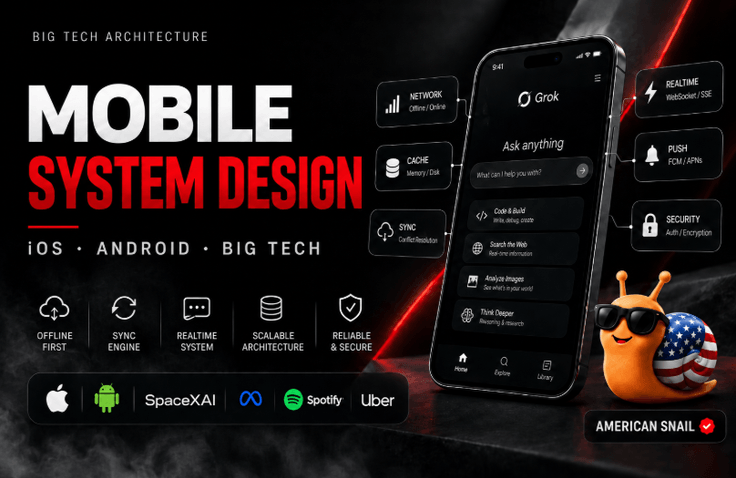
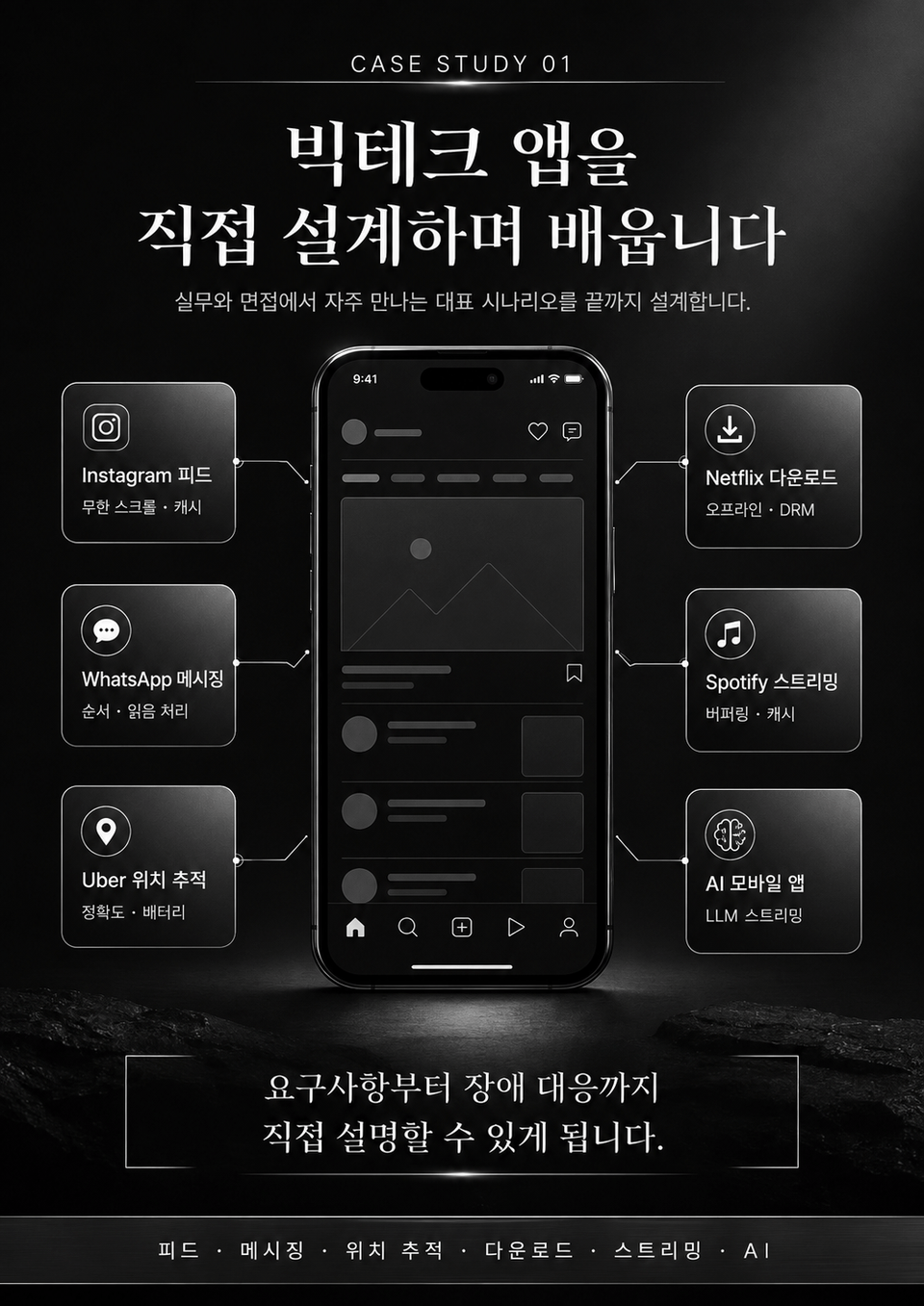
A mobile app is not complete simply because its screens are well designed. True mobile system design begins when the network disconnects, the app is terminated, data is duplicated, and countless events arrive simultaneously. In this course, you will directly design systems such as an Instagram feed, WhatsApp messaging, Uber location tracking, Netflix offline downloads, Spotify streaming, and ChatGPT,Claude-style AI apps, while developing the mobile architecture mindset expected at major U.S. tech companies. You will not memorize a finished architecture from the start. Beginning with the simplest implementation, you will identify problems such as data inconsistencies, slow screens, duplicate messages, battery drain, app termination, and deployment failures. Through solving these problems, you will progressively internalize the principles of offline-first design, Sync Engines, state machines, caching, retries, real-time connections, Push Notifications, observability, and AI-native architecture. By comparing the platform constraints of iOS and Android, you will learn how to design mobile systems that are fast, reliable, and capable of recovering from failures—not merely how to implement features.

107 learners are taking this course

Level Intermediate

Course period Unlimited

iOS
iOS
Android
Android
Swift
Swift
Kotlin
Kotlin
iOS
iOS
Android
Android
Swift
Swift
Kotlin
Kotlin

What you will gain after the course

  • I can systematically design Instagram feeds, WhatsApp messaging, Uber location tracking, Netflix downloads, Spotify streaming, and AI mobile apps—from requirements through incident response.

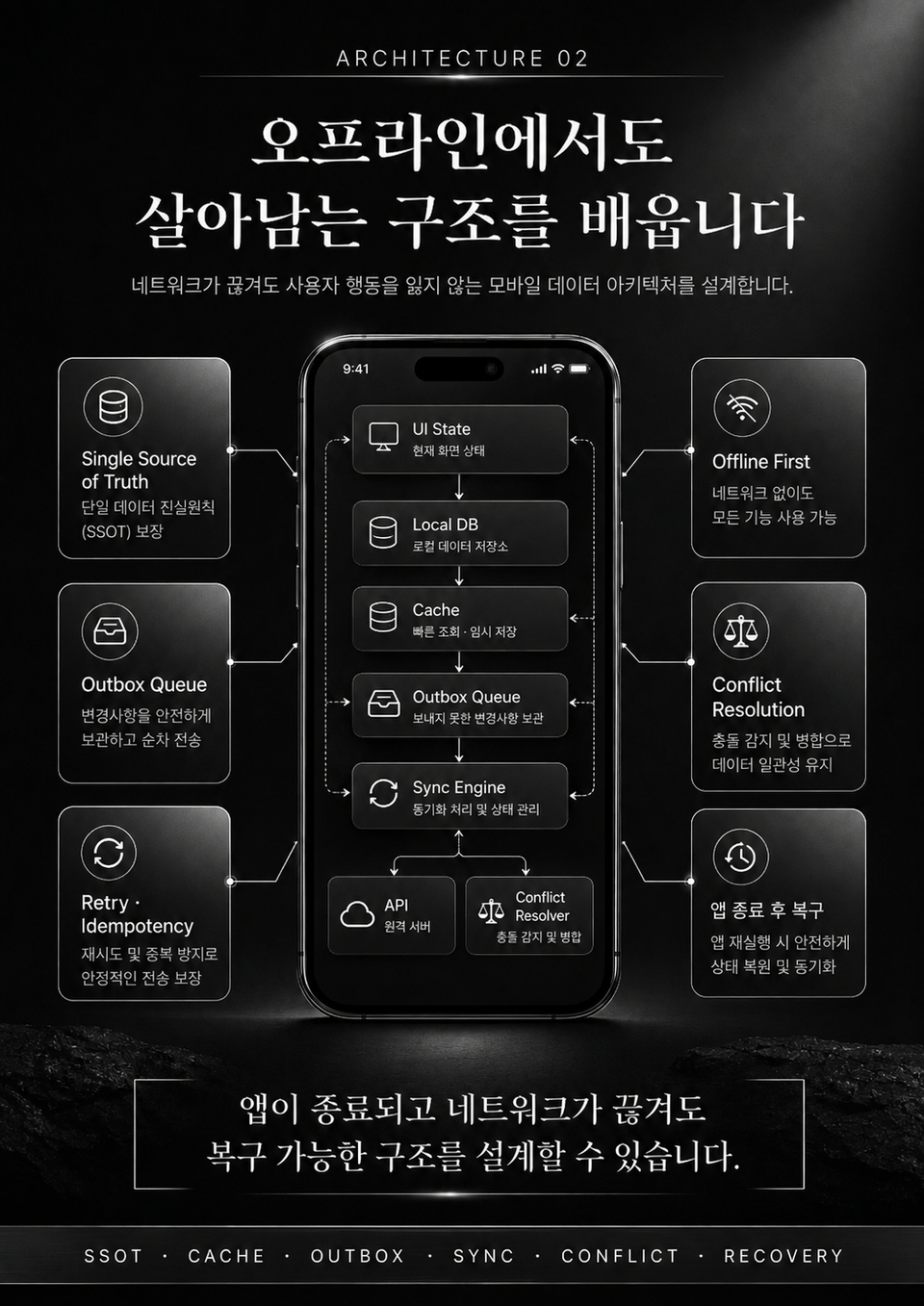
  • You can design a recoverable offline-first architecture and Sync Engine that handles network disconnections, app termination, duplicate requests, and data conflicts.

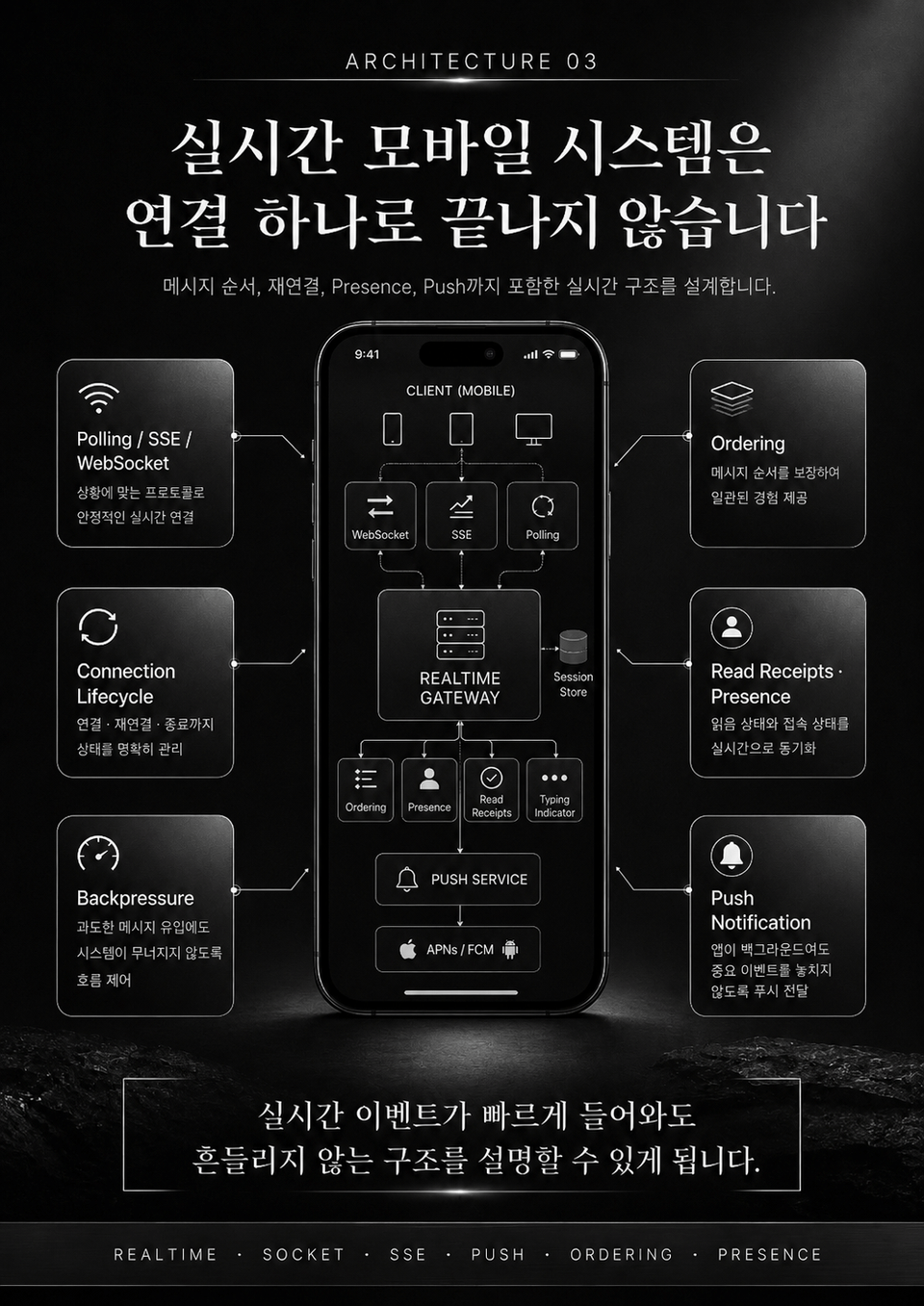
  • You can distinguish the roles of WebSocket, SSE, Polling, APNs, and FCM and design a real-time mobile system that includes message ordering, reconnection, read receipts, and Presence.

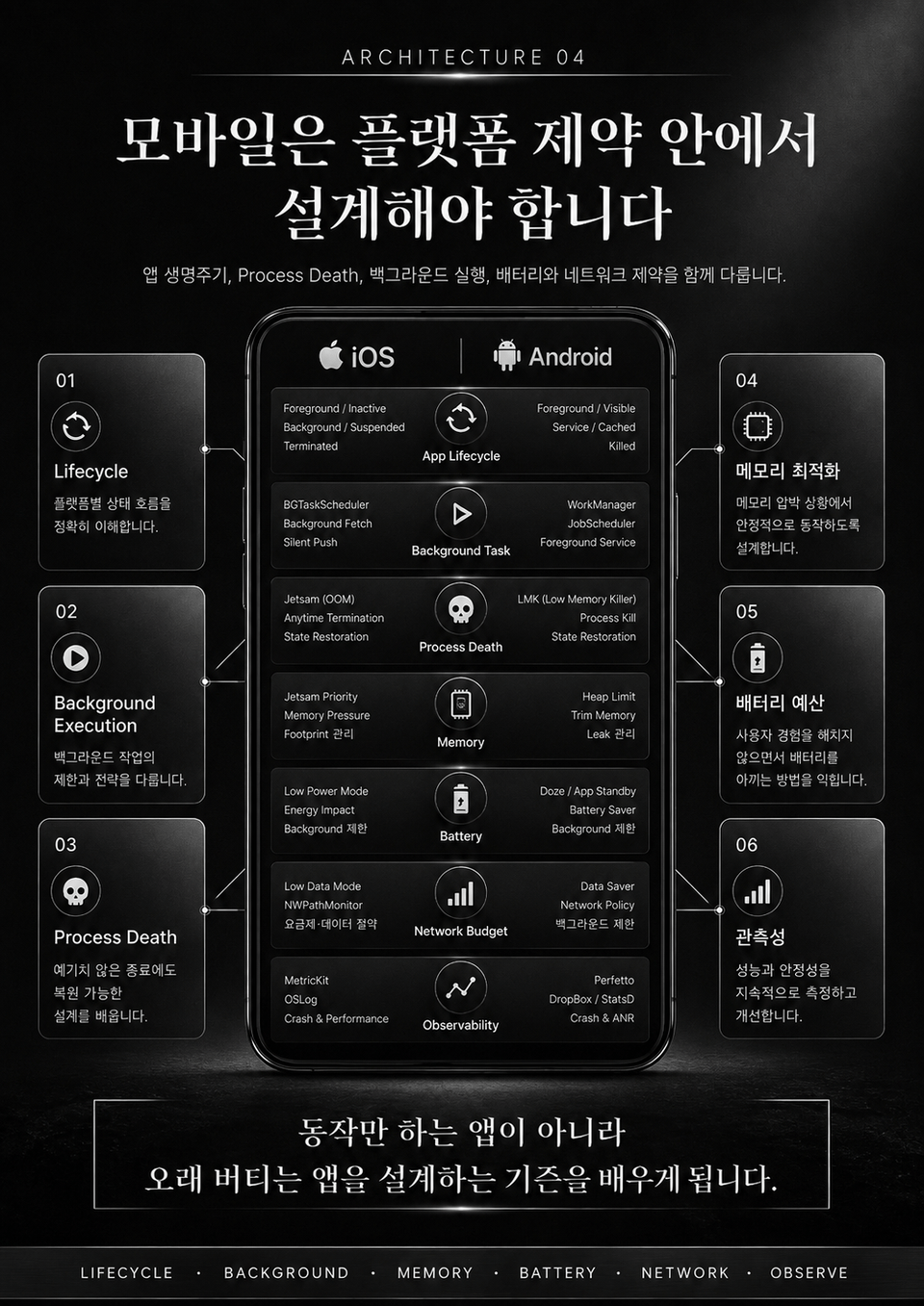
  • We can design architectures suited to iOS and Android by considering app lifecycles, process death, background execution, and battery and network constraints.

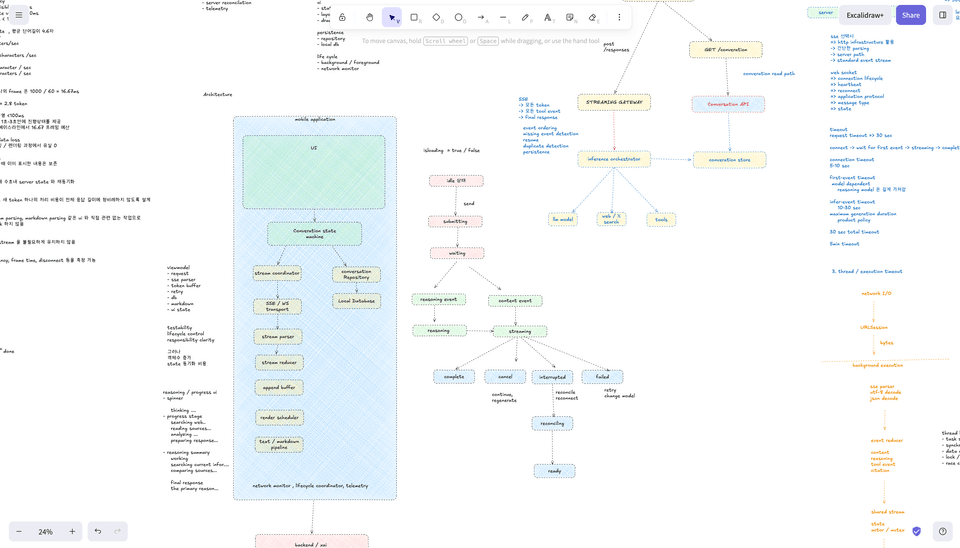
  • You can design an AI-native mobile architecture that includes on-device AI and server AI selection, an LLM streaming UI, Tool Call approvals, and cost and privacy considerations.

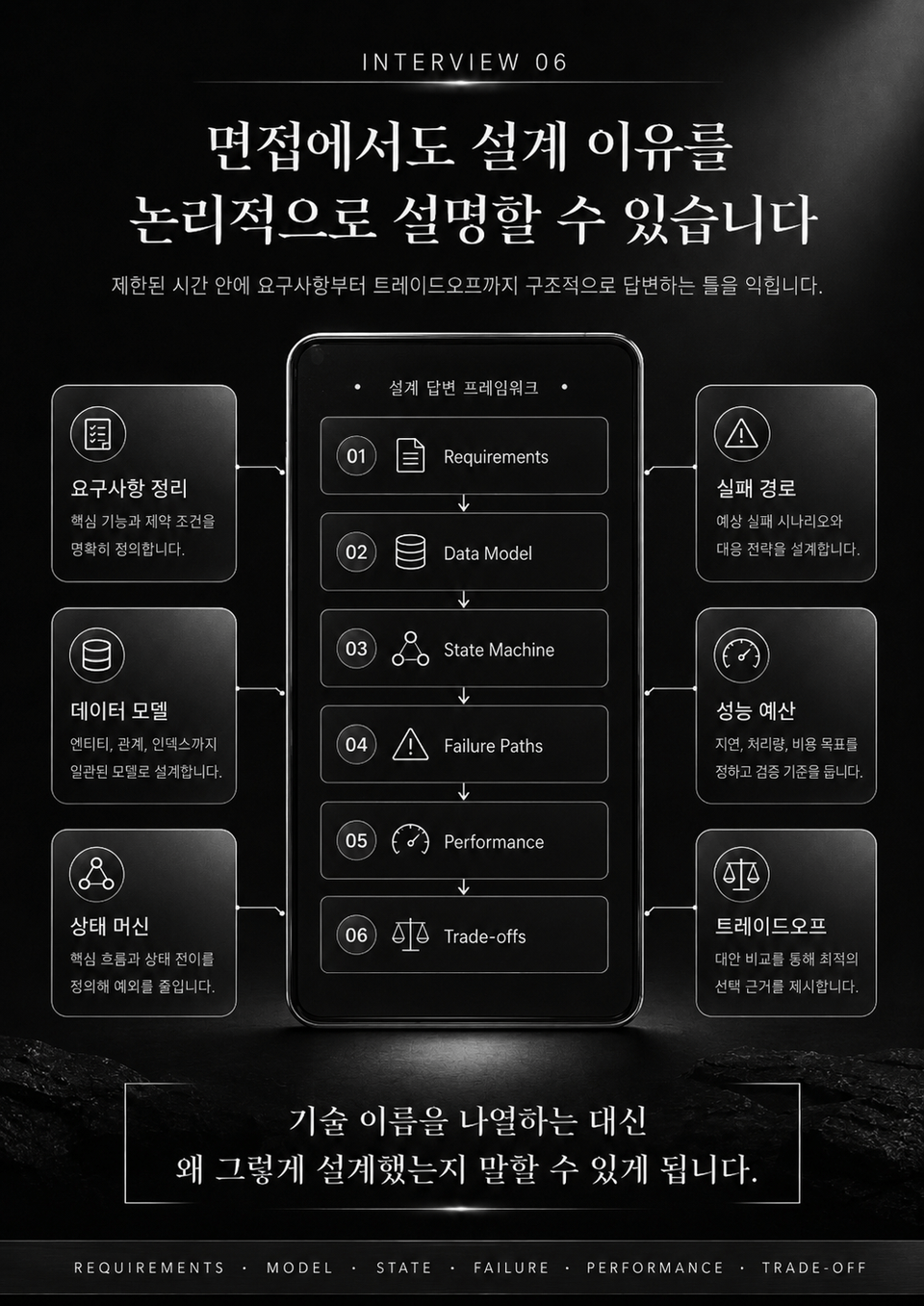
  • I can logically explain the requirements, data model, state machine, failure paths, performance, and trade-offs within the limited interview time.

A hands-on mobile system design course on structurally designing iOS and Android apps

Mobile apps are not completed by simply creating great screens.
True mobile system design begins the moment the network goes down, the app is terminated, data is duplicated, and countless events arrive simultaneously.

This course is designed to help you develop the mobile architecture mindset expected at major U.S. tech companies by designing Instagram feeds, WhatsApp messaging, Uber location tracking, Netflix offline downloads, Spotify streaming, and ChatGPT- and Claude-style AI apps yourself.

You do not memorize a completed architecture from the beginning.
Starting with the simplest implementation, you directly discover and solve problems such as data inconsistencies, slow screens, duplicate messages, battery drain, app termination, and deployment failures.
Through this process, you gradually master the principles of offline-first design, sync engines, state machines, caching, retries, real-time connections, push notifications, observability, and AI-native architecture.

By comparing the platform constraints of iOS and Android, you will learn not only how to implement features but also how to design mobile systems that are fast, reliable, and capable of recovering from failures.

Recommended for those who:

Mobile developers who can implement screens but feel overwhelmed about how to design the app as a whole

  • Those who can implement features but find their code becoming increasingly tangled

  • Those who use MVVM, Repository, and Clean Architecture but aren’t clear on “why they should design things this way”

  • Those who want to grow beyond merely implementing screens and become developers responsible for architecture.

Developers struggling with practical issues like offline functionality, synchronization, caching, and real-time updates using temporary code

  • Those who handle issues like network disconnections, app termination, duplicate requests, and conflict resolution with individual exception handling every time

  • Those experiencing issues where adding a cache causes data inconsistencies or makes real-time connections unstable

  • Those who want to move away from “a structure that works but cannot last”

Developers preparing for mobile system design interviews at major U.S. tech companies or looking to design larger-scale service architectures

  • Those who have prepared to some extent for iOS/Android coding interviews but feel overwhelmed by the system design round

  • Those who want to learn how apps like Instagram, WhatsApp, Uber, Netflix, and ChatGPT are actually designed

  • Those who want to become developers who can explain not just implementation, but also requirements, trade-offs, and failure handling.

After completing the course,

  • You can structurally design large-scale mobile services, from requirements through failure response.

  • You can design an offline-first architecture that can recover even after network disconnections and app termination.

  • You can design real-time systems that include message ordering, reconnection, read receipts, and Push notifications.

  • You can make iOS and Android architecture decisions that account for app lifecycle, battery, memory, and network constraints.

  • You can design an AI-native mobile app architecture that combines LLM streaming UI with on-device and server-side AI.

  • In interviews or at work, you can logically explain the reasons behind design decisions and their trade-offs rather than simply listing technology names.


Features of this course

1. A course where you encounter problems first, solve them, and learn the underlying principles along the way

This course does not explain a completed architecture from the beginning.
Instead, it starts with the simplest structure and has you directly confront the problems you will inevitably encounter in real-world services.

For example, with image loading,
we start by “simply fetching and displaying the image via its URL,”
and then directly encounter issues such as duplicate requests while scrolling, incorrect images being displayed, increasing memory usage, and cache invalidation.
Only then do you understand why concepts such as caching, request deduplication, cancellation, decoding, and disk caching are necessary.

In other words, this is not a course that merely introduces technology.
It is a course that helps you deeply understand why problems occur and how to solve them systematically.


2. A course that designs big tech case studies from a mobile perspective, end to end

We do not simply introduce the Instagram feed, WhatsApp messaging, Uber location tracking, Netflix offline downloads, Spotify streaming, or the ChatGPT and Claude mobile apps.

We design each case all the way through using the following flow.

  • What requirements are there?

  • What should the mobile client be responsible for?

  • Where is the data stored?

  • How does it work when offline?

  • What should be restored when the app is terminated?

  • How should real-time connections and push notifications divide their roles?

  • How should performance, battery usage, security, and observability be designed?

Therefore, by the end of the course, you will move beyond simply thinking, “Oh, I guess an app like this would be built roughly this way,”
to the point where you can actually explain your design proposal.


You’ll learn the following.


Fundamental Principles of Mobile System Design and Data Architecture

In this section, you will learn the core mindset of mobile system design.
You will understand the difference between feature implementation and system design and define the scope of what the mobile client should actually be responsible for.

We will focus particularly on the following topics.

  • Mobile System Design Approach

  • State Management and Data Layer

  • Single Source of Truth

  • Caching and Cache Invalidation

  • Offline-first

  • Sync Engine

  • Optimistic updates

  • Conflict resolution

  • App Lifecycle and Process Death Handling

  • iOS and Android background execution models

Through this section
, you will move beyond the level of an “app that displays data received from the server”
and establish the principles for designing a recoverable, long-lasting mobile data architecture.


Real-time systems, performance optimization, Push, AI-native architecture

This section covers the most challenging problems in real-world services.

  • WebSocket, SSE, and Polling Comparison

  • Message ordering guarantees and read status handling

  • Push Notification System Design

  • Image Loading and Caching Pipeline

  • Performance optimization for large-scale lists and feeds

  • Memory, battery, and network budget design

  • Mobile Observability Architecture

  • Phased rollout and operations strategy

  • On-device AI vs. Server AI

  • LLM Streaming UI

  • Agentic Mobile UX

Through this section,
rather than learning the concepts of each technology separately,
you will develop the ability to make integrated decisions about real-time features, performance, operations, and AI within a single app architecture.

The person who created this course

  • Silicon Valley Survivor | American Snail 

    Drawing on experience and know-how gained at the forefront of the Global Tech Scene, this course shows non-majors how to overcome technical barriers and become the owners of their businesses.

    • Current) Founder of a Silicon Valley AI coding agent startup

      • Operating the self-developed AI tool 'Snailer CLI' (20K+ downloads)

      • Selected for the Google for Startups Program

    • Formerly an engineer at major U.S. tech companies and promising startups

      • Gave up the final stage at Amazon to start a company

      • Silicon Valley AI FinTech Startup Engineer

      • OpenAI / Meta / Apple / Adobe / Amazon Full-Stack Fellowship

      • Domestic search engine portal, fintech development

      • AI startup AR/B2B/SDK development

    • Proven teaching expertise

I never viewed mobile app development as simply “creating screens.”
In practice, when you build an app, the problems begin after the screens are finished.

Images load slowly, networks disconnect, apps terminate, real-time connections become unstable, caches get tangled, and users feel that “the app is acting strangely” for no apparent reason.
What you need at that moment is not another new library, but a perspective that sees the system as a whole.

I have consistently worked on architecture, performance, real-time processing, streaming, data flow, and server integration issues in real-world service environments, with a focus on iOS development.
Through my experience with search portals, fintech services, vision/AR-based apps, real-time audio, video features, and mobile-server integration architectures, I came to one common realization.

Many developers learn how to “implement features,” but
it is difficult to systematically learn “why structures break down” and “how to design them.”

This course was created specifically to bridge that gap.

Instead of listing theories,
the course is designed to start with the simplest implementation, reveal problems, and teach the underlying principles as you solve them.
That is why the goal of this course is not to introduce a wide range of technologies, but to
enable students to determine the right design direction on their own when they encounter a new mobile service.

Do you have any questions?

Q1. Is this course only for iOS developers?

No.
This course does not delve deeply into the syntax of a specific framework; instead, it covers the principles and structure of mobile system design.
Therefore, both iOS and Android developers can take it.

However, because the explanations also compare the differences between iOS and Android,
even if you are familiar with only one platform, you can broaden your perspective to include the other platform as well.

Q2. Can beginners who are just starting out in mobile development take this course?

It is more suitable for those with basic app development experience than for complete beginners.

For example,

  • have experience calling APIs,

  • understand the concept of asynchronous processing and

  • Someone who has at least some experience with state management or local storage

you should be able to follow along without difficulty.

Conversely, if you are not yet familiar with Swift/Kotlin syntax itself,
it will be much more effective to first take a basic app development course.
This course focuses more on design and decision-making than on syntax.

Q3. Is it okay if I have no experience with server system design?

Yes, that's fine.

This course is not about implementing server infrastructure in depth;
it focuses on the constraints mobile clients face and the responsibilities they must take on.
Of course, we also cover the boundary between the client and the server,
but the key question is, “How should we design systems from the client’s perspective?”

If you have already studied server system design to some extent,
this course will help you clearly understand “what is different and what is more difficult on mobile.”

Q4. Does this course involve writing a lot of code, or is it focused on design?

We cover both, but the main focus is on design.

However, we do not explain design in purely abstract terms.
Starting with the simplest code structure, we examine what problems arise,
and then move on to refactoring and structural improvements.

In other words,

  • Concept explanation

  • Simple code example

  • Problem Scenario

  • Structural improvement

  • Final design

Because the course follows this flow,
it helps reduce the problem of “understanding the architecture but not being able to connect it to the code.”

Q5. Is it actually helpful for interview preparation?

Yes.
This course is not simply a collection of practical tips; it focuses on training you in the structure of system design answers.

For example, you will practice answering questions like the following.

  • What is the first thing to check in this requirement?

  • How should responsibilities be divided between the mobile device and the server?

  • What data should be retained when the network connection is lost?

  • How should real-time connections and Push be divided in terms of their roles?

  • How should performance, battery usage, and recoverability be evaluated?

Therefore, it is useful not only in practice
but also for preparing for big tech–style mobile system design interviews.

Notes Before Taking the Course

Practice Environment

  • This course can be taken in both macOS and Windows environments.

  • To run the iOS examples yourself, it would be helpful to have macOS and Xcode.

  • To check the Android examples yourself, it would be helpful to have an Android Studio environment.

  • However, the focus of the course is mobile system design principles, not how to use a specific IDE, so you can take the course even if your practice environment is not perfect.


Learning Materials

  • Lecture materials PDF

  • Key diagrams for each section

  • Architecture Explanation Notes

  • Example code and checkpoint code

  • System Design Answer Template

  • Practical Case Study Summary Materials

  • Key Questions for Review

The materials are designed not as a simple summary,
but as a reference you can revisit for work and interviews even after completing the entire course.

Prerequisite Knowledge and Notes

  • It would be helpful if you have experience developing mobile apps with one of Swift, Kotlin, Dart, or React Native.

  • Basic knowledge of REST API calls, JSON processing, and asynchronous programming is required.

  • If you have even a little experience with MVVM, state management, or local storage, you’ll be able to follow along more easily.

  • This course is not an introductory syntax course, but rather a course for intermediate-level and above learners focused on developing mobile architecture skills.

  • Rather than focusing on how to use a specific library, this course explains why this kind of structure is necessary.

  • We will continually supplement the course through questions and answers, and update the core content so it can be applied directly to practical work and interviews.

Recommended for
these people

Who is this course right for?

  • iOS and Android developers who can implement screens but feel overwhelmed about how to design the overall app’s data flow and architecture.

  • A mobile developer handling practical issues like network disconnections, app closures, cache invalidation, and synchronization conflicts with temporary code.

  • A developer preparing for the System Design round of a mobile engineer interview at a major U.S. tech company

  • A developer who wants to apply ChatGPT- and Claude-style LLM streaming UIs and agentic mobile UX to their product

  • A developer who wants to grow beyond implementing features into a mobile architect responsible for performance, battery life, security, observability, and deployment.

Need to know before starting?

  • Experience developing mobile apps using one of Swift, Kotlin, Dart, or React Native is preferred.

  • Basic knowledge of REST API calls, JSON processing, and asynchronous programming is required.

  • Experience with ViewModel, state management, and local storage will help you understand this.

  • Experience with advanced algorithms or server system design is not required.

Hello
This is americasnail

Inflearn Verified

2,112

Learners

123

Reviews

84

Answers

4.4

Rating

8

Courses

  • Silicon Valley Survivor | American Snail

    Drawing on the experience and know-how gained at the forefront of the Global Tech Scene, I show non-majors how to overcome technological barriers and become the owners of their businesses.

    • Current) Founder of a Silicon Valley AI coding agent startup

      • Operating the self-developed AI tool 'Snailer CLI' (20K+ downloads)

      • Selected for the Google for Startups Program

    • Former engineer at major U.S. tech companies and promising startups

      • Gave up an Amazon final-round opportunity to start a company

      • Silicon Valley AI Fintech Startup Engineer

      • OpenAI / Meta / Apple / Adobe / Amazon Full-Stack Fellowship

      • Domestic search engine portal, fintech development

      • AI startup AR/B2B/SDK development

    • Proven teaching expertise

      • Double major in Computer Science and Business Administration at a four-year university in Seoul, with extensive startup experience

      • Produced 2,100+ cumulative students, with 4.6K+ followers on SNS Threads and 500+ Substack followers.

More

Curriculum

All

33 lectures ∙ (11hr 42min)

Course Materials:

Lecture resources
Published: 
Last updated: 

Reviews

Not enough reviews.
Please write a valuable review that helps everyone!

americasnail's other courses

Check out other courses by the instructor!

Similar courses

Explore other courses in the same field!

25% off for new members

$64.70

25%

$84.70