

inflearn logo

AI Coding Interviews: What Will You Be Asked to Show? A Winning Strategy for AI Coding Interviews at Silicon Valley Big Tech Companies

An AI coding interview practice course on using Claude Code and the DRIVER framework to analyze, fix, verify, and explain an unfamiliar GitHub issue in 30 minutes.

53 learners are taking this course

Level Basic

Course period Unlimited

Python
Python
pytest
pytest
Python
Python
pytest
pytest

What you will gain after the course

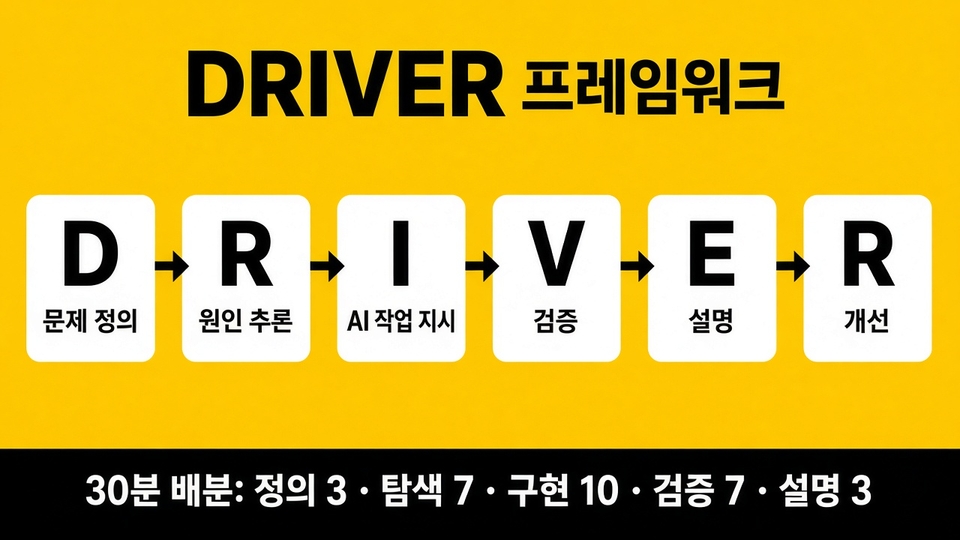
  • AI Coding Interview Evaluation Criteria and 30-Minute Time Allocation (Definition 3 · Exploration 7 · Implementation 10 · Verification 7 · Explanation 3)

  • Define an unfamiliar issue in 3 minutes: Use AI to trace the codebase and develop evidence-based hypotheses about its cause.

  • AI Instructions and Design Controls Covering Scope, Constraints, and Completion Criteria

  • Catching AI False Successes (Test Manipulation), Debugging Regressions and Concurrency

  • Think Aloud and Follow-up Answers, 60-Second Technical Explanation

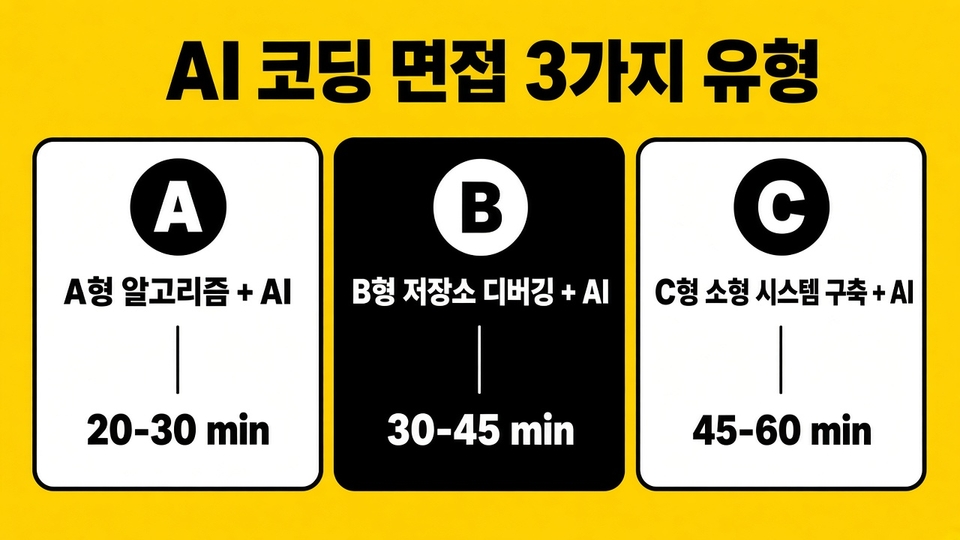
  • Strategies for Interview Types A (Algorithms + AI), B (Repository Debugging + AI), and C (Building a Small System + AI)

AI Coding Interview: 30-Minute Problem-Solving Practice

What should you demonstrate in an interview where AI writes the code? This course trains you to use AI coding tools to solve problems and explain your reasoning to the interviewer.

  • Practice the entire AI coding interview process, from defining the problem to using AI, validating results, and explaining your approach.

  • Even in an age when AI writes code for you, interviewers are evaluating your judgment: how you understand problems, guide AI, and verify its results.

Who This Is For

If AI writes all the code, what will they evaluate?

Recommended for developers who can write code using AI coding tools but are unsure how to demonstrate their skills to interviewers.

If an unfamiliar codebase feels overwhelming

It's suitable for those who find it daunting to analyze unfamiliar code and solve problems.

If you have an AI-assisted interview coming up

This course is for junior to mid-level developers preparing for AI-assisted interviews or AI skills assessments.

After completing the course,

  • You can read unfamiliar problems and quickly identify their key points.

  • You can use AI coding tools to solve problems and review the results yourself.

  • You can carefully review AI-generated results instead of trusting them as-is.

  • Your practice results build into a personal interview portfolio.

Features of This Course

· Practice in the format of real interviews, following the structure of actual AI coding interviews.

· Practice showcasing your judgment, not just your code. Having AI write the code is only the starting point. The practice also includes explaining why you made those choices.

· A hands-on program made up of concepts, exercises, mock interviews, and feedback.

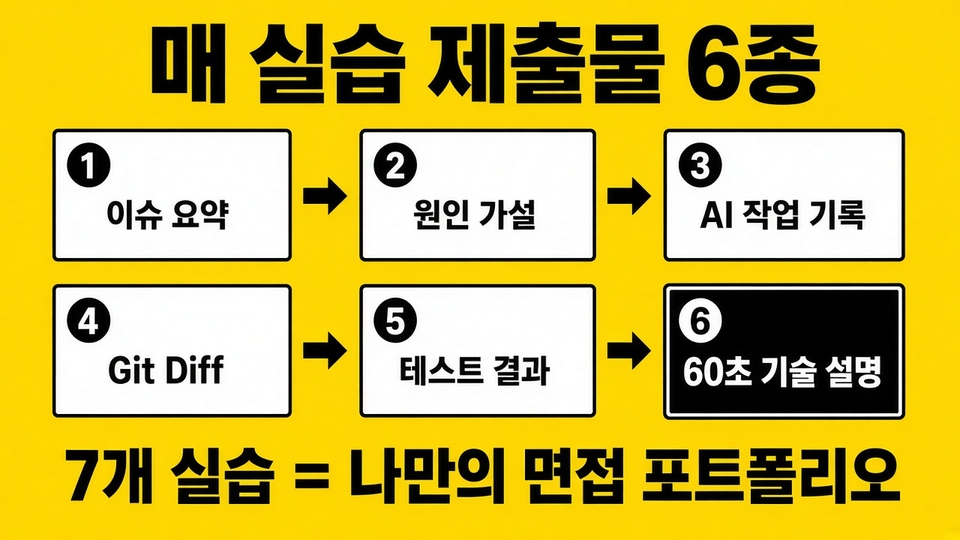
· Create a submission in the same format each time, and with each repetition, it becomes your interview portfolio.

· Provides hands-on practice materials based on real-world cases.

Train in the process interviewers look for, not just the correct code

Most coding test courses teach you how to get the right answer quickly. This course gives you repeated practice defining problems, validating solutions, and explaining your reasoning when AI writes the code for you.

An assessment rubric based on real-world Silicon Valley standards

Through hands-on exercises and mock interviews, you’ll identify your weak spots and work on them in the next exercise. The material is accessible to anyone with basic development experience.

Why This Course Now? Signals from the Industry

Amazon has rewritten its developer role guidelines with AI in mind. The question is no longer whether you use AI, but whether you can evaluate and explain its output. Interviews are changing in the same direction.
Original Amazon memo

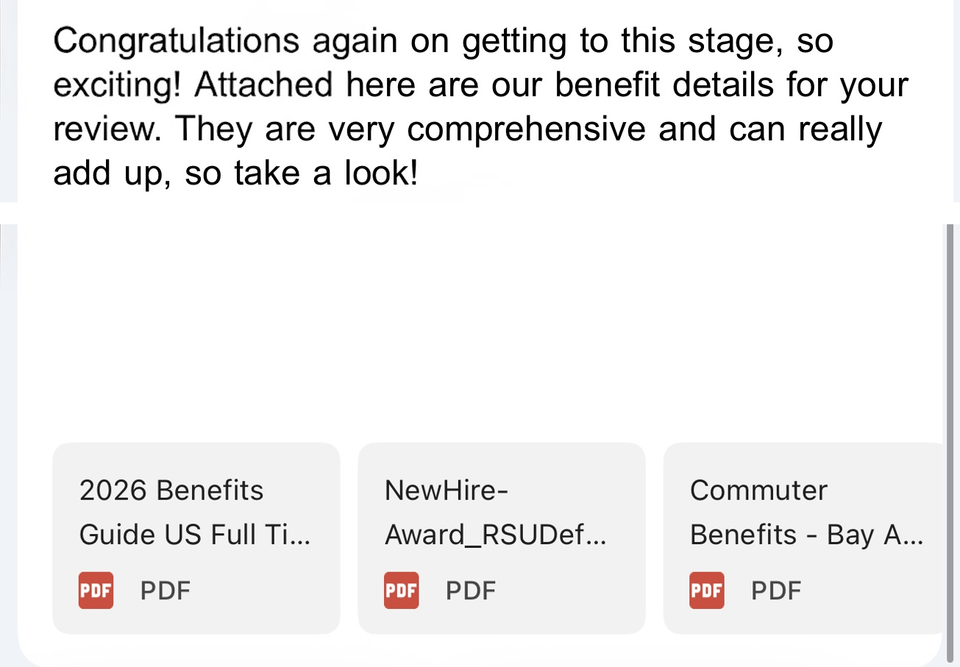
A friend of mine who got help using this exact approach throughout the interview process received an offer from a Big Tech company. Below is an excerpt from an actual email, shared with their consent and with personal information redacted.

An Anthropic Hiring Manager Says, "We’re Done with Traditional Coding Interviews"

The source is Felix Rieseberg’s post, “Hunger beats tenure, Advice for junior engineers” (https://felixrieseberg.com/hunger-beats-tenure-advice-for-junior-engineers/)

Felix Rieseberg, a hiring manager at Anthropic, wrote that starting this month, he would no longer give candidates traditional coding interviews.

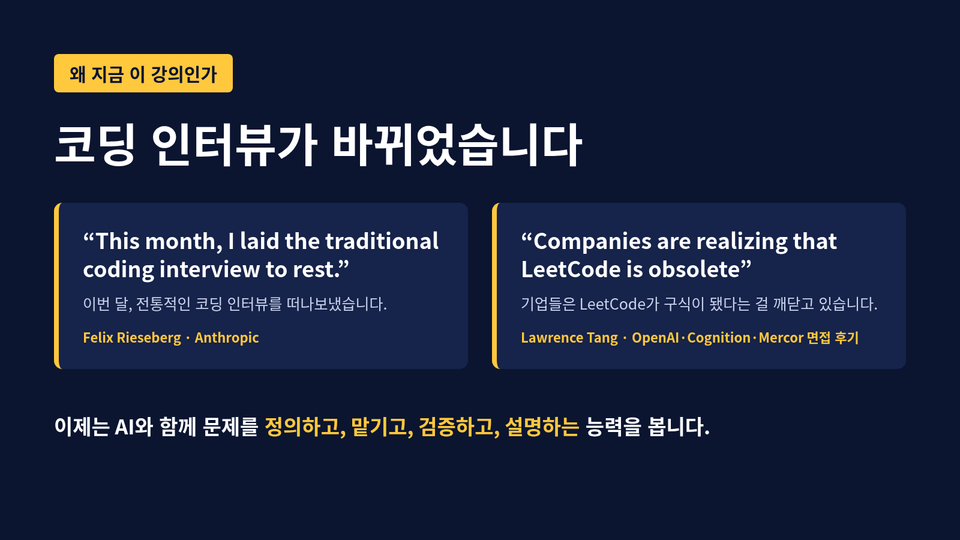
"This month, I laid the traditional coding interview to rest." (This month, I said goodbye to the traditional coding interview.)

The point is that Claude now solves tasks like small React problems better, so those kinds of assignments can’t identify good engineers.

"Our most impactful builders are successful regardless of how good they are at these tests." (The builders who make the greatest impact succeed regardless of how well they do on these tests.)

→ The connection to the lecture is this: More important than the ability to memorize syntax is the ability to give AI precise instructions (Instruct), verify the results (Verify), and explain your reasoning (Explain).

OpenAI, Cognition, and Mercor Interview Experiences: “LeetCode Is Becoming Outdated”

The source is a LinkedIn post by Lawrence Tang (Software Engineer @ Snapchat).

"Coding interviews are becoming more practical." (Coding interviews are becoming more practical.)

"Companies are realizing that LeetCode is obsolete" (Companies are realizing that LeetCode has become outdated.)

Instead of LeetCode-style problems, they ask candidates to implement a rate limiter class, fix bugs in a codebase, or build a new feature with a coding assistant.

→ Here’s how it connects to the course: analyzing unfamiliar code, fixing bugs, hands-on assignments, and the final mock interview all follow this format.

"System design is more important than ever." (System design is more important than ever.)

→ The connection to the course is this: even when AI writes the code, it’s up to people to define the structure and explain the trade-offs. DRIVER’s Reason and Explain help you practice this role.

In summary

Both articles point in the same direction. Interviews are shifting from testing how quickly you can solve algorithms by hand to assessing your ability to define real-world problems, delegate tasks to AI, verify the results, and explain them. To borrow Felix Rieseberg’s words, "Hunger beats tenure." (Drive matters more than years of experience.)

What You'll Learn From This

The DRIVER Six Steps and Strategies for Interview Types A/B/C

Learn the process of understanding problems, using AI, and verifying and explaining results in coding interviews in the AI era.

Evaluation Rubric and 5-Week Roadmap

Use hands-on exercises and mock interviews to assess your current level and identify areas to improve.

5-Week Roadmap

· In Week 1, you’ll understand the overall flow of AI coding interviews.

· In week 2, you’ll develop the ability to assess unfamiliar problems.

· In week 3, gain experience solving problems and checking your work.

· In Week 4, you’ll broaden your practical skills with a larger project.

· In week 5, consolidate what you’ve learned through mock interviews.

The person who created this course

  • Currently, founder of a Silicon Valley startup building AI coding and local model fine-tuning agents

    • Development and operation of Closiro CLI/Mac Desktop (20K+ downloads)

    • Selected for the Google for Startups Program

    • Selected for the Anthropic for Startups Program

  • Previously an engineer at major U.S. tech companies and promising startups

    • Gave up an Amazon final-round offer to start a company

    • Engineer at a Silicon Valley AI fintech startup

    • OpenAI / Meta / Apple / Adobe / Amazon Full-Stack Fellowship

    • Domestic search engine portal and fintech development

    • AR/B2B/SDK development for AI startups

  • Proven Educational Expertise

    • Double majored in Computer Science and Business Administration at a four-year university in Seoul, with extensive startup experience.

    • Has taught over 2,100 students, with 4.6K+ followers on Threads and 500+ Substack subscribers.

Do you have any questions?

We’ve compiled questions you may have before enrolling.

Q. Do I need to be proficient with AI tools to take this course?

It's okay if you're not familiar with specific tools. As long as you have basic development experience, you can follow along.

Q. Will this help me prepare if I’m only studying for algorithm coding tests?

It can also help you prepare for algorithms, but the main exercises focus on working with real code and projects. If you’re looking to practice only solving algorithms, please check the course scope first.

Q. Will taking this course help me pass actual interviews?

No. This course does not guarantee or predict that you’ll pass an actual interview. It helps you assess what you need to improve, and you can use the results of the exercises to prepare for interviews.

Important Notes Before Taking the Course

Practice Environment

  • The exercises will be done using Claude Code and Cursor. You’ll need an environment that supports both tools.

  • The hands-on exercises use Claude Code and Cursor.


  • Any macOS, Windows, or Linux environment that supports using a terminal is sufficient.


Learning materials

  • We provide practice materials and assignments.

  • You can compile your hands-on projects into a personal portfolio.

Prerequisites and Important Notes

  • Basic development experience is required.

  • It consists of videos and hands-on assignments. Consistent study is recommended.

  • Questions and updates will be communicated through course announcements and Q&A.

  • For information on using the course and learning materials, please refer to the course announcements.

Recommended for
these people

Who is this course right for?

  • Junior to mid-level developers preparing for hands-on coding interviews using AI coding agents (Claude Code, Codex)

  • A developer wondering, “If AI writes all the code, what do they look for in interviews?”

  • For those preparing for a MUSINSA-style AI competency assessment and repository debugging interview

Need to know before starting?

  • Basic Python skills and experience running pytest.

  • A setup for using Claude Code and Cursor is needed for the hands-on exercises.

Hello
This is americasnail

Inflearn Verified

2,203

Learners

131

Reviews

84

Answers

4.5

Rating

9

Courses

  • Silicon Valley Survivor | American Snail

    Drawing on experience and know-how gained at the forefront of the Global Tech Scene, I show non-majors how to overcome technological barriers and become the owners of their businesses.

    • Current) Founder of a Silicon Valley AI coding & local model fine-tuning agent startup

      • Development and operation of Closiro CLI/Mac Desktop (20K+ downloads)

      • Selected for the Google for Startups Program

      • Selected for the Anthropic for Startups Program

    • Formerly: Engineer at U.S. Big Tech Companies and Promising Startups

      • Gave up Amazon’s final stage to start a company

      • Silicon Valley AI Fintech Startup Engineer

      • OpenAI / Meta / Apple / Adobe / Amazon Full-Stack Fellowship

      • Domestic search engine portal, fintech development

      • AI startup AR/B2B/SDK development

    • Proven teaching expertise

      • Double major in Computer Science and Business Administration at a four-year university in Seoul, with extensive startup experience

      • Produced 2,100+ cumulative students, with 4.6K+ followers on SNS Threads and 500+ Substack followers.

More

Curriculum

All

9 lectures ∙ (3hr 9min)

Course Materials:

Lecture resources
Published: 
Last updated: 

Reviews

Not enough reviews.
Please write a valuable review that helps everyone!

americasnail's other courses

Check out other courses by the instructor!

Similar courses

Explore other courses in the same field!

Limited time deal

$8,747.00

30%

$77.00