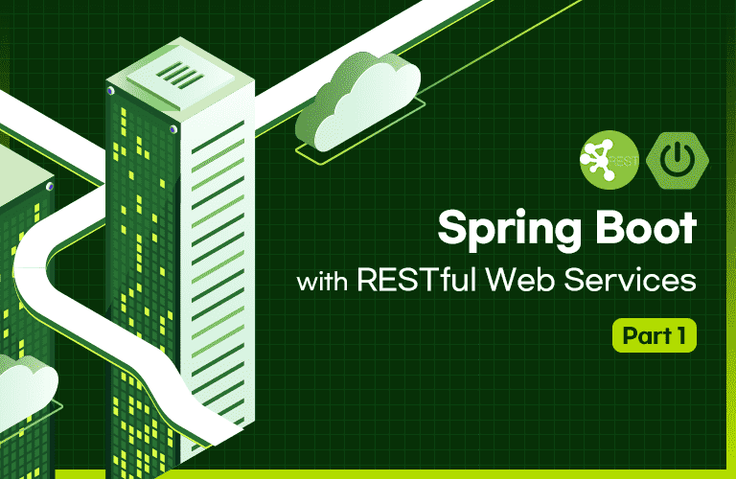
[Revised 2023-11-27] Developing RESTful Web Services using Spring Boot 3.x
This course covers the process of developing a RESTful Web Services application using Spring Boot, and you can learn the basic knowledge required for designing a REST API.
It's very good for basic introduction to Rest API. Thank you.
It was exactly the lecture I wanted.
When Swagger is added in SpringBoot2.2 or higher, a HATEOS usage error occurs. I wonder if there are people who struggle like me...
NoUniqueBeanDefinitionException occurs
Solution: Add the following to the Swagger configuration file class.
@Primary
@Bean
public LinkDiscoverers discoverers() {
List<LinkDiscoverer> plugins = new ArrayList<>();
plugins.add(new CollectionJsonLinkDiscoverer());
return new LinkDiscoverers(SimplePluginRegistry.create(plugins));
}
5.0
OMG
91% enrolled
There are many lectures within Infraon that cost more than 10,000 won per hour, and many of them are very expensive, but compared to those lectures, I think this lecture is quite cheap and its quality is not lacking at all compared to expensive lectures.
I look forward to the next lecture! Thank you for the great lecture :)
5.0
Olive
91% enrolled
It was solid. If you only have basic knowledge of Spring, it seems like a great introductory course to Boot REST API!! I will definitely come and watch the follow-up course.
What you will gain after the course
Spring Boot
REST API
RESTful services
JPA
OAS 3.0 (Swagger Specification)
The Bible of Spring Boot RESTful API Introduction!
This course is designed to help you learn about designing RESTful services and implementing and operating them using Spring Cloud APIs in the process of developing Microservices with Spring Boot and Spring Cloud.
📝 Course Introduction
# What are Microservices?
"Microservices are a software development technique —a variant of the service-oriented architecture (SOA) structural style— that arranges an application as a collection of loosely coupled services. In a microservices architecture, services are fine-grained and the protocols are lightweight." - wikipedia
The term microservices began to be used after a software architecture workshop was held in Venice in 2011. By adopting microservices development approaches instead of traditional monolithic development methods for application construction, cost reduction and increased efficiency have been achieved not only in development but also in maintenance, and customer requirements can now be processed quickly. Along with the popularity of these microservices, the RESTful development approach is also being widely used.
Microservice Architecture refers to a development and operational approach where applications that were traditionally developed and operated as a single large unit are broken down into dozens, hundreds, or even thousands of small service units. To develop these microservices, each service must be able to be developed independently, and they should meet the requirements of Polyglot Programming, which allows for selecting the optimal development language and database for each service.
For data communication between applications developed on different platforms like this, RESTful services that use the standardized HTTP protocol are widely used.
Spring Boot is a development tool and Spring Project that supports easy development of standalone, production-ready Spring-based applications. Using Spring Boot, you can easily create standalone Spring applications that are ready to run, minimize configuration work for the Spring framework and other third-party libraries, and invest more time in business logic. Additionally, by utilizing Spring Boot's Starter components, you can easily configure tasks related to statistics, health checks, external configuration, and other requirements needed for production deployment.
Our ultimate goal is to design and develop an application designed with a microservices architecture using Spring Boot and Spring Cloud.
✏️ Course Curriculum
💡 Through this course, you can learn the overall process of designing, implementing, and operating web services using Microservice Architecture with Spring Boot and Spring Cloud. (View Roadmap)
First Course (Current Lecture)
Learn the process from creating a project with Spring Boot to develop REST APIs, through designing REST APIs and implementing applications.
Second Course (Continuing Lecture)
Learn how to design and build Microservice Architecture using Spring Boot and Spring Cloud.
📢 Please check before taking the course
The development tools and libraries used in the course are as follows.
Java 17 + IntelliJ IDEA + Postman
Spring Boot 3.1.5(Spring Boot Security, Actuator, Starter, Spring Data JPA 등)
OpenAPI Specification 3.0
Swagger UI 5.2.0
H2 2.1.214
The practice code and materials (PDF) used in the lecture can be found on Github
Recommended for these people
Who is this course right for?
For those who want to develop web applications using Spring Boot
For those who want to develop REST API applications
I am an IT engineer. There was a time when I wondered which word I should choose for the occupation field: "office worker?", "developer?", or "instructor?" Then I came to think that “IT engineer” was the job title that suited me best, so I have continued to write "IT engineer" in the occupation field.
A profession represents the work you do, and I believe that work should be enjoyable and useful. Although no one can live by doing exactly the work they want, I am someone who likes the work I do and wants to do it well. Having worked as a developer, instructor, and consultant, I am constantly struggling to keep up with newly released and ever-changing IT technologies. Even so, I am one of those people who wants to encounter, share, and use them even a little earlier than others.
The field I have recently become interested in is online education consulting. The technologies I am interested in include Cloud Native Architecture, Blockchain, Machine Learning, Kafka, and Kuberbetes. I actually teach courses on these technologies and apply them in my work as well. However, since they are such vast topics, I am still continuously studying them.
They say that what you keep in your head is not true knowledge. I intend to share my knowledge and experience in various ways. And I will continue to be an IT engineer who takes on new challenges in new fields and with new technologies.
Current) CEO of NJ One Company
Current) Adjunct Professor, Department of Information Security, Graduate School of International Information, Dongguk University
Former) JP Morgan Chase AMJ Tech consultant (Japan)
Former) Samsung SDS CMS Business Division Lead Engineer
It's very good for basic introduction to Rest API. Thank you.
It was exactly the lecture I wanted.
When Swagger is added in SpringBoot2.2 or higher, a HATEOS usage error occurs. I wonder if there are people who struggle like me...
NoUniqueBeanDefinitionException occurs
Solution: Add the following to the Swagger configuration file class.
@Primary
@Bean
public LinkDiscoverers discoverers() {
List<LinkDiscoverer> plugins = new ArrayList<>();
plugins.add(new CollectionJsonLinkDiscoverer());
return new LinkDiscoverers(SimplePluginRegistry.create(plugins));
}
There are many lectures within Infraon that cost more than 10,000 won per hour, and many of them are very expensive, but compared to those lectures, I think this lecture is quite cheap and its quality is not lacking at all compared to expensive lectures.
I look forward to the next lecture! Thank you for the great lecture :)
I heard it well. I didn't know much about Spring Boot until now, but it has so many functions, and after using them one by one, I think I now know a little bit about what Spring Boot is and how to use it.
It was solid. If you only have basic knowledge of Spring, it seems like a great introductory course to Boot REST API!! I will definitely come and watch the follow-up course.
Content: Top
Preparation: Top
It seems like you prepared a lot to the point where there is no stuttering at all. It is a very good lecture.
Biggest drawback: The sound is so, so, so, so, so small that I wonder how someone with a good voice recorded it.
It is so small that it is stressful. Please pay attention to it from the next lecture.
---After the lecture---
I listened really, really, really well.
You have a teaching ability that is comparable to other lectures.
I quickly ran it twice and organized it on Git.
I learned a lot without even knowing it.
Since there are no consecutive lectures, I will go listen to other lectures. I will buy it and listen to it again when the lecture opens in the future.
I am worried about being compared to instructor DAWON when I go to other lectures.ㅎㅎ
Anyway, I will listen well.
ps. Please set the sound so that it can be heard well even at volume 30!
I set the sound to 100 for the lecture and listen, and then my ears will burst when other alarms go offㅜㅜ.
Hello, this is Lee Do-won.
After recording the lecture, I discussed it with the manager in charge of Inflearn. Since there was no designation for classes with medium or higher volumes during testing on Windows and Mac environments, I released the lecture as is.
I apologize for the inconvenience, and I will pay attention when releasing lectures in the future.
Thank you.









![[Revised Edition] Setting up IntelliJ IDEA for web application developmentCourse Thumbnail](https://cdn.inflearn.com/public/courses/331621/cover/3c440a92-fca5-4ce0-a950-d5865d534892/331621-eng.png?w=420)
![[Old version] Setting up IntelliJ IDEA for web application development (2020 ver.)Course Thumbnail](https://cdn.inflearn.com/public/courses/324954/course_cover/53636a00-6da7-4661-b3ee-52f2359cd1f3/web-app-intellij-eng-2.png?w=420)

![[Season 2] Spring AI in Practice: Developing Multi-AI Agent SystemsCourse Thumbnail](https://cdn.inflearn.com/public/files/courses/339915/cover/01kbqgcec3hb576vxxdf9ch76y?w=420)
![[Java Advanced Practical Project] Spring Core + H2 Based Food Truck Kiosk System DevelopmentCourse Thumbnail](https://cdn.inflearn.com/public/files/courses/336594/cover/01k8hetsq20rg69zw5ve0q5729?w=420)
![[From JSP to Spring Boot] The Unwavering Path to SpringBootCourse Thumbnail](https://cdn.inflearn.com/public/files/courses/334897/cover/01k2j21p3rz09cqh5s0frefaa5?w=420)



![[Season 1] Spring AI in Practice: Developing a Premium Reservation AI AgentCourse Thumbnail](https://cdn.inflearn.com/public/files/courses/339732/cover/01kb2qr7zw5gf0724jvv4rndns?w=420)
![[Renewed] Introduction to Python Backend and Web Technologies for Beginners (Intermediate Python, Understanding Backend and Web Technology Fundamentals with Flask) [Full-Stack Part 1-1]Course Thumbnail](https://cdn.inflearn.com/public/course-325804-cover/6afae82f-e06b-4a0b-914d-2bdf7b1f5b60?w=420)
![[MMORPG Game Development Series with C# and Unity] Part 6: Web ServerCourse Thumbnail](https://cdn.inflearn.com/public/course-325464-cover/1fa9d02e-de61-46aa-80db-a46a4a573ce9?w=420)