Practical GitOps CI/CD with Jenkins and ArgoCD

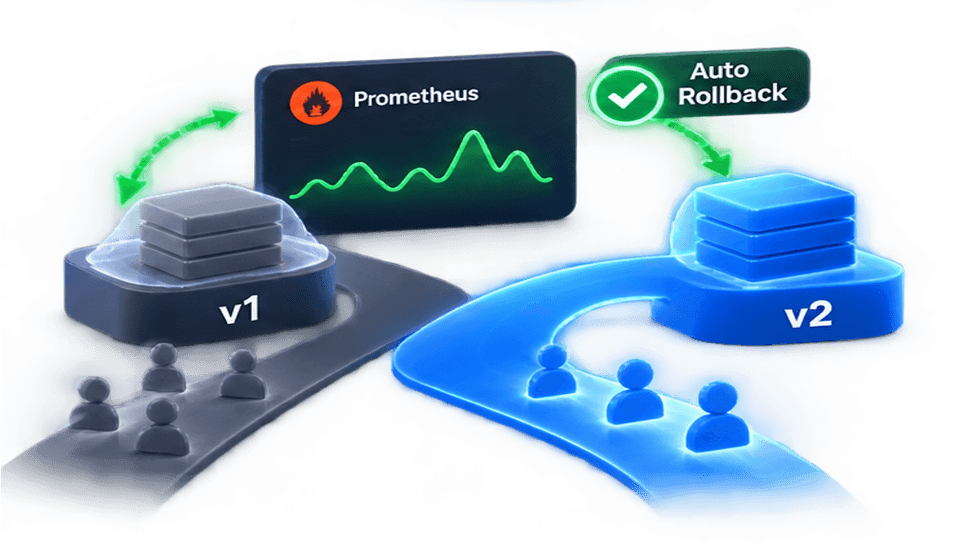
Beyond traditional Jenkins-based CI/CD, this course also covers GitOps deployments using ArgoCD. You will design and implement CI/CD and GitOps deployment strategies for dev, staging, and production environments by combining Jenkins and ArgoCD. You will work with both push-based Jenkins and pull-based ArgoCD, directly comparing the two approaches on the same cluster to build a practical hybrid deployment pipeline. You will practice essential deployment techniques for operations, including Canary, Blue-Green, RBAC, approval procedures, incident response, and automatic rollback.

97 learners are taking this course

Level Basic

Course period Unlimited

Docker
Docker
Jenkins
Jenkins
Kubernetes
Kubernetes
CI/CD
CI/CD
backend
backend
Docker
Docker
Jenkins
Jenkins
Kubernetes
Kubernetes
CI/CD
CI/CD
backend
backend

What you will gain after the course

  • A Decision-Making Framework for Designing Deployment Strategies Tailored to Each Environment

  • My own fully functional GitOps infrastructure setup

  • The ability to answer deployment-related interview and practical questions with sound reasoning.

Learn practical CI/CD strategies that combine Jenkins and ArgoCD for dev·staging·production environments, rather than learning them separately.😏

How to design deployment strategies tailored to each dev, staging, and production environment

"The deployment works, but I'm not sure if this is the right approach."

Have you ever set up CI/CD with Jenkins but weren’t sure whether your current approach was the right one, or studied ArgoCD and GitOps but felt unsure about how to apply them in a real-world project?

This course does not stop at simply learning how to use Jenkins and ArgoCD separately.

How to determine which deployment method to choose based on the characteristics of development (dev), staging, and production environments, and how to combine Jenkins and ArgoCD to design a working CI/CD and GitOps pipeline is covered.

By the time you complete the course, your computer will contain not just a simple hands-on example,

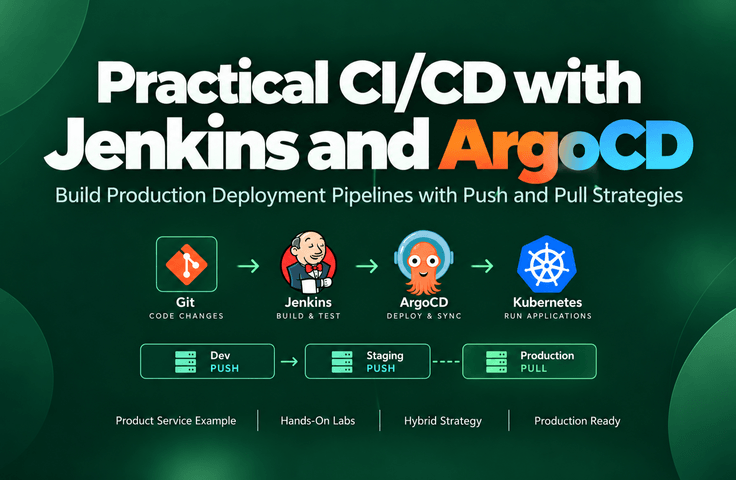
a hybrid GitOps pipeline where dev and staging use Jenkins-based push deployments, while production uses ArgoCD-based pull deployments is completed in a fully functional form.


Hybrid Pipeline

Features of This Course

📌 You will not learn Jenkins and ArgoCD separately.

In most CI/CD courses, learning Jenkins means using only Jenkins, while ArgoCD courses use only ArgoCD.

However, in practice, it is more common to combine multiple approaches depending on the environment and the organization’s characteristics rather than use just one tool.

In this course, we will directly implement the following hybrid structure.

  • Developer → Git → Jenkins → dev / staging

  • Developer → GitOps Repository → ArgoCD → production

In other words, we connect two different strategies into a single system: fast Push-based deployment in dev and staging, and Pull-based GitOps deployment in production, where Git serves as the source of truth.

📌 Complete the hands-on environment with just Docker Desktop

No separate cloud environment such as AWS, Azure, or GCP is required.

In your personal computer’s Docker Desktop environment

  • Kubernetes/

    Jenkins/

    ArgoCD/

    Argo Rollouts


You configure the environment yourself. It is designed so that you can experience the entire CI/CD and GitOps workflow without separate cloud costs.

📌 Develop a Single Spring Boot Service from Start to Finish

Instead of using a new example for each section, we continue using a single product-service based on Spring Boot throughout the course.

It starts with a simple Spring Boot API, then progressively evolves through Docker Image → Kubernetes Deployment → Kustomize → Jenkins Pipeline → ArgoCD → GitOps → Canary Deployment → automatic rollback.

Therefore, there is less burden of having to understand the example project again each time a new technology emerges.

📌 It covers not only deployment but also operations and permissions.

In a real-world CI/CD environment, simply being able to deploy is not enough.

  • Who can deploy to the development environment,

  • who can make changes to the production environment,

  • It is also important to determine who should approve production deployments.

For these tasks, this course also examines

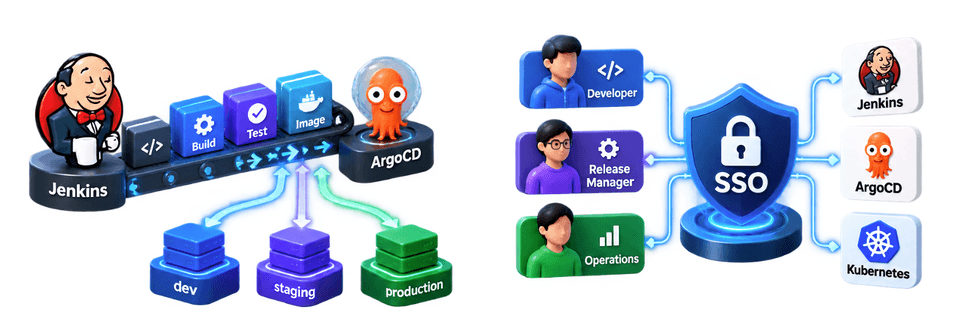
  • Jenkins Role Strategy/

    Jenkins Credentials/

    Approval Gate/

    ArgoCD RBAC/

    AppProject

We will also explore these topics. You will learn how to design CI/CD as part of an operational system, rather than merely as an automation tool.

Recommended for people like these

Backend developers

Recommended if you can develop applications with Spring Boot but have been using deployment pipelines created by others.

Infrastructure and DevOps professionals

Recommended for those who need to build a CI/CD environment for a new project or transition an existing Jenkins-centric deployment environment to a GitOps approach.

IT operations managers

You will also learn about the RBAC structures and deployment history management approaches of Jenkins and ArgoCD, enabling you to understand the fundamental architecture needed to discuss CI/CD policies.

After completing the course,

  • You can design deployment strategies for each dev/staging/production environment based on sound reasoning.

  • You will be able to work with ArgoCD at a practical level, from Applications to App of Apps, ApplicationSet, and RBAC.

  • You will directly implement canary deployments and automatic rollbacks, gaining experience responding to real-world incidents.

  • You can independently establish and apply a basic deployment strategy, approval process, and rollback plan for your own project.

You’ll learn the following.

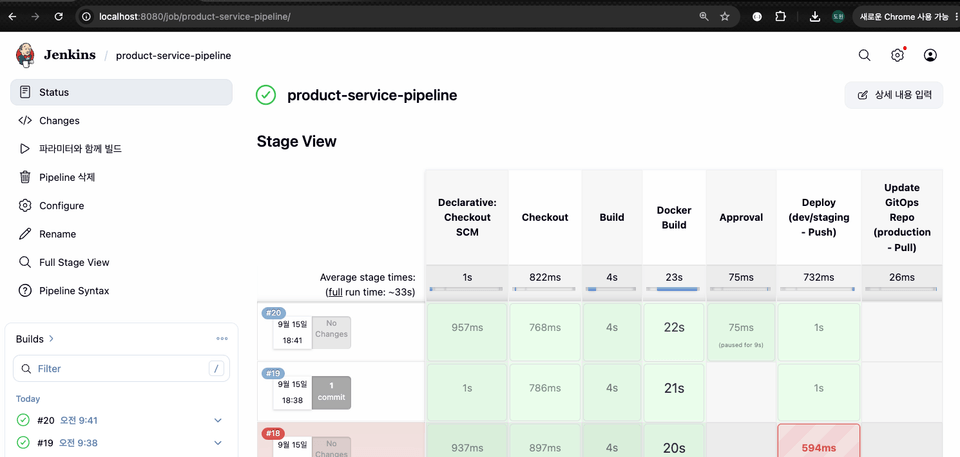
Build a Jenkins-based CI/CD pipeline yourself

Go beyond simply running Jenkins Jobs and build an actual CI/CD Pipeline. You will understand how Jenkins operates not merely as a “build server,” but as a CI/CD Orchestrator.

Understand how ArgoCD and GitOps work.

The most important question in GitOps is "Why should Git be the source of truth for the production environment?" . This course is designed to help you go beyond simply clicking the Sync button in the ArgoCD interface and actually design a real project structure.

Designing Hybrid GitOps with Jenkins + ArgoCD

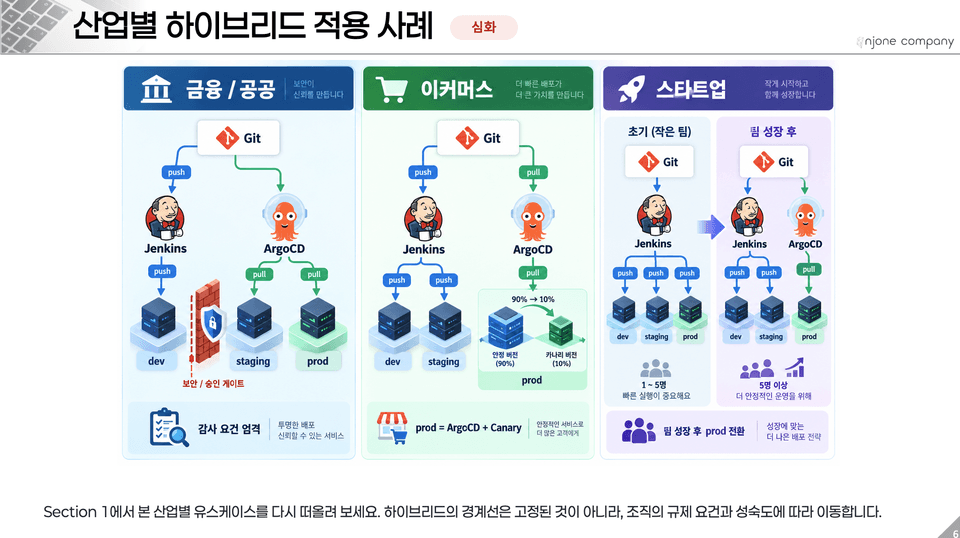
Instead of using the same deployment method for every environment, we apply dev → Jenkins Push, staging → Jenkins Push, production → ArgoCD Pull .

Experience Canary and Blue-Green deployments, including automatic rollback.

Using Argo Rollouts, you will practice switching to Canary Deployment, Rollback, and Blue-Green Deployment.

The person who created this course

"Knowledge in your head is not knowledge." With this belief, I strive to package my modest experience and knowledge effectively and explain them in a way that is easier to understand. I believe these lectures will be easier to follow for those who are interested in LLMs and AI based on Java and the Spring Framework.

  • Based on 26 years of experience in teaching, consulting, and development, I conduct lectures with explanations designed to help you understand practical experience and know-how.

  • My current work as an architect and engineer: I personally design and develop GraphRAG-based knowledge graph systems and enterprise AI platforms.

    • 2023 ~ Present: CEO of NJ One Company Co., Ltd.


    • Current) Adjunct Professor, Department of Information Security, Graduate School of International Information, Dongguk University

    • Former JP Morgan Chase AMJ Tech consultant (Japan)

    • Formerly) Samsung SDS CMS Business Division, Lead Engineer

  • Execution of AI/LLM projects in the financial sector: By carrying out multiple AI- and LLM-related projects in the financial sector, I gained practical experience designing and implementing LLM services in the financial domain, where reliability and stability are especially important.

  • Years of teaching MSA, cloud-native technologies, and AI: I teach courses in Spring Boot, Spring Cloud, MSA, Kafka, Blockchain, Machine Learning, Deep Learning, and DevOps.

  • Corporate training and curriculum design: I have designed curricula for and personally taught numerous corporate and bootcamp courses, including cloud, MSA, security, and AI programs. My principle is to incorporate real-world project experience into my lectures rather than stopping at theory.

Notes Before Enrolling

Practice environment

  • The course is explained based on MacOS (Sequoia 15.7.4), but those using Windows OS can also follow along easily.

  • In this course, the hands-on exercises are conducted using Visual Studio Code based on OpenJDK 17+.

  • Gradle is used as the build tool.

  • Installation of Jenkins and ArgoCD required for the hands-on exercises will be done during the course.


Learning materials

  • Slide materials provided for each section (PDF files)

  • Runnable Spring Boot example project

  • Kubernetes manifest files provided (GitHub repository provided)

Prerequisites and Important Notes

  • Not required, but having the following two things will make things much easier.

    • Experience creating a simple REST API with Spring Boot (not required; used as a deployment target rather than for the code itself)

    • Basic Git usage (clone, commit, push) and comfort with using the terminal

  • It is sufficient if you have only heard of very basic Docker and Kubernetes terms, such as containers and Pods.

    • Since we will cover the necessary concepts and installation from the beginning in Sections 1–2, the course is designed so that even those who have never used Kubernetes can follow along. However, if you are completely new to Kubernetes, we recommend familiarizing yourself beforehand with the basic concepts of container orchestration.

Recommended for
these people

Who is this course right for?

  • "I can create a Docker image, but everything after Kubernetes is difficult." says a backend developer

  • "Infrastructure and DevOps professionals considering how to gradually transition from their existing CI/CD environment to GitOps&quot

  • An IT operations professional who needs to understand "deployment approvals/operational permissions/incident recovery/change history"

Need to know before starting?

  • Basic Git Usage

  • Basic experience using the terminal

  • Basic knowledge of Docker containers

Hello
This is Dowon Lee

Inflearn Verified

31,788

Learners

1,779

Reviews

1,383

Answers

4.8

Rating

10

Courses

I am an IT engineer. There was a time when I wondered which word I should choose for the occupation field: "office worker?", "developer?", or "instructor?" Then I came to think that “IT engineer” was the job title that suited me best, so I have continued to write "IT engineer" in the occupation field.

A profession represents the work you do, and I believe that work should be enjoyable and useful. Although no one can live by doing exactly the work they want, I am someone who likes the work I do and wants to do it well. Having worked as a developer, instructor, and consultant, I am constantly struggling to keep up with newly released and ever-changing IT technologies. Even so, I am one of those people who wants to encounter, share, and use them even a little earlier than others.

The field I have recently become interested in is online education consulting. The technologies I am interested in include Cloud Native Architecture, Blockchain, Machine Learning, Kafka, and Kuberbetes. I actually teach courses on these technologies and apply them in my work as well. However, since they are such vast topics, I am still continuously studying them.

They say that what you keep in your head is not true knowledge. I intend to share my knowledge and experience in various ways. And I will continue to be an IT engineer who takes on new challenges in new fields and with new technologies.


  • Current) CEO of NJ One Company

  • Current) Adjunct Professor, Department of Information Security, Graduate School of International Information, Dongguk University

  • Former) JP Morgan Chase AMJ Tech consultant (Japan)

  • Former) Samsung SDS CMS Business Division Lead Engineer


More

Curriculum

All

94 lectures ∙ (10hr 40min)

Course Materials:

Lecture resources
Published: 
Last updated: 

Reviews

Not enough reviews.
Please write a valuable review that helps everyone!

Dowon Lee's other courses

Check out other courses by the instructor!

Similar courses

Explore other courses in the same field!

Limited time deal

$37,950.00

50%

$59.40