
inflearn logo

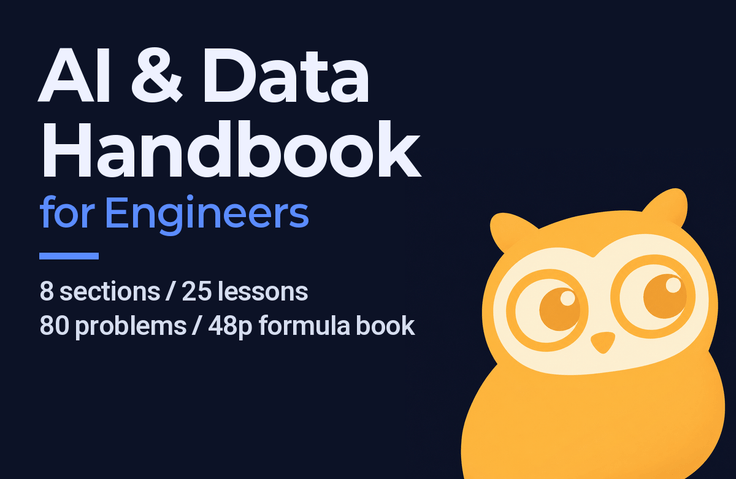
Practical AI and Data Handbook for Engineers

For engineers unsure whether they can trust AI analysis, we practice validation and observation based on hands-on experience in manufacturing and quality control.

1 learners are taking this course

Level Intermediate

Course period Unlimited

data-cleaning
data-cleaning
verification
verification
observability
observability
spc
spc
ROC
ROC
data-cleaning
data-cleaning
verification
verification
observability
observability
spc
spc
ROC
ROC

What you will gain after the course

  • Step-by-step verification of AI-generated analysis results using invariant checks and a validation ladder

  • Interpret model performance by linking precision, recall, and ROC-AUC with control charts, process capability, and MSA.

  • Observe data, models, and deployment results, and diagnose anomalies, drift, and performance degradation.

  • Feasibility and Investment Impact Assessment of Implementing Predictive Maintenance, Vision Inspection, and Yield Prediction Cases

  • Design verifiable questions and prompts, and explain the basis for the analysis in an industry report.

  • Progress step by step from basic statistics to intermediate-level quality analysis and hands-on AI operations.

Practical AI and Data Handbook for Engineers

A text-based course for engineers who can verify numbers produced by AI, instruct AI accurately, and explain its conclusions

  • Structure: 8 sections, 25 lessons, 80 practice questions, 4 hands-on notebooks, and 1 handbook PDF

Recommended for people like these

  • Engineers who use AI-generated analyses and reports in their work and need criteria to independently verify whether the numbers are correct

  • A data professional who wants to know what to ask again when told that a report is 99% accurate

  • Quality and process professionals who want to reorganize control charts, process capability, and measurement system analysis by connecting them with AI analysis results

What You Will Learn

Section Contents
1. Principles of AI and LLMs and safe usage: tokens, context, temperature, hallucinations, RAG and fine-tuning, information leakage, and prompt injection
2. AI output verification and collaborative instruction design: types of hallucinations and the verification ladder, invariant checks, and report structure
3. Probability and statistics: intuition for the normal distribution, standard error and p-values, base rates, and Simpson’s paradox
4. Machine learning evaluation metrics and overfitting: validation design, recall, precision, F1, MCC, regression metrics, and imbalanced data
5. Data quality and leakage: data checklists, five types of leakage and splitting principles, drift, and PSI
6. SPC and process capability: control charts and rules for identifying anomalies, the difference between control limits and specification limits, Cp, Cpk, and sigma levels
7. Measurement System Analysis (MSA): bias, linearity, and stability, %GRR and ndc in Gage R&R, and the kappa coefficient
8. AI cases in manufacturing: predictive maintenance, visual inspection, virtual metrology, yield models, and an AI adoption checklist

Provided Materials

  • 25 class notes (ready to read in the classroom), 25 accompanying class materials PDFs—one for each class—and a combined PDF compiling all 25 classes

  • Handbook PDF, *Practical AI and Data Handbook for Engineers*, 48 pages

  • An 80-question section-by-section practice workbook and a PDF of answers and explanations.

  • Section-by-section web mock exam: Solve 10 practice questions online and immediately view your score and explanations. During the exam, you can ask the AI assistant up to 3 questions per attempt.

  • 4 practice notebooks (control charts, Cp·Cpk, Gage R&R, and imbalanced classification metrics). Download them from notebooks.zip in the course materials.

Recommended for
these people

Who is this course right for?

  • Manufacturing and quality engineers who need to review errors and overstated conclusions in AI analysis reports

  • A data practitioner looking to connect control charts, process capability, and MSA with machine learning model evaluation

  • AI and data operations personnel who need to detect model performance degradation and data drift early

  • Process managers and technical leaders considering the adoption of predictive maintenance, vision inspection, and yield prediction.

  • Beginner to lower-intermediate learners seeking to systematically learn everything from the fundamentals of statistics and machine learning to their practical application in the field

Need to know before starting?

  • Understanding the concepts of basic statistics (mean, standard deviation)

  • Experience handling Excel or spreadsheet data

  • Practical experience in manufacturing, quality, or data analysis operations

Hello
This is yazzang

Career Verified

Research engineer by day.
By night, tools for AI coding agents, Korean game localization, and a home lab.

Curriculum

All

38 lectures

Course Materials:

Lecture resources
Published: 
Last updated: 

Reviews

Not enough reviews.
Please write a valuable review that helps everyone!

Similar courses

Explore other courses in the same field!

Limited time deal

$49,500.00

50%

$77.00