
inflearn logo

Learning 1-on-1s Through Stories: Interview Conversation Techniques for Team Leaders

This course is for team leaders who feel stuck because 1-on-1s devolve into work reports or small talk, and team members do not open up about what they really think. You will watch conversations between two teams—the Planning Team and the Operations Team—pause to reflect, and then write the opening line yourself, learning everything from preparation, active listening, feedback, trust-building, and situational conversations to follow-up management. By comparing unsuccessful statements with improved ones, you will create practical materials you can use in your next meeting right away, including operating cards, question cards, and agreement statements.

2 learners are taking this course

Level Beginner

Course period Unlimited

Communication
Communication
Communication
Communication

What you will gain after the course

  • You can create an operating card for the team’s 1-on-1 frequency, duration, and location, along with a script for opening the first meeting.

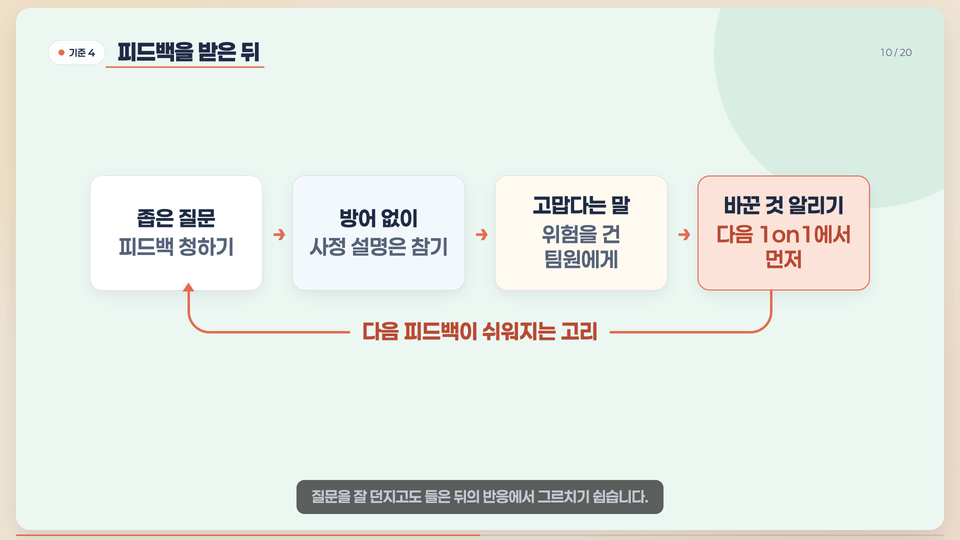
  • You can prepare ready-to-use sentences for active listening, open-ended questions, acknowledgment, and constructive feedback.

  • You can establish confidentiality and record-keeping principles, and design situation-specific conversations and follow-up commitments after meetings.

A typical 1-on-1 starts by scheduling a recurring calendar event. If you haven’t decided what to discuss, the meeting can drift into a work update or small talk, and during busy weeks, it is the first thing to be canceled. This course covers how to transform that kind of 1-on-1 into a conversation that begins with the team member’s story and continues through to the next meeting with commitments and notes.


Learn by watching, pausing, and writing the conversations between the two teams yourself.

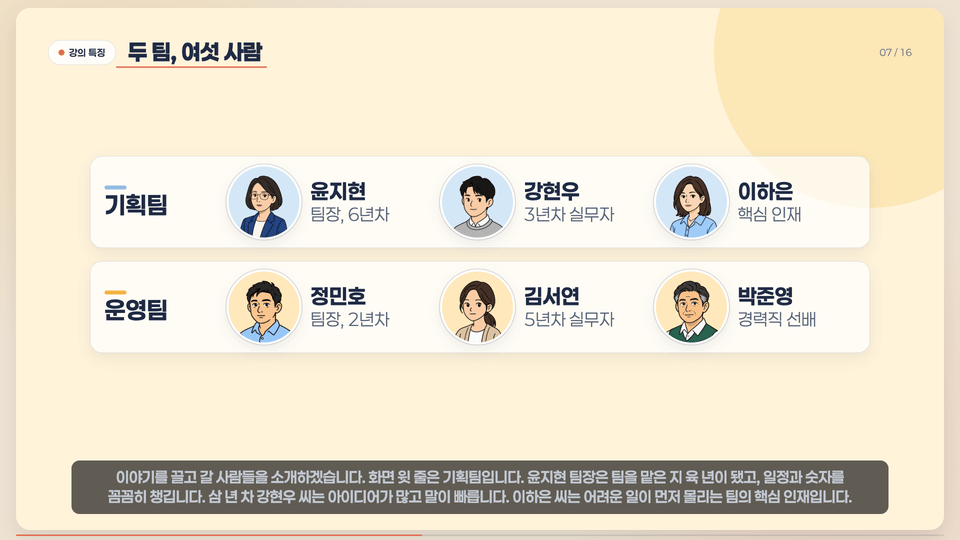
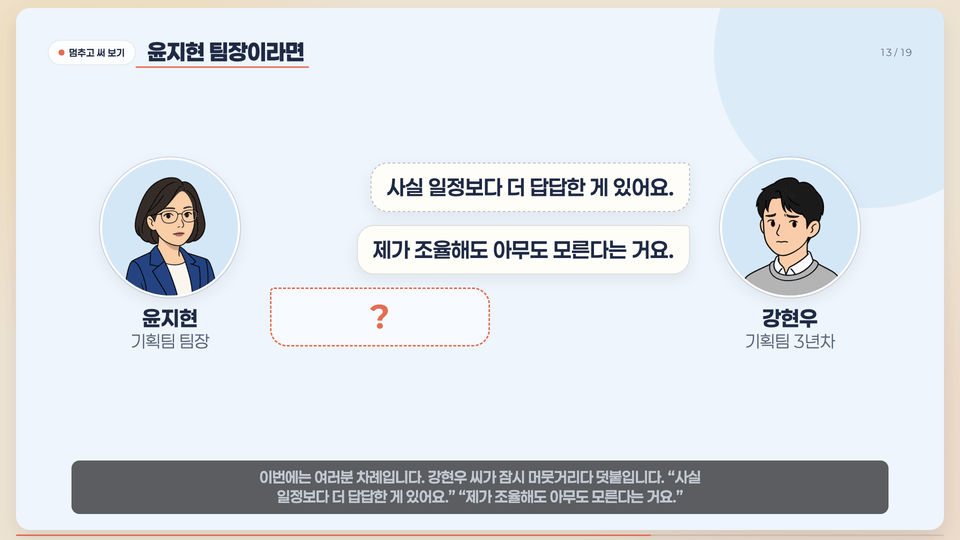
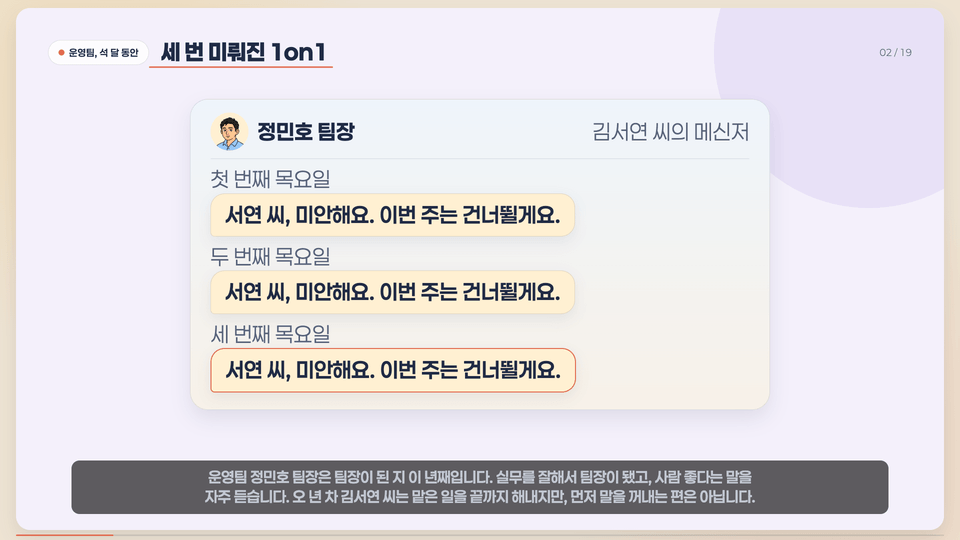
One-on-one scenes featuring six people from the planning and operations teams at the same company unfold through character illustrations and speech bubbles. The planning team is represented by team leader Yoon Ji-hyun, Kang Hyun-woo, and Lee Ha-eun, while the operations team features team leader Jung Min-ho, Kim Seo-yeon, and Park Jun-young. One team leader keeps putting off feedback, while the other gives answers before team members have finished speaking. Both team leaders make mistakes in every episode and correct them within the same episode.


See the failed and revised statements side by side.

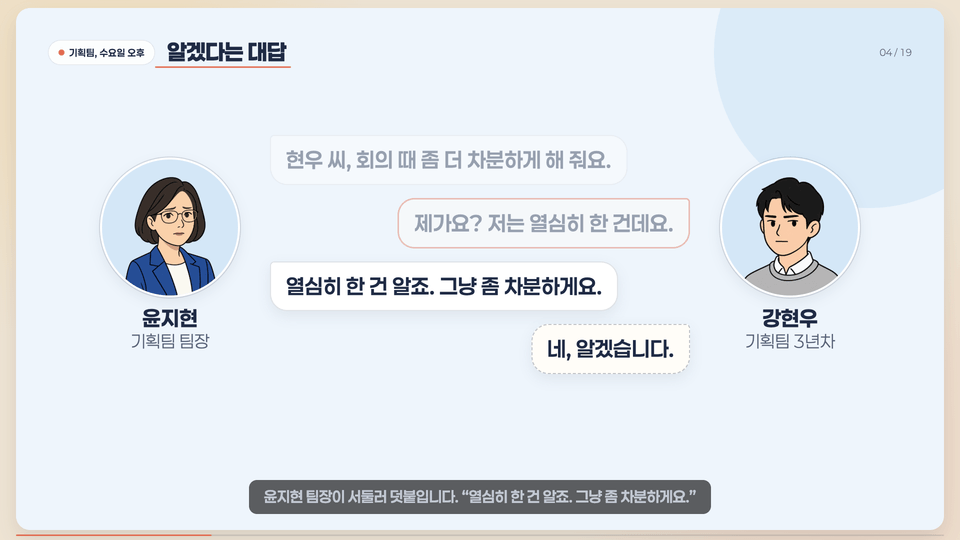
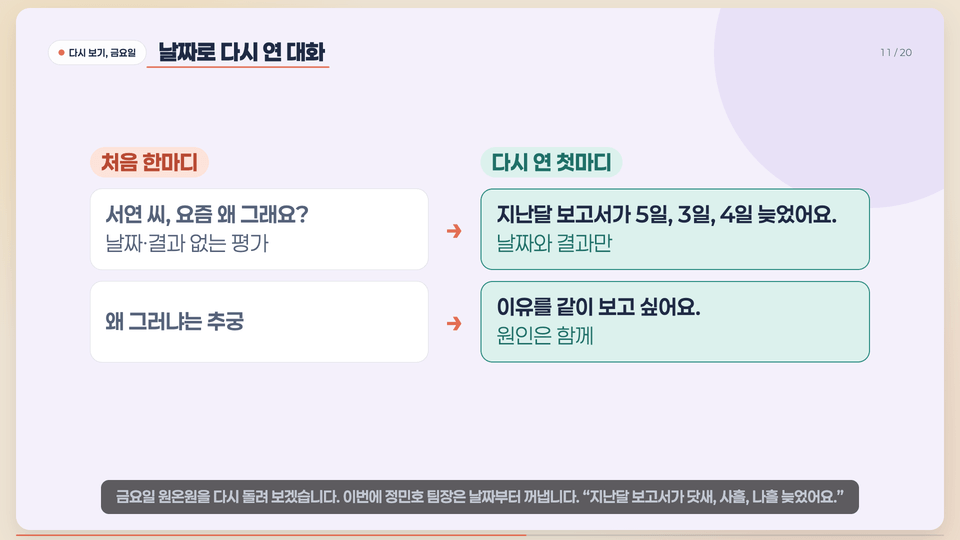
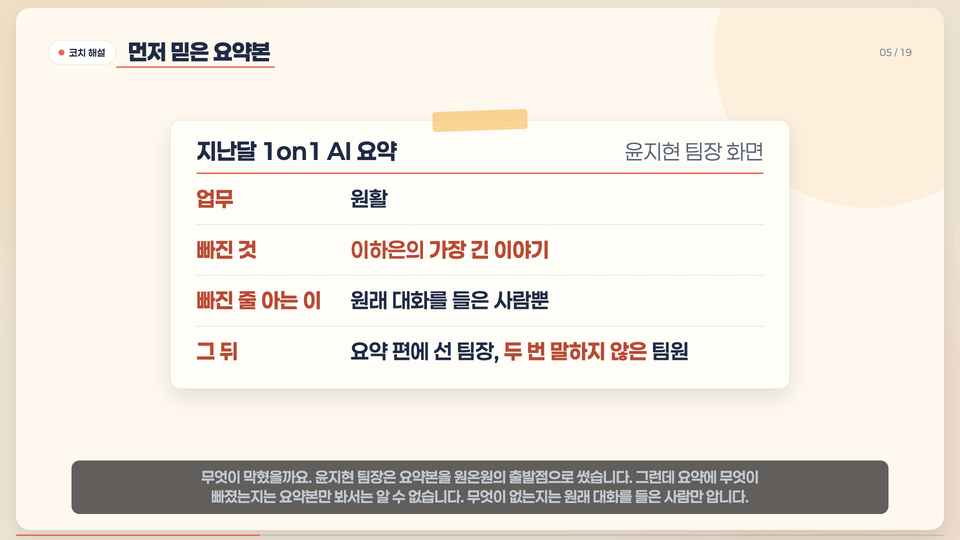
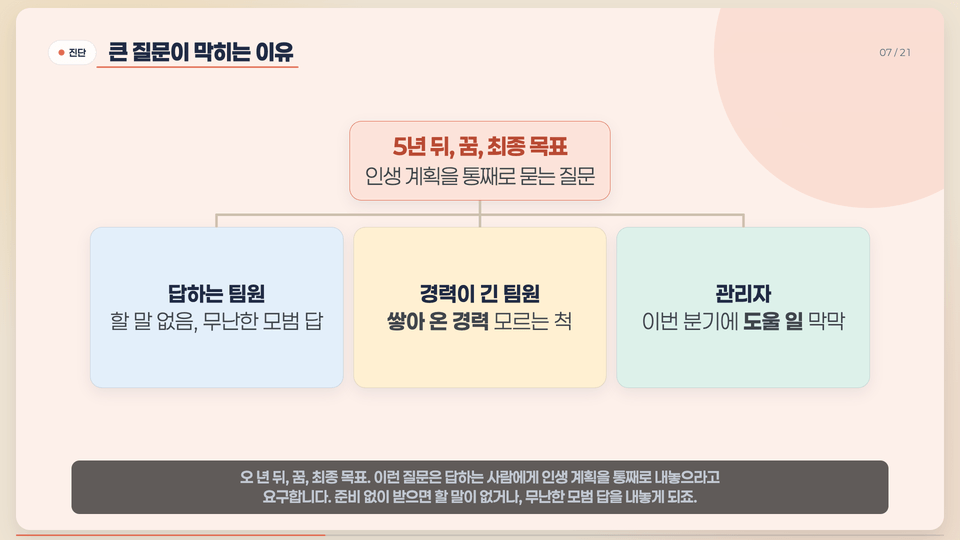
When the conversation gets stuck, the coach pauses the scene and explains why it stalled and what criteria to use for making decisions next time. The same scene is then shown again with revised wording. Brief annotations point out which remarks blocked the conversation and which ones opened it up. It also covers a balanced range of gender combinations between managers and team members, as well as conversations with older team members, without assigning roles or weaknesses based on gender or age.


Once per episode, pause and write it yourself.

Pause the video on a screen with the manager’s speech bubble empty and write the opening words yourself. On the next screen, review what the manager actually said and 3–4 evaluation criteria, then check the sentence you wrote. Each episode consists of a scene, coaching commentary and learning objectives, evaluation criteria, a revised scene, a writing exercise, the answer and self-check, and an afterword and summary. Even by watching just one episode, you can learn its content from beginning to end.


From the opening words to reviewing commitments, this covers the entire flow of 1-on-1s.

Part 1 explains the purpose of 1on1s and how they become formalized. Part 2 covers rules for frequency, duration, and location; agreeing on the purpose of the first meeting; and agendas and preparation led by team members. Part 3 practices listening, open and follow-up questions, responding to silence, and recognition and improvement feedback. Part 4 addresses confidentiality and documentation principles, consistent standards, and power differences. Part 5 prepares conversations tailored to declining performance, stagnation and burnout, careers and growth, and thoughts of changing jobs. Part 6 covers agreement statements, reviewing past commitments, and connecting 1on1s with goals and evaluations. Part 7 sets standards for using documentation tools and AI summaries, while Part 8 addresses manager development and organizational operating metrics. Finally, you review one full 1on1 cycle and create an action plan for the first 30 days.


Create deliverables you can bring directly to your team.

For each episode, you will create one practical deliverable, such as an operating card, shared agenda template, question card, agreement statement, record classification table, growth assignment card, commitment review questions, or quarterly review checklist. Since the course covers standards that can be used directly in conversations without relying on any specific program or company system, it can be applied in any organization.


The course consists of 24 episodes in total: 1 introductory episode, 22 episodes across 8 sections, and 1 concluding episode. You will learn through videos that include slides, coach narration, and subtitles. We recommend watching them in order at first, but if you are in a hurry, you may start with the relevant episode. This course is for team leaders and department heads conducting 1-on-1s with team members for the first time, managers whose meetings tend to turn into work reports or small talk, managers who find it difficult to hear what their team members are really thinking, and HR professionals and leaders looking to introduce a 1-on-1 program within their organization. The length of your management experience does not matter. We are waiting for managers who want to change one thing in their next 1-on-1.

Recommended for
these people

Who is this course right for?

  • Team and part leaders who are conducting 1-on-1s with team members for the first time and need to determine how to approach the initial conversation and structure the meetings.

  • Managers whose 1-on-1s turn into work reports or small talk, or who find it difficult to understand what their team members really think because they only say positive things.

Need to know before starting?

  • Not needed

Hello
This is openlab

Career Verified

633

Learners

104

Reviews

11

Answers

4.6

Rating

12

Courses

Packed with practical know-how you can use right away in your business work.
#EdTech #LifelongLearning #AX #eLearning


<Open Learning Lab>

* After working in the fields of e-learning, edtech, and lifelong learning, currently serving as the director of Open Learning Lab Co., Ltd.
* A doctor of educational technology with a strong interest in how individuals and organizations learn and grow
* Focused on turning ideas into reality in areas such as digital learning, edtech, lifelong learning, and the metaverse
* Active as a business content creator producing various types of content needed for business


<Business Areas>

* EdTech system and service consulting
* Information system planning and consulting
* Public-sector business system planning and consulting
* Web project management, web service planning, and learning content planning
* Data analysis and learning analytics
* Web trends lectures
* Startup business model coaching and consulting
* Metaverse-related lectures and consulting, and world-building projects
* AI-powered vibe coding and agentic coding
* AX-related trends and consulting, etc.

More

Curriculum

All

24 lectures ∙ (3hr 45min)

Published: 
Last updated: 

Reviews

Not enough reviews.
Please write a valuable review that helps everyone!

openlab's other courses

Check out other courses by the instructor!

Similar courses

Explore other courses in the same field!

Limited time deal

$382,637.00

50%

$28.60