

My Own ESP32 IoT Device for Collecting Sensor Data - For Beginners and Arduino Users

In an era overflowing with digital content created by generative AI, what is your competitive edge? Data generated by the Internet of Things (IoT), which connects AI with physical phenomena, will become your competitive advantage. This course will help you stay ahead of others by building a foundation in IoT. This course is helpful for the following people: - Digital content creators using sensor data collection, interpretation, processing, and AI model generation - Entrepreneurs and educational content developers utilizing sensor data

(5.0) 4 reviews

28 learners

Level Basic

Course period Unlimited

Big Data
Big Data
IoT
IoT
Embedded
Embedded
hardware
hardware
esp32
esp32
Big Data
Big Data
IoT
IoT
Embedded
Embedded
hardware
hardware
esp32
esp32

Reviews from Early Learners

Reviews from Early Learners

5.0

5.0

low

100% enrolled

I looked into YouTube and books to try and make a custom board, but I felt lost because there wasn't as much information as I expected. The most helpful part of the course was the hands-on process of drawing the schematics and performing PCB routing myself using KiCad. Also, in Section 5, using the board I made along with the firmware source code allowed me to clearly grasp how data moves back and forth via BLE and Wi-Fi. Thank you so much.

5.0

그린티파르페

100% enrolled

I've been wanting to try making my own development board since using Arduino, and I was able to learn how through this lecture. The instructor explains everything in great detail.

5.0

최은석

32% enrolled

I've completed about half of the lectures so far, and the process of creating a custom development board using a microcontroller is explained step-by-step from basic to advanced levels, which is very helpful for a novice engineering student like me. I think it will be a great help as I intend to create and use small modules combined with sensors in a wireless structure. I highly recommend this lecture, especially for beginners.

What you will gain after the course

  • Automation of environmental data collection (temperature, humidity, illuminance, etc.) and remote monitoring - Basic IoT system development capability

  • Basics of product development based on a microcontroller (ESP32) capable of wireless communication

  • Specific methods for ordering, production, and shipping through the hardware manufacturer's website

  • How to use the open-source circuit editing tool KiCad for schematic configuration and PCB design

  • Firmware development methods including sensor operation and wireless communication (BLE, WiFi), internet connectivity, and HTTP communication

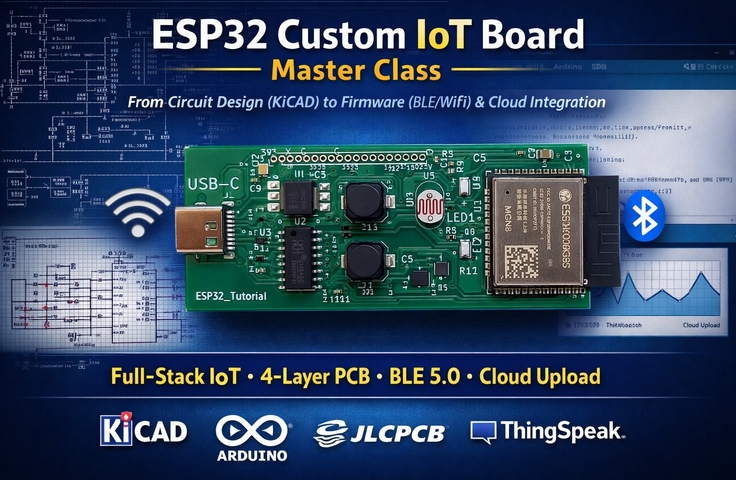
Create Your Own IoT Custom Development Board
with ESP32 and KiCad

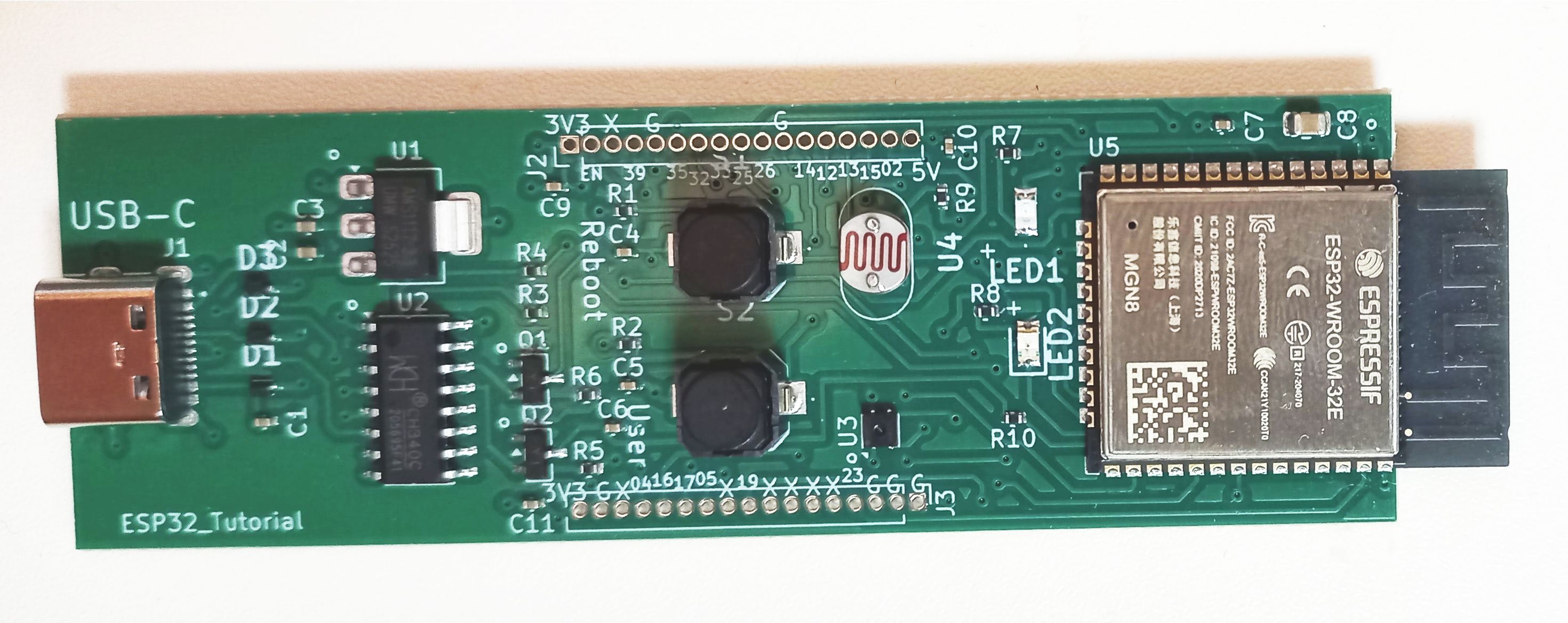
Actual photos of the boards you will create in this course


In an era overflowing with digital content created by generative AI,
what is your competitive edge?

AI creates code, writes text, and generates images.
However, it still cannot create data from the physical world on its own.

What fills this gap is
the technology that connects AI with reality, the Internet of Things (IoT).

Data collected through sensors is
not just simple information, but
a differentiated competitive advantage that only you can possess.

This course helps you become a creator who generates data,
rather than just a user following along
in the era of AI.


🔧 Course Introduction

This course is a practice-oriented lecture on designing and manufacturing your own custom development boards using the ESP32, a representative IoT microcontroller.

  • We have lowered the tuition barrier so that even beginners can learn easily. Invest just 6 hours.


  • Arduino users can transition directly to ESP32 development without any sense of unfamiliarity. (Using the Arduino development environment)

Beyond simply using the ESP32,
you will experience the entire process from circuit design using KiCad to PCB fabrication, firmware writing, and hands-on practice, developing the
ability to integrally understand hardware + software.

The lecture covers the following core technologies:

  • Digital Input/Output (GPIO) via buttons and LEDs

  • Analog input and sensor data processing

  • PWM control (analog output)

  • EEPROM data storage (non-volatile memory)

  • I2C communication (sensor operation)

  • BLE communication (communication with mobile phones)

  • WiFi communication (Internet connection, Internet of Things)

🎯 What you will gain from this course

Through this course, you will be able to grow in the following directions:

  • A digital content creator who combines AI models based on sensor data collection, interpretation, and processing


  • IoT-based startup and educational content developer who solves problems based on real-world data

This course is not simply about learning the ESP32.

This is the starting point for your transition
from being an “AI user
to becoming an “AI data provider.”


🔥 Closing Remarks

Do not be someone who merely consumes content created by AI;
become someone who creates real-world data that AI cannot imitate.

💡What students will take away upon completing this course

  • How to create a schematic for an ESP32 development board using KiCad, and wiring methods using the PCB Editor

  • How to order custom production using KiCad output files, and your own custom-made development board (the same board as in the photo above, with production costs borne separately by the student)

  • How to install component libraries, how to write firmware, and how to operate the board by downloading it 

Note: The manufacturing cost of the board is not included in the tuition fee for this course. (To be borne by the student)

Production is handled through the overseas manufacturer JLCPCB (https://jlcpcb.com), and after production, it is delivered to the student following shipping and customs clearance.

Example of production costs: As of March 2026, the exchange rate is 1,490 KRW per dollar, and the minimum production cost for the boards in this course (2 units) is as follows.

Production cost and duration:

Manufacturing 5 PCBs (minimum order quantity), and using 2 of those boards to produce 2 units with components fully soldered (minimum production quantity)

A total cost of $67 will be incurred, including $7 for the PCB and $60 for production, plus approximately $12 for shipping. Production takes 8 days excluding weekends. (Shipping will take a few additional days.)

If the production cost, including shipping, is less than $150, customs fees are waived; if it is $150 or more, customs fees will be incurred.


What you will learn

Hardware Basics and Design Theory

In this step, we introduce the core components and electrical concepts required to build a microcontroller board.

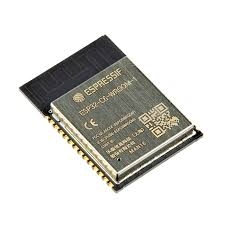
  • It covers custom board design based on the ESP32-WROOM-32 module, including power circuits, I/O interfaces, and sensor connections.

  • We will explore core features such as integrated Wi-Fi and Bluetooth functionality, a dual-core processor, and internal SRAM.

  • Explains when and why you should transition from an experimental development board to a custom board for an actual product.

  • Explains the power pins (3.3V, EN, GND) and bootstrap pins (GPIO0, 2, 5, 12, 15).

  • We explain the theory and practical implementation methods for eliminating floating voltage issues that can occur on input pins, as well as the design workflow from the Schematic Editor to the PCB Editor.


ESP32 WROOM Module

KiCad and Circuit Design

In this curriculum, you will use KiCAD, a free open-source EDA tool, to transform your circuit ideas into professional design files.

  • We explain the design flow from the Schematic Editor to the PCB Editor.

  • It explains how to set up Footprints (the actual pad layout of a component) and how to add missing components using footprint search engines like SnapMagic.


  • USB-C connection circuit, 

    5V → 3.3V power conversion circuit (AMS1117), 

    Design the USB-to-Serial communication circuit (CH340).


  • Connect the temperature/humidity sensor (SHTC3) and the illuminance sensor (GL5528), and

    Implement a user-controllable LED and a reset button.


  • Decoupling capacitors to reduce power noise and

    Apply ESD protection diodes for electrostatic protection.


KiCad Logo

PCB Layout and Manufacturing

In this stage, we cover the physical implementation and manufacturing process of the actual board.

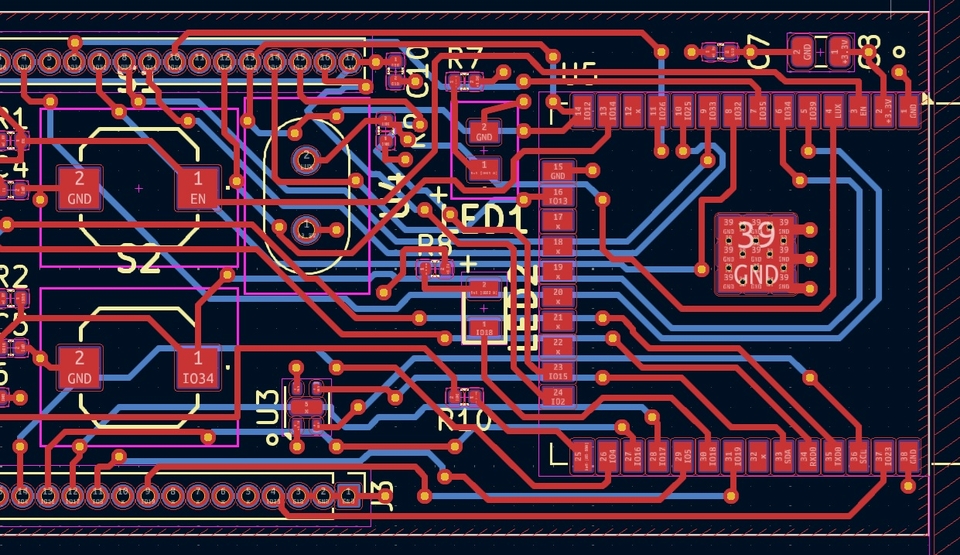
  • Design a 4-layer PCB structure (Top / 3.3V / GND / Bottom) using FR4 material.

  • Set the constraints for the board and wiring according to the manufacturer's specifications.

  • Import the schematic into the PCB and strategically place the components on the board, 

    Connect the components using multiple layers and

    Perform a DRC (Design Rule Check) to detect design errors.

  • Generate the following manufacturing files: 

    Gerber files, 

    Component placement files, 

    BOM(Bill of Materials)

  • We will explain the step-by-step process of ordering PCB production through the manufacturer, JLCPCB.

    It also includes instructions on how to use a Personal Customs Clearance Code and how to perform production checks.


PCB Editor

Firmware Development (Level 1–11) 

The firmware course is organized into a step-by-step (Level) structure based on the Arduino IDE, gradually increasing in complexity.

  • Level 1–3: Basic GPIO and Interrupts

  • Level 4: Analog I/O and PWM (Pulse Width Modulation)

  • Level 5–6: I2C Communication and Environmental Monitoring

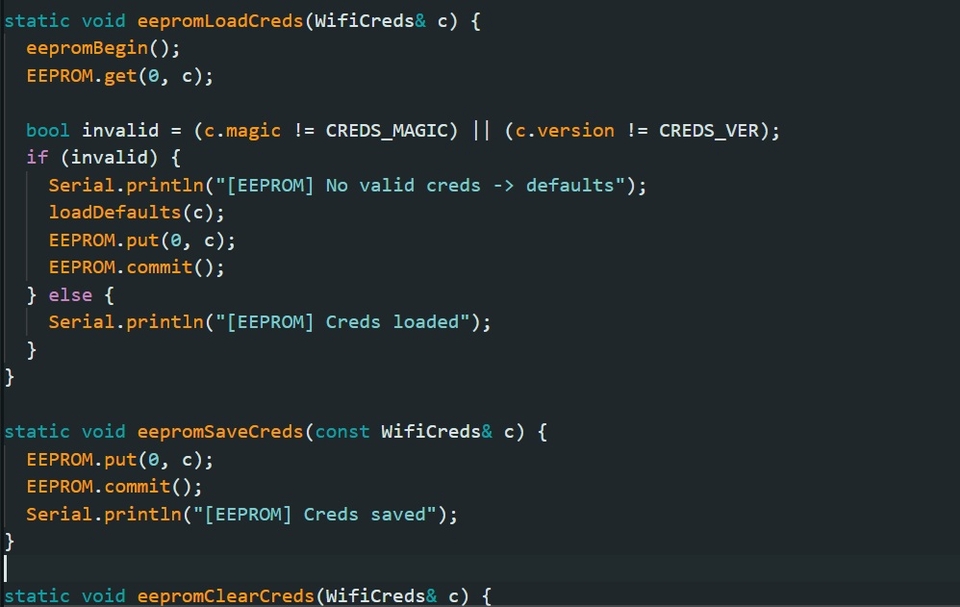
  • Level 7: EEPROM Memory, Persistent Storage

  • Level 8–9: BLE (Bluetooth Low Energy)

  • Level 10: WiFi and Authentication Information Management

  • Level 11: Remote Server Data Integration

Arduino editor screen

Notes before taking the course

Practice Environment

  • Operating System and Version (OS): All OSs including Windows, macOS, and Linux are supported.

  • Tools used: Arduino IDE (Download: https://www.arduino.cc/), KiCad (Download: https://www.kicad.org/)

  • PC Specifications: A standard PC with internet access

Learning Materials

  • Lecture Videos: Each lecture is approximately 10 to 15 minutes long (24 lectures in total)

  • Provided Lecture Materials: PowerPoint slides for each lecture, firmware (Levels 1–11, 11 in total), KiCad project files (including Gerber files and BOM files)

Prerequisites and Notices

  • Experience with Arduino and C (C++) is beneficial, but it is not strictly required as prerequisite knowledge to run the firmware in this course.

  • The firmware is written in C and C++ languages, and all of it is provided as learning materials, so you can download and use it immediately without needing to edit it.


  • The copyright of this lecture belongs to the copyright holder, GreenTam, and unauthorized distribution or reproduction is prohibited. The learning materials are also copyrighted and may not be used for any purpose other than personal study.

Recommended for
these people

Who is this course right for?

  • Someone preparing a hardware startup for the Internet of Things (IoT) that includes sensors

  • People who want to create digital content using production processes, methods, or sensor data

  • Makers, electronics hobbyists, or those interested in IoT (Internet of Things)

  • People who want to develop IoT devices that require wireless communication such as BLE and WiFi

  • Developers who want to go beyond the Arduino level and try "real embedded" development

  • Those who have used an ESP32 development board at least once but want to try making one themselves.

Need to know before starting?

  • Understanding of basic electronic circuits

  • Basic C and C++ languages

Hello
This is GreenTam

28

Learners

4

Reviews

1

Answers

5.0

Rating

1

Course

Hello.
I am an engineer who has been researching and developing electronic circuits and sensor systems.

I am creating educational content on the process of directly designing and manufacturing IoT devices and sensor systems.
In particular, I am producing lectures focused on ESP32-based IoT system design, PCB design (KiCad), sensor data collection, and cloud integration.

As the first in a follow-along series, this course introduces how to design and manufacture an ESP32 development board based on actual development processes. Following this, the second and third series are also being planned to focus on utilizing the ESP32 board.

Meanwhile, I consistently share content regarding IoT device development, PCB design, and ESP32 project production processes, as well as reviews of various electronic components, creator content, and solo entrepreneurship through social media.

Please visit if you are interested.

Naver Blog

https://blog.naver.com/greentam-

X (Twitter) Page

https://x.com/GreenTam_

Facebook

https://www.facebook.com/profile.php?id=61587292040569

More

Reviews

All

4 reviews

5.0

4 reviews

  • onejaesul0071님의 프로필 이미지
    onejaesul0071

    Reviews 1

    Average Rating 5.0

    Edited

    5

    100% enrolled

    I've been wanting to try making my own development board since using Arduino, and I was able to learn how through this lecture. The instructor explains everything in great detail.

    • greentam
      Instructor

      Thank you.

  • greentam님의 프로필 이미지
    greentam

    Reviews 1

    Average Rating 5.0

    5

    32% enrolled

    • silver779377님의 프로필 이미지
      silver779377

      Reviews 1

      Average Rating 5.0

      5

      32% enrolled

      I've completed about half of the lectures so far, and the process of creating a custom development board using a microcontroller is explained step-by-step from basic to advanced levels, which is very helpful for a novice engineering student like me. I think it will be a great help as I intend to create and use small modules combined with sensors in a wireless structure. I highly recommend this lecture, especially for beginners.

      • greentam
        Instructor

        Thank you. Please feel free to ask if you have any questions.

    • lowlow님의 프로필 이미지
      lowlow

      Reviews 3

      Average Rating 4.7

      Edited

      5

      100% enrolled

      I looked into YouTube and books to try and make a custom board, but I felt lost because there wasn't as much information as I expected. The most helpful part of the course was the hands-on process of drawing the schematics and performing PCB routing myself using KiCad. Also, in Section 5, using the board I made along with the firmware source code allowed me to clearly grasp how data moves back and forth via BLE and Wi-Fi. Thank you so much.

      • greentam
        Instructor

        Thank you. Please feel free to ask if you have any questions.

    Similar courses

    Explore other courses in the same field!

    Limited time deal ends in 4 days

    $20.90

    69%

    $68.20