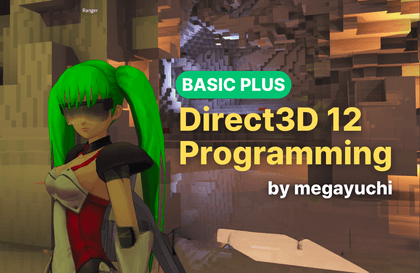
Introduction to D3D12 Programming
megayuchi

This course provides the basic knowledge needed for those with experience in D3D9/10/11 or OpenGL to adapt to D3D12 programming.

Intermediate
DirectX, d3d

Until 3-4 years ago, D3D12 was not the mainstream API for PC games. Many games were still being developed and released with D3D11, and it seemed difficult for D3D12, which was difficult to develop for, to become the mainstream API.
Then, D3D12 emerged as the mainstream API thanks to features such as RayTracing that could directly improve graphic quality.
The main API of popular commercial engines has also been moved from D3D11 to D3D12. Although it is not common, self-developed engines are also being developed with D3D12.
Now D3D12 is clearly the mainstream graphics API. If you only focus on utilizing commercial engines, it may not matter, but if you want to dissect and customize their structure, or write your own rendering code to create your own engine, I think D3D12 is an unavoidable process.
Learning D3D12 is more difficult than before, but once you get used to the somewhat unfamiliar concepts such as Descriptor Table, Resource Barrier, and asynchronous rendering, you will be able to develop with a similar feel to D3D11.
This course focuses on helping those with basic graphics knowledge and experience with traditional graphics APIs (D3D11, OpenGL, etc.) prior to D3D12 to adapt to the D3D12 API.


Compared to when I learned DX11 and OpenGl in school or by self-study, Learning DX 12 while listening to the instructor's explanation is easier to understand. It's more intuitive and fun for hardware and systems. I hope it doesn't end with the basics.
It was very helpful not only for DirectX12 but also for the overall structure, memory management, etc. If you are familiar with STL, this lecture and code will help you improve your skills.
I am taking this course after becoming somewhat familiar with Vulkan, but this is the first time I have seen a lecture that explains the latest GraphicsAPI functions so neatly. This is a lecture where the instructor's skills stand out. However, it seems like it will be a little difficult for those who are new to graphics programming to follow along. ps. Looking at the latest GitHub, it looks like there will be a follow-up lecture, so I'm looking forward to it. ㅎㅎ
This is a lecture that explains in detail the biggest changes that need to be taken into account when moving from existing APIs such as D3D11 to D3D12. It would be better if it introduces a bit more diverse (including cases where errors occur) Resource Barrier utilization cases, various Root Signature setting cases for single objects, and Descriptor Table maintenance cases, as shown in the last lecture. Or, it would be good for students to upload various cases as pull requests to the sample code repository.