inflearn logo

Understanding Basic Concepts of MCU Embedded SW Explained by an Incumbent

From hardware control skills actually required in the field to building custom build systems, and practical hands-on training using industry-standard ST EV boards (Nucleo).

5 learners are taking this course

Level Intermediate

Course period Unlimited

Embedded
Embedded
MCU
MCU
robotics
robotics
robot
robot
Embedded
Embedded
MCU
MCU
robotics
robotics
robot
robot

What you will gain after the course

  • Job seekers who want to find employment in the embedded software field but feel overwhelmed and unsure of how to prepare.

  • A junior developer who felt frustrated about how hardware actually works inside a chip

  • Developers who want to know the latest trends in practical (large-scale project) embedded development

Understanding Basic Concepts of MCU Embedded SW Explained by an Incumbent

From real-world hardware control techniques required in the field to building custom build systems, and practical hands-on experience using industry-standard ST EV boards (Nucleo).

Recommended for these people

Job seekers who want to find employment in the embedded software field but feel overwhelmed and unsure of how to prepare.


A junior developer who felt frustrated about how hardware actually works inside a chip


Developers who want to know the latest trends in practical (large-scale project) embedded development

What will you learn and gain after taking this course?

  • Low-Level Control Mastery | Bare-metal capabilities to control chips by directly analyzing datasheets without HAL libraries

  • Understanding the System Life Cycle | Understanding the entire operational principle of how the code I wrote is built, and how the chip boots and runs.

  • Building a Practical Development Environment | Hands-on experience with the latest RTOS trends and custom build system development capabilities

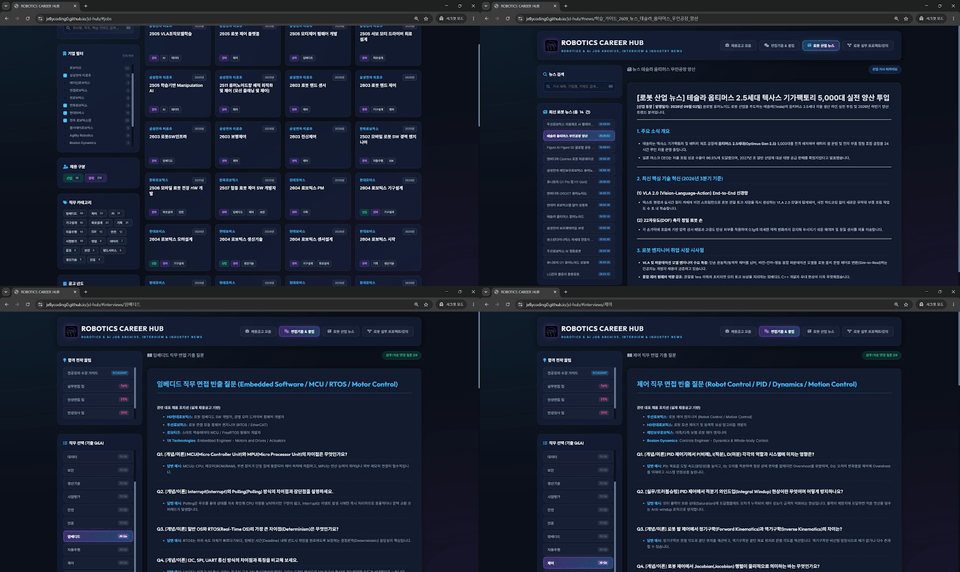
  • Identify Employment/Job Change Trends | Providing a collection of the latest domestic and international Robotics MCU Embedded SW job descriptions (JD)

Providing a collection of the latest domestic and international robotics job descriptions (JD)

Features of this course

  • Industry Standard | Hands-on practice with ST EV boards most commonly used in the field

  • Focus on Essentials | 1:1 comparison practice of Bare-metal (Register) vs HAL Library

  • Reflecting Latest Trends | RTOS and Custom Build Systems for Large-Scale Projects


The person who created this course

"Real know-how gained from grinding and struggling through everything from low-level HW to SW"

Hello, I am a current robotics developer at a global corporation. Working in the robot industry for several years, I have experienced everything from the bottom of hardware to embedded systems and high-level software.

This course is not an academic text that lays out grand theories. I am creating this course to organize the know-how I have fiercely accumulated in the field, while also earning some side income.

If you have any questions about the lecture, please feel free to leave a comment at any time. I will help you gain so much that you won't feel the lecture fee was a waste!

Do you have any questions?

  • Q. Can a complete beginner with no knowledge of the embedded field take this course?

    • A. Yes, it is designed so that anyone can follow along as long as you know the basic syntax of C (variables, basic pointers). Difficult registers or bitwise operations are explained kindly by showing manual diagrams and going through them bit by bit.

  • Q. How will this help with job interviews or actual work?

    • A. The type of applicant that interviewers find most disappointing is the one who "merely got things working by copying and pasting API functions." After completing this course, you will be able to confidently explain topics such as the reason for using the BSRR register (atomicity) and the principles of memory map address translation in front of interviewers, leaving a strong impression that "this candidate truly understands the essence of the chip."


  • Q. Is it mandatory to have the practice board (NUCLEO-F446RE)?

    • A. The first half of the lecture consists of theory and principle explanations, while the second half involves hands-on practice downloading to the actual board. Although just watching is very helpful for understanding the flow, I strongly recommend purchasing a practice board (around 20,000 KRW) to code and light it up yourself!

Notes before taking the course

Practice Environment Guide

  • Computer: Since this is a concept-oriented lecture, you can use any computer, including Windows, Mac, or Linux.

  • Required Equipment: 1 NUCLEO-F446RE development board (+ USB A-to-Mini B cable) (Easily available on the market, strongly recommended for hands-on learning)

Prerequisites and Notices

  • Prerequisite Knowledge:

    • Basic C language syntax (variables, conditional statements, loops, functions, and basic 1D array/pointer concepts)

    • Having a basic understanding of bitwise operators (&, |, ~, <<) will make it much easier to progress through the hands-on exercises. (The core concepts of bitwise operators will be reviewed in Lecture 7.)

  • What you don't need to know:

    • You do not need any prior knowledge of complex electronic circuits, analog signal processing, or PCB fabrication techniques. In the latter part of the course (Lesson 27), I will teach you only the core concepts essential for an embedded SW developer, starting slowly from the very basics.

    • It is perfectly fine even if you have no prior experience in microcontroller (MCU) development. Since we start with the fundamental differences between CPUs and MCUs, non-majors or web/app developers can also successfully complete the course.

Hands-on Example Source Code (GitHub)

The complete source code for every step of this course's hands-on practice is publicly available via GitHub. Feel free to use it whenever you encounter build errors or need to compare behaviors while practicing!


Recommended for
these people

Who is this course right for?

  • Low-Level Control Master | Bare-metal capabilities to control chips by directly analyzing datasheets without HAL libraries

  • Understanding the System Life Cycle | Understanding the principles of the entire process from building the code I wrote to the chip booting and running.

  • Building a Practical Development Environment | Practical Skills in Latest RTOS Trends and Custom Build System Development

  • Understand Employment/Job Change Trends | Providing a Collection of the Latest Robotics MCU Embedded SW Job Descriptions (JD) from Home and Abroad

Need to know before starting?

  • Basic C language syntax (variables, conditional statements, loops, functions, and basic 1D array/pointer concepts)

  • Basic understanding of bitwise operators (`&`, `|`, `~`, `<<`)

Hello
This is jelly

Career Verified

Hello, I am a robotics developer currently working at a global corporation.

Having worked in the robotics industry for several years, I have experienced everything from the bottom-level hardware to embedded systems and high-level software.


I am organizing the know-how I have fiercely accumulated in the field, and

I am creating this course to share my knowledge and earn some side income at the same time.


If you have any questions about the lecture, please feel free to leave a comment at any time.

I will help you gain so much that you'll feel the cost of the lecture was well worth it!

More

Curriculum

All

30 lectures ∙ (1hr 47min)

Course Materials:

Lecture resources
Published: 
Last updated: 

Reviews

Not enough reviews.
Please write a valuable review that helps everyone!

jelly's other courses

Check out other courses by the instructor!

Similar courses

Explore other courses in the same field!

25% off for new members

$49.40

25%

$59.40