


inflearn logo

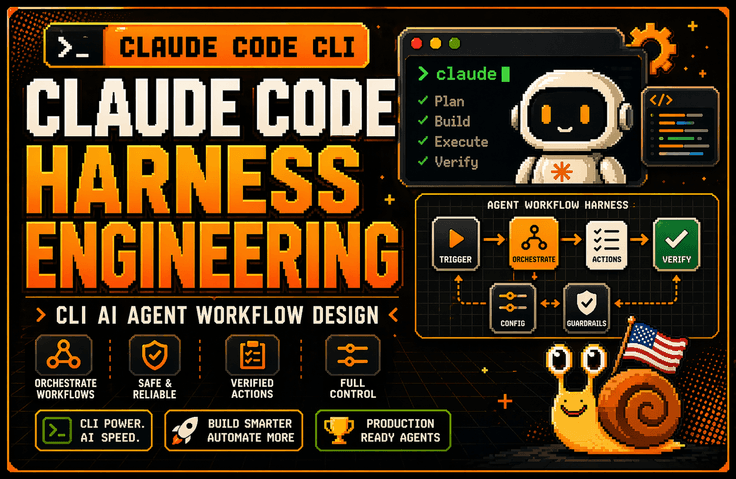
Claude Code Harness & Graph Engineering: Advanced Claude Code CLI Harness Engineering in Practice

The lecture explains why the harness is more important than the model through the lens of Claude Code architecture. It also covers how to design a Claude Code work system around six structures: Context Harness, Permission Harness, Verification Harness, Tool Harness, Subagent & Worktree Harness, and Debugging Harness. It then connects these concepts to CLAUDE.md, session management, controlling large codebases, parallel worktree operations, error log analysis, and tracking environment variable and configuration scope issues, helping you establish practical standards for continuing to use Claude Code in real-world backend and DevOps work.

(4.4) 55 reviews

710 learners

Level Basic

Course period Unlimited

AI
AI
claude
claude
Vibe Coding
Vibe Coding
harness
harness
AI
AI
claude
claude
Vibe Coding
Vibe Coding
harness
harness

Reviews from Early Learners

4.4

5.0

이태용

61% enrolled

It's great because it allows for a solid understanding of the basic knowledge of harness engineering.

5.0

안준우

32% enrolled

It is great that you list many key words for each step and situation. It is also very helpful that you repeat those words.

5.0

김민재

61% enrolled

You explain how to use Claude Code so well! I love that you also explain the conceptual parts so that even non-majors can use it effectively! (Though I'm not sure if I'll understand everything...)

What you will gain after the course

  • Design Criteria for a Harness That Integrates Claude Code CLI into Real-World Projects

  • The ability to design a workspace for working on large codebases through CLAUDE.md, session management, and context control

  • The ability to design permissions / authorization policies that define the scope of actions Claude can take

  • Practical know-how for a Verification Harness that validates Claude’s output through tests, diffs, and counterexamples instead of trusting it as-is

  • Subagent & Worktree operational skills for safely isolating multiple tasks using worktrees and parallel sessions

  • Practical Debugging Harness skills for organizing error logs, environment variables, configuration scopes, and hard-to-reproduce bugs so Claude can solve them

Claude Code can be fun in a GUI.

However, Claude Code pays off in CLI harness design.

This course does not introduce Claude Code CLI as merely an AI coding tool. Instead, it covers how to establish Claude Code within real backend and DevOps workflows through the lenses of Context, Permission, Verification, Tool, Subagent, and Debugging Harness. By connecting log analysis, bug fixes, test recovery, CLAUDE.md design, session management, and parallel worktree operations, you will learn how to design a work system that enables Claude to work safely on real projects.

Recommended for those who:

Developers who have installed Claude Code but can’t keep using it in real-world projects

If you could ask questions and get answers conveniently in the GUI, but in actual work you found yourself back in the terminal reading logs, running tests, reviewing diffs, and organizing Git branches, you need this course. This course provides the framework for transforming Claude Code from a “tool you try out briefly” into a “tool you keep using in real projects.”


A non-CS developer who spent five hours on something Claude could do in 30 minutes in a large codebase

The problem is likely not simply the model’s performance, but an inadequate design for what information Claude should see and within what scope it should operate. This course covers practical patterns for helping Claude navigate large codebases more effectively through Context Harnesses, CLAUDE.md, session management, and context redesign.

Developers and non-majors who want to advance from merely “trying AI coding tools” to operating them as a “professional system”

This is recommended for those who need practical standards beyond simple feature introductions—such as deciding which tasks to delegate to Claude and which to handle themselves, determining which results should be verified through tests and diffs, and knowing which automations should be extended with Hooks/MCP/Skills. It is especially suitable for backend developers, DevOps engineers, and tech leads.

After taking the course,

After taking this course, you will no longer see Claude Code as merely a “tool for entering good prompts.” Instead, you will be able to determine what Claude should see, how far it is allowed to act, how to verify the results, when to clear/compact/restart if a session becomes polluted, and how to manage worktrees and parallel sessions.

Specifically, you will be able to structurally codify project rules and prohibitions in CLAUDE.md, organize logs, environment variables, and configuration scope issues into a form that Claude can solve, and review Claude’s proposed changes through testing, diff, and counterexample validation loops. In other words, you will take Claude Code beyond being a GUI-based assistant and bring it to a level where it can be integrated into actual backend and DevOps workflows.

Features of this course

1. Rather than explaining features, it teaches from a “harness engineering” perspective based on research papers.

This course does not list Claude Code’s features like official documentation. Instead, it explains how to design Context, Permission, Verification, Tool, Subagent, and Debugging Harnesses so that Claude Code can work safely in real projects. As a result, you’ll be less affected by rapidly changing version information and retain practical principles that can be applied to real projects.

2. It is based on large codebases and real-world work problems

Rather than simply building demo apps, this course covers how to keep Claude from getting lost in large codebases, reduce session contamination, safely manage worktrees and parallel sessions, and connect the GitHub Issue → PR workflow with Claude. It starts with the points where people actually get stuck in real-world work.

What you'll learn

Getting Started with Claude Code CLI in Practice /

Architecture / Memory / CLAUDE.md / Plan Mode / Skills

In the first section, we clearly lay out the differences between GUI-based Claude and the CLI, starting with the basics. Rather than simply comparing interface differences, we explain why GUI-based workflows tend to stop at “asking questions and receiving answers,” while the CLI can connect all the way to actual logs, tests, Git, and deployment preparation. We then use Claude Code architecture to understand why the harness is more important than the model, and explore the role of memory across sessions and CLAUDE.md, as well as the differences between Plan/Thinking Mode and Subagents, and between Skills and Tool use.

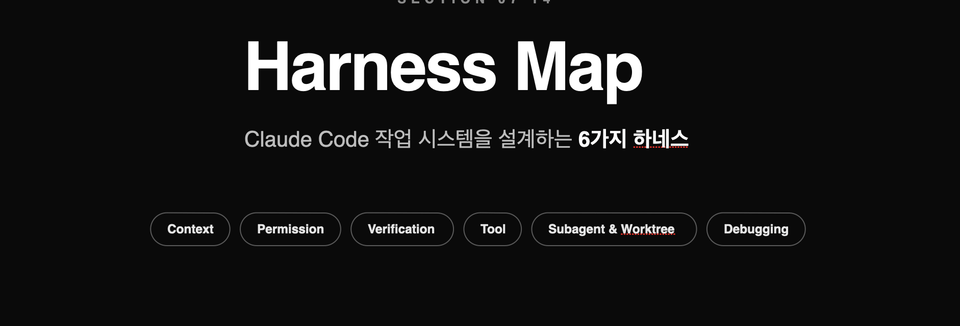
Harness Map / Context Harness / Permission Harness / Verification Harness / Tool Harness / Subagent & Worktree / Debugging Harness

The second section is the core of this course.

This section explains the six harnesses needed to integrate Claude Code into real-world projects as a single work system. It provides a high-level overview of what information Claude should see, how far it can act, how to verify its results, which tools to connect and in what structure, how to isolate parallel work, and how to turn logs and environment variables into a format that makes troubleshooting possible. In the hands-on section that follows, you will implement this map in practice.


Harness configuration file to copy and use immediately

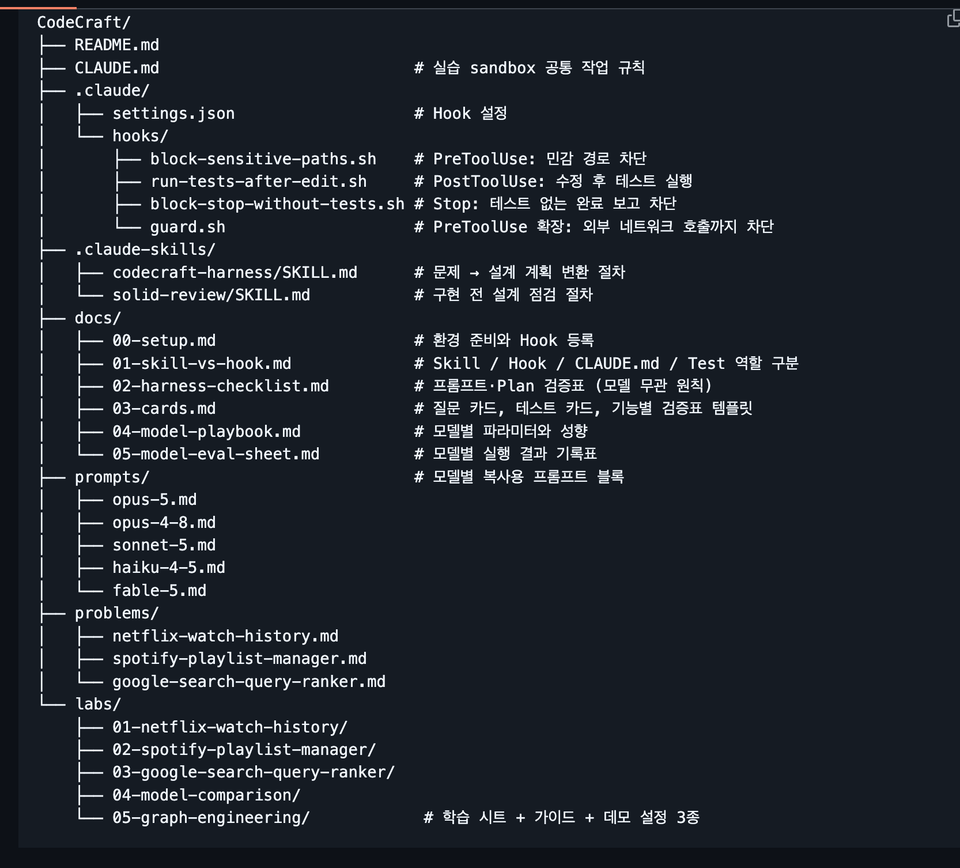
The harness configuration you create directly in the course is provided in full as completed files.
After taking the course, you can copy them into your own project and apply them immediately without having to write everything again from scratch.

The provided settings are as follows.

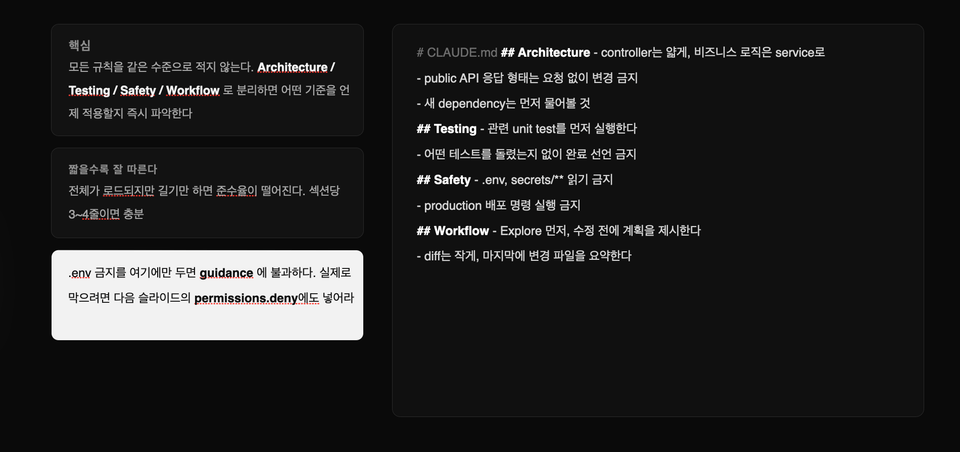
  • CLAUDE.md
    Defines the work rules Claude must follow in the project.

  • codecraft-harness/SKILL.md
    Transforms a short, ambiguous one-sentence request into a concrete design and implementation plan.

  • solid-review/SKILL.md
    Before starting implementation, check whether responsibilities are properly separated and whether the design is unnecessarily complex.

  • block-sensitive-paths.sh
    Blocks access to sensitive files and paths, such as .env, SSH keys, and parent project folders.

  • run-tests-after-edit.sh
    Automatically runs the relevant tests every time Claude modifies a file.

  • block-stop-without-tests.sh
    It prevents Claude from reporting a task as complete when tests have not been run or have failed.

  • guard.sh
    It blocks even unauthorized external network requests to create a secure execution environment.

The Hooks included in the course are not merely sample code.
We ran them all in real environments and verified that they work.

Once you register the configuration file, tests run automatically every time Claude modifies the code, and when the tests fail, it cannot arbitrarily end by saying, “I’ve completed the task.”

In other words, you will learn how to go beyond simply asking Claude to verify through prompts and make the system forcibly execute the verification process.


3. Model-Specific Prompt Playbook

Even when using the same harness, each model differs in which instructions it follows well and which it is likely to miss.

In this course, instead of using the same prompt for every model, we provide five copy-ready prompt blocks that outline which instructions to remove and which to add based on each model’s characteristics.

  • Opus 5
    Reduces verification instructions that the model performs on its own to prevent unnecessary duplicate work.

  • Opus 4.8
    Clearly specify the tool execution conditions so that the necessary tools are used at the right time.

  • Sonnet 5
    This section covers how to describe the files that need to be modified and the scope of the changes in specific, literal terms.

  • Haiku 4.5
    It lays out the execution procedure step by step so you can work reliably even with models that do not have an effort option.

  • Fable 5
    We provide, for reference, an approach that avoids giving the model too many instructions and retains only the necessary prescriptions.

Each playbook also includes the following content.

  • Parameter combinations that cause a 400 Error when requested

  • Default parameters and behavioral differences by model

  • A record table comparing results while changing the effort value

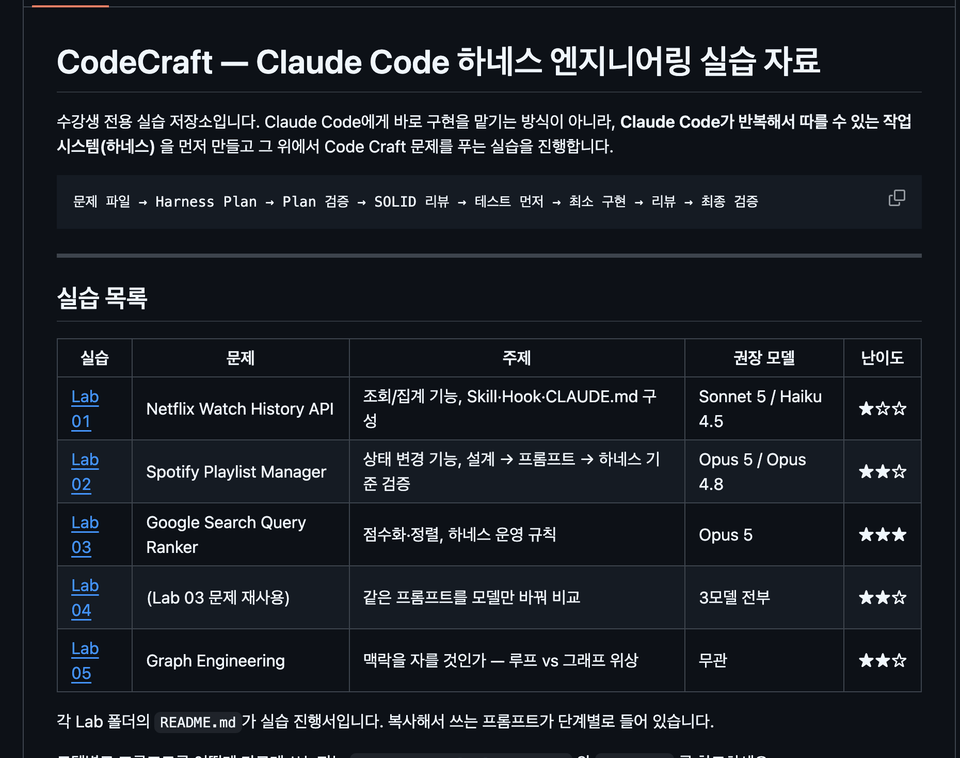
  • Run the same prompt on multiple models and compare the results in the Lab 04 exercise

Rather than simply explaining “which model is better,” you will learn how to find the optimal settings for each model yourself by repeatedly running the same task and recording the results.


Graph Engineering Practice Materials — Lab 05

You will directly compare the approach of handling complex tasks sequentially in a single pass with the Graph Engineering approach of dividing and processing multiple tasks according to their dependencies.

Interactive Learning Sheet

You can use it by opening the HTML file in a browser, without any separate installation or server setup.

You can play back step by step how the same request is processed differently in the following two approaches.

  • Repeating a single flow with loop-based execution

  • Graph-based execution that divides a task into multiple nodes and dependencies

When you select each step, you can also view the configuration file that created the corresponding action, allowing you to immediately understand the relationship between the execution result and the configuration.

Step-by-step learning guide

We provide a learning guide totaling 645 lines.

Rather than explaining the theory at length from the beginning, it is organized in the following order.

Check the conclusion → 30-minute practice → core concepts → advanced theory

There are also separate learning paths for non-majors and for students with development experience.

Even if you’re using Claude Code for the first time through vibe coding, you can start with hands-on practice, while developers can delve deeper into its internal workings and design principles.

3 demo projects you can run yourself

Rather than simply reading configuration files, you will run claude in an actual project folder and see firsthand how Hooks block and validate tasks.

Each project intentionally includes the following issue.

  • Type error

  • Test failure

  • Logic bugs that appear normal on the surface

Students will directly experience the following workflow.

Detect the issue → Block the task → Modify the code → Run the tests → Pass validation

Loop-based and graph-based projects use the same code, with only the harness configurations set up differently.

Therefore, you can accurately compare how results differ due not to code differences, but to differences in how the work is organized.


Reference Documentation

We also provide practical documentation that you can refer to when configuring projects or solving problems even after completing the course.

  • Environment Setup Guide
    This section covers preparing the execution environment, how to register Hooks, and common errors and their solutions.

  • Distinguishing the Roles of Skills / Hooks / CLAUDE.md / Tests
    Explains what each component is responsible for and which tool to use for which problem.

  • Harness Inspection Checklist
    You can check that nothing is missing from the prompt, design, implementation, tests, or completion criteria.

  • Question and test cards
    Provides questions to use when requirements are unclear, test design criteria, and verification table templates.

  • Model-Specific Playbook Documentation
    Organize each model’s parameters, behavioral characteristics, and prompt-writing guidelines in one place.

  • Model evaluation log
    You can run the same task with multiple models and configurations, then compare and record the results.

These materials are not merely course supplements; they comprise a Claude Code harness operations manual that you can reuse repeatedly in real-world projects.


The person who created this course

  • Silicon Valley Survivor | American Snail 

    Drawing on experience and expertise gained at the forefront of the Global Tech Scene, this course presents a path for non-majors to overcome technical barriers and become the owners of their businesses.

    • Current) Founder of a Silicon Valley AI coding agent startup

      • Operating the self-developed AI tool 'Snailer CLI' (18K+ downloads)

      • Selected for the Google for Startups Program

    • Former engineer at U.S. big tech companies and promising startups

      • Gave up the final stage at Amazon to start a company

      • Silicon Valley AI Fintech Startup Engineer

      • OpenAI / Meta / Apple / Adobe / Amazon Full-Stack Fellowship

      • Domestic search engine portal, fintech development

      • AI startup AR/B2B/SDK development

    • Proven teaching expertise

Do you have any questions?

Q. I've used Claude Code a little before—will this course still be helpful?

Yes. In fact, those who have used Claude Code even briefly may find this course particularly valuable. It may have seemed convenient at first, but if you’ve experienced Claude repeatedly losing its way when applying it to a real project, or felt frustrated that you still had to handle the final steps—such as testing, Git, and deployment—yourself, this course addresses exactly those problems. Rather than simply introducing features, this course focuses on “the structure that makes you keep using it.”

Q. Can't I just refer to the official documentation?

Official documentation is the most up-to-date and accurate source of information. However, simply reading the official documentation makes it difficult to gain the practical judgment needed to know “when to use which feature,” “why things fail in a large codebase,” “which rules to put in CLAUDE.md and which to move to permissions,” and “how to get back on track when a session becomes corrupted.” Although this course refers to the official documentation, its content is based on the paper. It provides structures and guidelines you can apply directly in practice.

Q. How comprehensive is this course?

This is not an introductory course on “quickly building an app.”

This is an intermediate, hands-on course designed to integrate the Claude Code CLI into workflows for real-world projects, mobile app development, backend, frontend, DevOps, and more. Accordingly, it will cover topics such as log analysis, session management, CLAUDE.md, context redesign, parallel worktree operations, and, as bonus lessons, model routing and context budget management.

Notes Before Taking the Course

Practice environment

  • macOS is the most recommended operating system, while Windows users are advised to use a WSL environment. Most of the exercises can also be followed in a similar way on Linux. The practical sessions focus on the Claude Code CLI, and having experience using the terminal will make things much easier. Since the course covers project structures and makes some use of Git/worktrees, it is best to have a basic development environment already set up.

Learning materials

  • PPT, Notion

  • The course provides not just a collection of links, but materials centered around templates and criteria that can be applied directly to real-world work. For example, resources such as the CLAUDE.md template, context pack examples, session summary prompts, a worktree operations playbook, and a model routing criteria table are designed so that you can review without having to replay the videos from the beginning.

  • Provided Materials


    ▎ GitHub repository exclusively for course participants (33 documents · 5,540 lines)


    ▎ - 5 hands-on exercises — step-by-step guides + 29 copy-ready prompts + sample data


    ▎ - Complete harness configuration — 2 Skills, 4 Hooks, and CLAUDE.md (operation verified)


    ▎ - 5 Prompt Blocks by Model — Opus 5 / 4.8 / Sonnet 5 / Haiku 4.5 / Fable 5


    ▎ - Graph Engineering materials — Interactive learning sheets + 3 executable demo projects


    ▎ - 6 reference documents — environment setup, verification checklist, question and test cards, record sheet

Prerequisites and Important Notes

  • Basic development experience, familiarity with using the CLI, and an understanding of Git concepts are recommended.

  • Rather than being a course where you casually “try out” Claude Code for fun, this course focuses on building a structure that you can continue using in real-world projects, so it provides harness engineering techniques suitable for all learners, regardless of their academic background.

Recommended for
these people

Who is this course right for?

  • Developers who installed Claude Code but couldn’t get themselves to keep using it in real projects

  • Developers who feel limited by GUI-based Claude and need practical CLI-based usage techniques

  • Those who want to learn CLAUDE.md, permissions, hooks, MCP, and subagents from a practical, hands-on perspective rather than through feature introductions

  • Developers who want to take AI coding tools beyond merely “trying them out” and up to the level of “operating them as a work system”

Need to know before starting?

  • Experience using LLMs such as ChatGPT or Claude is a plus.

Hello
This is americasnail

Inflearn Verified

1,949

Learners

109

Reviews

81

Answers

4.4

Rating

8

Courses

  • Silicon Valley Survivor | American Snail

    Drawing on experience and expertise gained at the forefront of the Global Tech Scene, I show non-majors how to overcome technical barriers and become the owners of their businesses.

    • Current) Founder of a Silicon Valley AI coding agent startup

      • Operating the internally developed AI tool 'Snailer CLI' (18K+ downloads)

      • Selected for the Google for Startups Program

    • Former engineer at U.S. big tech companies and promising startups

      • Gave up Amazon’s final-stage opportunity to found a startup

      • Silicon Valley AI Fintech Startup Engineer

      • OpenAI / Meta / Apple / Adobe / Amazon Full-Stack Fellowship

      • Domestic search engine portal, fintech development

      • AI startup AR/B2B/SDK development

    • Proven educational expertise

      • Dual major in Computer Engineering and Business Administration at a four-year university in Seoul, with extensive startup experience

      • Over 1,800 students taught cumulatively, with 4.5K+ followers on SNS Threads and 470+ Substack followers.

More

Curriculum

All

52 lectures ∙ (7hr 11min)

Course Materials:

Lecture resources
Published: 
Last updated: 

Reviews

All

55 reviews

4.4

55 reviews

  • jinp19933808님의 프로필 이미지
    jinp19933808

    Reviews 6

    Average Rating 5.0

    5

    32% enrolled

    I tried to apply Harness in practice but failed every time and only wasted time, so this was the first time I realized it needs to be built so systematically. In particular, I didn't know when to use things like agent skills or hooks and even asked AI to write those features for me, but now that I know their purpose and how to use them, I think I'll be able to utilize them much better.

    • americasnail
      Instructor

      Thank you so much for your valuable review. ☺️ I will continue to reinforce the content with practical methods for using Claude Code more stably in real-world tasks, based on research papers and actual case studies.

  • wowmen17577817님의 프로필 이미지
    wowmen17577817

    Reviews 2

    Average Rating 5.0

    5

    61% enrolled

    It's great because it allows for a solid understanding of the basic knowledge of harness engineering.

    • americasnail
      Instructor

      Hello Taeyong Lee, thank you for your valuable course review. I hope you have a wonderful day today. Please look forward to this month's update as well!

  • kevinx64님의 프로필 이미지
    kevinx64

    Reviews 2

    Average Rating 5.0

    5

    61% enrolled

    You explain how to use Claude Code so well! I love that you also explain the conceptual parts so that even non-majors can use it effectively! (Though I'm not sure if I'll understand everything...)

    • americasnail
      Instructor

      Thank you for your valuable review. We are currently establishing an update plan based on various feedback. We will make sure to create it in a way that is easy for everyone to understand. Thank you. Have a great day.

  • jbsh님의 프로필 이미지
    jbsh

    Reviews 13

    Average Rating 5.0

    5

    32% enrolled

    It is great that you list many key words for each step and situation. It is also very helpful that you repeat those words.

    • americasnail
      Instructor

      Hello Junwoo Ahn, thank you for your detailed and valuable course review. I hope you have a great day today :)

  • hoojunlee7658님의 프로필 이미지
    hoojunlee7658

    Reviews 1

    Average Rating 3.0

    Edited

    3

    37% enrolled

    The instructor's level of knowledge is high, but the delivery of the lecture fell short of expectations, so I am leaving feedback focused on drawbacks and areas for improvement. 1. The teaching materials are poor. Regarding the attached PPT materials: I can tell they were made with Claude, but shouldn't there at least be some post-editing for line breaks or broken blocks? (It's only a few pages, so it wouldn't even take 30 minutes.) The font in the video materials is too small to see clearly, and the focus keeps shifting, so I gave up trying to follow along visually. The explanation and the materials feel disconnected. 2. There is too much redundant and unnecessary theoretical explanation from the beginning through the middle. (It felt like being teased, wondering when we would finally get to the main point.) It seems like you have a lot of information to share, but from a learner's perspective, it is difficult to summarize or organize the core points. 3. I was expecting hands-on practice in the latter half, but it ultimately felt like just watching the instructor's demo presentation. It would be much better if you organized the curriculum to be more core-focused, added practical explanations, and guided students to actually type out sample code or markdown files while explaining. I've only skimmed parts of the latter half, but I still have high hopes and will definitely finish the course.

    • americasnail
      Instructor

      Hello jjun1004, First of all, thank you very much for your suggestions for improvement. We will review the points you mentioned and update the service by reflecting those improvements in the latter half of July. We apologize for any disappointment caused. Thank you for taking the course, and we wish you a wonderful day.

    • Now I understand what this review was about. I paid today and realized it after getting past three pages... I’ve already gone over 7%, so I can’t cancel it. Sigh... Ah... the text is way too hard to see...

americasnail's other courses

Check out other courses by the instructor!

Similar courses

Explore other courses in the same field!

25% off for new members

$48.20

25%

$68.20