The Pillow Investment Method Series: The Korean Stocks Edition
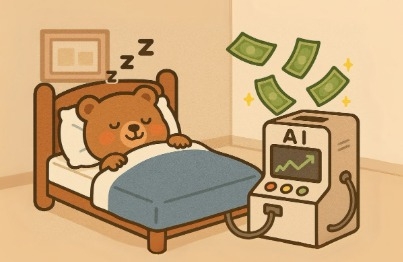
While you work,
your account works on its own.
Read the buying and selling flows of foreign investors and institutions, and build and fully own an AI-powered automated trading system dedicated to the Korean market that buys and sells on its own.
07:00
Data collection and prediction,
through AI review
10:00
Only stocks that pass verification
are automatically purchased
During market hours
Every 60 seconds
monitoring take-profit and stop-loss conditions
15:40
Automatic reconciliation with the brokerage’s ledger
All you did was go to work.
Two and a half years
A Dedicated Course on Automated Trading
1,600+
Total students enrolled across the series
4.9/5.0
Previous installment: U.S. Edition course rating
24 hours
Currently running unmanned verification on AWS (simulated)
While you work
You only went to work,
but your account works a full day.
Turn on the system in the morning and head to work. Here’s what happens in the meantime.
🧍 My Day
🤖 A Day in the Life of Your Account
07:00
Turn off the alarm and
get ready for work
It completes data collection, AI predictions, and reviews on its own.
10:00
During the meeting,
focus on work
Automatically buy only stocks that have passed verification.
During market hours
After lunch
Afternoon work
Monitor take-profit and stop-loss every 60 seconds
15:40
Prepare to leave work
After the market closes, automatically reconcile with the brokerage ledger
Evening
Rest at home,
📱 check notifications
Send today’s trading report via Slack
“
You live your daily life,
while the system watches the market.
You don’t have to stay glued to the charts. Monitoring, trading, and record-keeping are all handled by the system. Your only job is to start your day in the morning—that’s all.
Why this course was created
"Instructor, is there a Korean stock version?"
It wasn’t just one person asking.
For the entire two and a half years during which I created the series from Version 1 through Version 3, requests to “please cover Korean stocks as well” continued to accumulate.
2025.02
T***[Inquiry about applying to Korean stocks] Would it be possible to collect price information for Korean stock listings this way as well?
2025.12
m***I wish there were also a course on algorithmic trading in the Korean stock market.
2026.05
유***Is this a course that only covers U.S. stocks? I'm wondering if Korean stocks are also supported.
2026.06
A***Would it be possible to manage multiple accounts? I’m planning to operate them as U.S. + Korean.
s***Would this technique also work in the Korean stock market?
8***I only trade Korean stocks. Would it still be okay for me to take this course?
And countless requests…
So, we created the Korean stocks edition.
With your support, we redesigned it from the ground up specifically for the Korean market.
Not a port, but a redesign
Built from the ground up
according to the rules of the Korean market
"Couldn’t we just swap out the brokerage API in the U.S. system?" I started by testing that assumption too. The conclusion was a redesign. That’s why you get a system that truly fits the Korean market.
News sentiment → Supply and demand
Korea is a market where "who is buying"
is made public
Korean stocks lack sufficient news sentiment data. Instead, what foreign investors and institutions buy and sell every day is publicly disclosed. This system uses that flow of money as a signal — the only independent source of information coming from outside price charts.
VKOSPI → VIX T-1
Turn the time difference into logic rather than a flaw
VIX is an index indicating how unsettled the U.S. market is. Since the U.S. market closes during the night in Korea, the freshest data available in the morning in Korea is “the level of U.S. fear confirmed last night.” On days when the market is volatile, the system automatically tightens its buying.
The Structure of the Korean Market
We embedded the market’s grammar into
code.
Avoiding the simultaneous auction, truncating to KRX tick sizes, the ±30% price limit, determining market holidays, fixed Korean time without daylight saving time—and even why the day starts at 7 a.m., after the U.S. market closes. The system knows it all, so you don’t have to.
The automated trading system you build along with it
looks easy
Automated trading in the video
With just a few conditions, the purchase succeeds.
Buy on a golden cross and sell on a death cross.
In a sunny bull market, anything works.
Live Trading Accounts in a Bear Market
It’s different when foreign investors start selling.
Gap down, no criteria for when to sell, and ambiguous executions.
This is always the point where your account collapses.
This course does not teach you the “code to buy” stocks.
It teaches you the criteria for not buying and when to stop.
At the heart of those criteria is data disclosed every day only in the Korean market.
The net buying by foreign investors and institutions—in other words, capital flows.
Simply put, it shows where the market’s big players are actually putting in and taking out their money.
The question this course answers
The real question about automated trading
is something else.
If you have traded Korean stocks, you already know firsthand why this course is necessary.
The chart and news looked good, but the stock was helplessly driven down once foreign investors started selling
Bought on instinct, with no criteria for when to sell—a loss that grew
I tried adding automated trading, but with only a few buy conditions, I experienced it falling apart in a declining market
“
It’s not about whether the code runs,
but whether you can trust it with your money.
In the real market, communications can be cut off, a day’s worth of data can go missing, and there are moments when it’s unclear whether an order was filled. How is the system designed to behave in those moments? The Pillow Investment Method Korean course teaches you exactly that.
What You Build in This Course
25 large-cap KOSPI and KOSDAQ stocks,
a fully automated system that operates all day long
For 25 large-cap stocks, including Samsung Electronics, SK hynix, LG Energy Solution, Hyundai Motor, NAVER, POSCO Holdings, Celltrion, and Hanwha Aerospace, the decision pipeline below runs without human intervention. You only need to check the results.
Data collection→
ML price prediction · 14 days→
Technical indicators + supply-demand score→
AI final review→
Automatic buy→
60-second take-profit/stop-loss monitoring→
Automatic sell
If any stage of the pipeline fails, it stops immediately — “No purchases that day” is the default (fail-close).
Every time a purchase or sale occurs, and every time data collection is complete, a notification containing the rationale for the trade arrives in Slack. On your way to work, all you have to do is read “why the system chose this stock today.” And this entire process is built through vibe coding with AI (Claude)—not by typing code one line at a time, but from the position of a developer who plans, instructs, and verifies.
From choosing stocks in the morning to reconciling the books in the afternoon
The steps below do not end as separate examples; they are automatically connected every day within a single system.
1
7:00 a.m., Data Collection
Automatically collect market prices, macroeconomic indicators, and the net buying and selling activity of foreign investors and institutions every day.
2
Scoring of supply and demand and indicators
Convert supply-and-demand data into a -1 to +1 score and calculate seven technical indicators.
3
Machine Learning Prediction
Kaggle’s free GPU predicts the prices of 25 stocks 14 days ahead.
4
AI Final Review
Claude exercises the final veto. We do not buy on days when the review fails.
5
10:00, automatic purchase
We only buy stocks that pass all four stages of verification, with a 10% cap per stock.
6
60-second monitoring during market hours
Automatically executes profit-taking (locking in gains), stop-losses (cutting losses), and time-based exits. Stop-losses always come first.
7
Automatic Selling and Slack Reporting
When you sell, the reason for the sale arrives immediately, along with the rationale.
8
3:40 PM, Ledger Reconciliation
We reconcile with the brokerage records and close out the day.
Paper trading and live trading differ in their API environments and order methods. In the course, we review the Korea Investment & Securities KIS OpenAPI specifications together, implement them to suit the environment, and first validate the order functionality in paper trading.
From the actual course materials — The system completed in this course
25
Trading targets
Large-cap stocks
96items
Collected columns
Backfilled since 2010
9
DB tables
16 service modules
80+
Automated tests
(pytest)
24h
Still running unattended on AWS
with paper trading right now
One weapon · supply and demand
The system first identifies the stocks that foreign investors and institutions are buying.
In Korea, the market publicly reveals every day “who is buying.” We score the net purchases over the past five trading days as a ratio relative to each stock’s size, measuring not the amount but how unusually aggressive the accumulation is. This means you can receive the movements of major players as a single score every morning without having to search through stock news every night.
From the actual lecture materials — Why We Chose Supply and Demand Instead of News Sentiment
Two weapons · Four-step verification
Of the 25 stocks, only one or two that qualify for purchase today
are left.
We only buy stocks that pass four rounds of verification, not those that merely look good on the surface. Blocking impulsive purchases at the system level—that is the first way to protect your account.
Universe: 25 stocks
ML gate · 14-day forecast of +3% or more
7 hard filters · Composite score
VIX Gate
AI Veto Power
Buy
AI can only eliminate candidates. On days when errors or outages prevent an AI review, we do not buy without a review—we take the day off.
From the actual course materials — how scores are calculated; every step of the process is recorded in numbers.
Three weapons · safeguards
We build not a "working example"
but a "system you can entrust"
Even on days when the market is volatile, the system operates only according to its predefined rules. So you don’t have to keep your eyes glued to the charts throughout the trading day.
If it’s ambiguous, don’t buy.
If the AI fails, the forecast is outdated, or ATR cannot be calculated, all purchases are blocked.
The same order will never be sent twice.
Four layers of protection against the worst automated trading accidents
Stop-loss orders are market orders; stop-loss comes first.
Always exit, even on a gap down.
An error in one stock cannot stop the entire system.
Isolation by instrument, with automatic daily reconciliation against the ledger
From the actual lecture materials — if we can’t clear even one gate, we abandon the entry.
WeaponNet · Security
The place we put the most effort into is
where you can’t see it.
Your securities account API keys will be stored on this server.
So rather than a pretty dashboard, we built an impenetrable vault first.
We show you through the architecture—not words—why you can trust us with your account information.
The only port exposed externally is SSH.
Database key separation and row-level security
Authentication that prevents even timing attacks
Token and account number masking
From the actual course materials — Zero external exposure of the API surface area
Check your balance and executions in the world’s most accurate ledger*, the brokerage’s official app. The reasons for trades arrive via Slack reports. This is the design standard for developers who handle security in the field.
* Ledger (元帳): This is the official record of the transactions in your account maintained by the securities firm. Market prices and executions change by the second, while separately created screens receive this record and display it again, so the figures may briefly differ due to transmission and synchronization delays. That is why the securities firm’s app, the original source, is the most accurate place to verify them.
Weapon Five · Regime Response
We do not respond to bull and bear markets with
the same values.
After operating the system in practice for two and a half years, the threshold values for take-profit (locking in gains) and stop-loss (cutting losses) evolved three times, from v1 to v3, and every reason for the changes has been documented. What you take away is not the “correct numbers,” but thresholds you can adjust yourself according to market conditions—so even if the market changes after the course ends, you’ll be able to fine-tune the values yourself.
v1
×2.5 / ×1.5
Risk of being stopped out early during a sharp decline
v2
×4.0 / ×2.5
Holding for too long before taking profit
v3 · Current
×3.0 / ×2.5
Decompose and adopt the backtest
From the actual course materials — The priority of sell decisions: cutting losses always comes first
Course reviews
Stories from Those Who Started First
These are genuine reviews from students of the Pillow Investment Method series (from Part 1 through the U.S. edition).
★★★★★
"I’m very interested in automated trading and have taken other courses as well, but your course is the best. It’s fun and easy to understand. I’m taking away a lot of valuable insights."
yun*** · U.S. Edition
★★★★★
"I successfully completed the process of building the system from start to finish while maintaining a sense of excitement. Over the next few months, I’ll explore it in greater depth, fine-tune it, and optimize it to suit me."
jun*** · U.S. Edition
★★★★★
"I purchased it and listened diligently for two days, completing it. I’m going to start paper trading on Monday. I’ve become interested in automated trading."
byu*** · US Edition
★★★★★
"I’m leaving another review after completing the course. Overall, it was a well-structured and well-organized course, and it was a great help. I’m also looking forward to future updates."
cou*** · U.S. Edition
★★★★★
"This course has more to learn than I expected. I started with this course, and now I’m convinced that I should take the previous courses as well."
EN** · U.S. Edition
★★★★★
"Thank you for your efforts to find new tools and improve with every lecture. I’ll listen to it several times and follow along."
조** · U.S. Edition
★★★★★
"I was satisfied because the course was compact and practical. It made me think of indicators I’d like to add myself, and I hope the stock automated trading course comes out soon!"
cri*** · Series Part 1
★★★★★
"I was very interested in automated trading using coding and machine learning, and I gained the confidence that I could study the things I really wanted to learn myself and build them on my own!"
Ji* · Series 1cuntegn
★★★★★
"The explanations were clear, and the course was well structured, so I was able to follow along and learn without any difficulty. I plan to take other courses after reviewing this one!"
IT Sal*** · Series Part 1
★★★★★
"I should try applying it directly to my portfolio. Please upload the next lecture soon~"
sil*** · Series Part 1
전체 수강평
보러 가기 →
Swipe the cards sideways to see more.
Two ways to use it
Hand everything over, or
just receive morning recommendations
Even if automation feels overwhelming at first, that’s okay. Start with whichever approach you’re comfortable with—you can switch to the other one at any time.
The first option
Fully automated trading
Delegate everything—from buying, monitoring, and selling to reconciling the ledger.
You only need to check the notifications and your brokerage app.
The second method
Recommendations from the system, trading by my own hand.
No money is moved; each morning, you receive only the candidates and rationale via Slack. You trade directly through your brokerage app.
I, too, have long used an approach where I refer only to recommendations and make trades myself, and I have seen sufficiently satisfying results from that alone. (This is based on personal experience and does not guarantee profits.)
One more
Learn how to work in a way that will help you survive in the AI era
too
The key to vibe coding isn’t typing speed—it’s planning. Defining for yourself what to build and learning how to give instructions that AI can understand precisely—these are the skills this course repeatedly trains throughout all 12 lessons. These skills will serve you well beyond automated trading, no matter which AI tool you use.
Planning is half the battle.
Write the design document before the code. The quality of AI output is determined by the quality of the instructions.
Give the AI rules
Enforce through documentation the boundaries that must not be crossed.
Use AI to verify AI
Reviewing the five defects caught by the verification agent.
People guard the final boundary
The ability to define the boundaries of automation is a design skill.
AI does the typing for you,
but people who plan, instruct, and verify become stronger with AI.
This is a way of working that applies not only to developers, but also to planners, marketers, and everyone who uses AI.
Curriculum
12 lessons,
in the exact order the system is built up
By following the four stages in order, a fully automated system comes online in the final lesson.
1Foundational DesignLessons 00–04 · The System’s Framework
00 System Overview
01 Planning and Architecture
02 AI Agents and Development Rules
03 Initial Project Setup
04 Stock Universe Selection
Planning comes before code — Complete the design document and development rules for assigning tasks to AI at this stage.
2Data and PredictionsLessons 05–07 · The System’s Eyes
05 Market Data Collection and Backfilling
06 Supply and Demand Scoring — The Heart of This Course
07 Machine Learning Predictions — Kaggle GPU
This is where the supply-and-demand score—the heart of the system—is created, including how to prevent data leakage that can ruin backtests.
3Buy DecisionLessons 08–09 · The System’s Judgment
08 Extracting buy candidates — 7 indicators including the golden cross, RSI, and MACD, plus the ML gate
09 Composite score and AI review — 7 hard filters, the VIX gate, and AI veto power
The process of turning "If it’s ambiguous, don’t buy" into code — Implementing data freshness checks and blocking purchases when failures occur
4Trading and OperationsLessons 10–11 · The System’s Hand
10 Korea Investment & Securities Automated Trading — Orders and executions, ATR take-profit/stop-loss, four-layer protection against duplicate orders
11 AWS Deployment and Automation — Scheduler, Slack notifications, four types of security enhancements
Covers the transition structure from paper trading to live trading, along with a roadmap of tasks to check before making the transition.
Python · FastAPI · Supabase · Kaggle GPU · TensorFlow · Claude API · Korea Investment & Securities KIS OpenAPI · APScheduler · AWS
We've eliminated in advance the reasons to hesitate about starting
.
Start without any principal capital.
The first run is a simulated investment using virtual funds. After validating the entire process, you can decide whether to proceed with real trading.
If you get stuck, the instructor answers directly.
We have continued providing direct answers to questions until the system is up and running.
You don't need coding skills.
Build the entire process with AI. Terminal commands and editing configuration files are all you need.
The person who builds
Without losing them, without being breached.
Built to a working developer’s standards
I am a working developer who has developed a blockchain project worth 15 billion won for a major financial corporation. Working in security led me to adopt the standard of "building systems that cannot be breached", and after directly operating automated trading for two and a half years, I added the standard of "designing systems so you don't lose money". This is why I build programs that genuinely work, rather than flashy results, and these stories from the field add to the immersion throughout the course.
This course isn’t just one installment—it’s two and a half years of accumulated experience.
On top of Part 1’s predictions, we built Part 2’s automated trading, and on top of that, Part 3’s full automation. In this Korean edition, we’ve added supply-and-demand analysis and security. Questions from students and lessons learned from real-world operations in each part inform the design of the next.
Click a card to go to each course.
Run it alongside the U.S. version for the Korean market during the day and the U.S. market at night. This completes a hands-free 24-hour system.
Target audience
Recommended for people like this
Working professionals who want to know what foreign investors and institutions are buying but don't have time to look it up every day
For those who want a complete system that goes beyond a few lines of automated trading conditions and includes criteria for when not to buy and stop-loss rules
Learn how to actually fix errors and failures encountered in vibe coding. This is for those who want to learn how to reach the desired result by continuing to check and fix things, even when they do not work on the first try.
For those who want to build a thoroughly secure automated trading program
Those who want to learn how developers work in the AI era—planning, giving instructions, reviewing, and testing—through engaging real-world stories
It's okay if you don't know how to code. For those who want to see it through to the end with AI while understanding what they're doing
This isn’t suitable for those who...
Day trading and scalping. This system takes a 14-day swing perspective.
Those expecting a finished product that works as soon as it is installed
For those who want guaranteed profits, we make no such promises
Prerequisites · No coding skills required (proceed with AI) · Korea Investment & Securities account (paper trading available) · Apply for KIS OpenAPI
Frequently Asked Questions
Click what you’re curious about.
코딩 초보인데 가능한가요?
Yes. We show the entire process exactly as it is: writing the design document and building it together with AI. Basic terminal commands and configuration file edits are all you need. In fact, many students who took the previous course had no technical background, and some even completed it in just two days. If you get stuck, the instructor will personally help you through the Q&A board, so you only need to follow the steps in order.
운영 비용은 얼마나 드나요?
Machine learning runs on Kaggle’s free GPU, so there is no cost. Aside from that, there are only the costs of a small AWS instance and Claude API calls, and the course also covers configurations for saving money. During the paper-trading phase, you do not need to deposit any real money into a brokerage account. I show you my exact operating setup in the course, so you can review the expected costs before getting started.
잔고와 체결은 어디서 확인하나요?
Check using the brokerage’s official app, which is the most accurate ledger, while the rationale for each trade arrives in Slack reports. The server is locked down with four layers of security. Not creating a separate interface was intentional by design. Numbers in a custom interface can differ from the brokerage’s ledger, and opening an interface creates an attack surface. The system focuses solely on explaining the “reason” for each trade.
실계좌 전환은 언제 하나요?
The default is paper trading. After validating it through sufficient simulated operation, you can proceed at your own discretion. The remaining tasks will also be revealed as a roadmap in the final lecture. Not rushing is the philosophy of this system. As simulated operation data accumulates, the course will also cover which values to check and how, so that you can determine the right time to switch for yourself.
미국편을 먼저 들어야 하나요?
No, this course is self-contained. The Korean edition alone gives you one complete system. However, the two systems share the same design philosophy, so if you operate them together, they form a 24-hour setup covering the Korean market during the day and the U.S. market at night. If you take them in order, you’ll revisit the same problems in different markets, leading to a much deeper understanding.
Important Notes and Disclaimer
This course is a system design course for educational purposes and is not a recommendation of specific securities or investment advice · You are solely responsible for all investments, and losses of principal may occur; nothing herein guarantees returns · The default is paper-trading mode, and switching to live trading should be done only after sufficient validation, based on your own judgment and at your own risk (currently operating in a paper-trading environment; does not guarantee live-trading performance) · The parameters used in the course are reference values for learning purposes · The policies and fees of external services (KIS, Kaggle, AWS, Supabase, Claude API) may change
The true skill in automated trading lies not in "code that buys"
but in "code that stops when something is wrong".
A system that doesn’t buy when uncertain, never places the same order twice, and compares itself against the brokerage’s ledger every day. Build it yourself, understand it completely, and own it.
The first run is a virtual-funds paper trade. Verify it without risking principal, then you can decide whether to trade for real.
"Instructor, is there a Korean stock version?"
The Pillow Investment Method is now available in the Korean stocks edition.
Starting tomorrow, even while you’re in meetings, the system will read the market flow, verify it, make trades, and protect your investments on your behalf. Together with the U.S. edition, from the Korean market during the day to the U.S. market at night—a hands-off 24-hour automated trading system is yours.
If you start building today, your system will wake up along with the market when it opens next.










![[Done in a single word!] How to create your own monetized website with AICourse Thumbnail](https://cdn.inflearn.com/public/files/courses/336091/cover/01jxykkyatyya1dnv22ctkvtwe?w=420)

![[New Revised Edition] This is Real Crawling - Practical Edition (AI Monetization)Course Thumbnail](https://cdn.inflearn.com/public/courses/328045/cover/aec69a0c-6a3c-4602-b4a0-62d492398c12/328045.png?w=420)