inflearn logo

Mastering the Architecture of the Silent AI, JEV System One

When you use a chat-optimized LLM for classification, routing, and guardrails, it returns a string that you then have to parse again. This comes with hallucinations, type drift, delays of several seconds, and output-token costs. This course follows the architecture of Jev, TypeSafe’s first System One model: provide a state, and it returns typed decisions within a schema along with calibrated probabilities. The model does not generate strings. It covers, through concepts and code, why parallel sampling and RLCD (Reinforcement Learning for Calibrated Decisions) make those decisions fast, how to combine Choice · Score · Noul in a single request, and a hybrid approach that leaves structurally defined judgments to Jev and open-ended descriptions to an LLM.

4 learners are taking this course

Level Beginner

Course period Unlimited

AI
AI
Python
Python
LLM
LLM
AX(Agent Experience)
AI Agent
AI Agent
AI
AI
Python
Python
LLM
LLM
AX(Agent Experience)
AI Agent
AI Agent

What you will gain after the course

  • Write a direct call that takes a state and returns a typed decision and probability without parsing.

  • Combine Choice · Score · Noul in a single request to design routing, scales, and true/false questions in parallel.

  • Read the 70–500ms and 40–200× speed differences, and divide the roles of Jev and the LLM (routing, guarding, and verification).

The AI That Doesn't Speak

Mastering the JEV System One Architecture

This course on autonomous driving cars using AWS DeepRacer covers artificial intelligence (AI), reinforcement learning, and autonomous driving technologies. As of May 2023, when the course was launched, AI Castle ranked first in South Korea in the AWS DeepRacer League.

The course covers various topics, including Python programming, vehicle control using AWS DeepRacer, and cloud computing. Upon completing the course, students will gain an in-depth understanding of autonomous driving technology and improve their ability to develop autonomous driving models using Python.

What you will learn

1⃣ Receive typed decisions, not text

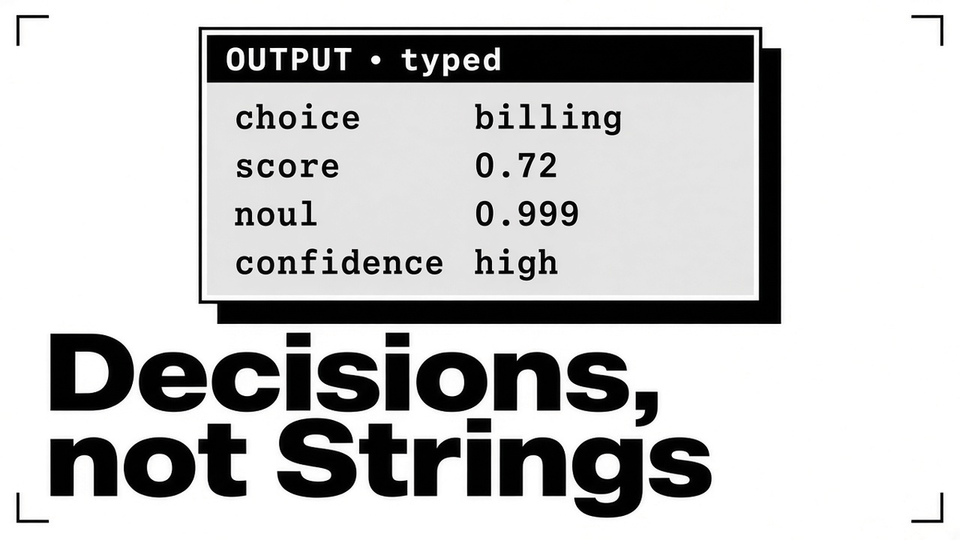
An LLM writes text, and then code interprets that text again. Jev fixes the output space first. When you provide a state and a question, you get back a value of an allowed type and a probability, and answers outside the schema cannot even be expressed.

In Lesson 1, we cover System 1 and System 2, along with four structural limitations of LLMs (string-based output and hallucinations, the latency of sequential generation, and unreliable confidence scores). In Lesson 2, we look at type-safe structured output, parallel sampling that produces all answers in a single query, and RLCD, which aligns confidence with actual accuracy.

2⃣ Design Choice · Score · Noul in a single request 

There are three ways to ask Jev.

  • Choice selects one of the predefined options. The selected value, the probability for each option, and the confidence are provided together. For example: deciding whether to route a ticket to the payments, technical support, or sales team.

  • Score is a value on an ordered scale. Example: the intensity of a customer complaint.

  • Noul is a probability between 0 and 1 for “Is it true?” For example: Is it urgent? Is it a refund request?

When three questions are combined into a single state, they share the same state and are evaluated in parallel. Even if you increase the number of questions from one to several, the latency remains nearly the same. In Lesson 3, you’ll write this call directly using support ticket JSON and langchain_typesafe’s TypeSafeClassifier, and cover the pattern of splitting one large question into atomic questions and then combining them in code.

3⃣ Millisecond decisions and a hybrid that shares roles with the LLM

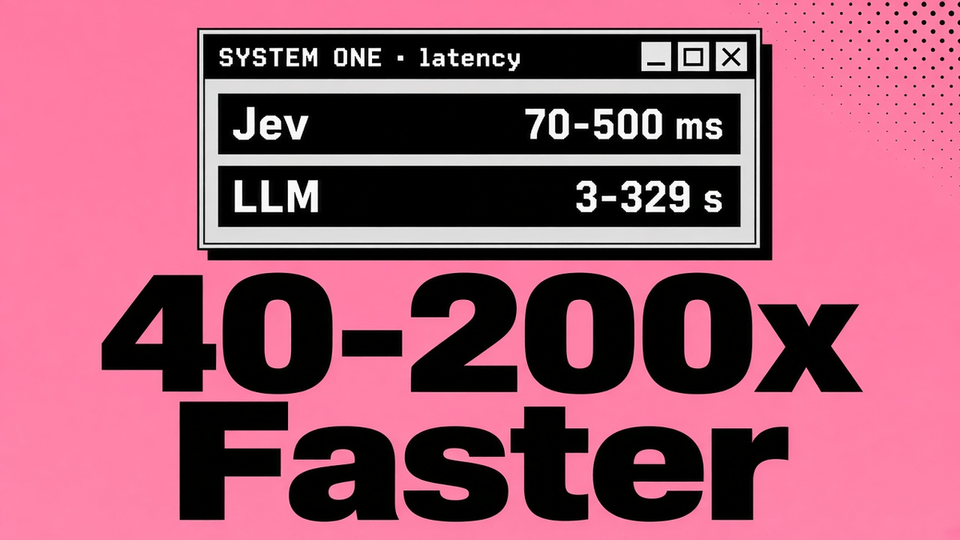
For System One-style queries, Jev’s end-to-end response time is 70–500ms. Compared with the 3–329 seconds required by LLMs that generate tokens sequentially, it is about 40–200 times faster. Input costs $0.042 per 1 million tokens, while output tokens are free. In the 4-way benchmark, it reads results showing approximately 68% accuracy across four workflows, close to that of upper-mid-tier LLMs, while leading by more than two orders of magnitude in speed and cost.

The reason it’s fast is also where it’s used. Intelligent conditionals that replace fragile if statements, map-reduce for large volumes of data, real-time decisions at the user-facing layer, and guardrails that filter LLM outputs and jailbreak attempts before execution. Jev does not replace LLMs. Jev handles decisions that can be reduced to structure, while LLMs handle open-ended prose, and when confidence is low, the decision is handed off to a human.

Pre-Course Notes

Learning Materials and Notes

  • All learning materials are available at the following link.

  • The copyright for this lecture and its learning materials belongs to the knowledge sharer. Unauthorized distribution and reproduction are prohibited, and the materials may not be used for purposes other than personal learning.

  • No separate practice materials are provided.

Recommended for
these people

Who is this course right for?

  • Backend and AI engineers unable to deploy classification and routing to production due to hallucinations and schema deviations while parsing LLM responses as JSON

  • Service developers who can’t incorporate AI decision-making into real-time workflows because of the several-second delay of waiting for tokens one by one and the cost of each call.

Need to know before starting?

  • You just need to be able to read dicts and JSON with Python.

  • If you’ve seen the process of sending a JSON body to an HTTP API, you can follow the example right away.

  • It can be compared as long as you know that LLMs generate tokens in sequence.

  • You don't need to know System One, type systems, or LangChain in advance.

Hello
This is DEVJH

67

Learners

5

Reviews

5.0

Rating

5

Courses

Hello. I’m Jonghyun Lee.

While working as a software developer at Coupang, I gained hands-on experience developing and operating real-world services. I am currently balancing work and studies while researching machine learning and deep learning in the Master’s program in Artificial Intelligence at Yonsei University.

With over 10 years of software development experience, I conduct AI research firsthand and implement it through various projects and services. I am particularly interested in machine learning and deep learning, LLMs and generative AI, RAG, AI agents, and AutoML. Rather than merely studying these technologies, I value the process of implementing and experimenting with them directly to solve problems.

Based on hands-on experience developing AI models, I have participated in various AI competitions and achieved strong results. In the 2026 K-League–University of Seoul Open AI Competition, I placed third out of 947 teams, and in the 5th ETRI Artificial Intelligence Paper Competition on Human Understanding, I ranked second on the Private Leaderboard out of 409 teams.

I have also continued to achieve results in research. My work on FS-DCM, which addresses the nonstationarity and volatility of time-series data, was accepted as a first-author oral presentation paper at the International Conference on Automated Machine Learning (AutoML 2026), while my first-author paper, MathQueue, was also accepted at the EMNLP 2026 MathNLP Workshop. In addition, I continue to pursue research on interpretable AutoML using LLMs and the practical application of AI technologies.

I currently operate the AI learning service Commuting AI (https://mdooai.com). I also work as a Upstage Certified Trainer (Upstage-certified AI trainer), providing generative AI education and mentoring.

Based on my practical experience in development, AI research, and education, I work with everyone from those just starting out in AI to those looking to expand their development experience into the AI field, helping them consider realistic learning paths and project experiences suited to their individual circumstances.

Going forward, I aim to contribute to helping more people understand AI, implement it themselves, and apply it effectively to their work and projects, based on AI technologies and research that I have directly experienced and validated.

Thank you.

More

Curriculum

All

12 lectures ∙ (1hr 31min)

Published: 
Last updated: 

Reviews

Not enough reviews.
Please write a valuable review that helps everyone!

DEVJH's other courses

Check out other courses by the instructor!

Similar courses

Explore other courses in the same field!

Limited time deal

$16,500.00

50%

$26.40