If you have just finished the Java Basics book or are a Java beginner, I expect that through this course you will learn design patterns and be able to program with more efficient code when programming using Java.
This course is helpful for beginners to learn what design patterns are.
5.0
성낙현(낙자쌤)
100% enrolled
I tried to study design patterns by reading books and looking for lectures...
I finally found a lecture that I like..
Overall, it was well organized, and most of all, I liked the examples.
It's not easy to provide sufficient understanding with short example sources, but I could feel that a lot of effort was put into it.
Thank you for the great lecture..I think it would be helpful for other developers to listen to it once.^^
5.0
느림보개발자
100% enrolled
I had a vague feeling about design patterns, but through this lecture, I was able to easily understand frequently used design patterns. I recommend it to those who are curious about Java-based design patterns~
What you will gain after the course
Advanced Uses of Java
Implementing advanced code using Java
A smooth resolution of various problems that arise during project progress
What is a design pattern?
The important reason for creating a program by applying design patterns is
This is to make it easier to respond to various additional requirements .
That is, to make it easy to modify the code.
Through my previous experiences, the experiences of others, etc.
In this situation, if the purpose of the modification is this, it is better to do it like this.
A design pattern is something that is systematically organized.
So when we apply design patterns to programming,
It will make programming a little more comfortable.
The 'Design Patterns with JAVA (Gof)' course explains some of the Gof Design Patterns using Java.
The usefulness of design patterns
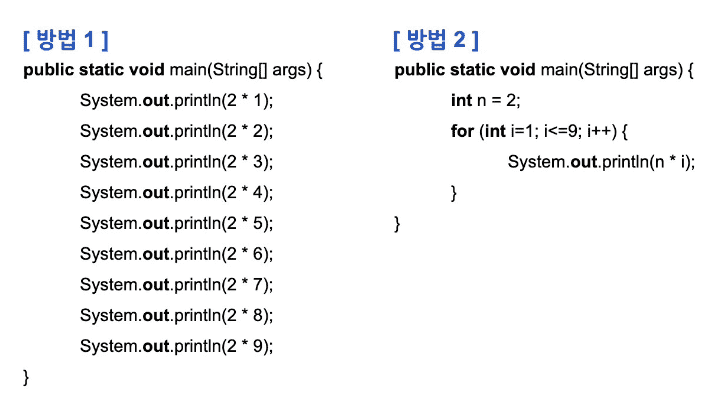
Making a 2nd multiplication table
💁🏻♂️If I need to print from 1 to 999, what would be a good method? 🙋🏻♀️[Method 1] requires a very long hardcoding, whereas [Method 2] only requires changing the condition inside the for loop to i<1000!
💁🏻♂️If I need to print 3 columns, what would be a good method? 🙋🏻♀️[Method 1] requires you to change all 2s in the horizontal line to 3, whereas [Method 2] only requires you to change int n = 3; and you're done!
This example is not a design pattern, but if you apply design patterns to your project, it will look like this example.
It makes it easier to respond to various additional requirements.
소스코드자료는 싱글턴패턴의 세 번째 강의 "쓰레드 사용시 문제점 해결과 좀 더 효율적인 코드 만들기"에 첨부 되어 있습니다.
해당 수업에서 좌측 상단의 수업 리스트버튼을 눌렀을 때 첨부파일을 확인할 수 있습니다.
Recommended for these people
Who is this course right for?
For those who have just finished the Java Basics book
For those who want to use Java at a higher level
For those who want to study design patterns
This is suitable for those who are moving from [beginner → intermediate] level.
Need to know before starting?
We assume you have Java programming experience.
It does not cover installing JDK, build tools, or IDE.
This course was created using JDK 1.8, Eclipse 2019-06.
Understanding Classes and Object-Oriented Programming Design Patterns with JAVA: A Core Introductory Course for Spring Boot! Cocos Creator 2D Game Development: Game Design Patterns with Unity
Understanding Classes and Object-Oriented Programming Design Patterns with JAVA: A Core Introductory Course for Spring Boot! Cocos Creator 2D Game Development: Game Design Patterns with Unity
I thought it would be a practical example just by watching the open lectures, but there are none. It's no different from the free lectures on YouTube, but it's a bit expensive at over 30,000 won.
To be honest, the lecture is a general explanation of design patterns, but I don't think I'll understand it more or use design patterns after listening to it. (It doesn't satisfy my intellectual curiosity ㅠㅠ)
I think it will be helpful for those who don't know at all to get a general understanding.
I don't think it's worth paying 30,000 won to listen to..
I recommend that you search for the design patterns listed in the lecture list on the Internet and buy it if you don't understand them.
1.
The example code is not an example of practical application, but it ends at the level of "This is called a ~ pattern" while looking at simple example code.
-You can learn everything by Googling.
2.
The number of patterns taught is also small. If you're going to record a lecture with this level of quality, wouldn't it be right to upload more patterns?
3.
The lecture sound is also too low...
[Conclusion]
I would have been grateful if it was a free lecture, but I don't think it's worth paying 30,000 won for. I think around 10,000 won would be appropriate.
The lecture content was a bit disappointing. I thought it would be a practical code that could be used right away in practice, but it was a bit disappointing.
Also, while the beginning was written step by step, from the middle to the latter part, it was a bit disappointing that it just
pasted the source code and gave a rough explanation.
It would have been better to understand if it had been written step by step, but
since it was too fast to paste the code and explain it, I missed a lot of parts and had to go back and look at them.
However, for those who lack the basics or do not have a basic understanding of design patterns,
I think they will get the feeling that this pattern is implemented this way.
Anyway, it is an overall disappointing lecture with poor quality.






















![[Java Advanced Practical Project] Spring Core + H2 Based Food Truck Kiosk System DevelopmentCourse Thumbnail](https://cdn.inflearn.com/public/files/courses/336594/cover/01k8hetsq20rg69zw5ve0q5729?w=420)