[Renewed] Beginner’s Python Machine Learning Bootcamp (Easy! Learn by Solving Real Kaggle Problems) [Data Analysis/Science Part 2]
Based on the instructor’s experience of struggling when first learning machine learning, this course has been newly designed—unlike conventional courses—to help you understand machine learning easily and apply it to real-world problems.
If it's a lecture by 잔재미코딩, it's a must. I took the complete SQL course and complete Python course, successfully transitioned my career to data analyst, and now I'm working overseas. (I purchased all the courses and posted questions with my previous account, but I lost that account and had to create a new one😭😭) Even someone like me with absolutely no coding experience could understand and complete my own projects, so you can imagine how well he explains things. I've taken courses from various instructors on Inflearn, but personally, I don't think anyone can match his teaching skills. He doesn't just read text monotonously but explains why things work in a way that really sticks in your ears. He's simply the best. Now I have a new goal, so I'll continue the journey from machine learning to deep learning together. Thank you always for the great lectures.
5.0
YuJin Lee
94% enrolled
The process of planning and filming the lectures must have been very difficult; it was truly a packed lecture. It was worth every penny I spent on the purchase. If your goal is to get an introduction to machine learning with no prior knowledge, this lecture is perfect for grasping the overall framework. However, just listening to the lecture may not be enough. You need to review the class materials, lecture content, and additional searches, including GPT. If you want to make it your own, I think these additional efforts are essential. The lecture materials are also very detailed, making it easy to learn just by looking at the code without the lecture. I think it's even better because the lectures have been recently updated to be up-to-date. Thank you for providing such a high-quality lecture :)
5.0
hhs834373
92% enrolled
As you said, it was a lecture that was very helpful in grasping the big picture. I found additional detailed theories and mathematical knowledge in the knowledge I learned in school and studied it, which was also a new kind of fun.
Above all, it was a lecture that helped me quickly learn various models through practice and start to get a feel for them.
What you will gain after the course
Introduction to Machine Learning
sklearn and Python machine learning
Introduction to Kaggle
Machine Learning Classification Techniques
Machine learning regression techniques
Machine Learning Clustering Techniques
Practical techniques such as one-hot encoding and hyperparameter tuning
The official course chosen for in-house training by Naver, Kakao, LINE, Coupang, and Baemin!
For beginners learning Python machine learning for the first time
A high-quality course
This course is designed for beginners learning Python machine learning for the first time, based on a data analysis/science roadmap Drawing on the instructor’s experiences of failure when first learning machine learning, it has been carefully designed to help you understand the essential concepts and key application techniques by solving a variety of real-world problems You can learn to apply machine learning to real-world problems in a short period of time without getting stuck.
This course is currently being used as an official in-house Python machine learning training course at one of the major Korean tech companies.
This course has been newly revamped to reflect previous feedback.
I'm new to data! Where should I start with complex machine learning and artificial intelligence technologies?
Machine learning and artificial intelligence involve complex concepts and a wide variety of techniques for applying them to real-world problems, making the subject matter extremely extensive.
When first learning, you should start with the basics of machine learning, combining essential concepts with techniques for applying them to real-world problems in a well-balanced way.
Once you get a feel for machine learning that way, you can build on it to learn artificial intelligence technologies.
The more theory-heavy and complex a technology is, the more you need to build up your knowledge step by step, starting with the essentials, before you can put it to use.
This course was improved based on what the instructor learned through repeated failures!
Rather than focusing too much on deep principles like mathematics and statistics or listing outdated techniques that you will never use,
Designed to help you learn the essential concepts and key techniques while solving real-world problems
There are many techniques you can apply to real-world problems. Learn those various machine learning techniques through practical problems.
By applying as many practical techniques as possible to well-known problems with abundant resources, you will learn the techniques to consider when using machine learning in real-world applications.
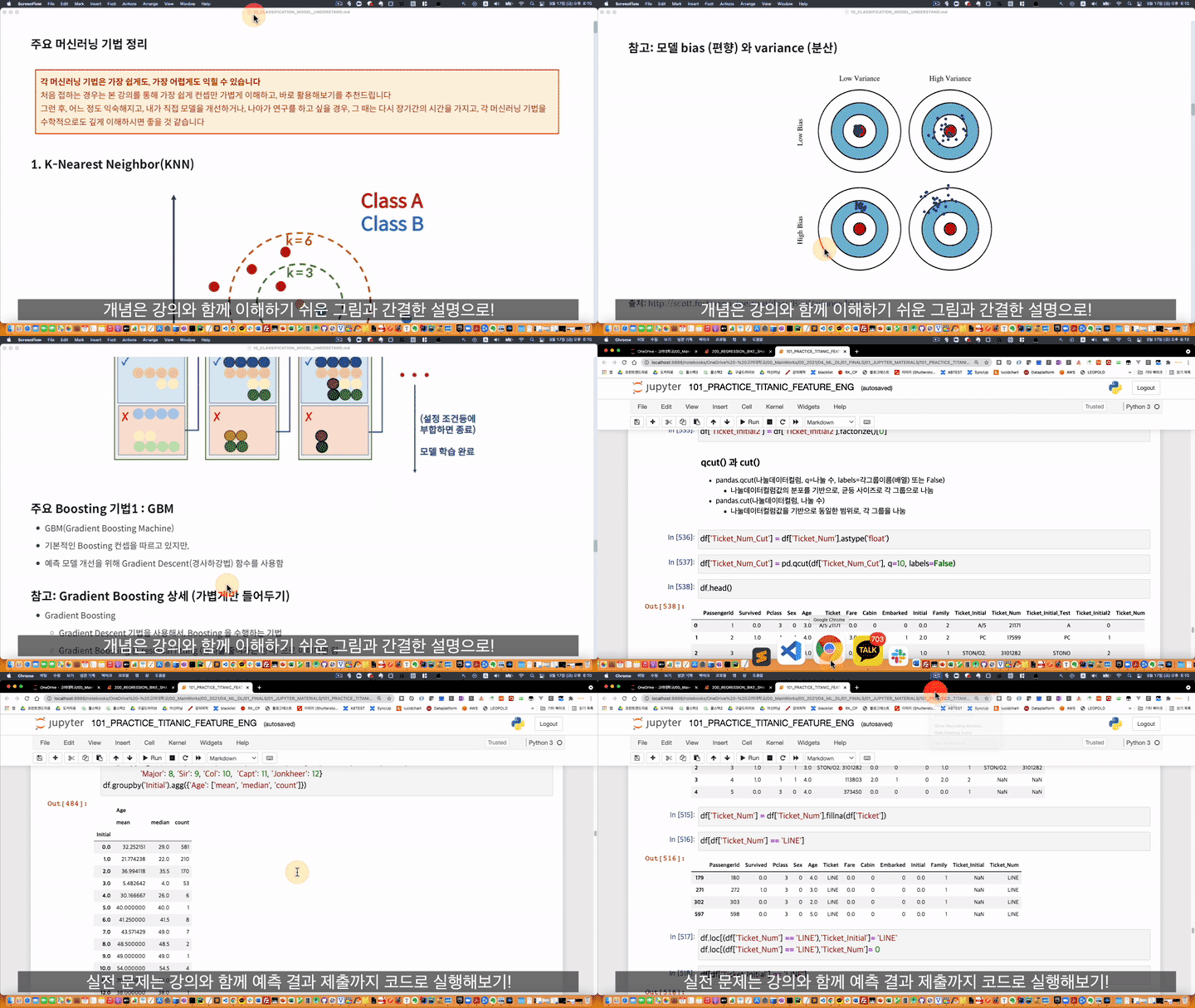
Using the famous Kaggle site for data prediction problems, we work through the entire machine learning process by downloading data, making predictions, and submitting the final results.
강사도 몇 차례 실패 끝에 이 순서로 학습해 현업에서 잘 활용하고 있습니다.
I want to use machine learning techniques, even if only at a basic level. How can I do that?
This was the part that frustrated me as an instructor for a long time. First, learn how to apply machine learning techniques to real-world problems. Even if you understand the basic concepts, applying them to real-world problems can be difficult because there are various techniques to use. By following those techniques at the code level and learning the necessary concepts as they come up, you can use the entire process, even if only at a basic level.
Once you become familiar with it, you can understand the overall machine learning technology in a short time and put it to use right away
I’m new to machine learning! What skills do I need to learn first to take this course?
You can take the course if you know only Python; it is also possible if you can use pandas and data visualization techniques We provide a data analysis/data science roadmap that takes into account the difficulty level for those who are not familiar with the relevant technologies In particular, if you take it together with the Beginner's Python Data Analysis course on the data analysis/data science roadmap described at the bottom of this page, you can sequentially learn how to work with data in Python.
I’m a beginner considering a career in data. How can I learn systematically?
The data field encompasses a wide range of theories and technologies, so taking the wrong approach can make it difficult to learn even after spending a long time. I also failed several times. However, focusing on core technologies can make it easier than you might think.
Learn the core data skills sequentially by dividing them into collection, storage, analysis, and prediction. Building knowledge in a business field (domain knowledge) alongside these skills will give you a competitive edge. I created a data analysis/science roadmap to help you learn by gradually increasing the difficulty. You can find it at the bottom of this page.
We also created a video that explains in detail the entire data analysis/science process and data-related careers. If you refer to it, you can learn the data process on your own in a short time without trial and error, depending on your goals!
These are proven courses that many people have studied over the years and given highly positive feedback on.
Proven by 20,000 paid online and offline students over 10 years! Don't waste your time! IT courses can vary depending on the instructor! If you're thorough and practical, you can do it!
How difficult is it to learn machine learning technology?
If you can use Python, it isn't difficult! The most difficult part of learning machine learning for the first time is studying the mathematics, statistics, and probability needed to understand the theory. Even when an instructor who has spent decades studying related technologies explains things simply, it can take learners a very long time to master them.
Rather than delving into deep mathematical principles, try to understand the concepts lightly and learn how to write machine learning code using real-world problems. Instead of aiming for the top 1% from the start, first aim to reach the top 20% in data prediction while learning coding techniques and practical application methods. If you understand the concepts as much as you can and actually apply the code, you will be able to understand and use machine learning, which may have seemed vague when learned only through theory.
These days, there are also many Kaggle competitions for solving real-world data problems. Would that be possible?
This course is also structured to help you learn step by step by applying what you learn to real Kaggle problems and data one by one.
There is a significant difference between learning how to use machine learning and the code and steps required to solve real-world problems.
We proceed step by step to analyze, process, and make predictions using real data.
At each stage, we explain the techniques you need to understand and go all the way through to submitting the prediction results.
It is designed so that you won’t get tired of spending a long time learning only theory, while also understanding how to apply it in practice.
As this course is intended for beginners, it focuses on the essential technologies you need to learn, with the goal of covering the top 20%!
Designed so that you can truly understand and apply machine learning techniques.
This course serves as a stepping stone for those learning machine learning for the first time. With real-world experience, well-organized materials, and examples, the instructor teaches as if learning it for the first time too! So that even beginners can apply machine learning techniques and reach the top 20% in a short time!
Focusing on the key machine learning techniques still in use today!
Based on real-world Kaggle problems and data → What machine learning techniques are available → The steps involved in analyzing, processing, and making predictions with real-world data → Practical techniques needed for real-world applications, including Feature Engineering, Hyper Parameter Tuning, Voting, and Encoding
Applying it to real-world problems is fun, and when the predictions turn out well, it’s truly rewarding! I hope to share the little joys of machine learning with thoughtful, wonderful people.
Boost your learning with easy-to-understand summarized materials and code, using them as the foundation for the course!
There is an abundance of materials and information. After taking a detailed lecture based on summary materials designed to help you understand only what is essential, you will be able to immediately understand things just by looking at the materials whenever you think, 'Ah! There was something like this?'
Written so that you can understand and apply the relevant topics materials concisely written with only the essentials and actual machine learning application code files for real-world problems
The test code is provided as Jupyter notebooks that can be run immediately, and the basic theory is provided in PDF files.
You can check the machine learning PDF materials anytime, just like an ebook. (However, copying and downloading are restricted due to copyright issues.)
'Ah! It really is different!' This is a series of IT courses thoughtfully created so that you can feel that way.
Please enroll only if you value reasonableness and consideration for one another, and are capable of forming good relationships.
Learn systematically Dave Lee’s roadmap for Fun Coding
Following this course, the AI · development · data · CS roadmap you can learn according to your goals giúp bạn học theo mục tiêu của mình
IT technologies are interconnected. By selecting and learning connected technologies, then adding AI, you can reach your goals much faster.
Every roadmap covers how to connect and use technologies together, is designed to increase in difficulty from the beginner level to the expert level, and is continuously updated over the years.
It is also more discounted than taking the courses individually.
1. The fastest complete data roadmap
From Data Analysis to Data Science: Your Complete Career Journey
4. The Most Reliable Ultimate AI Utilization Roadmap (2026)
From Claude Code-based work automation to vibe coding, Codex, OpenClaw, Claude Code-based data analysis, advanced Claude Code techniques such as agentic, harness, and loop engineering, and even AI agent development
Key Experience: Coupang Senior Development Manager/Principal Product Manager, Samsung Electronics Development Manager (Approx. 15 years of experience)
Education: BA in Japanese Language and Literature, Korea University / MS in Computer Science, Yonsei University (A complete mix)
Key Development Experience: Samsung Pay, E-commerce Search Service, RTOS Compiler, Linux Kernel Patch for NAS
Books: Linux Kernel Programming, Understanding and Developing the Linux Operating System, IT Core Technologies That Anyone Can Easily Read and Understand, Python Programming Primer for Absolute Beginners
I think coding is divided into two parts: theory and practice.
However, if we focus too much on each, we won't be able to apply it well when we actually code, and we won't know why it actually works this way. This lecture is a lecture that can cover both theory and practice.
Of course, even if it's hard to learn the details through this lecture (it's more efficient to study that part on your own or you can learn it at university), you can learn how the overall flow is flowing, and because of this, you can recognize and proceed with the overall flow when you do your next personal project. This may seem small, but it's very helpful when you actually start doing a project.
I've taken Dave Lee's classes on data analysis/crawling/database/machine learning, and for me, it's a class that made me realize that coding is 'fun'. This class was not only helpful to me, but it was also fun, which was the best part. Thank you so much for explaining machine learning so easily and understandably.
I would appreciate it if you could make more interesting classes in the future.
Thank you!
Thank you for taking the time to write such a good review. It is difficult to spend time on online lectures to give such a review because we do not know each other, but I am also happy and motivated by it. I hope it will be helpful to you and help you in your desired career, and we can create a good ecosystem together. Thank you.
Oh, I also made this lecture with the same intention in mind, thinking about how to capture the big picture in a short period of time, within the possible scope, and also practice Kaggle, so I'm really happy that you recognized it. Thank you.
It seems like this is almost my first class review, but thank you for your kind words. The content may be more substantial than I thought. I hope it will be helpful to you.
It's definitely good for good people, but personally, my least favorite lecture style
There's no proper explanation of theories or principles, and the professor just reads the concepts through text
The coding is just written... It feels like reading lecture materials rather than lectures
And more importantly, there are much better free lectures than this one!!
It's much better to go to Kaggle and listen to the world's best lectures. It's much cheaper and much more effective than this one.









![[Renewed] Python Introduction and Web Scraping Basics Bootcamp [From Python and the Web to Fundamental Data Concepts] (Updated)Course Thumbnail](https://cdn.inflearn.com/public/courses/324082/cover/57af93de-1021-40b4-80d7-a0dfc17190cf/324082.png?w=420)


![[Renewed] First-Time SQL and Database (MySQL) Bootcamp [From Beginner to Practical Applications]Course Thumbnail](https://cdn.inflearn.com/public/courses/324208/cover/85872a8e-d2bb-4c43-82fc-d55fa067746e/324208.png?w=420)

![Python Backend for Beginners: An Introduction to FastAPI (From FastAPI to Asynchronous SQLAlchemy) [Full-Stack Part 1-2]Course Thumbnail](https://cdn.inflearn.com/public/courses/333248/cover/7323d828-100e-4ac9-8e6e-0e51a17ac741/333248.png?w=420)
![Docker and Modern Server Technologies for Full-Stack Development (Linux, nginx, AWS, HTTPS, Deployment) [Full-Stack Part 3]Course Thumbnail](https://cdn.inflearn.com/public/courses/326771/cover/bc862b4d-abe6-4d80-a826-3a5324a9f998/326771-eng.png?w=420)
![A Solid Front-End Bootcamp for Full-Stack Developers (HTML, CSS, Vanilla JavaScript + ES6) [Full-Stack Part 2]Course Thumbnail](https://cdn.inflearn.com/public/course-326306-cover/4ea213de-f786-4af1-a9d0-b8932263885a?w=420)
![Flutter for Beginners: From Basics to Real-World Applications [Full Stack Part 4] (Easy, Robust, and Step-by-Step Through Various Projects)Course Thumbnail](https://cdn.inflearn.com/public/courses/331245/cover/1f8c5bb8-8aad-4542-b3bc-977cda51c846/331245.png?w=420)
![[Renewed] Introduction to Python Backend and Web Technologies for Beginners (Intermediate Python, Understanding Backend and Web Technology Fundamentals with Flask) [Full-Stack Part 1-1]Course Thumbnail](https://cdn.inflearn.com/public/course-325804-cover/6afae82f-e06b-4a0b-914d-2bdf7b1f5b60?w=420)
![[Renewed] First-Time MongoDB and NoSQL (Big Data) Database Bootcamp [From Beginner to Practical Use] (Updated)Course Thumbnail](https://cdn.inflearn.com/public/courses/324183/cover/fbe9f0cc-4c42-4435-b855-f283f6932415/324183.png?w=420)
![First-Time Deep Learning and PyTorch Bootcamp (Easy! From the Basics to the Core Transformers Behind ChatGPT) [Data Analysis/Science Part 3]Course Thumbnail](https://cdn.inflearn.com/public/courses/329540/cover/1be7b8cb-800f-48cb-a30c-b7d78996c075/329540-eng.png?w=420)
![[Updated] Your First Python Data Analysis (Easily! Learn the Entire Process of Preprocessing, pandas, and Visualization) [Data Analysis/Science Part 1]Course Thumbnail](https://cdn.inflearn.com/public/course-325576-cover/75d85753-8e0b-40f3-9f11-ca43e70c5200?w=420)
![[PyTorch] Deep Learning Leading to Practical AI - From Basics to Paper ImplementationCourse Thumbnail](https://cdn.inflearn.com/public/courses/326248/cover/945f4b20-e4e1-4d10-8e64-f2757c01736b?w=420)
![[Beginner/Introductory] Implementing Recommendation Systems through Various ExamplesCourse Thumbnail](https://cdn.inflearn.com/public/files/courses/337887/cover/01jyvdpxdgj736bzm3ek4mnk59?w=420)
![[Side Projects After Work] Big Data Analysis Engineer Practical Exam (Task Types 1, 2, and 3)Course Thumbnail](https://cdn.inflearn.com/public/courses/329972/cover/dcfb28fd-48c1-4bb1-ab31-d59eac874194/329972-original.png?w=420)
![[Python in Practice] Web Crawling and Data Analysis: Analysis of the Transfer Fees of Football Players WorldwideCourse Thumbnail](https://cdn.inflearn.com/public/courses/326406/cover/150871bf-bc44-4a81-a577-c957f2df0a5f?w=420)