Requirement Analysis Implementation Methods: Requirement Analysis Implementation Methods for Successful System Development
Most system development failures or requirement changes occur due to faulty requirements analysis. This covers how to implement requirements analysis to ensure successful system development. Requirements are addressed with scenarios, not code. This covers how to address requirements with scenarios.
The Foundation of System Development, Requirements Analysis
Just as building a house requires first creating a foundation, then constructing the house on that foundation, and finally doing interior decoration, system development also has a sequence. System Development Life Cycle (SDLC) consists of planning, requirements analysis, system design, and program development phases. Planning is like deciding to build a house, and creating the foundation is exactly what requirements analysis is. Trying to solve requirements with program code is a risky approach, like trying to build a house without a foundation. This course covers requirements analysis in the SDLC.
Requirements Analysis, Why Should You Learn with This Course?
Strategic Approach
To succeed in system (software, project) development, strategies and methods are necessary. Good programming coding skills alone cannot guarantee successful system development.However, since system development involving many stakeholders must succeed, systems should be developed with strategies and methods. This course covers strategies and methods for successful system development.
How to Write Successful Scenarios
In system development, you need scenarios that clearly define requirements. By following scenarios while developing programs, you can develop systems conveniently and safely. This course covers how to define and write requirements as scenarios. You can learn requirement analysis implementation methods that lead to successful system development.
It took over 40 years for this lecture to come out
The instructor has been doing contract software development for over 35 years, including 12 years of running a software development company. Contract software development always involves deadlines, costs, quality, and inspections. The development environment with deadlines, costs, quality, and inspections made the instructor need methods and strategies to succeed in system development. The environment where project stakeholders inspect the program code I wrote made the instructor a professional developer.
The key to successful system development is requirements analysis. Contract development has another environment where development must be completed in a short period. For this, we integrate requirements analysis and system design. An approach is needed that conducts more complete requirements analysis through the integration of development phases while shortening the development period.
Know-how perfected through experience
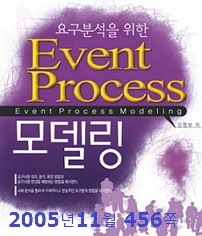
The image shows the book 'Event Process Modeling for Requirements Analysis'. This was during my 26th year of development. Even after publishing the book, I continued to develop requirements analysis methods by reflecting on my requirements analysis experience. I refined these experiences and thoughts to create this course. This course is not a simple theoretical lecture. It is a practical course created from over 40 years of experience. The book is out of print, and this course is the final version.
Recommended for these people
Analyst who analyzes and defines requirements
Project Planner
System Designer
Developer jumping to analyst
Join this course! ✨
Lectures specialized for practical application
This covers requirement analysis implementation methods that lead to successful system development. It covers practical methods that can be immediately applied to requirement analysis in system development. This is the only course that covers requirement analysis implementation methods.
Including System Design
To conduct more complete requirements analysis, we have also included some system design-related content. This can shorten the system design period, and once requirements analysis is completed, you can immediately proceed to program development.
Learn requirements analysis completely The deepest and most accurate path
Requirements Analysis Tree-Building Approach
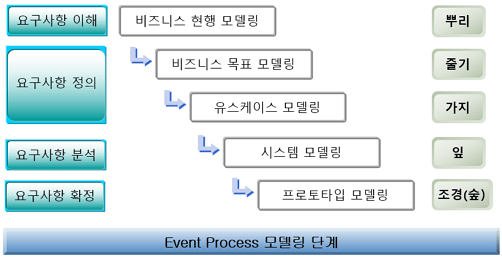
To clearly define and analyze requirements, we perform requirements analysis divided into 5 stages. We approach this by creating the roots, trunk, branches, and leaves of requirements analysis. Finally, we finalize the requirements to landscape the requirements analysis and create a forest. A preview of the concepts for each stage is provided.
Logical Approach to Requirements Analysis
Going from Seoul to Busan via Daejeon and Daegu is one connection and flow. Requirements analysis results should also be in the form of a connected flow.
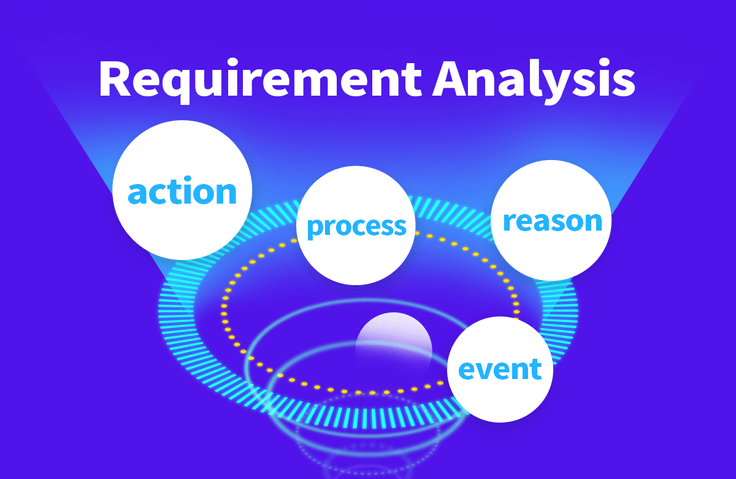
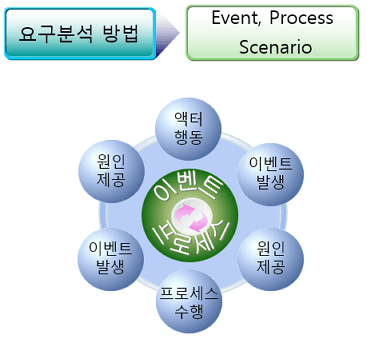
The requirements analysis of the Event Process Modeling method is based on Events, Processes, and Scenarios. When an actor acts, an event (the cause, reason, and purpose for performing the next process) occurs. The next process is performed by receiving the event (cause, reason, purpose) generated from the previous process. Processes are connected to processes through events. Processes are logically connected with a foundation.
This form where processes are connected and have a flow is called a scenario. If each process is not logically connected, it becomes a scenario lacking evidence, which means the requirements analysis was done incorrectly. In this lecture, we covermethods for performing requirements analysis based on logic.
Following the scenario Program development
Requirements analysis is the process of creating scenarios so that requirements can be implemented as programs. The written scenarios are completed through review and confirmation by project stakeholders. Program development can proceed by following the scenarios that result from requirements analysis. In other words, requirements are solved through scenarios, not through program code.
After taking the course, you will 📚
✔️ You can grow into a full stack developer who develops software creatively.
✔️ You will learn strategies and methods to prevent requirement changes.
✔️ By learning how to define requirements as scenario processes, you can naturally resolve refactoring and clean code issues.
Please check before enrollment 📢
Practice Environment
No practice environment is required.
Learning Materials
We do not provide separate textbooks.
The lecture content is written on the browser screen and explained, so the screen content serves as the textbook.
Prerequisites and Important Notes
No prior knowledge is required. However, understanding of programming concepts is necessary.
It will be easier to understand if you have programming development experience regardless of the programming language. (Java, Python, Javascript, etc.)
The copyright of the lecture content and materials related to this course belongs to the instructor. You cannot reproduce, copy, distribute, or teach the lecture content without permission.
Recommended for these people
Who is this course right for?
An analyst who analyzes and defines requirements
Project Planner
A designer who designs systems
Program developer (regardless of programming language)
Need to know before starting?
Not required, but understanding the program concept is necessary.
클린업 자바스크립트: 점프업 클린업 자바스크립트: 베이스 빌드업 자바스크립트 비기너, 자바스크립트 중고급 모던 자바스크립트(ES6+) 기본, 모던 자바스크립트(ES6+) 심화 DOM 기본, DOM 인터랙션 React 비기너, React 완전 끝내기 요구분석 구현 방법 자바스크립트 머신러닝 TensorFlow.js
저서: 9권 몰입! 자바스크립트 ECMAScript 6 HTML5 DOM 스크립팅 자바스크립트 정규표현식 요구분석을 위한 Event Process 모델링 머신러닝 TensorFlow.js, Ajax 활용, prototype.js 완전분석 9권 중에서 8권은 국내 최초 저자입니다. 특히, "머신러닝 TensorFlow.js JavaScript"는 출판하는 시점에 amazon.com에 관련된 책이 없었습니다.
I listened to it once quickly, and from the second time on, I read it carefully. Even the teacher, who has a meticulous personality, had typos, and it felt human :)
At first, I didn't even know what requirement analysis was, and I listened to everything the teacher taught without thinking because I wanted to see everything, but as I worked, I did a rough requirement analysis of my boss's request and made a rough screen design document (because I didn't learn how to do it properly, I kept working like that and didn't worry), and the work style of just talking here was so difficult (because all the situations mentioned in the lecture happened...), so I watched the second time really understanding one by one with the intention of doing requirement analysis and design. It was fun and I was looking forward to the next video.
I watched it all and enjoyed it. I want to apply it one by one to my work in the future and watch the video again and again. I'm struggling with the development work that's just talk and such incompetence, but thanks to you, I'm working thinking that I've learned and gained skills. Thank you for making the video so hard.
Thank you. It feels like you have entered the world of professionals. Congratulations. If you develop your current thoughts, you will develop the belief that if you leave it to that person, the job will be done successfully. I support the beautiful world of professionals.