
inflearn logo

A Quick Look at C Programming

You can quickly understand the basic concepts and fundamental syntax of the C language.

20 learners are taking this course

Level Beginner

Course period Unlimited

C
C
Embedded
Embedded
C
C
Embedded
Embedded

What you will gain after the course

  • Variables, data types, standard I/O, basic operators, conditional statements, loops

  • Arrays, strings, functions, pointers, structures, file I/O

🧭 Precautions

The course is currently being completed. The downside is that you may have to wait a long time until the course is fully finished (although it will be supplemented frequently). Please take this into consideration when making your purchase decision.

📋 Change History

  • 2025.09.20

    • The table of contents has been revised to switch the initially completed lectures to public (preview) and to reinforce the course with various new sections and lessons. The goal is to provide more abundant information to existing paid subscribers and to allow those who want to get started with C to quickly grasp an overview of the language by browsing the preview lectures. If existing paid subscribers also wish to quickly skim through the overview of C, you can start by taking the lectures marked as 'Preview'.

🎯Course Introduction

C language is an important foundational language for computer programming and is widely used in various fields such as system software, games, embedded systems, and operating system development. This course is designed for learners who are new to C language and focuses on understanding basic concepts and syntax.

🎯 Course Objectives

This course aims to help you quickly understand and memorize the basic concepts and syntax of the C language. You will learn a wide range of topics, from the basics of declaring variables and performing operations to control structures using conditional statements and loops, efficient programming with functions and pointers, and file input/output.

🎯Teaching Method

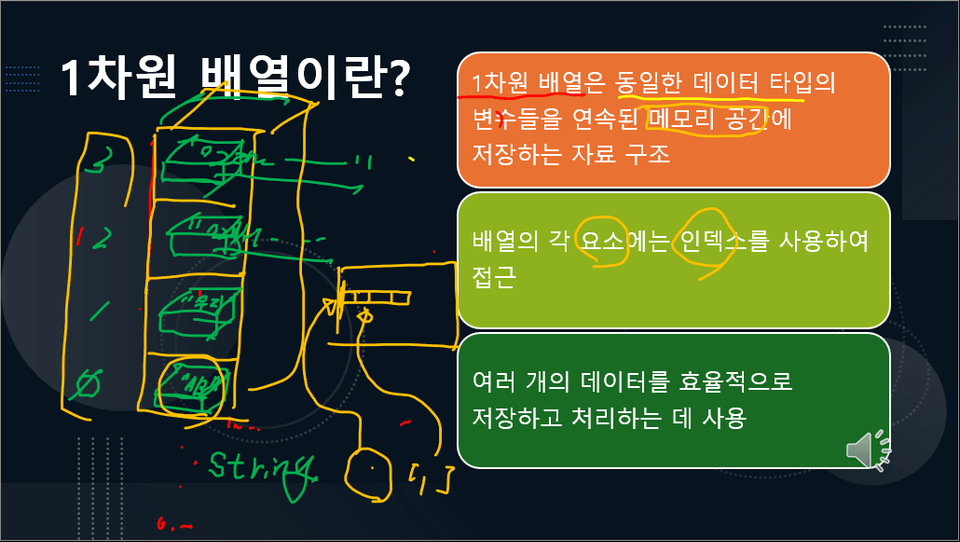
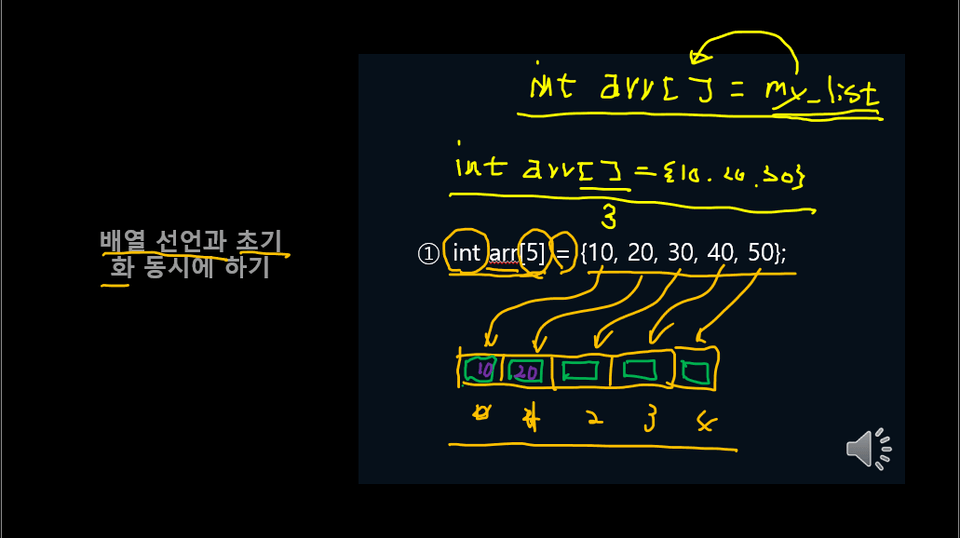
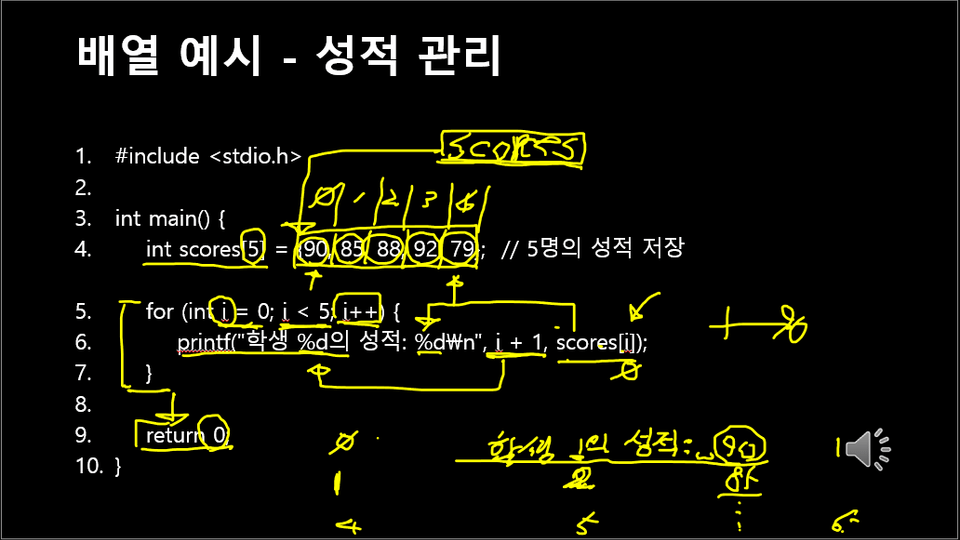
Lecture screen example: Provides in-depth explanations of the technical background of coding.

Lecture screen example: Explains the relationship between technical background knowledge and code in great detail.

Lecture screen example: Explains the relationship between technical background knowledge and code usage cases in connection with the program flow.

🎯Course Curriculum

The course consists of a total of 7 sections, and each section is designed to explain core concepts and maximize learning effectiveness through hands-on practice.

🔹 Section 1: C Language Overview

C language is a high-level programming language that maintains a close relationship with computer systems and possesses the characteristics of a low-level language close to hardware. In this section, you will learn the basic concepts of C and build a foundation for computer programming. C language serves as the basis for other programming languages and is widely used in developing operating systems, system software, and various applications. You can experience the appeal of C by setting up your development environment and writing your first C program. Through this, you will gain a deep understanding of how C language interacts with computers.

🔹 Section 2: Basic Syntax

Understanding the basic syntax of C is the first step toward building a foundation in programming. In this section, you will learn about variables, data types, and the input/output functions printf and scanf, while mastering how to write basic programs. Variables are the fundamental units for storing data, and the type of value stored depends on the data type. Input and output methods using printf and scanf are crucial parts of the C language, where you will learn how users input data and how the program outputs results. This section establishes an important foundation for understanding C syntax and developing the ability to perform basic calculations and process data.

🔹Section 3: Operators and Control Statements

Programming is the process of processing data and controlling flow based on conditions. This section covers various operators and control statements in the C language. Operators are used to calculate or compare data, while conditional and loop statements control the flow of the program. You can use conditional statements such as if, else, and switch to perform actions based on specific conditions, and automate repetitive tasks through for, while, and do-while loops. A solid understanding of operators and control statements will allow you to master the programming techniques essential for solving complex problems.

🔹 Section 4: Arrays and Strings

Arrays and strings are important data structures for efficiently managing and processing multiple pieces of data. In this section, you will learn how to store and process multiple data points using arrays, as well as how to handle strings. Arrays allow for the continuous storage of data of the same type, while strings are treated as a collection of characters. Arrays and strings are essential structures used in various programs and are extremely useful when data sizes increase. Through this section, you will develop the ability to store and handle data efficiently.

🔹Section 5: Functions

Functions play a crucial role in writing and maintaining programs efficiently. In this section, you will learn the basic usage of functions, including function declaration, calling, parameter passing, and return value handling. Functions help modularize programs, increasing code reusability and significantly reducing code length. By breaking down complex tasks into multiple functions, the program becomes more structured and easier to understand. Mastering the use of functions will allow you to write cleaner and more efficient code when developing larger programs.

🔹Section 6: Pointer Basics

Pointers are a crucial concept in C, serving as variables that store the memory addresses of other variables. In this section, you will learn the basic concepts and usage of pointers. By using pointers, you can directly modify the values of variables or efficiently handle complex data structures like arrays. Since pointers are a vital element of the C language, it is essential to understand and use them correctly.

🔹 Section 7: Structures and File I/O

In the C language, a struct is an important data structure used to group different data types into a single unit. In this section, you will learn how to define and utilize structs, as well as how to handle complex data structures. Additionally, you will learn how to save data to files or load data from files through file input/output. Techniques for processing files using functions such as fopen, fprintf, and fscanf are extremely useful for permanently storing or managing data within a program. Through this section, you will be able to increase program efficiency and write code that is ready for practical use.

🎯What will you achieve after the course?

After taking this course, you will have mastered the basic syntax of C and reached a level where you can write simple programs on your own. Furthermore, you will build a solid foundation for advanced programming in C or for learning other programming languages. Now, let's embark on a journey into the world of C together!

Recommended for
these people

Who is this course right for?

  • A person learning the C language for the first time

  • Those who want to build a solid foundation in programming basics

  • Developers who want to enter fields where the C language is required, such as embedded programs and system programming.

Hello
This is arigaram

691

Learners

38

Reviews

2

Answers

4.6

Rating

18

Courses

I am someone for whom IT is both a hobby and a profession.

I have a diverse background in writing, translation, consulting, development, and lecturing.

Curriculum

All

86 lectures ∙ (25hr 4min)

Course Materials:

Lecture resources
Published: 
Last updated: 

Reviews

Not enough reviews.
Please write a valuable review that helps everyone!

arigaram's other courses

Check out other courses by the instructor!

Similar courses

Explore other courses in the same field!

$26.40