


판다스 기초 1 수업
학습 관련 질문을 남겨주세요. 상세히 작성하면 더 좋아요!
질문과 관련된 영상 위치를 알려주면 더 빠르게 답변할 수 있어요
먼저 유사한 질문이 있었는지 검색해보세요
안녕하세요
판다스 기초 1 - 8분
df type 확인할때 아래와 같은 에러가 뜹니다
이전 코드들도 다 동일하게 run 하고
runtime 모두 실행으로 돌려도 에러가 발생하고
type(df), type(df['가격']) 모두 동일합니다
# 데이터 프레임 type 확인
type(df)
pandas.core.frame.DataFrame
def __init__(data=None, index: Axes | None=None, columns: Axes | None=None, dtype: Dtype | None=None, copy: bool | None=None) -> None/usr/local/lib/python3.10/dist-packages/pandas/core/frame.pyTwo-dimensional, size-mutable, potentially heterogeneous tabular data.
Data structure also contains labeled axes (rows and columns).
Arithmetic operations align on both row and column labels. Can be
thought of as a dict-like container for Series objects. The primary
pandas data structure.
Parameters
----------
data : ndarray (structured or homogeneous), Iterable, dict, or DataFrame
Dict can contain Series, arrays, constants, dataclass or list-like objects. If
data is a dict, column order follows insertion-order. If a dict contains Series
which have an index defined, it is aligned by its index. This alignment also
occurs if data is a Series or a DataFrame itself. Alignment is done on
Series/DataFrame inputs.
If data is a list of dicts, column order follows insertion-order.
index : Index or array-like
Index to use for resulting frame. Will default to RangeIndex if
no indexing information part of input data and no index provided.
columns : Index or array-like
Column labels to use for resulting frame when data does not have them,
defaulting to RangeIndex(0, 1, 2, ..., n). If data contains column labels,
will perform column selection instead.
dtype : dtype, default None
Data type to force. Only a single dtype is allowed. If None, infer.
copy : bool or None, default None
Copy data from inputs.
For dict data, the default of None behaves like ``copy=True``. For DataFrame
or 2d ndarray input, the default of None behaves like ``copy=False``.
If data is a dict containing one or more Series (possibly of different dtypes),
``copy=False`` will ensure that these inputs are not copied.
.. versionchanged:: 1.3.0
See Also
--------
DataFrame.from_records : Constructor from tuples, also record arrays.
DataFrame.from_dict : From dicts of Series, arrays, or dicts.
read_csv : Read a comma-separated values (csv) file into DataFrame.
read_table : Read general delimited file into DataFrame.
read_clipboard : Read text from clipboard into DataFrame.
Notes
-----
Please reference the :ref:`User Guide <basics.dataframe>` for more information.
Examples
--------
Constructing DataFrame from a dictionary.
>>> d = {'col1': [1, 2], 'col2': [3, 4]}
>>> df = pd.DataFrame(data=d)
>>> df
col1 col2
0 1 3
1 2 4
Notice that the inferred dtype is int64.
>>> df.dtypes
col1 int64
col2 int64
dtype: object
To enforce a single dtype:
>>> df = pd.DataFrame(data=d, dtype=np.int8)
>>> df.dtypes
col1 int8
col2 int8
dtype: object
Constructing DataFrame from a dictionary including Series:
>>> d = {'col1': [0, 1, 2, 3], 'col2': pd.Series([2, 3], index=[2, 3])}
>>> pd.DataFrame(data=d, index=[0, 1, 2, 3])
col1 col2
0 0 NaN
1 1 NaN
2 2 2.0
3 3 3.0
Constructing DataFrame from numpy ndarray:
>>> df2 = pd.DataFrame(np.array([[1, 2, 3], [4, 5, 6], [7, 8, 9]]),
... columns=['a', 'b', 'c'])
>>> df2
a b c
0 1 2 3
1 4 5 6
2 7 8 9
Constructing DataFrame from a numpy ndarray that has labeled columns:
>>> data = np.array([(1, 2, 3), (4, 5, 6), (7, 8, 9)],
... dtype=[("a", "i4"), ("b", "i4"), ("c", "i4")])
>>> df3 = pd.DataFrame(data, columns=['c', 'a'])
...
>>> df3
c a
0 3 1
1 6 4
2 9 7
Constructing DataFrame from dataclass:
>>> from dataclasses import make_dataclass
>>> Point = make_dataclass("Point", [("x", int), ("y", int)])
>>> pd.DataFrame([Point(0, 0), Point(0, 3), Point(2, 3)])
x y
0 0 0
1 0 3
2 2 3
Constructing DataFrame from Series/DataFrame:
>>> ser = pd.Series([1, 2, 3], index=["a", "b", "c"])
>>> df = pd.DataFrame(data=ser, index=["a", "c"])
>>> df
0
a 1
c 3
>>> df1 = pd.DataFrame([1, 2, 3], index=["a", "b", "c"], columns=["x"])
>>> df2 = pd.DataFrame(data=df1, index=["a", "c"])
>>> df2
x
a 1
c 3
답변 1
0
아~ 당황했을 것 같네요
에러가 아니라 pandas 라이브러리의 DataFrame에 관한 설명입니다.
코랩 판다스가 최신 업데이트 되면서 설명이 함께 출력되네요! pandas DataFrame의 생성 방법, 사용 가능한 메소드, 생성자의 매개변수 등에 대한 설명이 포함된 문서입니다
시험 환경의 판다스는 구 버전이라 강의와 같이 출력됩니다 🙂 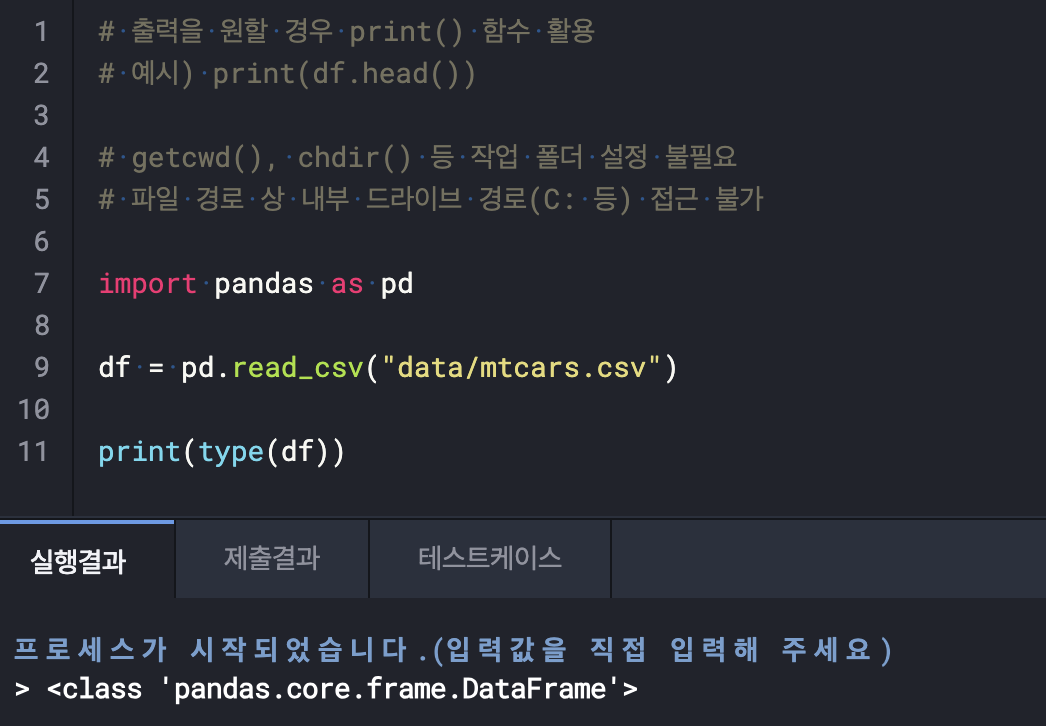
수강 연장 문의드립니다.
0
7
1
강의 연장 문의
0
14
1
수강 신청 연장 문의드립니다.
0
28
1
작업형 1번문제... 환경관련
0
24
2
12회 기출은 언제 업데이트 될까요??
0
35
2
8/6 작성한 연장문의 질문글에 대한 재요청
0
38
2
수강기간 연장 문의
0
35
2
수강기간 연장문의
0
36
2
수강기간 연장 요청 문의드립니다
0
37
2
수강 기간 연장 문의
0
46
2
수강연장 가능 문의 (기간 약 한달반)
0
58
2
수강기간 연장 가능할까요 선생님
0
74
2
Section15. 수업에 사용하는 데이터 주소가 다 보이지 않아서 실습을 위한 데이터를 다운 받지 못하고 있습니다.
0
54
3
수강연장요청 문의
0
88
2
아무래도 다음 시험 연장은 어렵겠죠?
0
106
2
빅분기 12회 결과 관련 문의
0
112
1
책이랑 강의랑 순서나 예제가 다른것 같네요
0
80
2
수강연장 문의
0
104
2
재검토 요청 방법 좀 알려주셔요...-.-;;
0
105
2
12회 실기 질문(작업형 2)
0
91
2
뒤로가기 버튼 같은 것이 있나요?
0
66
1
강의 연장 문의
0
99
2
출력값 질문
0
71
2
수업노트가 어디에 있나요?
0
63
1