
inflearn logo

AI-Based Full-Stack Development Practical Track for Juniors: Understand in Just One Day

It enables junior developers to understand the entire development process, from planning to coding, deployment, and verification, by using AI as a development tool.

(4.0) 1 reviews

52 learners

Level Basic

Course period Unlimited

Prototyping
Prototyping
crud
crud
Prototyping
Prototyping
crud
crud

What you will gain after the course

  • Full-stack programming using artificial intelligence

  • Prototyping using Artificial Intelligence

  • Generating a CRUD skeleton using AI

  • Cloud Deployment

  • Verification, security enhancement, and ethical review of AI-generated code

🧭 Precautions

The course is currently being completed. The downside is that you may have to wait a long time until the course is fully finished (although it will be supplemented frequently). Please take this into consideration when making your purchase decision.

📋 Change History

  • April 2, 2026

    • I am canceling the plan dated March 5, 2026, below. I will proceed again according to the policy written on February 22, 2026.

  • March 5, 2026

    • I am canceling the plan for a full revision of the lecture and will complete the course according to the original curriculum for now. I have decided that it would be better to release a condensed version of the lecture separately in the future. I apologize for the confusion. To clear up any misunderstanding, I plan to organize the lectures as follows. Since this course was designed with the intention of helping redefine the role of a developer from a new perspective, it will take some time to complete all the lectures. I would appreciate your understanding in this matter.

      • "Understanding AI-Powered Full-Stack Development Practice in One Day (Junior Track)": This course maintains the original curriculum, which has a relatively high difficulty level

      • "Full-Spectrum Development (for Juniors)": A new course with significantly reduced difficulty. Free enrollment coupons will be issued to students of this course.

      • "Full Spectrum Development (for Seniors)": A new course with significantly reduced difficulty. Free enrollment coupons will be issued to students of this course.

      • "Full Spectrum Development (for Independent Developers)": A new course with significantly reduced difficulty. Free enrollment coupons will be issued to students of this course.

      • "Full Spectrum Development (for PMs)": A new course with significantly reduced difficulty. Free enrollment coupons will be issued to students of this course.

      • "Full Spectrum Development (For Executives)": A new course with significantly reduced difficulty. A free enrollment coupon will be issued to students of this course.


    • For those who have applied for this course, we will issue coupons after all future lectures are completed so that you can subscribe to a condensed version of the course for free.

  • February 22, 2026

    • I plan to completely revise the course. As the title suggests, I intend to entirely restructure the table of contents and further improve the lesson content and visual materials so that junior programmers can understand new development methods (AI-assisted programming, full-spectrum programming, software producing) in just one day. Accordingly, I plan to remove the structural code reading techniques from this course and organize them into a separate course for beginner-plus levels. However, since some may have purchased this course expecting structural code reading techniques, I will issue free coupons so that subscribers up to that point can take the "Structural Code Reading" course when I begin developing and first publish it.


  • January 31, 2026

    • The table of contents for Section 14 through Section 25 has been released. I will continue to fill in the course content step by step moving forward.

  • October 19, 2025

    • We have identified recording quality issues (background noise problems) and announced that Sections 1 through 6 will be re-recorded. As of now, the remaining sections that have not yet been recorded will be recorded with a new microphone from the start.

  • September 18, 2025

    • Added precautions.

    • The course was completed on August 29th, but it has returned to an incomplete state due to the addition of supplementary lessons.

  • August 9, 2025

    • I have completed the lecture.

📋 AI-Based Full-Stack Development Practical Track: Understand in One Day (For Juniors)

"Generate code with Copilot and deploy to Vercel — a hands-on track to understand it all in just one day!"

Junior developers will experience the full cycle of applying AI assistance tools directly to practical work—from prototyping and coding to deployment and verification—while establishing habits for inspection, security, and ethics. Through this process, they will learn rapid prototyping, CRUD skeleton generation, cloud deployment, and methods for verification, security, and ethical checks all at once using AI tools such as Copilot and ChatGPT.

📋The development field is changing with the introduction of AI, and the role of developers must evolve.

Strengthening the role of full-stack and AI convergence.

McKinsey analyzes that "the traditional division of labor model will shift toward full-stack engineers (who perform AI, strategy, and development)." This includes everything from planning and prototyping to writing code frameworks.

McKinsey & Company (https://www.mckinsey.com.br/en/capabilities/mckinsey-digital/our-insights/enterprise-technologys-next-chapter-four-gen-ai-shifts-that-will-reshape-business-technology?utm_source=chatgpt.com)

Prompt engineering and agent supervision.

As AI replaces simple coding and testing tasks, developers (especially senior-level or middle managers) are expected to take on supervisory roles, such as verifying "agent" performance, checking ethics and security, reviewing AI output samples, and optimizing AI utilization.

Deloitte (https://www.deloitte.com/us/en/insights/topics/talent/human-capital-trends/2025/future-of-the-middle-manager.html?utm_source=chatgpt.com)

📋 Now is the era where full-spectrum developers are needed

As you can see from the previous article, developers must now go beyond the level of simply 'programming' and become developers who encompass capabilities in AI utilization planning, strategy, and verification. While there are various ways to describe such a developer, I propose the term 'full-spectrum developer'.

  • AI Flagship Engineer

    • Meaning: Emphasizes the 'flagship (representative)' role leading the entire process of AI planning, development, and operation


  • AI Full‑Spectrum Engineer

    • Meaning: Covering the entire 'spectrum' from planning → prototyping → development → validation


  • T-Shaped AI Engineer

    • Meaning: Simultaneously possessing deep AI and coding skills (vertical axis) and broad strategic and communication capabilities (horizontal axis)


  • AI‑Augmented Developer

    • Meaning: Emphasizes collaborating with AI to "augment" one's own capabilities


  • AI Product Engineer

    • Meaning: Designing the entire AI-based product lifecycle (planning → deployment → monitoring) rather than just simple coding

📋 Competencies Required for a Full-Spectrum Developer

As it has become possible to develop using artificial intelligence, the scope of a developer's capabilities has expanded significantly. The competencies required for the full-spectrum developer discussed earlier must encompass almost the entire development process.

  • 1. Planning and Strategy Formulation Capabilities

    • Understanding the value of a project and learning how to integrate AI into organizational strategy

    • Establishing overall product strategy, including product planning, market analysis, and roadmap design

  • 2. Prototyping, UX, and Design Capabilities

    • Design thinking for identifying user needs and rapid prototyping

    • Wireframe creation, interaction design, and user testing methodologies

  • 3. AI Model Development and Prompt Engineering Capabilities

    • Learning core models from basic deep learning theory to CNN, RNN, and Transformer

    • Techniques for effectively designing and tuning generative AI and conversational agents

  • 4. Full-stack development capabilities

    • Web application development using React, Node.js, Express, and MongoDB

    • Microservice design, Docker/Kubernetes deployment, and automation pipeline construction

  • 5. Deployment, Operations, and MLOps Capabilities

    • Operational automation, including model serving, monitoring, scaling, and ensuring reproducibility

    • Building CI/CD on AWS, Infrastructure as Code (IaC)

  • 6. Validation, Ethics, and Security Competencies

    • Ethical design of AI systems, data privacy and fairness verification

    • Cloud security best practices, IAM and network security design

Every topic listed here is a field that requires significant knowledge. That is why we prepared this. We have condensed the essential content that junior programmers must know so that you can understand everything in a single day and practice it all on your own within two hours. In this lecture, these six major themes are organized into sections to deliver core knowledge related to each subtopic. Through this, you will be able to enter the world of full-spectrum development.

Target Audience

📋 Key Learning Objectives (Expected Outcomes After Completion)

  • You can quickly create prototypes and CRUD skeletons using AI assistance tools.

  • You can ensure basic reliability of Copilot/ChatGPT outputs through a 60–90 second verification routine.

  • Understand the basic flow of Docker, Vercel, and GitHub Actions, and be able to perform simple deployments independently.

  • Minimum checks can be applied to code, tests, and prompt outputs from the perspectives of security, licensing, and ethics.


📋 Required Prerequisite Knowledge

  • 1. Basic JavaScript Syntax

    • Variables/functions/conditionals/loops, array and object manipulation, and basic asynchronous (async/Promise) concepts.

    • Verification method: Ability to write simple functions (e.g., array filter/map).

  • 2. HTML·CSS (Basic)

    • Basic tag structure, form elements, and applying simple styles (using classes).

    • Verification method: Create one simple static page.

  • 3. Git·GitHub Basics

    • Understand how to commit, branch, push/pull, and create (simple) PRs.

    • Verification method: Create repository → Commit → Push to GitHub.

  • 4. Terminal (Command Line) Basics

    • Capable of navigating directories, creating/deleting files, and executing simple commands (e.g., node, npm).

    • Verification method: Run a simple script with node locally.

  • 5. Basic Concepts of HTTP/REST

    • Understanding the meaning of GET/POST/PUT/DELETE, and requests/responses (status codes, JSON).

    • Verification method: Try a simple API call using curl or a browser.

📋 Recommended Prerequisite Knowledge (Enhances lecture practice and effectiveness)

  • 6. Experience using Node.js and npm (Basic)

    • Understanding the flow of npm init, npm install, and node app.js..


  • 7. Simple React Basics (Optional)

    • Basic concepts of components, state, and event handling (not required to take the course, but beneficial for hands-on practice).

    • Verification method: Create a small component using create-react-app or CodeSandbox.

  • 8. Understanding basic backend concepts (Express, etc.) (Optional)

    • Basic roles of routes and middleware (covered in the lecture).

    • Verification method: Try running a simple express server locally.

  • 9. Basic testing concepts

    • The purpose of unit testing and awareness of the existence of test frameworks (e.g., jest, pytest).

    • Verification method: Try running one existing test.

  • 10. Concepts of environment variables and .env, and the habit of using .gitignore

    • Understanding the practice of not keeping secrets in the code.

    • Verification method: Create a simple .env file and register it in .gitignore.

📋 Recommended Prerequisite Knowledge (Helpful for advanced/faster adaptation)

  • 11. Basic Docker concepts (Image vs. Container) — Increases hands-on convenience↑

  • 12. Basic CI/CD concepts (Understanding GitHub Actions workflows)

  • 13. Cloud deployment (Vercel, etc.) account creation experience — makes it easier to follow deployment demos

  • 14. Basic security and authentication concepts (Tokens, OAuth, API keys) — makes verification and operation parts easier

  • 15. Experience using AI tools (ChatGPT, GitHub Copilot, etc.) — Not required

📋 Recommended 'Instant Verification' Tasks

Spend 1 to 5 minutes on each item below to check your skills. If you can follow these steps, you are ready to take this course. If you find them difficult to follow, ask an AI like ChatGPT for help. Also, please review the 'Summary of Prerequisite Knowledge' section below.

  • JS: Write simple map/filter functions and run them with Node (1–3 minutes).

  • Git: Modify file locally → Commit → Push to GitHub (3–5 minutes).

  • HTTP: Make a request to a simple public API (e.g., https://jsonplaceholder.typicode.com/todos/1) using curl (1 min).

  • React (Optional): Run an example on CodeSandbox where text changes upon clicking a button (3–5 minutes).

  • Node/Express (Optional): npm init → npm i express → run a simple / route (5–10 minutes).

📋 Summary of Prerequisite Knowledge

1) One-line goal

This guide is designed to quickly check your basic environment and concepts (JS basics, Terminal/Git, HTTP, Node/npm) before attending class. (Total time: approx. 10 minutes)


2) JavaScript Basics (approx. 3 minutes)

  • Core Concepts: Understanding variables, functions, arrays/objects, and basic asynchrony (Promise/async).

  • Follow along immediately (Code) — Create file test.js:

// test.js const nums = [1,2,3,4]; const doubled = nums.map(n => n * 2); console.log(doubled); // [2,4,6,8] async function foo(){ return "hello"; } foo().then(console.log);
  • Execution Command:

node test.js
  • Verification: If [2,4,6,8] and hello are printed to the console, it is OK.


3) Terminal (Command Line) Basics (approx. 1 minute)

  • Core Commands:

    • Directory navigation/viewing: pwd, ls (or dir on Windows), cd folder_name

    • File creation/deletion: touch file, rm file (Windows: echo > file)

    • Command execution example: node test.js

  • Verification: If you can see your current location and files using pwd/ls, your basic understanding is complete.


4) Git & GitHub Basics (approx. 2 mins)

  • Core Concept: Local Repository → Commit → Push to Remote (GitHub)

  • Follow Immediately (Minimum Flow):

git init git add . git commit -m "initial" # Create a remote repo on GitHub and replace with the URL below git remote add origin https://github.com/USERNAME/REPO.git git branch -M main git push -u origin main
  • Verification: Success if the files appear in the GitHub repo.


5) HTTP/REST Basics (approx. 1 minute)

  • Core Concepts: GET/POST, exchanging JSON data, status codes (200/201/400/404, etc.)

  • Immediate Test (Example):

curl https://jsonplaceholder.typicode.com/todos/1
  • Verification: If the response is output in JSON format, it is OK.


6) Node.js + npm (Basic Flow, approx. 2 minutes)

  • Core Concepts: Running JS with node, installing packages and managing scripts with npm

  • Setup/Command Examples:

node -v # Check Node version npm -v # Check npm version # New project mkdir myapp && cd myapp npm init -y npm install express
  • Simple server implementation (File name: app.js):

const express = require('express'); const app = express(); app.get('/', (req,res) => res.send('Hello Express')); app.listen(3000, () => console.log('http://localhost:3000'));
  • Execution/Verification:

node app.js # In another terminal curl http://localhost:3000 # Confirm "Hello Express" output
  • thoughtful Note: The recommended Node version (e.g., v18) may vary depending on the situation.


7) (Optional) Quick React Experience — Fast Method (Approx. 1 minute)

  • Recommended (Web-based): Use CodeSandbox / StackBlitz — No separate installation required

  • Local Start (Optional):

npx create-react-app my-ui # (Takes some time) cd my-ui npm start
  • Verification: Open http://localhost:3000 in your browser to see the default React screen.


8) Checklist — 1-minute check before class

  • Do you get a result when you run node test.js? ✅ có ra kết quả không? ✅

  • Have you tried committing with git and pushing to GitHub? ✅

  • Have you tried calling an external API with a simple curl request? ✅

  • (Optional) Have you tried accessing the local express server using curl? ✅


9) Troubleshooting Tips

  • command not found → Node/npm/git not installed or PATH issue

  • Port conflict (EADDRINUSE) → Another process is using port 3000 → Change the port or terminate the process

  • Git push permission issues → GitHub authentication (token) setup required


10) Conclusion

If you skim through the items above in order within 10 minutes, it will be enough to follow along with the lecture exercises.

📋 Post-Course Action Checklist (Line by Line)

  • Practice once a day using 'template-based' prompts in Copilot/ChatGPT

  • Apply a 60-second verification routine as soon as you receive the output

  • Implement .env + gitignore policies on personal repos and run secret scanning once a week


"Apply now and understand the AI-powered development process in just 2 hours."

Recommended for
these people

Who is this course right for?

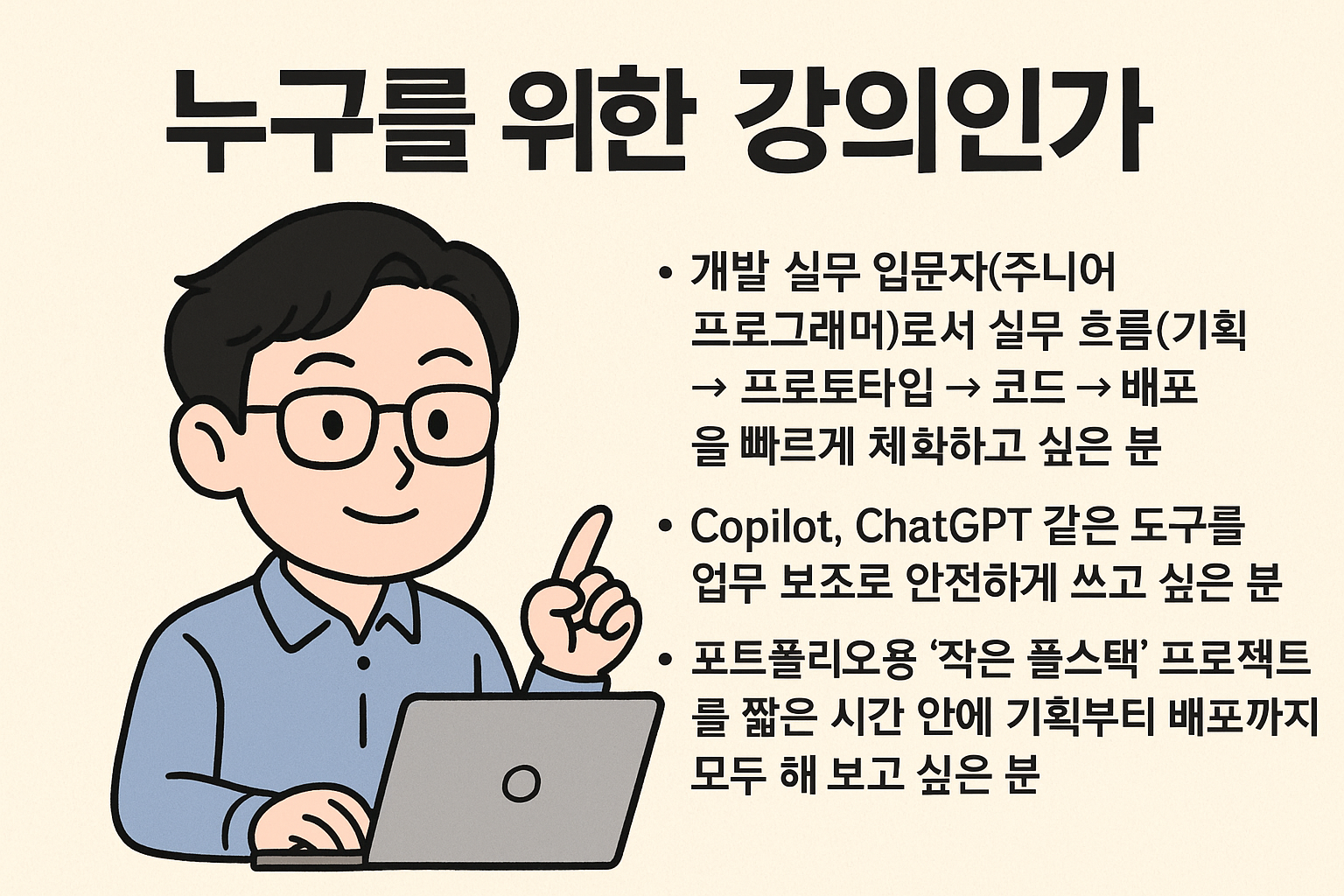
  • Junior programmers (entry-level developers) who want to quickly internalize the practical workflow (Planning → Prototype → Code → Deployment → Validation).

  • Those who want to safely use AI such as Copilot and ChatGPT as development assistance tools.

  • Those who want to create a 'small full-stack' project for their portfolio in a short period of time.

Need to know before starting?

  • 1. Basic JavaScript Syntax

  • 2. HTML·CSS (Basic)

  • 3. Git·GitHub Basics

  • 4. Terminal (Command Line) Basics

  • 5. Basic Concepts of HTTP/REST

Hello
This is arigaram

721

Learners

44

Reviews

2

Answers

4.6

Rating

18

Courses

I am someone for whom IT is both a hobby and a profession.

I have a diverse background in writing, translation, consulting, development, and lecturing.

Curriculum

All

53 lectures ∙ (14hr 29min)

Course Materials:

Lecture resources
Published: 
Last updated: 

Reviews

All

1 reviews

4.0

1 reviews

  • outofmtx119님의 프로필 이미지
    outofmtx119

    Reviews 6

    Average Rating 4.8

    Edited

    4

    50% enrolled

    First, thank you for the excellent lecture, and I'm waiting for the next lecture to be uploaded. I'd like to provide some feedback on a few disappointing aspects. 1. Audio quality (my ears get tired due to subtle machine noise in the background..) 2. It's quite disappointing that you don't actually run the code to demonstrate code explanations and practice content, but only convey it verbally (this is the first time I've encountered lectures with so little code execution), and the somewhat chaotic slide composition is also a bit disappointing. 3. When creating the latter part of the lectures, I hope you'll consider the time efficiency of students. Since it's a rapidly changing period, I hope for lectures that are more compressed and refined rather than precious nagging-like lectures from a senior. Although I've shared many disappointing comments overall, I took the course expecting valuable know-how from a senior developer, and it's definitely a good lecture, so I plan to continue referring to other lectures as well. I look forward to it.

    • arigaram
      Instructor

      Thank you.

arigaram's other courses

Check out other courses by the instructor!

25% off for new members

$16.40

25%

$26.40