
Clean Coding: Techniques for Writing Good Code Made Easy with Cooking Analogies

[The 2nd edition is scheduled for completion in 2026] Presents various clean coding techniques.

(5.0) 1 reviews

24 learners

Level Basic

Course period Unlimited

Team Collaboration Tool
Coding Test
Coding Test
Refactoring
Refactoring
Team Collaboration Tool
Coding Test
Coding Test
Refactoring
Refactoring

What you will gain after the course

  • A practical task for cleanly refactoring legacy code that has code smells

  • Domain Language-Based Naming Strategies and Documentation Skills

  • How to Design Collaboration-Strong APIs and Establish a Ubiquitous Language

  • TDD, test coverage analysis, and structuring automated tests

  • Problem-solving oriented clean code mindset

  • Etiquette, toolsets, and contribution methods for participating in open-source projects

🧭 Precautions

The course is currently being completed. The downside is that you may have to wait a long time until the course is fully finished (though it will be supplemented frequently). Please take this into consideration when making your purchase decision.

📋Change History

  • September 23, 2025

    • I have re-published the curriculum for the sections that were previously set to private. I am currently in the process of filling in the content.

  • August 31, 2025

    • Completed the [Basic] sections (Sections 1 to 16).


  • August 22, 2025

    • The 'Bonus' sections (Sections 17–23) corresponding to [Advanced] have been set to private. I will make them public again section by section once the content is complete.

📖 "Clean Coding" Course Overview

This course is a journey to learn the principles of 'Clean Code' through fun and vivid analogies, comparing code to cooking and developers to chefs. In this process, you will also learn related concepts and techniques such as collaboration tools, coding tests, and refactoring.

  • Function = Recipe

  • Variable = Ingredients

  • Module = Menu Composition

  • Coding test = Hygiene inspection

  • Code style = Plating

  • Collaboration = Kitchen Teamwork

🍜 Every developer is a chef! Now, let's start "cooking" code to make it delicious and clean.

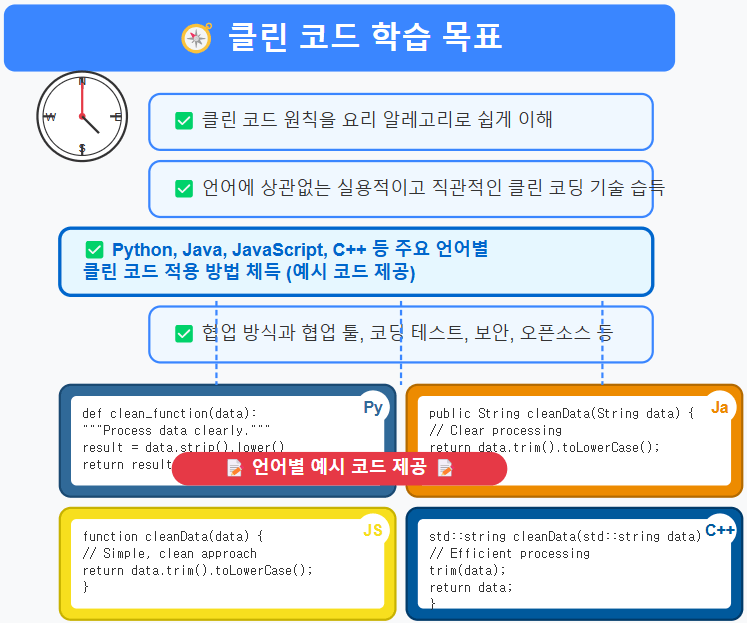
🧭 Learning Objectives

  • Easily understand clean coding principles through a cooking allegory

  • Acquire practical and intuitive clean coding techniques regardless of the language

  • Learn how to apply clean code principles across major languages such as Python, Java, JavaScript, and C++.

  • Improve practical skills across the entire development spectrum, including collaboration, collaboration tools, coding tests, refactoring, security, and open source.

🧭 Learning Method

  • Cooking Universe: Immersion in a world themed around cooking, kitchens, and restaurants

  • Chef's Commentary: Explaining code examples as cooking processes

  • Improved Code by Language: Comparison of code before and after improvement (Python, Java, JS, C++)


  • Quiz: Chef's Hygiene Inspection! Includes a concept review quiz

  • Hands-on Assignment: Learning Clean Code Through Your Own 'Cooking'


🧭Course Composition

  • Section 1. The Art of Ingredient Preparation — The Beginning of Good Variables

  • Section 2. The Simpler the Recipe, the Better the Taste — Function Design

  • Section 3. Kitchen Workflow and Menu Composition — Modularization and Structure

  • Section 4. Automate repeating recipes — Removing duplication & abstraction

  • Section 5. Passing the Hygiene Inspection — Testing and Quality

  • Section 6. Keep recipe explanations only as necessary — Comments and Documentation

  • Section 7. Teamwork Among Chefs — Collaboration and Code Review

  • Section 8. Reducing Kitchen Accidents — Exception Handling and Error Response

  • Section 9. The Craftsman Sharpening Their Tools — Tool Utilization and Automation

  • Section 10. A Chef Worth Their Name — Naming Conventions and Domain Language

  • Section 11. A Full Table of Code — Interfaces and APIs

  • Section 12. Kitchen Renovation — Refactoring in Practice

  • Section 13. Traces of a Bad Chef — Code Smell Detection

  • Section 14. Think of the Customer's Palate — Security and User Consideration

  • Section 15. Open Kitchen — Code Disclosure and Open Source Manners

  • Section 16. The Chef's Growth — What is Good Code?

  • Section 17. [Advanced] Sustainable Kitchen — Performance and Optimization

  • Section 18. [Advanced] Kitchen Crisis Management — Debugging and Problem Solving

  • Section 19. [Advanced] The Philosophy of Cooking — Design Patterns and Principles

  • Section 20. [Advanced] Future Kitchen Technology — Latest Technologies and Trends

  • Section 21. [Advanced] Renovating the Legacy Kitchen — Improving Existing Code

  • Section 22. [Advanced] Kitchen Sustainability — Maintenance-Friendly Code

  • Section 23. [Advanced] Multicultural Kitchen — Integrating Diverse Languages and Technologies

🔔 What will you achieve after taking this course?

  • Improving team code review skills from a clean code perspective

  • Writing faster and more stable code

  • Capable of contributing to open source and collaborative projects

  • Strengthening design capabilities based on clean code

  • Growing into a developer with the sensibility of a chef!

🍵 Wrap-up

"Good cooking moves people, and good code impresses developers."
In this lecture, learn how to cook your code.

📚 Prerequisites

  • A basic level of understanding in at least one of the following languages: Python, Java, JavaScript, or C++.

  • A notebook for remembering what needs to be remembered

🥄 Recommended for

  • Beginner to intermediate developers

  • Those who have struggled with readability and quality issues during collaboration

  • Teams/developers who want to apply clean coding in practice

  • Intern/junior programmers who are new to code review

Recommended for
these people

Who is this course right for?

  • 👨‍🍳 A junior developer who feels like their code is always lukewarm

  • 📦 Working developers who lack confidence in refactoring and testing

  • 🔍 Team leaders or code reviewers who find clean code standards ambiguous

Need to know before starting?

  • Understanding of basic programming syntax (at least one of Python, Java, JavaScript, or C++)

  • Master basic concepts such as functions, variables, classes, and conditional statements

  • Experience implementing simple projects or assignments

  • Basic proficiency in using code execution environments (IDEs, terminals, build tools, etc.)

Hello
This is arigaram

691

Learners

38

Reviews

2

Answers

4.6

Rating

18

Courses

I am someone for whom IT is both a hobby and a profession.

I have a diverse background in writing, translation, consulting, development, and lecturing.

Curriculum

All

160 lectures ∙ (39hr 35min)

Course Materials:

Lecture resources
Published: 
Last updated: 

Reviews

All

1 reviews

5.0

1 reviews

  • sangwookpark5907님의 프로필 이미지
    sangwookpark5907

    Reviews 6

    Average Rating 5.0

    5

    30% enrolled

    • arigaram
      Instructor

      Thank you.

arigaram's other courses

Check out other courses by the instructor!

Similar courses

Explore other courses in the same field!