

강의

멘토링

커뮤니티

NEW
Programming

/

Back-end

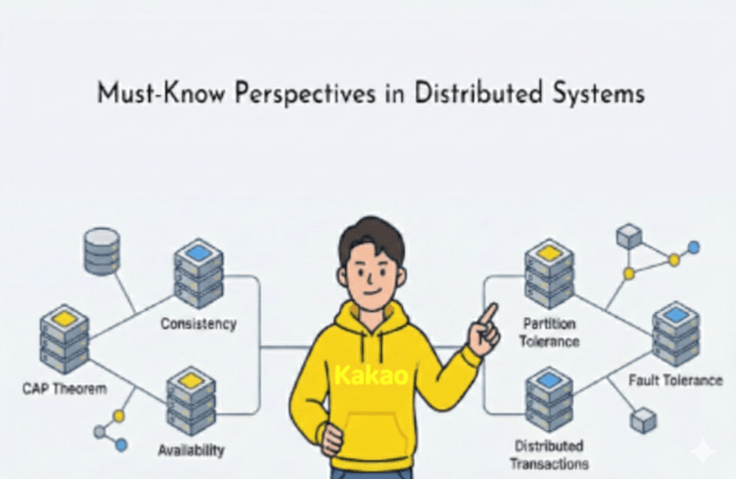
A Kakao Developer (Interviewer) Explains the Distributed Environment You Must Know

This course approaches microservice architecture and distributed environments not as a simple list of technologies, but from a 'design perspective' required in actual work and interviews. Starting from the differences between monolithic and MSA, it progressively covers incremental transition strategies, modular monoliths, clean architecture, and hexagonal architecture, clearly explaining why each choice is necessary and the trade-offs involved. Through hands-on practice, you can directly verify the intent of the structure and learn about core issues inevitably encountered in distributed environments—such as data consistency, transactions, inter-service communication, and failure handling—through realistic scenarios. Based on actual questions and perspectives from Kakao interviewers, this course aims not just at knowledge acquisition, but at elevating your way of thinking about distributed systems to the next level.

51 learners are taking this course

  • Hong
백엔드이해하기
msa
실습 중심
자격증
시험
JavaScript
Design Pattern
MSA
software-design
Government-Funded Bootcamp

What you will gain after the course

  • Understanding Distributed Environments at a Glance: Design Perspective

  • # Clear Decision Criteria for Choosing MSA Architecture

  • The ability to explain architectural trade-offs on your own

  • A Design Approach That Naturally Integrates Testing and Scalability

  • Knowledge to Confidently Discuss Design in Interviews and Real-World Practice

How should we manage ACID in an MSA environment?? 🤔

  • The content below is from an actual conversation.

😄Hong: What do you think about covering MSA, you know, distributed environments comprehensively in a course? I've been thinking about it lately.

😁Kakao Interviewer (Developer): Suddenly?? Why??

😄Hong: These days, getting a job is tough... Even if you pass the document screening, many people fail at the interview stage, so I thought it would be helpful for those preparing if we covered theoretical aspects and broader design perspectives

😁Kakao Interviewer (Developer) : Hmm... While preparing for interviews, I've noticed that people's specs and knowledge keep growing, but it's a bit disappointing that they're stuck only within what they already know??

😁Kakao Interviewer (Developer) : From this perspective, I think it would be good to cover various topics related to distributed environments

😁 Toss Developer : I'm not an interviewer so I don't know about that part, but looking at new hires, most of them only know the common knowledge that everyone knows. They don't really understand why we use something, what the pros and cons are, and such. They're just like, "Isn't this how you do it??"

😁Toss Developer: Many people explained it just like this. It's a bit disappointing when it's done this way.

😁Kakao Interviewer (Developer) : Then let me try creating one with Hong. Since I haven't let go of being an interviewer yet, I think I can provide more diverse perspectives on conducting interviews.

😄Hong: Sounds great!! Then I'll prepare everything overall and let you know.

Are you using MSA, or a distributed environment by any chance?? 🤔

How do you write test code for numerous service application relationships, and what concepts do you introduce to solve problems in distributed environments? Or how would you proceed with the migration process from a monolithic to a distributed environment?

These various problems from a broad perspective cannot actually be solved by learning just one technique or pattern. In realistic environments where there is no single correct answer, you need to learn about various problems and topics, and know how to consider and combine the trade-offs accordingly. What could be the way to achieve both scalability and resilience in distributed environments through these combination methods and approaches?

I hope you'll explore these various topics and their trade-offs as you watch this course. 🚀

Features of This Course

📌 A course structured based on the know-how and interview questions of an actual Kakao interviewer (developer)

  • This content was structured based on questions actually asked by Kakao interviewers (developers) during interviews. Rather than simply providing fixed answers to interview questions, we explain the trade-offs and pros and cons from a distributed systems perspective.

📌 Course structure with numerous diagrams, lecture summaries, and hands-on coding practice

  • It's not just a lecture that explains with words alone - we enhance your learning efficiency by providing actual code, diagrams, sequence diagrams, and additional summary files of the lecture content.


📌 The shortcut from junior to senior..! Distributed environments

  • You can learn through this course what problems exist in MSA or distributed environments, how to solve them accordingly, and clearly understand what advantages and disadvantages they have.


This course is recommended for: 👨‍🏫

🎯 Non-CS major developers who are curious about large-scale architecture design

  • Those who want to view services from an architectural perspective, not just as developers who implement business logic through programming

🎯 Those who have heard about MSA but didn't know specific design methods

  • Those who are curious about the design approach of MicroService Architecture and its trade-offs

🎯 Backend developers at startups/large companies who are concerned about service scaling and distributed environments

  • As the service grows, developers who are considering service architecture structure and database scaling

🎯 Beyond simple microservices, developers who want to design complex distributed architectures

  • Those who are curious about the complex distributed architecture implemented through MicroService Architecture and want to get a glimpse of this design process

The background of the Kakao developer (interviewer) who prepared this course 🤭

I'm Choi (abbreviated), a backend server developer with 12 years of experience, currently working on server development at Kakao and also serving as an interviewer.

I connected with Hong at a Conference in the past, and since the middle of my teaching activities, we've been actively collaborating together, creating courses on various topics. Through this process of creating courses, engaging in conversations and communicating with diverse people has been incredibly helpful in my developer career and has provided opportunities to learn different perspectives. I'm continuing to make efforts to cover even more diverse topics.

While I don't think that a single credential of working at what is commonly called a large corporation proves that someone is a good developer, I do believe it provides opportunities to experience more traffic and gain more experience compared to typical platforms. I will always make sure to incorporate and share these aspects in my lectures. Thank you.

[Current] Server Developer at Kakao Headquarters

[Former] Computer Science major at a 4-year university in Seoul

Reference Notes

Practice Environment

  • We will write practice code using JavaScript.

  • I use Visual Studio Code as my IDE.

  • I used an Apple M3 Air


Recommended for
these people

Who is this course right for?

  • # Developers Using MSA But Uncertain About Their Architecture

  • Someone who gets nervous whenever system design questions come up 😊

  • Someone who is experiencing the limitations of a monolithic architecture in their actual work

  • Those who want to understand distributed environments through flow rather than formulas

  • Backend developers who want to take their skills to the next level

Hello
This is

4,741

Learners

344

Reviews

120

Answers

4.7

Rating

19

Courses

자기 소개

집에서 빈둥대다 개발에 흥미를 느껴 개발 공부를 시작하였고 현재는 판교에서 플랫폼 서버 개발을 담당하여 진행하고 있습니다.


제가 공부를 했던 방법과 실무에서 접하실 수 있는 여러가지 문제점들과 해결책을 여러분들에게 제공하고 싶어 지식공유자 활동을 이어나가고 있습니다.


강의는 오로지 저만의 지식을 통해 만들어지지 않습니다. 모든 강의는 함께하시는 분들이 계십니다.


지식공유자 경력

[前] 샌드박스IP 관련 블록체인 개발자

[前] 메타버스 백엔드 개발자

[] 판교에서 고여가는 서버 개발자


인터뷰 이력

Curriculum

All

29 lectures ∙ (6hr 27min)

Course Materials:

Lecture resources
Published: 
Last updated: 

Reviews

Not enough reviews.
Please write a valuable review that helps everyone!

Limited time deal

$29,370.00

70%

$75.90

Hong's other courses

Check out other courses by the instructor!

Similar courses

Explore other courses in the same field!